Pacific Commission
pp. 23-153 · Read in the full issue
Vital October Conference
A New Look Soon For South Pacific Commission
By a Staff Writer
Proposals for far-reaching changes in the function and thority of the South Pacific Commission are being shaped d considered by member countries.
i proposals result from the ex jerience gained by the SPC since as set up by agreement at erra on February 6, 1947; and the important political changes ; South Pacific over the last few in political developments have the swift de-colonisation of the sh-speaking territories, and the cement of the Netherlands in New Guinea by Indonesia, i has resulted in the Netherlands ig to have any interests in the Pacific. Technically she ceases a member of the SPC at the if this year, but for all practical ses she has already withdrawn, ig membership now to five politan powers.
The Proposals
the plans now being shaped at ighest levels are accepted, this kv the new South Pacific Com m will look: Research work will be more ly linked with the every day ad the technical training of the ■ people.
Top executives of the Com >n will provide closer liaison be member governments, in lal administrations and the il purpose of the Commission; loser liaison also with UN and r instrumentalities.
The bureaucratic deadwood has placed a barrier in recent between Commission research I recommendations and their mentation by Governments, will ept away. t chief purpose of the SPC, set f Australia (which has paid 30 cent, of the cost), United lorn, New Zealand and Nether (each 15 per cent.) and France United States (each 12i per I has been to assist the economic Ocial development of the non pverning Territories, and the re and advancement of their ps by engaging in research, ing the data thus made avail- I and making recommendations I six countries concerned.
The Commission is a consultative and advisory body—it has no political authority whatever.
The Commission, from head quarters made available by France in Noumea, set up a Research Council, divided into three depart ments (Health, Social Development and Economic Development) with an expert in charge of each. Remark able work has been done by those departments, especially in the earlier years.
The Commission has also con ducted a South Pacific Conference every three years, where delegates of the indigenous communities, from nearly all Pacific territories, have discussed matters of health and social and economic welfare, and made recommendations to the Com mission.
The theory has been that the six member countries should consider these various recommendations, and give effect to them, wherever possible and practicable, in the administration of their South Pacific territories.
In practice, it has not worked out.
There have been ineptitude and lack of imagination on the part of many members of the Commission, and in difference on the part of their Gov ernments.
There has seemed to be no one with the wish or power to follow the recommendations through the capitals into the field of administra tion. The great majority have been merely pigeon-holed; many—some representing months and years of faithful research—have been for gotten.
A great mass of valuable data has been compiled, but—as the Com mission has no powers of imple mentation, and the Governments con cerned have been more or less in different—the mass has been generally useless.
At the end of the first 10 years, it could be seen that the Com mission justified neither its existence nor its cost (not less than £lOO,OOO a year).
J (Over)
In 1957-58, the six countries held a “review conference” in Canberra.
This was the result of criticism of and dissatisfaction with the SPC.
But the “reviewers” mostly were the appointees of the Governments and of the Commission, and they achieved little—for they could not be expected to condemn themselves. There was no discernible improvement.
The Commission has rolled along— generally ineffective, unimaginative, and bound by the shackles of a complacent bureaucracy.
PIM writers, in the last decade, have frequently pointed out that, un less the SPC structure could be given some sort of political authority, most of its work, designed to advance the welfare of the native peoples, would end nowhere.
General dissatisfaction with the record of the Commission was shown clearly at the Fifth South Pacific Conference in Pago, in July.
Behind the scenes, some senior representatives of the participating Governments did not hide their belief that changes would have to come— and be made effective before the next South Pacific Conference in three years’ time. The native delegates themselves freely criticised the present role of the SPC—some wanted to know why the Commission did not take a more active part in their day to-day problems.
It was evident that the member countries could not much longer re main asleep over the SPC.
They have been stirred by the fact that the Anglo-American policy of decolonisation has taken a new and ferocious shape in most sections of the colonialist world. Some were rudely jolted into wakefulness when the Foot Report on New Guinea was
tabled in the UN and when the un expected support of Indonesia by the US forced the Dutch out of West New Guinea.
The candid comments of the native leaders at the Pago Conference gave colour to the sorry picture.
And now, suddenly, the four English-speaking members (Australia, Britain, New Zealand and United States) appear to have realised that the establishment of self-government in their territories must be their future active policy—and that in that connection the hitherto semi moribund SPC could be of consider able use to them, in the early future, if clothed with some additional powers and purpose.
And that is what is now under con sideration, at the top level.
PIM indicated in August and Sep tember, as a result of information gathered by a staff writer at the Pago Conference, that far-reaching plans for a new SPC were in the wind.
Those plans are now taking shape and the next development will follow a meeting of the Commissioners representing the five member Govern ments of the SPC in Noumea on October 15.
The Netherlands will not be there.
It is expected the meeting in Noumea will deal with the following matters:
New Secret Ary-General
Australia, Britain, the US and New Zealand, since 1947, have each nominated the top executive officer, in that order. Netherlands now is out, and France does not wish to nominate. The term of Mr. T. R.
(Continued on p. 150)
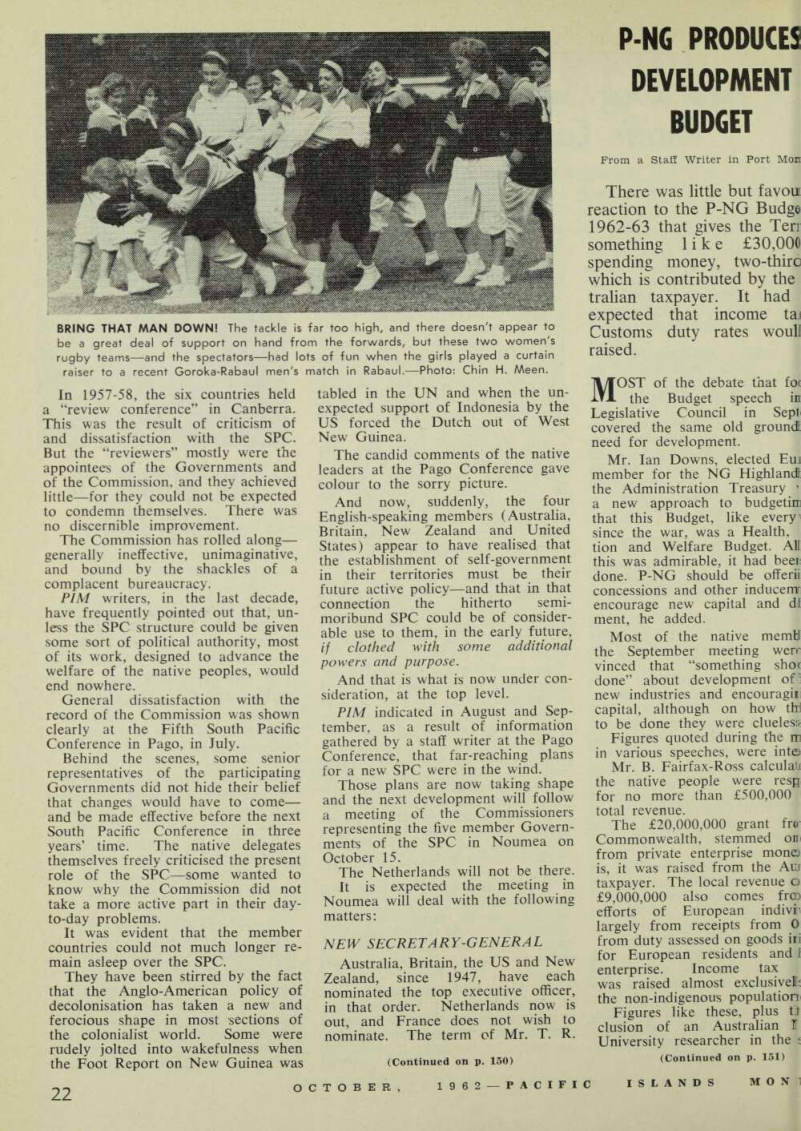
BRING THAT MAN DOWN! The tackle is far too high, and there doesn't appear to be a great deal of support on hand from the forwards, but these two women's rugby teams —and the spectators —had lots of fun when the girls played a curtain raiser to a recent Goroka-Rabaul men's match in Rabaul. Photo: Chin H. Meen.
Smith (NZ nominee) expires next March. So it is again Australia’s turn to nominate. The new Secretary- General probably will be announced after the Commission meeting.
Unofficial reports indicate that Aus tralia will nominate Mr. W. D.
Forsyth, OBE, who is now an Assis tant Secretary in the Department of External Affairs, Canberra. He was the man chosen in 1947 to organise and establish the South Pacific Com mission in Noumea, and he was Sec retary-General there from 1948-51.
After that, he was the Minister in ?Vx a T rB^? f the Australian Mission to UN, 1951-55; and he since has held other important diplomatic posts, in cluding an Australian Ambassador ship m south-east Asia.
The selection of Mr. Forsyth, and his acceptance of the SPC post, would be significant. He is a man of out standing ability, with a remarkable knowledge of Pacific affairs, but with his background, it is most unlikely h( L a B ain take charge of bPC affairs unless (a) the SPC is given extended powers and (b) Aus tralia expects to take a much larger share in directing and training the bouth Pacific native communities generally.
On the facts, as PIM knows them both of these things are likely.
Australia, whether she likes it or not, now realises she must accept certain obligations cast upon her as the leading nation of the South Pacific; and there are few men better qualified tc represent Australia, in that respect, than Mr. Forsyth.
Extended Powers For Spc
Plans for amendment of the Agree ment under which the SPC was con stituted in 1947 probably will come before this October meeting. Matters involved in the Agreement include: • The withdrawal of The Netherlands from membership, and the (so far) unknown intentions of Indonesia, which could ask for membership. In any case, the Dutch withdrawal means a financial rearrangement. • The admission to membership of Western Samoa, which has achieved self-government and is no longer a dependency of NZ. The article of the Agreement defining the territorial scope” of the Com mission may have to be re-phrased to permit this. • A re-definition of the functions and powers of the Com mission, so that it would clearly
have the right to train native peoples in the arts and crafts which are necessary if they are to exercise an increasing measure of self government. It is even suggested that “training of Islands people for self-government” be included form ally in the objects of the Com mission. • Consideration of a plan, sub mitted by New Zealand, under which the Commission’s obligation to (a) maintain a Research Council, and (b) organise the triennial South Pacific Conference, will be revised, with a view to
substituting another instrumentality
called a “Regional Council”, to achieve both purposes.
It is apparent that while all these matters may come before the Com mission in October, the Commission is not competent to deal with them —they must go back to the member countries.
Therefore, it is expected that the Commission will recommend a Re view Conference some time in 1963, to deal with these matters.
Finance and Development Probably, among matters for the superior conference, would be that of providing finance for the economic and social development of the Pacific territories.
At present, the territories depend for their vital capital needs upon the nation to which they are attached.
For example, Australia provides Papua and New Guinea with huge annual grants; Britain recently has made millions available to Fiji; the US has recently provided American Samoa with large developmental funds. Some of the other territories get nothing.
The new planners envisage a system under which the member countries might in some way combine their funds to assist development in their territories generally. Some people hope that under certain con ditions very large sums, “for the aid of under-developed states”, might come from the United States.
If the machinery of the SPC were to be used in this manner, it is obvious that the Commission must be given additional powers, and that there must be much closer liaison between the Commission and the member Governments thaA there has been in the past 15 years.
The Position of France The four English-speaking mem bers seem to be tentatively agreed upon policies and procedures; but the French outlook is not clear.
It is recognised that France has
little sympathy with the En; speaking countries’ new policy o colonisation. The policy of Fi is—and always has been— to courage a large measure of local government, but to keep the dev mg “colonies” within the Fi Empire or Commonwealth, Caledonia and French Polynesia example, elect Deputies and Sen who go regularly to the Fr Parliament in Paris.
France subscribes heartily to objects of the South Pacific C mission as at present defined.
France may want very definite assurances in relation to any r to confer extended powers upon Commission.
Recent criticism of the 15 y record of the SPC includes points; Headquarters at Noumea awkwardly situated in relation tc other territories, and some cour still favour a more central pi like Suva; and the operation of Commission in two langu (English and French) is inconvei and very expensive.
As against that, the French i generous in 1947 in making Pentagon at Anse Vata, Nom available to the Commission, and move elsewhere now would incr the Commission’s annual cost.
The British and Amerii emphatically wish to retain Fr« membership of the SPC, and will to considerable lengths to I France friendly and on-side, if it is planned to use SPC ins mentalities to advance the policT de-colonisation—in other words', encourage the independent government moves seen recently New Guinea, Samoa and elsewi —the Commission may find itsell prickly and delicate ground.
Where Stands Indonesia?
The effect on the SPC of In nesia’s take over of NNG is c< pletely uncertain.
The Netherlands administered M Guinea was “a non - self - goverr Territory”, in accordance with art 2 of the 1947 Agreement.
Indonesia has agreed that, in 1? it will allow the Papuans of V* New Guinea to decide, themsell whether to accept self-government! incorporation in Indonesia. Me while, it has formally announced t West New Guinea will be adrm stered after May 1, 1963, as anoti province of Indonesia.
In the circumstances, will Im nesia call West New Guinea “a m self-governing Territory” and s> membership in the SPC, in places the Netherlands? If she does, T
be regarded as offering a antee that Indonesia will honestly ;ard the plan that West New t ea natives will be encouraged to self-government in 1969? ;ance, officially, has disapproved :he surrender of Dutch New iea to Indonesia. Would France, he circumstances, be prepared it on the South Pacific Corn ion with Indonesia? lese are difficult, ticklish tions. But, upon their answer, nds in a measure the future of >PC.