Pacific Commerce and Produce
pp. 163-164 · Read in the full issue
[?]ish Pacific Is. And Common Market
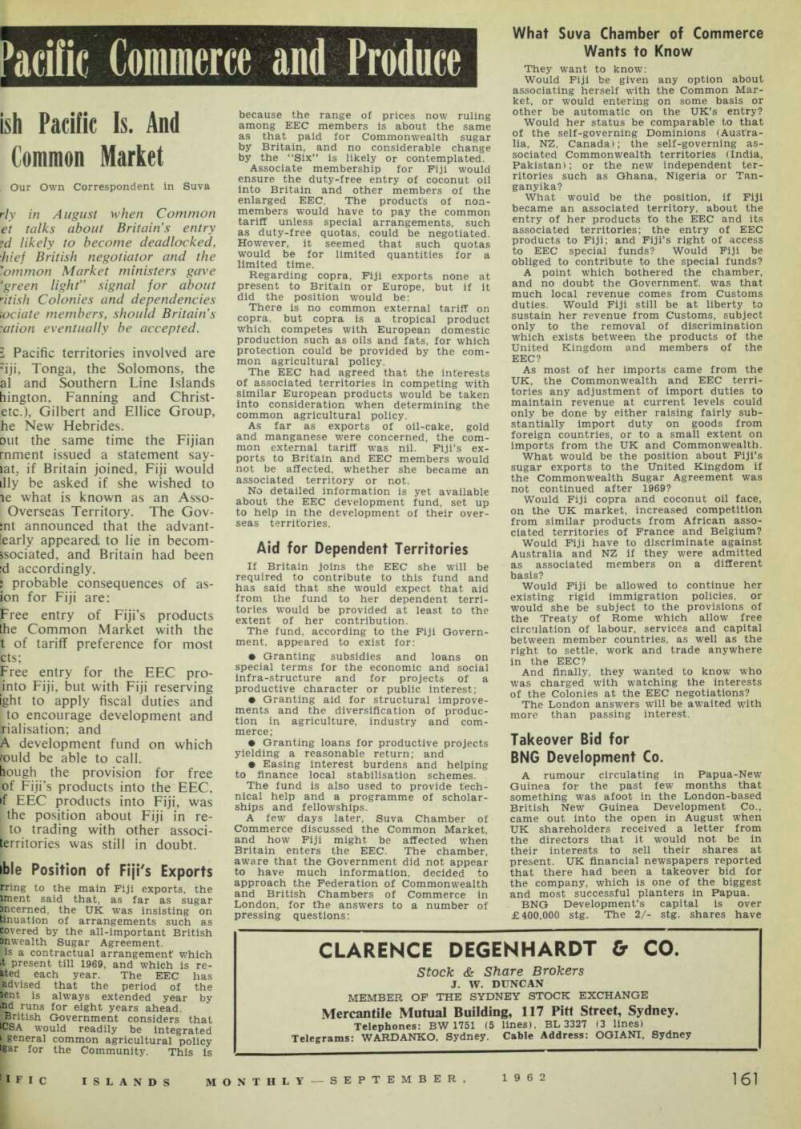
. Our Own Correspondent in Suva rly in August when Common et talks about Britain’s entry ?d likely to become deadlocked, hief British negotiator and the lommon Market ministers gave ‘green light” signal for about dtish Colonies and dependencies lociate members, should Britain’s :ation eventually be accepted.
I Pacific territories involved are 7 iji, Tonga, the Solomons, the al and Southern Line Islands hington. Fanning and Christ etc.), Gilbert and Ellice Group, he New Hebrides, out the same time the Fijian rnment issued a statement say iat; if Britain joined, Fiji would illy be asked if she wished to le what is known as an Asso- Overseas Territory. The Gov snt announced that the advant learly appeared to lie in becom ssociated, and Britain had been :d accordingly. 5 probable consequences of as ion for Fiji are: free entry of Fiji’s products the Common Market with the t of tariff preference for most cts; Free entry for the EEC pro into Fiji, but with Fiji reserving ight to apply fiscal duties and I to encourage development and Irialisation; and A development fund on which rould be able to call, hough the provision for free of Fiji’s products into the EEC, f EEC products into Fiji, was j the position about Fiji in re- I to trading with other associ lerritories was still in doubt.
ible Position of Fiji's Exports
rring to the main Fiji exports, the iment said that, as far as sugar incerned, the UK was insisting on tinuation of arrangements such as povered by the all-important British towealth Sugar Agreement, is a contractual arrangement which ft present till 1969, and which is re nted each year. The EEC has advised that the period of the lent is always extended year by ind runs for eight years ahead.
British Government considers that ICSA would readily be integrated [general common agricultural policy igar for the Community. This is
because the range of prices now ruling among EEC members is about the same as that paid for Commonwealth sugar by Britain, and no considerable change by the “Six” is likely or contemplated.
Associate membership for Fiji would ensure the duty-free entry of coconut oil into Britain and other members of the enlarged EEC. The products of non members would have to pay the common tariff unless special arrangements, such as duty-free quotas, could be negotiated.
However, it seemed that such quotas would be for limited quantities for a limited time.
Regarding copra, Fiji exports none at present to Britain or Europe, but if it did the position would be: There is no common external tariff on copra, but copra is a tropical product which competes with European domestic production such as oils and fats, for which protection could be provided by the com mon agricultural policy.
The EEC had agreed that the interests of associated territories in competing with similar European products would be taken into consideration when determining the common agricultural policy.
As far as exports of oil-cake, gold and manganese were concerned, the com mon external tariff was nil. Fiji’s ex ports to Britain and EEC members would not be affected, whether she became an associated territory or not.
No detailed information is yet available about the EEC development fund, set up to help in the development of their over seas territories.
Aid for Dependent Territories
If Britain joins the EEC she will be required to contribute to this fund and has said that she would expect that aid from the fund to her dependent terri tories w T ould be provided at least to the extent of her contribution.
The fund, according to the Fiji Govern ment, appeared to exist for: • Granting subsidies and loans on special terms for the economic and social infra-structure and for projects of a productive character or public interest; • Granting aid for structural improve ments and the diversification of produc tion in agriculture, industry and com merce; • Granting loans for productive projects yielding a reasonable return; and • Easing interest burdens and helping to finance local stabilisation schemes.
The fund is also used to provide tech nical help and a programme of scholar ships and fellowships.
A few days later, Suva Chamber of Commerce discussed the Common Market, and how Fiji might be affected when Britain enters the EEC. The chamber, aware that the Government did not appear to have much information, decided to approach the Federation of Commonwealth and British Chambers of Commerce in London, for the answers to a number of pressing questions:
What Suva Chamber of Commerce
Wants to Know
They want to know: Would Fiji be given any option about associating herself with the Common Mar ket, or would entering on some basis or other be automatic on the UK’s entry?
Would her status be comparable to that of the self-governing Dominions (Austra lia, NZ, Canada); the self-governing as sociated Commonwealth territories (India, Pakistan); or the new independent ter ritories such as Ghana, Nigeria or Tan ganyika?
What would be the position, if Fiji became an associated territory, about the entry of her products to the EEC and its associated territories; the entry of EEC products to Fiji; and Fiji’s right of access to EEC special funds? Would Fiji be obliged to contribute to the special funds?
A point which bothered the chamber, and no doubt the Government, was that much local revenue comes from Customs duties. Would Fiji still be at liberty to sustain her revenue from Customs, subject only to the removal of discrimination which exists between the products of the United Kingdom and members of the
Eec?
As most of her imports came from the UK, the Commonwealth and EEC terri tories any adjustment of import duties to maintain revenue at current levels could only be done by either raising fairly sub stantially import duty on goods from foreign countries, or to a small extent on imports from the UK and Commonwealth.
What would be the position about Fiji’s sugar exports to the United Kingdom if the Commonwealth Sugar Agreement was not continued after 1969?
Would Fiji copra and coconut oil face, on the UK market, increased competition from similar products from African asso ciated territories of France and Belgium?
Would Fiji have to discriminate against Australia and NZ if they were admitted as associated members on a different basis?
Would Fiji be allowed to continue her existing rigid immigration policies, or would she be subject to the provisions of the Treaty of Rome which allow free circulation of labour, services and capital between member countries, as well as the right to settle, work and trade anywhere in the EEC?
And finally, they wanted to know who was charged wdth watching the interests of the Colonies at the EEC negotiations?
The London answers will be awaited with more than passing interest.
Takeover Bid for
BNG Development Co.
A rumour circulating in Papua-New Guinea for the past few months that something was afoot in the London-based British New Guinea Development Co., came out into the open in August when UK shareholders received a letter from the directors that it would not be in their interests to sell their shares at present. UK financial newspapers reported that there had been a takeover bid for the company, which is one of the biggest and most successful planters in Papua.
BNG Development’s capital is over £400,000 stg. The 2/- stg. shares have
been selling at around 3/3 stg. in London, giving an income yield from dividends of between 20 and 30 per cent, in the last three years.
Australian financial commentators im mediately suggested that either of two big Islands companies, W. R. Carpenter & Co. Ltd. or Steamships Trading Co.
Ltd., might have been responsible for the takeover bid —but neither publicly admit ted it was interested in the deal.
Sangara Negotiates For
Three More P-NG Hotels
Sangara (Holdings) Ltd. was negotiat ing to buy three more hotels in Papua- New Guinea, Mr. Peter Drake, consultant to the company, said in August. He would not say which hotels were involved. Mr.
Drake’s statement followed; • Sangara’s recent purchase from Papua and New Guinea Development Corporation Ltd. of the Wau Hotel, Goroka Hotel, and the Hotel Cecil at Lae, and the purchase of a controlling interest in New Guinea Breweries at Lae. These properties had previously been owned by Hamac Holdings Ltd. • The acquisition of an interest in San gara by Sandy Creek Gold Sluicing Ltd. (PIM, Aug. p. 164).
Sangara announced in May (PIM, June, p. 157) that the purchase price for the three hotels and the interest in the Lae brewery was £101,185 in cash and 769,000 fully-paid 5/- ordinary shares in Sangara.
Sangara’s shares on the Sydney Stock Ex change were then quoted at 4/- to 4/3, making the value of the 769,000 shares about £ 150,000. Following the share issue for the hotel deal and an issue of one for-two at par which shareholders (and preference holders) were called upon to subscribe, Sangara’s shares began to sag and in mid-August were quoted at 1/to 1/9.
Sandy Creek’s interest in Sangara is £150,000 8 per cent, registered mortgage debentures. For this, Sandy Creek issued 1,200,000 of its fully paid 2/6 shares to Sangara. The debentures are payable in cash —£25,000 on June 30, 1963, and there after at the rate of £lO,OOO every six months.
In August, Sandy Creek purchased the old-established Favelle group of Sydney engineering companies for 600,000 fully paid 2/6 shares and debentures (from seven to nine per cent.) worth £67,500.
Sandy Creek’s shares on the Sydney Stock Exchange in mid-August were quoted at 1/3 to 1/8.
Details of the complicated history of Sangara, Hamac, and Papua and New Guinea Development Corporation were given in PIM in June, p. 157.
Cigarette Campaign for NC
Cigarettes made by Rothmans of Pall Mall (Aust.) Ltd. went on sale in New Caledonia at the beginning of August.
Mr. John Arent, director of the firm’s export department, went to Noumea to start the sales campaign. He said he was very satisfied with results. Within a few days, 150,000 cigarettes had been sold.
CSR Raises Interest For
Debenture Conversions
Holders of £4,000,000 5 per cent, de bentures in Colonial Sugar Refining Co.
Ltd., which fall due on September 30, may convert them to 7 per cent, deben tures, announced the Company on August 10. The new debentures will be repayable at par on September 30, 1974, or, at CSR’s option in 1972.
The new issue is for the maturing de bentures only—no cash subscriptions were sought. Holders of the 5 per cent, deben tures at August 6 may participate to the extent of all or part of their holdings at that date. There are no renounceable rights.
Amount of the new issue will be so much of the £4,000,000 as is converted, but directors did not indicate any arrange ment to meet a possible shortfall.
£2O Million Federal
Grant for P-NG
In the 1962-63 Budget brought down in Federal Parliament on August 7, the grant from Australia to Papua-New Guinea was increased by £2,700,000 over the £17,300,000 provided last year (though actual expenditure was £6,602 less). The larger grant, said the Federal Treasurer, will permit the recruitment of additional staff and increased expenditure on capital works and services, particularly for hous ing, schools, hospitals, roads, bridges, wharves, and electricity generation and reticulation.
Details of the grant, etc., compared with actual expenditure last year, show;
Shipping subsidy for P-NG services is estimated at £150,000; last year shipping payments totalled £112,500.
This year £367,000 has been allocated for loans to ex-servicemen engaged in P-NG agricultural enterprises. Last year’s loans totalled £551,000.
An item in War and Repatriation Ser vices reveals that the Treasury Depart ment last year waixed £65,048 represent ing the cost of post-war repatriation of Chinese nationals from Rabaul.
Cost of running the Department of Ter ritories will be £514,000—£354,000 salaries and £160,000 administrative expenses— against £427,907 in 1961-62.
Norfolk Island in 1962-63 receives the same grant as last year—£32,ooo. Of the special allotment of £20,000 last year for restoration and maintenance of his torical structures (the old stone convict built dwellings and quarters) only £6,196 was spent; £19,000 is provided this year.
Other items in the Estimates show; Representation in New Caledonia will amount to £5,475 (£3,898 last year), in Portuguese Timor £1,825 (£1,663), and in Indonesia £142,900 (£137,115).
The South Pacific Commission will cost Australia £91,900 (£86.064).
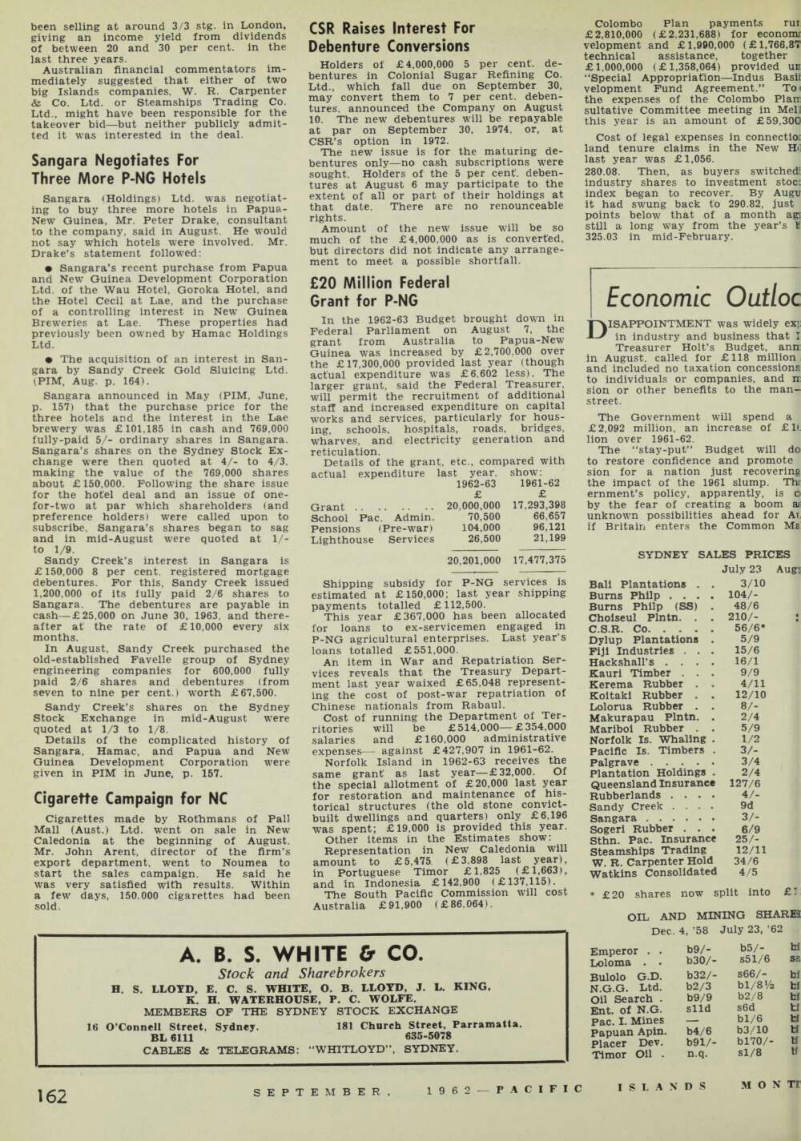
Colombo Plan payments rui £2,810,000 (£2,231,688) for economr velopment and £1,990,000 (£1,766,87 technical assistance, together £1,000,000 (£1,358,064) provided un “Special Appropriation—lndus Basil velopment Fund Agreement.” To< the expenses of the Colombo Plan; sultative Committee meeting in MelJ this year is an amount of £59,300 Cost of legal expenses in connectioc land tenure claims in the New HO last year was £1,056. 280.08. Then, as buyers switched! industry shares to investment stoc: index began to recover. By Augu it had swung back to 290.82, just points below that of a month ag£ still a long way from the year’s If 325.03 in mid-February.
1962-63 1961-62 £ £ Grant 20.000,000 17.293,398 School Pac. Admin. 70,500 66,657 Pensions (Pre-war) 104,000 96,121 Lighthouse Services 26,500 21,199 20,201,000 17,477,375