Pacific Report
pp. 120-144 · Read in the full issue


The month’s round-up of news and pictures of people and events, from PIM correspondents in the South Pacific.
Samoans Charged With
Murder of Official
Three Samoans, jointly charged with murder, were due to appear at a preliminary hearing in Apia, West ern Samoa, on August 15. They had been remanded in custody after ap pearing before the Registrar of the Supreme Court, Mr. F. I. Thomsen, on July 23.
The Samoans are Antonio Nauer, 30, Itilo To’ailoa, 20, and Lemisio Lilo, 20. They were jointly charged with murder following the death at Apia hospital early on July 22 of Allan William Reed, 36, of Papauta, near Apia.
According to a hospital report, Reed died from internal injuries al legedly received on the night of July 21 when he was assaulted on a lonely stretch of road near Letogo, about four miles from Apia.
Reed, a popular senior Post Office official with 20 years’ service, is sur vived by his wife Patosina and seven young children. A large crowd at tended his funeral on July 23.
More Islanders
Visit New Zealand
During the 12 months ended March 31, 1962, 1,922 Cook Islanders, Niueans and Samoans arrived in New Zealand either as visitors or to live, according to the latest report of the NZ Department of Island Territories.
This was a marked increase on previ ous years.
A total of 783 islanders went from NZ to their home territories.
Cook Islanders entering NZ num bered 619 (286 more than in the previous 12 months), Niueans 264 (an increase of 112), and the num ber of Samoans rose 202 to 1,039, says the report.
Possible factors in increased migra tion include: lifting of travel re strictions on able-bodied Niuean men (imposed by the Niue Island As sembly after the hurricanes of 1959 and 1960); more berths now that
Matson Line ships call at Rarotonga; and the desire of many Samoans to visit friends and relatives in NZ be fore their country became independ ent probably in the mistaken belief that migration regulations would be tightened up.
The report says the replacement of the Maui Pomare on the Cook Islands’ run with the m.v. Moana Roa has been justified by the increase in cargo carried. The new vessel has stimulated production in the Cook Islands.
In its last 12 months the Maui Pomare carried 7,720 tons of cargo to the Cook Islands, and returned with 5,853 tons. In its first 12 months the Moana Roa carried 12,952 tons there and 10,682 tons back.
In Mauke, They're
Working for Peanuts
A five-year project to grow peanuts, kumara, cassava and other crops on 640 acres of fern land at Mauke, in the Cook Group, was begun recently.
The project is under the direc: of Mr. A. M. Hall, the islat Resident Agent, who is a qualiJ agricultural scientist.
Mauke, a volcanic island of aV 4,500 acres, is the easternn island in the Cook Group, ano about 150 miles north-east Rarotonga. Until now its » export crops have been ora;/ (about 8,000 cases last year), cr (30 to 40 tons) and tomatoes.
Part of the area being sown peanuts, kumara and cassava o prises 300 acres of barren, inf© land previously covered in guava j staghorn fern. This area had ah lain idle, although nearly all islanders hold some interest in Following a meeting with the 0 Islands Resident Commissioner, A. O. Dare, the islanders allowed the area to be used as< block, regardless of surw boundaries.
Finance for developing the and experimental work is being ; vided by the Cook Islands Go t < ment. If at the end of five : the islanders wish to take < individual planting, they may d«J On the other hand, if the pn becomes self-supporting and islanders wish it to continue » communal basis, arrangements be made for profit distribution.
Details on the planting of yze experimental crops with difff fertilisers are given in an artic: Mr. Hall in the latest issue oc South Pacific Bulletin.
Mr. Hall says: “Although it ii early to predict the result of operations, it is already clear: considerable soil improvement! been achieved. (•
Rabaul
Wedding
Married at the Rabaui Methodist Memorial Church Miss Wilhemina Siloox (right) to Mr. George Ah-Ken. Best man was Mr. Andy Sikus and bridesmaid Miss Dorothy Muskitta, Name of the flower girl was not given.
Photo: C. H. Meen
“Needless to say it is our hope that icanuts may be grown economically, iven if the most pessimistic view is »orne out in practice, a ‘problem’ oil area will have been considerably mproved and made available for acal subsistence cropping.
“If, on the other hand, it can be hown that peanuts or other readily aleable crops can be grown conomically on this difficult soil ype, it will represent a major dvance towards self-sufficiency of the dand and perhaps a contribution to griculture outside Mauke.”
Uom Scientists' Niue Visit
flay "Tie Up Loose Ends"
Sir Ernest Marsden, New Zealand’s jading nuclear scientist, left Auck md in the Tofua on August 8 for six-week visit to Niue to try to iscover the origin of the island’s adioactivity and to determine its fleets on the islanders. Parts of Jiue are 20 times more radioactive ran normal.
Sir Ernest Marsden made head nes last year when he announced lat Niue Islanders “might provide le key to the future of mankind in le atomic age” after laboratory tests n soil, bone and teeth samples sent ) him by agriculture and medical fficers on the island. (P/M, August 961, p. 51).
For some time, Sir Ernest Marsden eld the theory that Niue’s radio ctivity may have been connected rith the plankton in the sea around le island which had been found to e extremely radioactive. But on a ecent world cruise, he found that lankton was the same everywhere.
Before leaving for Niue, Sir Ernest larsden said: “At the moment we re just guessing what effects radio ctivity has on humans, but this visit light tie up some of the loose ends, f we can come up with something tattling we can turn to the world jaders and say: ‘Look what you are loing’.”
iveryone Has Pet Plan On
Native Liquor Laws
A wide variety of methods of elaxing P-NG’s liquor laws were uggested in Port Moresby in August vhen the six-member Liquor Com nission of Inquiry began its hearings, fhe methods suggested ranged from he lifting of all legal prohibitions o a strictly policed system of permits.
Umost every witness had a different Wggestion.
The commission’s chairman is todge Francis Robert Nelson, of Victoria. Its terms of reference are
to inquire into the means and methods of relaxing P-NG’s ban on consumption of liquor by natives, and to examine present liquor laws to recommend a comprehensive liquor and licensing ordinance.
The Minister of Territories, Mr.
Hasluck, announced the Government’s decision to relax drinking laws for natives on May 15.
The first witness before the commission was the Secretary of the Administrator’s Department, Mr.
David Fenbury, who urged the lifting of all legal prohibitions against native drinking.
He said primitive peoples should be insulated from problems that would arise from the supply of alcohol, by the Administration exerting a tight control over the spread of liquor retailing outlets.
A system of proclaimed areas, where people would have access to alcohol, while it was forbidden in other regions, would not be practical.
It would mean some natives, who were allowed to drink while working on a plantation or living in town, would lose the privilege when they returned to their villages.
Mr Ivan Champion, the Native Lands Commissioner, suggested a liquor permit system for both whites and natives with their degree of civilisation as the criterion for judgi applicants Gala Gala Rarua, a former schoolteacher and now assistant to the Assistant Administrator, Dr. John Gunther urged a permit system with eligibility based on income, general behaviour and degree of sophisticat j on
Rarua, a delegate to the recent South Pacific Conference in Pago Pago, American Samoa, voiced approval of the American Samoa system in which beer is available to everyone over 21, with a permit system for spirits.
Toua Kapena, representing three Port Moresby district villages covered by Fairfax Local Government Council, said natives would be satisfied for a start to have access to liquor in their own social clubs.
Dr. B. G. Burton-Bradley, a psychiatrist of the P-NG Public Health Department, said natives should have the same drinking rights as Europeans, because the mental health dangers posed by discrimina tion were substantially greater than the dangers offered by native access to alcohol. A permit system for natives would be undesirable as it would continue discrimination, The vice-president of the Fairfax Local Government Council, Sinaka Goava, said everyone over 21 should be allowed to drink beer and those who wanted to drink spirits should be given permits if they were of good reputation.
Mr. Goava said people m primitive areas should be allowed to drink, but should not be encouraged, He said when a married man asked for a permit to drink spirits his Wl^e should be allowed to tell the permit committee if her husband could afford it.
Mr. Leonard Dexter a planter from Ukua m the Central District of Papua, said he expected drinking would accentuate tribal differences among his 100-man labour force.
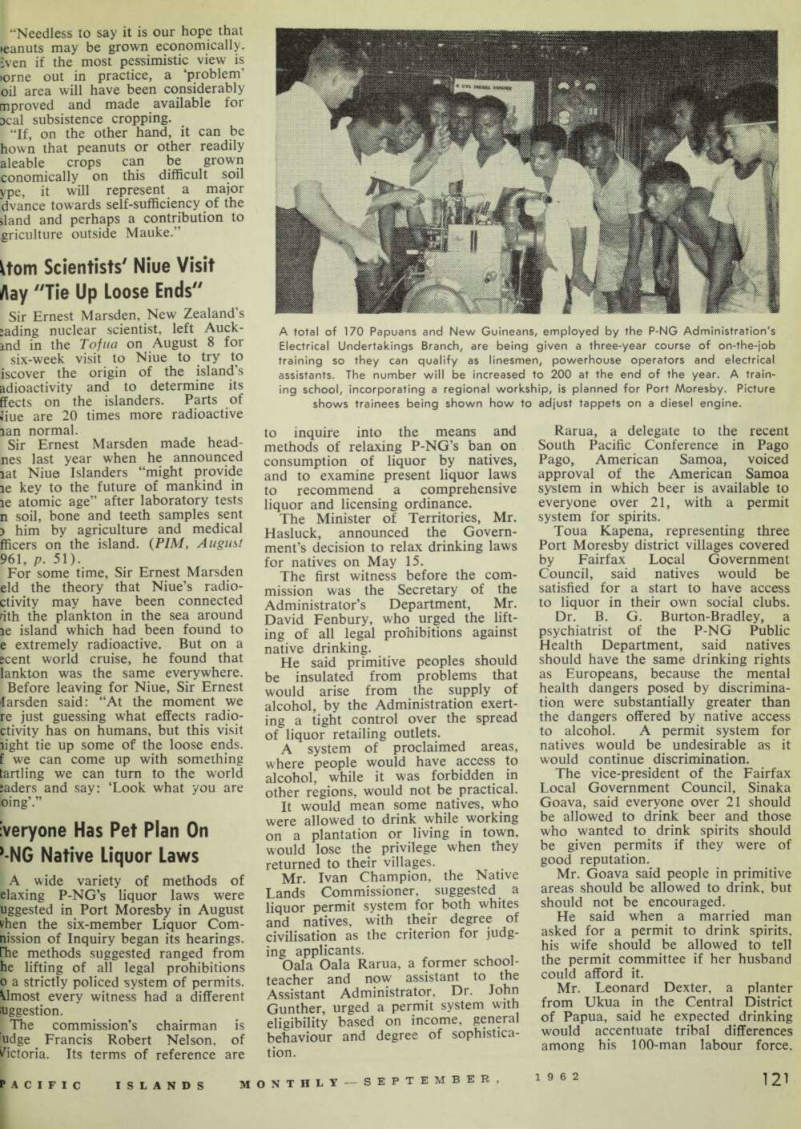
A total of 170 Papuans and New Guineans, employed by the P-NG Administration's Electrical Undertakings Branch, are being given a three-year course of on-the-job training so they can qualify as linesmen, powerhouse operators and electrical assistants. The number will be increased to 200 at the end of the year. A train ing school, incorporating a regional workship, is planned for Port Moresby. Picture shows trainees being shown how to adjust tappets on a diesel engine.
If the supply was cut off whij trouble was brewing, natives won be inclined to “break down the tra«i store” to get more.
To minimise the impact of tj ban’s relaxation, Mr. Dexter pn posed a twofold permit systes applying to Europeans and natiw alike.
A permit to buy beer would available to all adult natives au Europeans. A second permit fl spirits could be obtained only ! persons who could prove to ti authorities that they were experience in drinking hard liquor.
A native who proved he cotu handle beer could “go up a stee and apply for a spirits permit aft a reasonable time, Mr. Dexter said A group of Papuan pastors a:j deacons of the London MissionaE Society, who said they thoug liquor was “a bad thing for tl people of this country”, propose that only people over 25—be Europeans and natives—should allowed to drink.
Mr. G. F- Hall, of Port MoresH a stipendiary magistrate and licensii Commissioner, said there was reason why control over liquor shou differ from control over any otH commodity.
“In my opinion, liquor H achieved a status symbol which does not warrant,” he said.
Availability of liquor in groce stores and trade stores with hoc bars open at the hours of their choc would “take the glory out of drii ing a glass of beer”.
Mr. Hall said there had been t much distinction between wild arr and urban areas in regard to wl drinking rights natives should hav\ He opposed a permit system : native drinking because of 1 impossibility of enforcing it, and 1 cause discrimination between wH and native was repugnant to A i tralian policy in P-NG and to 1 people of the Territory.
The Rev. Paul C. Parkin, of United Church, and the Rev.
Kemp, of the Methodist Overs*?
Mission, proposed a local optil system for deciding drinking am for both whites and natives- The Director of Native Affairs, H I. K. McCarthy, who first went. J P-NG 35 years ago, said natii should be given the same drinks rights as Europeans, without delays He said the natives would not tn promises for a gradual relaxation i the law.
To protect from alcohol primitti peoples who were unused to conth with Europeans or sophisticae natives, he recommended the declas tion of certain geographical an
ere liquor outlets would not be >wed. fhe areas would be determined by [Administration, and not by local ion.
Licensing prohibitions could be ed later with the advancement of people.
Mr. McCarthy said the permit tern, giving only certain natives i right to buy and drink spirits, uld be discriminatory and would [against all natives customs which d that a man must share with his Wives and friends.
Limiting natives to beer with a fer alcohol content than that sold lerally would also be discrimina- H and was not practical.
When the commission chairman J Mr. McCarthy’s ideas went
much further than those of native witnesses, Mr. McCarthy said he believed the proper way to govern the people was to give them things just before they were ready for them —not wait for the swell of demand before acting.
Answering questions, Mr.
McCarthy said he felt the fears ex pressed by people in isolated areas on repercussions from natives drink ing were much exaggerated.
It was unfortunate, he said, that many Europeans who had lived in the Territory for years had never got to know the natives well and were “still at heart frightened by the indigenous people”.
The commission continued its hearings in Rabaul on August 22.
Campaign to Rid American
Samoa of Filariasis
A team headed by Dr. John F.
Kessel, of the UCLA School of Medicine, was due to begin a campaign in American Samoa in August to combat filariasis.
Filariasis, a common disease in the South Pacific, is contracted from the bite of a mosquito, which injects microscopic worms in the veins of its victims. The worms make their way into the lymph glands and grow and breed by millions.
Other mosquitoes draw up the young worms in infected blood and pass them on to other victims.
Elephantiasis, a manifestation of filariasis in its late stages, is characterised by huge swellings of
arms, legs, breasts, vulva and turn. The skin grows rough like elephant’s hide, and the huge llings add to the elephantine >r. Kessel’s chief weapon in his ipaign is a post-war drug called razan. In the past five years, got most of Tahiti’s 40,000 pie to take it, and the incidence ilariasis there has dropped from per cent, to less than five per ;. Elephantiasis has practically ppeared. [etrazan does not kill all the adult ms or cure immediately a serious ; of filariasis, but it prevents fection by killing the filarial ms in their early, vulnerable se. i Tahiti, Dr. Kessel also taught natives where the disease-carry mosquitoes breed and how to roy them. The mosquitoes are ?x fatigans and members of the es family. hey breed mainly in rain barrels, cans, holes in trees and rocks, ol drums, worn-out tyres, adoned canoes, and in coconuts eaten by rats. »r. Kessel’s campaign in American 10a has the support and en ragement of Governor H. Rex > and Dr. Kessel expects the same Its as in Tahiti. leanwhile, in Niue, the Health lartment has been conducting a ipaign to urge the natives to rent the breeding of mosquitoes, ay water drums have been itied by departmental officers on ige inspections because they were y and full of mosquito larvae.
baul Gets Its
5t Chinese Priest
Wien Fr. Albert Chan, MSC, ducted his first Holy Mass on [day, July 22, in Rabaul’s St. ncis Xavier’s church, it was an oric occasion for Catholics in the ritory. : r. Albert, following his ordina the previous day by H.E. the st Reverend Bishop V. P. Copas, C. of Port Moresby, became the i locally born Chinese to take orders in Rabaul. At the same e he became the first Chinese isionary in the Sacred Heart ler.
'he ordination ceremony, watched ?,000 people—many of them non holies but family friends—was a ud moment for senior citizen John [ Chai Chan, the new priest’s ler. ’ohn Ah Chai, 82, has lived in [Territory for 60 years and was
himself one of the first Chinese converts to Catholicism.
Arriving as an indentured cook to early German settlers in the Duke of York group, John Ah Chai skimped and saved; finally with £6O capital amassed during his 5-year term, bought an area of jungle on New Ireland and carved the planta tion “Karias” out of the wilderness with little more than his bare hands.
Here he raised his large family of six sons and five daughters, of whom no less than six were destined to take religious vows. His wife died in prison camp during the war through lack of medical attention by the Japanese.
First to join the church were sons Luke and Gabriel, who ; having studied for the priesthood in Hong kong, embarked on missionary work in mainland China, where they were joined a year or two later by a sister, Elizabeth.
Today Luke lies bedridden with TB in a Shanghai hospital; Gabriel, for seven years a political prisoner of the Communists, lies languishing in prison, while Elizabeth, forced to discontinue her missionary work, is living as a “civilian” also in Shanghai.
Sister Mary and Rosita also took vows later and are at present in Australia, Mary at a convent in Bowral and Rosita at Sydney Uni versity where she is studying to embark on missionary work in Japan.
The ceremony was for Albert the culmination of eight years’ intensive study in Australian schools and
After ordination Father Albert Chan blesses Bishop Copas, MSC.
Photo: C. H. Meen.
seminaries, and the tall you priest, composed and handsom made an impressive figure as stood in the packed, bedecked chun throughout his ordination.
During the ensuing week, Tuesday, July 24, matters were giv a finishing touch at a huge sit-do’i eat-up reception held Chinese-stl in Rabaul’s Xavier Hall.
More than 1,000 guests of all ra«j and all religions rolled up and helfl themselves to about 10 courses toothsome Chinese food.
Appropriate speeches were ms by Bishop Copas, Fr. Mitchell, scho friend of the new priest, Oliver Chd his brother Frank Chan, lollywae magnate Gabriel Achun (who add) a postscript in Chinese for John A Chai’s benefit), and emerging natl orator To Stanis Boramilat of t Tolai tribe.
Said Stanis in his glib Englisi “. . . with Tolai priests and now/ Chinese priest we are a big hap family; a fact which my people w remember when they return to thri homes and talk about discrimiii tion”.
French Warship Pays a
Call on New Volcano
Because of a heavy sea, no o from the French warship Dunk\ quoise could land on Matthew Isla:* the southernmost active volcano • the New Hebrides chain, when t warship called there on July Monsieur Priam, the Condominm Mines Officer, who was travelling j
Proud father of a missionary family, Jo Ah Chai Chan, poses with his daugh[?] in-law and grandson.
warship, had hoped to examine island closely, vlatthew Island, which is about 150 es south-east of Aneityum, had y one peak when it was discovered 1788. But in October, 1953, a p reported that a second peak had ieared and that the island had re than doubled its size. The old ik is about 460 ft high; the new, ) ft. An isthmus separates them, following the visit of the Danker rise, Monsieur Priam reported that new peak had several craters from ich a great deal of sulphureous mi was rising. A spectacular ;am of lava, about 90 ft wide, 5 running into the sea. jreenish-yellow water all round island seemed to indicate sub rine fumaroles (gas - emitting es) on the submerged slopes which ild be “more important than had n suspected.”
Monsieur Priam said the island 5 bare of vegetation except for a r plants on the rocky slopes of old peak. Thousands of sea birds I found a refuge there. A few bs were also seen.
i Search for Three
ssing Boys
[he Fiji search-rescue organisation ly in August swung into action to k for three young Fijians who were orted missing on a voyage between 0 and Dravuni Islands, just off davu.
Mter a few days when no report ne to hand that the boys had ided anywhere in the neighbour od, it was presumed that they had ;n lost at sea.
Fhe boys, whose ages ranged from |to 18, apparently left Ono Island a 24 ft canoe on July 28 to re ft to Dravuni.
Major Earthquake,
it Little Damage
No one was injured and little mage was caused when an earth ake occurred in the Bismarck Sea, out 100 miles north of Wewak, rly in the morning of July 31.
The Port Moresby Geophysical Ob fvatory reported that the quake had magnitude of 7i on the Richter ale, a reading which classed it as major disturbance. It was the big st earthquake in the New Guinea ea for some time.
The only serious damage reported as at the Boram Gaol near Wewak. 1 carpenters’ workshop and a sheet etal workshop were extensively imaged.
Tremors were felt at Wewak and
at many other places on the north coast of New Guinea, and some ships were buffeted by high waves.
Fiji Court Case: Goods
Removed from Jap Ship
There was lively interest in Fiji in August in the hearing (extending over six days) of theft charges against four well-known men, aris ing out of the stranding of the Jap anese fishing vessel Asahi Mara No. 8 on the reef off Sigatoka in Feb ruary, and the reported abandonment of the vessel.
The four men, charged with steal ing about £l5O worth of goods from the vessel (electrical equipment, fish
ing gear and removable articles of that sort) were George Raeburn, former manager of the Sigatoka branch of Morris Hedstrom Ltd., agents for the Asahi Maru No. 8; William Clark, manager of Korolevu Beach Hotel; Graham Wallace, de scribed as a fisherman, who was as ; d with clark in a tjmber en . ; in liquidation, Koro , Industries Ltd., and a former ma of Nadi Ai t and Fred , erick B Carter caterin g manager at Korolevu, who has managed several , . , .’ XT ® . hotels in the e cham - The defence, skilfully conducted by Mr. Maurice Scott, was that the four men had not stolen the goods.
had openly taken them from stranded vessel in the mistaken ;f that the ship had been aban id. There had been no attempt xmcealment. When it had ap ed, after the expiry of two or e months, that a syndicate in ;h Mr. Barry Philp was promin had bought the stranded ship, and return of the articles was de ded, the articles were returned, be magistrate, Mr. Moti Tikaram. id that Raeburn was guilty of t, and fined him £lOO on the first ge and £75 on a series of other ges involving goods worth £5l. lark, Wallace and Carter, how , were found not guilty of theft, of an offence under the Wreck Salvage Ordinance, which pro s that articles from a stranded , in such circumstances, must be r ered to the Receiver of Wreck, ;r pain of a large fine. The istrate acknowledged that Ordin was not well known, and per the three men erred in ignor , and he therefore ordered as
punishment a fine of £25 in each case.
The evidence indicated that Rae burn was in an unfortunate position.
It was shown that as manager of the Morris Hedstrom branch at Siga toka, he was regarded as custodian of the vessel, because Morris Hed* strom Ltd. was the official agent fox the Japanese owners. Between the stranding of the vessel and the initia tion of police proceedings, Raeburn had resigned in order to return to Scotland, and he was actually on board an oversea vessel in Suva, with his family, when ordered by the police to return and meet the charges.
A key witness in the case was Stuart Barry Philp, formerly proprie tor of the Mocambo Hotel, Nadi Air port. and one of a syndicate which bought the Asahi Maru for £1,600.
Philp denied several times during cross-examination by Mr. Maurice Scott, that he had informed the police about missing articles.
He had spoken to Clark in a friendly conversation about the return of the articles; but he did not think that Clark appreciated the serious ness of the situation, for he did not return them for seven or eight days.
However, he admitted having written letters to Clark, promising to keep him covered if he returned the articles.
Overall, the defence set up a plea that the four men thought the ship had been abandoned; and Raeburn (who represented Morris Hedstrom, agents for the ship) admitted in court that he told the other men they could take property off the ship. Raeburn said he had expected the other men to tell the police that they took the goods off the ship with his authority.
The other three men confirmed this when they gave their evidence.
The court was also told that they had gone openly to the ship by day light to remove the goods, and had called at the Sigatoka Hotel on the way back, where Clark had spoken to a high police officer.
A witness called by the defence,
Mohan Ram, said he had visited an other stranded Japanese fishing ship, the Koyei Maru, at Beqa, in March, and had taken parts from it to his house at Navua.
Later, he saw the police who told him he would not be prosecuted be cause he did not know he had done wrong, and did not plan to steal.
Mr. Tikaram, in his judgment, said the men had gone to the ship with the avowed intention of taking the goods, and their defence was that they believed the ship had been they believed the ship had been aban doned. He had to be satisfied beyond all reasonable doubt that this was done without claim of right, and with the intention of depriving the owner of the property.
If they genuinely believed that the property they had taken was aban doned, they could not be found guilty of theft. But he was also
The Japanese fishing vessel "Asahi Maru No. 8" on the reef off Sigatoka in
February.
Barry Philp, a key witness in the "Asahi Maru" case.
satisfied there would have beeni removal of the goods but for B burn’s instructions.
He held there was no evidence such a belief of actual abandons by Raeburn; no such belief hadt fact, ever existed as far as Raeß was concerned.
He was unable to reject the ▼ that Clark, Wallace and Carter v led to believe, and did believe, the ship was abandoned and they could help themselves. He given them the benefit of any d<J there was; but he was satisfied were guilty of an offence under Wreck and Salvage Ordinance, Wv was designed to avoid the miso of all and sundry removing prop from a ship.
All were charged on August with offences under the Customs n lations, in that they brought g» into the country without submit them for assessment of duty, if and each, on pleading guilty, fined Raeburn heavily and J others lightly.
Under the Swaying Palms
Wild West Lives Again!
Hollywood has added a new hs to travel in Western Samoa, to coping with wandering horses* and children, occasional tki stones, and tired villagers sle«; on the warm asphalt, motorists have the added thrill of a cH meeting with highwaymen notorious “Black Gang”.
Rumours mixing fact with 1 of the activities of this gang reached such a pitch in Apia I that some car owners, espet; towards evening, will not drive ; of Apia if they are unarmed.
One person whose car was up on the cross island road i 20 miles west of Apia describes bandits as “real cowboys.” H chief clerk of the Education ment R. Nickel.
“My car was stopped by a on horseback in the middle oc road holding out his arm,” said Nickel.
“When I stopped I saw am horseman on the side of the road) was armed with a shotgun, other one had a sheath knife o left side, a tomahawk on his and a bush knife stuck through front of his belt. Both haoi edges of their sleeves and shirti cut in stripes in frontiersman Both wore sombreros and scarves hiding the lower portii; their faces.”
After seeing a rifle in the from of Mr. Nickel’s car, the highwa\
re stuck for words. Finally one them asked for a match. After y were given a light they galloped into the bush, According to Mr. Nickel, he was second victim that day. Earlier the same area an old man was d up and robbed of 2 lb of sugar I a packet of cigarettes. )ther reports put the gang number high as eight—seven men and one man. They are always dressed cowboy style with blackened or sked faces. According to one •y they terrorised a family in a ely faile, circling it on horseback I whooping like Indians as they hed the coconut blinds with bush ves. !ut Apia police dismissed the re ts of gangs of masked men ©rising areas and holding up r ellers as “greatly exaggerated”, 'hey said that only two incidents jiving masked men had been Light to police attention over the t month or so, and that these gang vities were nowhere approaching scale that public rumour had it. no incidents had people been sically harmed. ; appeared that mainly youths e involved and it was likely that :ases not reported to the police, ige elders themselves had taken iplinary action, said a police £r.
Rep. Finds Growing
ational Consciousness"
he United Nations representative Papua-New Guinea, Mr. Samuel ani, made his first visit to the Bteeship Territory of New Guinea n August 3 to August 26.
Ir. Dajani is Director of the ted Nations Information Centre Port Moresby. He took up his ! appointment about three months •uring his NG tour he visited the ricts of Morobe, New Britain, i Ireland, Sepik, Madang, Western
[Eastern Highlands,
ist before he left Rabaul for ieng, Mr. Dajani summed up his ressions from his talks with New uea people, and his first ex ence of the Territory, He said: there is a growing national con bsness in the Territory; this is my ression from meeting different ips of indigenous peoples. 1 have been told that tolerance ?een groups is improving. Rela- I between races are better and people are coming closer to ler.”
Svidence of this was seen during Dajani’s visit to Rabaul High
School where children of all i were observed in sports teams classrooms.
Evidence of the increasing natd awareness was also reflected in • tions put to him about Nether]' New Guinea, about membershii the UN, and of different poll systems and ideologies practise* various members of the U[ Nations.
Previously limited to schools* year’s observance of United Nae Day October 24 will be memorated in the Territory by brations in which all sections o< community will participate.
“In Rabaul, for instance, it ii pected at least 3,000 children! march; last year 1,200 only marc: “Celebrations throughout the 7 tory will include rallies, man Mr, Dajani said.
Mr. Dajani said he was impn by the friendliness of the n peoples. He had been welc: everywhere he had gone.
He also paid a tribute to the cation of Administration off They were not merely doing as he said, but were undertake mission.
After seeing over Malaguna nical School, Rabaul, and R i High School, Mr. Dajani said: “I have visited schools in H developed countries and in les veloped countries. Malaguna nical School and Rabaul High S are two of the best schools ofi kind I have ever seen.”
Fiji's Socialised
Building Workers
A quaint Fijian habit as Public Works Department empll led to a recent Suva court case; two months’ gaol for a plumben plumber, Korotini Tomu Bogii; charged with the theft of building materials.
He told the court that whei PWD men finished a job at as the outlying islands it wasi practice to give the villager! surplus materials in exchange food.
The prosecution told the cou:i Korotini, who had been worki Kadavu, had given away pain ridging material.
Four of the villagers, who pq guilty to having received the goods, were each sentenced days’ imprisonment, which thea recommended should be served! murally at Kadavu.
nds of Change in
Pacific Islands, too
he winds of change blowing >ugh much of the South Pacific now being felt in the Island ter ries of the United States. The Secretary of Interior, Mr. Stewart ill, made this clear in Honolulu lugust on his way back to Wash on after visiting Kwajalein, Guam, fan and American Samoa for the I time since assuming office in pary. 1961.
All the island people are moving idly,” he said. “Their spokesmen stepping forward and speaking up. re is a new current at work )ng the islands peoples. They
will be heard from soon.”
As soon as Mr. Udall got back to Washington, he announced a five point plan to speed up social, political and economic progress in the US Island territories. He called for: • Early discussions with top De fence Department officials on re strictions prohibiting foreign vessels and visitors from Guam and US Trust Territory islands. • Elimination of dual-wage prac tices on Guam. • Extended programmes to in crease the fishing economy. • Development of tourism. • Support of increased self-gov ernment, particularly on Guam.
Education Means Better
Jobs in Fiji Civil Service
Fiji’s civil service at the end of 1961 was made up of 428 officers recruited overseas and 4,195 locals.
The locals were made up of 383 Europeans, 2,091 Fijians, 1,555 Indians and 166 “others”.
Although Fijians outnumbered Indians a breakdown of figures showed that Indians outnumbered the Fijians in the higher salary scales, chiefly in professional and technical posts.
The Public Service Commission in its annual report said that the
[?] TONGAN POSTS: Inspector Simione [?] (top left) the first Tongan to be pro [?]ed to the new post of Superintendent, Ministration, in the Tonga Police Force, jiving his new insignia recently from lnspector Tevita A. 'Ahome'e, while Minister of Police, Salesi Manoa Havea, is on. Below: Inspector Tevita F. Hama [?] who has been promoted to the new of chief inspector, receives his in [?]ia from the Minister of Police. At
[?] is Sergeant Falepapalangi who has
[?] promoted to the new post of staff sergeant.
Photos: Tulua Bros.
reason for this was that many Indian parents had found it possible to send their children overseas for higher education, while very few Fijian parents had been able to afford to do that.
The Government was trying, through an in-service training pro gramme and by scholarships financed from UK Colonial Development and Welfare grants, and in some cases from local funds, to equip suitable Fijjians for higher posts.
Although that assistance was not confined to Fijians the Government recognised that as the indigenous people they were entitled to special consideration.
Blown-away Samoans
Have a New Newspaper
South Pacific Air Lines—which en tered air-line competition in the area late, but which has been battling hard —has widened its sales campaign, much to the benefit of Samoans away from home.
For the airline is now subsidising a new newspaper, Talofa, written and edited in the San Francisco Samoan colony for the benefit of Samoans everywhere. It is a handy compilation of births, marriages,
deaths and graduations in the main land Samoan communities—plus a report of the news back home.
The English-language paper is commercially printed in San Fran cisco. A special bundle of 400 copies went to the South Pacific Conference at Pago Pago in July for distribution there by Ernest Reid, president of the Samoan Civic Association of San Francisco. It was read with interest by conference delegates.
Editor of Talofa is Tenari Fui maono. Circulation manager is Lio Petelo.
Tourism Increases Its
Share of Fiji Economy
Revenue from the Fiji tourist in dustry is gradually increasing. Ac cording to Fiji Visitors Bureau esti mates, the foreign exchange income in 1961 was £1,206,548, an increase of £34,240 over the 1960 figure. In 1959 the tourist industry earned about £1,000,000. The 1958 figure was about £862,000.
According to the Fiji Visitors Bureau chairman, Mr. C. A.
Stinson, the 1961 earnings would have been much higher but for a cut in the number of cruise ships which visited Suva for two days. His
Mr. H. Dickinson and Miss Elizabeth) youngest daughter of Mr. and Mrs[?] Chan of Kavieng, cut the wedding after their marriage at the St. I Xavier Church, Rabaul, recentll Photo: C. H.
isoning is more or less borne out the fantastic sales Suva retailers perienced during a recent visit of j Oriana.
The Oriana was at Suva for two ps, and most shopkeepers reported it their sales of luxury items were least twice as high as for any previ -5 ship.
Fhe tourist industry is now firmly ablished in the third position an earner of foreign income the Colony behind sugar >out £8,000,000) and copra (about 000. Gold is fairly static ind the £1.000,000 mark in fourth ce. dr. Stinson is confident that the rist industry may one day be the jor earner of overseas exchange, [here may be good reasons for optimism, for higher sugar sales not appear likely within the fore able future, and there has not been ufficient increase in copra produc i to warrant unduly high hopes.
'• Copes With Fakaofo's
opulation Explosion"
i school of six classrooms will built next year on Fanuafala, a acre islet of Fakaofo Atoll in Tokelaus, as part of a New Zea ! Government plan to cope with “population explosion” on Faka . At present, Fakaofo’s 780 pie live on an islet of only 6\ ;s. knuafala, which was bought by NZ Administration from family lers, has been subdivided into 212 ions of about a fifth of an acre 1, with space for roads, churches, 1 administration buildings. The administration building and a hment to supply rainwater tanks, be erected this year, he NZ Minister for Island Ter-
I Zealander Shelley Stevenson smiles '•ly after her recent marriage in vl's Methodist Memorial Church to ISimpson, formerly of Melbourne. A ng sister at Nonga Native Hospital, cy recently returned from leave in iome town, Auckland. She and hus- I John honeymooned in the High- I before returning to Rabaul to live.
ritories, Mr. F. L. A. Gotz, said re cently that the present overcrowding on Fakaofo could produce serious results if an epidemic broke out. “The new settlement is therefore a great boon to the people,” he said. “New administration buildings and a better water supply should greatly improve the standard of living on the atoll.”
Photographic Contest
Entries in TEAL’s 1962 photo graphic competition must reach the Publicity Manager at TEAL’s Auck land office by September 21. The competition is open to photographers in NZ, Australia, Norfolk Island, Fiji, Samoa and Tahiti, Subjects must have a strong tourist attraction angle in any territory to which TEAL flies.
Entries must be matt finished and measuring approximately 12 in, by 15 in. mounted on 16 in. x 20 in.
Prizes of £5O, £lO and 10 of £l/10/- will be awarded.
Fiji Amnesty Backfires
Over Warriors' Gun
A machine gun handed in to the Fiji police in its latest arms amnesty has been handed back to its owners.
The amnesty is to reduce the number of unlicensed firearms in the colony.
The machine gun was handed in by Ratu Inosi Vatucicila, adminis trative head of the province of
Lomaiviti. Ratu Inosi told the Com missioner of Police, Mr. R. H. T.
Beaumont: “The gun was captured from the Japanese in the Solomons during the Second World War by “C” Company, 3rd Battalion, Fiji Infantry Regiment.
The company was manned solely by men of this province.
“When the company returned home, they presented the gun to the provincial office where the soldiers expected it to be inspected by their children, grandchildren and great grandchildren, to make them con fident that they are the offspring of warriors.
“Since the law does not allow us to keep this gun any longer, I, on behalf of the members and the officer commanding our gallant company and the chiefs and people of this province, hand over the gun to the law.”
The Commissioner of Police examined the gun, decided it was obsolete and said the province could keep it.
Hallstrom Trust To
Be Dissolved
The trustees of the Hallstrom Trust had recommended unanimously that the trust be dissolved, Papua- New Guinea Administrator Sir Donald Cleland said in August.
The trust would be terminated
The Acting TPNG Commissioner for Girl Guiding, Lady Cleland, wife of the Ad ministrator of TPNG, recently flew to Rabaul and conducted a three-day resident course in Trefoil House for local commissioners and trainers. Seen from left to right are Mrs. L. Sharp, Miss M. Simms, Mrs. L. East, Lady Cleland, Mrs. S. Toohey, Mrs. S, Simpson, Mrs. J. Green, and Divisional Commissioner Mrs. B. Hayes. Seen in the front row are native trainers, Lilian, Niareweu and Taklaman. Girl guiding is becoming very popular with the Tolai girls.
operated a livestock station in the ;stern Highlands and instructed :ives in pastoral management. It s also active in collecting New tinea fauna.
Sir Donald told a Press conference it the trustees, at a Sydney meet ; he had attended, had felt the ist had served its purpose.
The trust would be terminated •ough a special ordinance to come fore the September session of the NG Legislative Council.
inister Won't Approve
srfolk Hotel Plans
A recent ruling by Territories inister Paul Hasluck has ended ms for the establishment in jrfolk Island of a new hotel costing 0,000, with first-class accommoda m for 44 guests, according to M’s Norfolk Island correspondent.
The importing firm of K. A. entice & Co. was recently success l in tendering for a block of land lown as No. 4 Quality Row. There rre no other tenders.
Mr. Prentice commissioned a New aland architect to prepare plans r a hotel. The architect, Mr. W. , Jaine, visited the island, prepared e plans which were submitted by e Administrator to the Minister for iproval. The Administrator, Major-
General Wordsworth, was reported to be enthusiastic about the scheme, since he has agreed that additional good-class accommodation is essential if the Norfolk tourist industry is to continue to expand.
No conditions were laid down in the conditions of the lease regarding reconstruction of the building which had occupied the site. Little remains of this old convict ruin apart from some low walls, and the area is practically obscured by a miniature jungle. However, it was stressed that any building to be erected must blend with the surrounding landscape and not clash with existing Colonial style buildings still in use by the Administration.
In his report, Mr. Jaine stated: “While it is most desirable that the building planned does not overpower any existing buildings or ruins in the area it is not in my opinion necessary to build a replica of that period, but as far as possible apply a present day approach to that style.
In that respect a gable design would seem to be the answer, bearing in mind that the magnificient views warrant large areas of glass. As long as the building is low and well de signed it will implement the existing buildings to a pleasing degree”.
Mr. Jaine lectures on architecture at Auckland University, but unfortun ately neither his designs nor his explanatory comment found favour with Mr. Hasluck. In rejecting the design Mr. Hasluck summed up: “The preservation of the Colonial buildings and the exclusion of any structure that would detract from or clash with their architectural and historical interest are the over-riding considerations in this case.”
Mr Prentice admits disappoint ment over Mr. Hasluck’s verdict.
“Tourists coming here want facilities equal to what they have at home— or better”, he said. “In attracting visitors to Norfolk my company has played a strong part and we wish to continue to do so”.
Need For P-NG
Fishing Industry
Although numerous surveys of Papua-New Guinea fisheries or potential fisheries —have been made over the last decade, the Territory still has no industry worth the name.
That something more is needed than the hit-or-miss, virtually unorganised coastal fishing of the native villagers is obvious. The native people are short in protein foods, and fish—es pecially high quality fish such as barramundi and crayfish—could be come an export industry.
The latest survey was made by J. van der Meulen, who concentrated on economic and marketing problems.
His findings have recently been pub lished by the Faculty of Agricultural Economics of the University of New England for whom the project was undertaken.
Mr. van der Meulen spent 10 weeks in the Territory, the aim of his study being to find out whether the lack of development of a fishing industry in the Territory was due to deficiencies in the channels of distri bution and, if so, to suggest ways of overcoming them.
He found that while some com mercial fishing was supplying such places as Port Moresby, few natives depended wholly on fishing for an income and only two Europeans were encountered who made their living by fishing.
The main problems in fish market ing in Port Moresby were lack of marketing and storage space and a shortage of transport for fish to this centre of distribution. At present the only market is the Koki market. The only available freezer space of any capacity is privately-owned, and Mr. van der Meulen seems to think that this would be a bad arrangement be cause in “case of conflict between the producers and themselves [the owners] they would be unwilling to rent out freezer space at all”.
In view of these facts, he says the provision of proper marketing facili
An artist's impression of the proposed Nor folk Island hotel that Territories Minister Paul Hasluck has re jected.
ties in Port Moresby seems, therefo a “pre-requisite of further develJ ment of the fishing industry”—w provision also for cool storage andJ ice-making plant.
Papua’s most valuable potential port sea-foods are barramundl which is regarded in Australia as very valuable eating fish—and cr fish. Both are found in the Gulf a Western Districts of Papua.
Mr. van der Meulen feels that a development of these industi should be kept in local Papuan hai and should be done soon beff European fishing enterprises from Australian mainland horn in.
Already, he says, barramundi I been fished out in north Austral! waters and fishing boats from thi are working as close to the Papu coast as they can go.
He does not favour Territo European enterprise taking part this industry as, according to hi private enterprise would be tempi to sell on the mainland as there ; such poor facilities for storing i fish in Port Moresby.
He thinks, also, that native pa:j cipation is necessary not only in i fishing but in the marketing, becat if the marketing is left to priw enterprise, “friction will develop” 1 tween producers and dealers. Natl participation in selling will also me that native consumers will have eas access to sales outlets.
He says that both in Port Mores and Lae he noticed that while ft was more expensive in the natl markets than in the shops, natl women bought in the markets rat! than enter the shops, although thu was no colour bar.
Mr. van der Meulen’s report seee to mean that European enterpn should be kept out of any fishen development in the Territory, K that as natives haven’t the capital J do it in the way that it should done, “someone” should do it : them. This “someone” will have to i the poor old Government, we suspe Or some other benevolent institute that feels that it is worthwhile savr P-NG fishing for local posterity.
Guadalcanal Battle Of
1942 Remembered
The landing of the United Stas Marines on Guadalcanal and 1 sinking by the Japanese of HM.I Canberra off Savo Island in t Solomons 20 years ago were coo memorated with moving ceremom in the Solomons on successive dsl in August.
On August 8, a memorial servv was held at the Cenotaph in Honisi to mark the landing of the Marina
J on August 9 a service was held board RCS Komaliae over the proximate spot where the Canberra is sunk while covering the landing.
Lhe services were held exactly 20 jrs after the events they com ;morated.
Representatives of the United States jvernment and the US and unmonwealth Armed Forces at ided the Honiara ceremony. Among ase present were the High Com ssioner of the Western Pacific, Sir ivid Trench; the US Consul in ji, Mr. George Grey; Brigadier meral Ballance, US Marine Corps st.); Lieutenant-Colonel J. V. ather, ED; Mr. W. F. M. (Mark) emens, CBE, MC; and Sergeant ajor Vouza.
Lieutenant-Colonel Mather, an jstralian recruiter for Levers in the lomons before the war, landed on aadalcanal with the Ist Division the US Marine Corps. He was tached to the corps because of his :al knowledge and was later com issioned.
Mr. Clemens, an Administration ficial on Guadalcanal when the panese landed at Tulagi in May, »42, built up a local army of nearly ) natives and made numerous irassing patrols until the Marine arps landed three months later.
Ithough the Japanese offered re ards for his capture, the natives fused to betray him.
Sergeant-Major Vouza was one Solomon Islander who refused, despite being tortured and left for dead. His courage won him the George Medal and Silver Star.
Lieutenant-Colonel Mather and Mr.
Clemens, who now lives in retire ment in Melbourne, travelled to Honiara together. In a note to PIM written the day before the cenotaph ceremony, Mr. Clemens said: “We have visited all the historic spots we can find, but the lush tropic growth has concealed almost all of the traces of our passing.
“The last ribs of the Jap trans ports off the beach at Aruligo can still be seen, and a lonely Jap gun rusts near Kokumbona in a fenced paddock, with grazing cattle for company under the waving palms.
Simple Stone Cenotaph
“The simple stone cenotaph at Honiara is inscribed with the names of the countries whose fighting men took part in the campaign, and on a bronze plaque: ‘To the memory of all who in the World War of 1939-45 defended and guarded the British Solomon Islands Protectorate and rested not until the last enemy was overcome.’
“A tree from each of the countries has been planted on the pleasant terraced lawns surrounding the cenotaph. This is situated looking out to sea at Point Cruz between Government House and the Mendana Hotel.
“There are few of the old hands about at Honiara these days. I have seen Ken Hay, who served at the Gold Ridge coast watching post, J. A.
Johnstone who was 2 i/c of the Labour Corps, and hope to see A. M.
Andresen at the service. We had hoped to bring “Snowy” Rhoades down from Rabaul, but he was busy with a cocoa marketing scheme.
“Honiara gives you the feel of the new spirit of the Solomons.
Smartly uniformed Solomon Islanders are to be seen driving land-rovers, trucks and graders—doing efficiently jobs undreamed of before the war.
All the expatriates, of whom there are many, are working with them, in Government and in commerce, in a
splendid spirit of co-operation.
“The latest sign of the times is a new airfield being hacked out of the jungle on Malaita, a few miles north of Auki. It was a thrill to drive for the first time along an excellent road which I had paced on foot in 1938, and see the roots of giant trees being ripped out by two Solomon Islanders driving giant bulldozers/’
Among those who travelled in RCS Komaliae to take part in the Canberra service were Captain L. M.
Hinchcliffe, RAN, the Naval Officer in charge of the North Eastern Area; Father J. M. Wall; Canon C. E. B.
Wood; the Superintendent of Marine, Captain M. A. Campbell; and Mr.
T. E. Mitchell, District Commissioner, Central Solomons.
The vessel’s engines were stopped when she was over the approximate spot where the wreck of the Canberra now lies and Father Wall and Canon Wood read the service, A wreath of frangipani and red hibiscus was cast in the sea by Captain Hinchcliffe, and was followed by others.
een in Rabaul recently was this Kandrian ultul, who seemed to be very impressed [?]ith local progress. Kandrian is the [?]rincipal centre and Administration sub listrict at the western end of the south oast of New Britain—the opposite end to Rabaul.
GEIC Air Service Proposed:
Fiji Airways' Expansion
Fiji Airways may provide Gilbert and Ellice Islands Colo with its first regular air services.
The airline, which is owned Australia, Britain and New Zealaj is considering putting in a serw to link Fiji with Funafuti and Tarat and possibly Ocean Island and Nau The services would probably be fo nightly and would be for the beni mainly of the Western Pacific H] Commission and British Phosphi Commission personnel.
The old wartime strip at Funafl is in need of repair before it cou be used, and a strip would have be put down at Ocean Island. Nau already has a strip suitable for DO Heron aircraft have the range this service, but the airline is at considering the purchase of the Hen 11, which has a retractable undt carriage and longer range.
The Western Pacific High Coc mission is especially interested getting the GEIC service in ope; tion.
Fiji Airways is also considering creasing the frequency of the prest; service between Suva and Honiaf via the New Hebrides, which is present a fortnightly one by Hero Suggestions have been made tH the service be made weekly, or es three flights made every month. * announcement may be made soon.
Another Fiji Airways service be looked at again shortly is the foe nightly flight between Fiji at I Western Samoa. Proposals has been made that it be increased toe weekly flight, or that it be mades leg on a proposed new trianguli flight to operate between Fiji, Tonji Western Samoa and back to Fiji.
It is understood that the directo are not satisfied that there sufficient traffic to warrant triangular flight at this stage.
Meanwhile Fiji Airways has pi r < chased Korolevu Air Transpoc which operates one light aircraft Fiji (see below), and this airerr may be used by Fiji Airways operate additional feeder servio internally.
Fiji Airways Buys
Korolevu Air Transport
Fiji Airways has bought tf Korolevu Air Transport Pijq Caribbean aircraft for an undisclosz sum. Fiji aviation pioneer, Mr. Ten French, in association with Mr- V J. Clark, manager of the Korolee
ch Hotel, started KAT in ober, 1959.
Vith the trim little aircraft they vided a taxi service between relevu and Nadi and Suva. The /ice was particularly popular with rists, and it had a record of con ent, trouble-free flying, dr. Chris Ritchie, manager of Fiji ways, said his airline would con le to operate the Piper Caribbean the same routes with the same Fiji Airways flew the aircraft, ng with a Drover, to Ba for the cial opening of the airstrip there August 4.
go Airport May Become
tal Airlink for PAA
U though there has been no cial comment, it is believed m fific aviation circles that Pan lerican Airways is considering iting its main Pacific jet services ough Pago Pago International Air ■t, instead of Nadi. It would irate feeder services between Pago 1 Nadi for passengers specifically nting to visit that area, fhe new development follows the idal opening, in July, of the 9,000 strip at Tafuna. Work is con uing to make the Pago airport ly operational for night traffic.
Already PAA operates DC7c vices between NZ and Honolulu i return, using Pago. South cific Airlines operate into Pago im Honolulu and alternatively from hiti, using a Super-G Constellation. ■AL uses Electras on its Coral »ute service between NZ and hiti, via Pago.
Use of Pago for through traffic s between Australia and America iuld save PAA money on landing arges it pays at Nadi, which are psidered high. It would also give pport to the announced American jvernment intention of building up fe status of Pago airport.
The new 9,000 ft airstrip has an Iditional 200 ft overrun at each end, id is 150 ft wide. It is bitumen packed coral that was dredged 5m the sea. Like the new Faaa tstrip at Tahiti, which it closely sembles, it is built right on the »ast, partly over a lagoon.
ew Hebrides Airways
ompletes First Two Years
New Hebrides Airways, which was te first company to begin an internal rline in the New Hebrides, has been iceiving congratulations on its first vo years of operations. [Proving flights began in June, 1960,
with a De Havilland Rapide, and commercial operations started in October, 1960. In August last year, the Rapide was replaced by a Drover aircraft which has flown principally between Vila, Erromango, Tanna, Aniwa, Futuna, Arbrym, Pentecost and Santo, with regular twice-weekly scheduled flights to Tanna.
The aircraft has been used exten sively by geologists and vulcan ologists, principally on research and inspection of the Lopevi and Ambrym volcanoes. The Drover was the first aircraft to land on the ash plain surrounding the Ambrym volcano.
During the course of its operations, the company has been responsible for the construction of two aero dromes on Tanna (one at Aniwa and one at Futuna), and surveys have been made at Tongoa and Aneityum.
At Aneityum, an airfield is being constructed jointly by the Condo minium and the Aneityum Island Council, with the French mining re search organisation, BRGM, con tributing part of the cost.
New Hebrides Airways have opened up new sources of income in the Group, airfreighting oranges from Aniwa, and woven baskets and coco nut crabs from Futuna. The island of Tanna, with its easily accessible volcano, has been opened up to tourists.
Up to the first of July this year, the company had flown 1,310 hours, covering a distance of 164,000 miles, carrying 6,105 passengers, 10 tons of air freight, and 73 urgent medical cases.
NZ Trade Mission Gets
Huge Orders
The New Zealand trade mission to the South Pacific had taken orders for £1 million in the next 12 months, the leader of the mission, Mr. R. H.
Stewart, said on his return to NZ in August. The mission visited Fiji, Tonga, Niue, the two Samoas, Tahiti, the New Hebrides and New Cale donia.
Articles which sold best were foodstuffs, agricultural sprays, chickens and chicken equipment, beer, automotive equipment, electrical equipment (including electric welding gear, one of the best sellers), hospital furniture, and pharmaceutical products.
“Firm orders we received, and potential business, will more than double the sales of NZ-manufactured goods in the Islands during the next 12 months,” Mr. Stewart said. “This fillip to trade can be maintained provided manufacturers follow up the openings and the contacts which have resulted from the mission.”
The big need was for a New Zealand-based trading house in the Pacific—possibly at Suva or Apia— to push sales of NZ goods at com petitive prices, Mr. Stewart said. Its aim would be to capture a share of the business at present held by Aus tralian interests.
“Some of these interests even have their own trading ships,” he said.
To push Pacific sales of NZ goods, more were needed to distribute them in the various areas, said Mr.
Stewart. Shipping must be regular and frequent. “At present, our com petitors can guarantee shipping, but we can’t”, he said.
Massacre Aftermath
-27 Natives Convicted
Twenty-seven natives charged after a massacre in which more than a score of villagers died, were con victed of murder in a judgment announced in Port Moresby in August. Five others, also charged with murder, were acquitted.
The death sentence was recorded against the 27 found guilty but it is not the practice to carry out death sentences in capital cases involving primitive natives.
Word of the verdict was received by the Administration from Kerema, 160 miles north-west of Port Moresby, where the trial was held under Mr. Justice R. Ollerenshaw from July 9 to 25.
The massacre took place in June, 1961, in mountainous country inland from the Gulf of Papua. Both
Tom French, Fiji aviation pioneer, next to the Piper Caribbean aircraft which has been sold to Fiji Airways.
raiders and inhabitants of the sack village were wild Kukukukus.
Bill Royal of the
Big Six Passes
The death in Lae, New Guinea,, end of August, of Mr. Bill Royal, moved all but one of the Big J syndicate that in 1926 put Edie Cre on the map as the miracle goc producer of the Morobe district.
The survivor of the Six is N Albert Royal, Bill Royal’s brothi who did not take such an active p< in the operations of the syndicate the others. The four other membu were Dick Glasson, Frank Chisholl Bill Money and Joe Sloane.
Although each won a fortune, soi of the members of the syndicate ha died in tragic or poor circumstanc It was Bill Royal who actual found gold on the Edie but Di Glasson accompanied him on t historic climb up the 7,000 ft of N Kaindi. Although both had be prospecting in the Territory for couple of years neither they nor the mates had been able to “get on anything” although others were ms ing fortunes on the Koranga, at Ws and in the Lower Edie.
It was said of the Big Six’s strr that they got £2OO out of every ys of dirt worked; and that 3-1/3 tons; gold came out of the Edie in the fir year of operations.
Most of the syndicate had su sequent periods of living like lorr but by the beginning of World W 11, Bill Royal was working a modi lease near Maprik, in the Sej District, He and Mrs. Royal return] there after the war but, in mo recent years, he had a job with Nd Guinea Goldfields Ltd. in Wau. I was 78 at the time of his death.
Ships Tied Up Over Samoa
Banana Shipment
Lyttelton (NZ), watersiders late : August refused to unload a £50,00 cargo of bananas from Weste Samoa from the Danish ship Africa Reefer because they claimed Nd Zealand ships should be used in t banana trade. More than 170 watf siders had been suspended by Augi< 28 for their refusal.
Nineteen ships in NZ’s four nuj ports—Auckland, Wellington, Lyttl; ton and Dunedin —were tied following the suspensions. Meetini of seamen in those ports had agro unanimously not to take their sh:r to sea until the suspensions we\ lifted. LATER: Strike settled, Augi§ 30.