Cruising Yachts
pp. 105-119 · Read in the full issue
Pacific Shipping And
The occasional speculation that Burns Philp’s Malaita, 3,300 tons, is to be taken off the run shortly, was given another airing in August. But again there seemed to be no real reason to take the speculation seriously—even though Burns Philp itself started the rabbit running in this case.
[ALAITA, built in 1933 (and brought into service in 1934), currently running passengers and go between Australia and P-NG Is. \t the 80th annual general meet of BP’s in Sydney in August, the tirman, Mr. James Burns, said: ‘The position in regards to ship g remains much the same, with les over-supplied with vessels of nerous nationalities seeking avail e cargoes. This, combined with high operation cost of the com ly’s vessels, has resulted in an in ase of losses which has proved a at burden on other earnings of companies and has adversely :cted the profit on trading. How r, as mentioned in last year’s re t, shipping must remain an in ral part of the overall operations, i to maintain a minimum tonnage las been decided to call for ten s for a new cargo vessel for de ry about the end of 1963 to re :e the M.V. Malaita.”
IP’s has been talking about re :ement for some time now, but it mlikely the firm will get a new go vessel for less than a million mds. £1,250,000 is a figure some es mentioned. Faced with this enditure, BP would probably pre to keep the Malaita going for as g as it can, and many of the old ds think that is what the big l will in fact do.
> Whaling Abandoned:
) Norfolk Whaling Company’s ser Norfolk Whaler, left Norfolk nd for Ballina, NSW, on August fter abandoning the 1962 whaling son at the island. The company 1 at that stage caught four hump ks compared with 56 at the same e last year. An attempt may be de to continue the whaling when [ southerly migration takes place, sibly in mid-September, before Norfolk Whaler returned Australia, the company attempted [enlist the crew’s co-operation in nting one week’s free labour— ich had been offered by the shore
station staff. However, few re sponded.
Norfolk Whaler spent many days cruising without making a sighting.
On one occasion the ship chased a solitary whale for nine hours—and it disappeared. The Norfolk Whaler has no great reserves of speed and is slow on the turns, taking a wide arc before bearing on a new course.
In previous years this handicap has not been so great, as a chase could be broken off in favour of a closer whale. But this year every whale of permissible size was a target.
• “Hoodoo Ship”
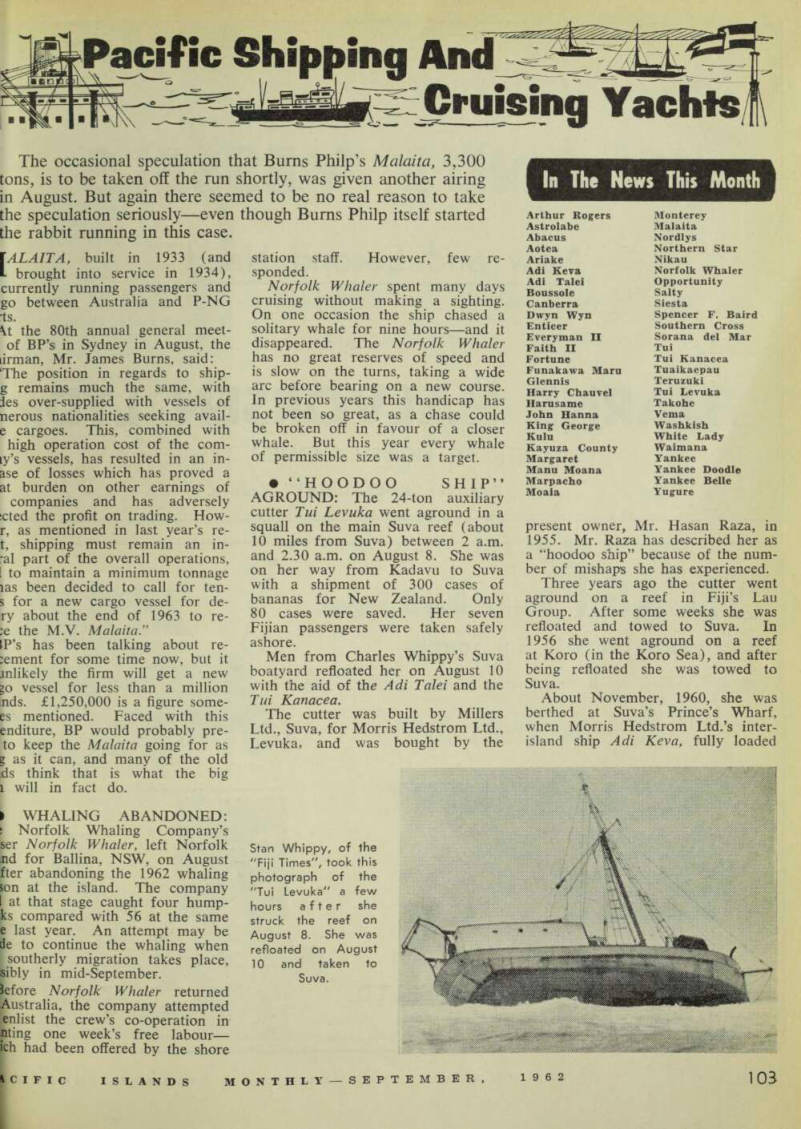
AGROUND: The 24-ton auxiliary cutter Tui Levuka went aground in a squall on the main Suva reef (about 10 miles from Suva) between 2 a.m. and 2.30 a.m. on August 8. She was on her way from Kadavu to Suva with a shipment of 300 cases of bananas for New Zealand. Only 80 cases were saved. Her seven Fijian passengers were taken safely ashore.
Men from Charles Whippy’s Suva boatyard refloated her on August 10 with the aid of the Adi Talei and the Tui Kanacea.
The cutter was built by Millers Ltd., Suva, for Morris Hedstrom Ltd., Levuka, and was bought by the
present owner, Mr. Hasan Raza, in 1955. Mr. Raza has described her as a “hoodoo ship” because of the num ber of mishaps she has experienced.
Three years ago the cutter went aground on a reef in Fiji’s Lau Group. After some weeks she was refloated and towed to Suva. In 1956 she went aground on a reef at Koro (in the Koro Sea), and after being refloated she was towed to Suva.
About November, 1960, she was berthed at Suva’s Prince’s Wharf, when Morris Hedstrom Ltd.’s inter island ship Adi Keva, fully loaded
Stan Whippy, of the "Fiji Times", took this photograph of the "Tui Levuka" a few hours after she struck the reef on August 8. She was refloated on August 10 and taken to Suva.
h sugar, crashed into her stern 1 damaged her extensively in the prstructure. Early last year, when t was berthed at the north end of l King’s Wharf, the overseas cargo p King George grazed her star ird side while coming alongside, e Tui Levuka’s crew hurriedly mdoned her because they thought [ would be swamped.
• Cargo Jettisoned: The
)-ton coastal vessel Kulu reached t New Britain port of Lodi early , August 8 after radioing that she is taking in water and in danger of king. The Kulu, a wooden ship ned by G. & M. Shipping Company Rabaul, jettisoned her cargo of »ber. Trouble began about 17 les off Cape Beechey on the south tst of New Britain while the ship s en route to Port Moresby. The p was expected to go on to Rabaul
[ repairs.
• Mercy Flight: P-Ng
(ministration surgeon Dr. Ken szy, of Rabaul, made a mercy |ht to Kavieng, New Ireland, on igust 5 to perform an emergency eration on a critically ill crew ‘mber of the US hydrographic
\frfr C°y}*Ba County. The crewman, William Earl Richards, of Phoenix, “ a , believed to be an engineer, had been landed at Kavieng suffering from an internal haemorrhage.
Dr. Clezy flew from Rabaul in a DC3 after a message had been sent from Kavieng that Richards needed an nnmedmte operation. Dr. Clezy and the DCS crew members had been located at various sporting meetings.
Richards was transferred next day to Rabaul’s Namanula Hospital, when he was reported to be recoverin S-.
Vice-Admiral W. R. Smedberg 111,
Chief of US Naval Personnel, later sent a message to P-NG Administra tor, Sir Donald Cleland, thanking the people of Kavieng for providing blood “critically needed” to save Richards’ life.
E Jap Tuna Ship In
TROUBLE; The Japanese tuna fish ing vessel Funakawa Maru, with a crew of 30 to 40 trainee fishermen, docked at Wreck Wharf, in Rabaul’s Simpson Harbour, on August 7 for repairs to a seized rudder. The repairs were expected to take about four days. (o ver>
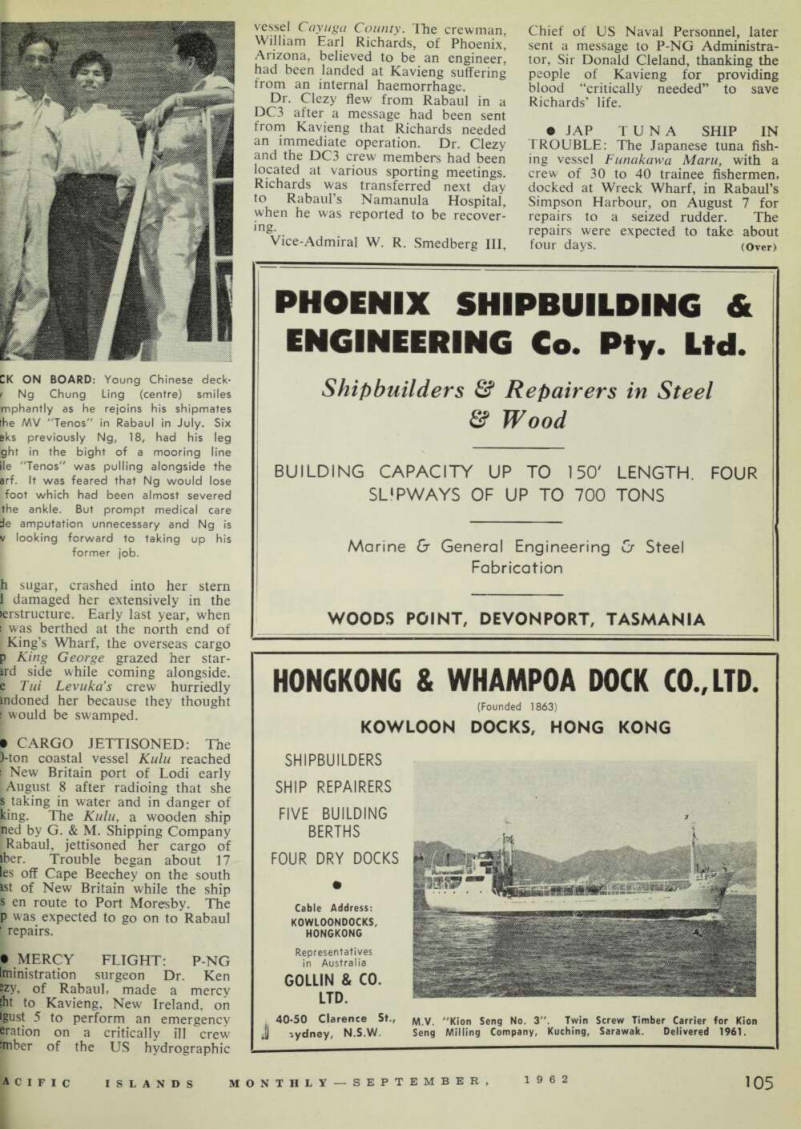
CK ON BOARD: Young Chinese deck [?] Ng Chung Ling (centre) smiles [?]mphantly as he rejoins his shipmates the MV "Tenos" in Rabaul in July. Six [?]eks previously Ng, 18, had his leg [?]ght in the bight of a mooring line [?]le "Tenos" was pulling alongside the [?]arf. It was feared that Ng would lose foot which had been almost severed the ankle. But prompt medical care de amputation unnecessary and Ng is [?] looking forward to taking up his former job.
• Eagles And Birdies,
SIDES SEAGULLS: Tourists on American liner Monterey’s Pacific lise in October will be able to look eagles and birdies as well as gulls, albatrosses and other sea ng avians. The liner will be ned into a floating golf “clinic” the cruise, and two professionals 1 give golfers daily tuition. The ;r will carry a vast supply of old i repainted golf balls as the driv range will be on the stern and the Is will be hit into the sea. The ise, lasting six weeks, will begin Sydney and will take in Suva, nolulu, San Francisco, Los geles and Auckland.
• Refloated From Muo
NIC: The motor vessel Sorana del t, which was stranded on a mud ik at Norsup, New Hebrides, early July was refloated with the help the Burns Philp trading vessel :au on July 13 and went on to ito.
I Teething Troubles; The
• new 24,700 tons Northern Star ich Shaw Savill has just launched d its round-the-world service in ible harness with Southern Cross, [owed the example set by P & O .’s Canberra in 1961 and had some bine trouble of her maiden voyage ; of Southampton in July-August. \s a result, Northern Star arrived Sydney two days late and remained re until August 24 to have some pessary work done. She was ginally scheduled to sail on August , to continue her voyage via New iland ports, Suva, Papeete, Panama nal and West Indies ports to UK.
In general appearance and design, Northern Star follows her older sister Southern Cross which has now been in service for seven years; but she is nearly 5,000 gross tons larger and there has been some change in interior layout. Like Southern Cross, the new ship has her funnel and all engine room and generating machinery as far aft as they can be accommodated. This was considered revolutionary seven years ago but the advantages were sufficient to en courage the owners to build their second ship in the first’s image.
One result of this arrangement is that there are large areas of pas senger deck-space and more room for cabins in the centre of the ship, where space in a more conventional layout would be taken up with holds and engines. The disadvantages of inside
cabins have been overcome by air conditioning and, to keep the illusion, an artificial sunrise every morning.
Coinciding with natural dawn, light is “piped” into inside cabins with about the same growing intensity as the real thing. This is independent of the normal cabin lighting and for people who are never in a mood to face the dawn, presumably it can be turned off so that they get the best of all possible worlds.
In silhouette, Northern Star has a more yacht-like stern in contrast to Southern Cross’ rounded, tug-boat posterior.
Both ships are designed exclusively for one-class travel; cabins vary from single berth, with toilet and shower, to six-berth rooms using communal facilities; prices vary accordingly.
There are three swimming pools.
The vessel was built by Vickers- Armstrong (Shipbuilders) Ltd., at Newcastle-on-Tyne and was launched on June 27, 1961, by the Queen Mother. Her overall length is 650 ft; the machinery installation, by Parsons Marine Turbine Co., consists of a twin-screw arrangement of geared turbines with high pressure boilers, the electrical power being provided by turbine and diesel-driven alternators. The turbines are capable of developing sufficient power to maintain the vessel at 22 knots.
There is accommodation for just over 1,400 passengers and there is a ship’s company of 483 officers and crew. Like Southern Cross, she will make four round the world voyages a year; Southern Cross is expected generally to take the west-bound route —out through Panama Canal and the Pacific, home by Africa; while Northern Star will take the east-bound —out via the Cape and home via the Pacific and Panama.
Occasionally Northern Star will add
Rabaul locals take an interest in the diving operations beneath the stern of "Funakawa Maru", while the rudder was repaired in August. See page 105.
The 24,000-ton "Northern Star" on her maiden voyage. She was in Australia in August. Story this page.
mi, Bermuda or Lisbon to her ;dule. Ports that will receive liar calls from both vessels are Palmas, Durban, Perth, Mel rne, Sydney, Wellington, Auck l, Suva, Papeete, Panama, acao, Trinidad and Southampton.
> Base For Survey: The
tralian Army landing ship Harry \uvel, with a special platform n which a helicopter will operate, p be used as a floating base in ua-New Guinea waters for a 'ey of New Guinea. The survey mrt of a plan arranged by the ister for National Development nap Australia and P-NG. The ieyors will be from the Army dquarters Survey Regiment, digo, Victoria. The Harry uvel arrived in Port Moresby in August.
I Spring Feeling: A Hori
al waling mounted on rubber ers, estimated to cost £16,000, [ be fitted to Port Moresby wharf absorb the impact of berthing s. Suva’s new wharf has already i fitted with rubber buffers of a [rent type.
I Japanese Cruise: The
1 Japanese warships on their th Pacific goodwill cruise received sstrained, but courteous welcome !uva in August. The local people ned to remember events of 20fyears ago, even though the new was not involved. About K) people watched the four ships re to their berths at King’s Wharf, r they had anchored overnight he stream. be ships— Teruzuki, Ariake , I 'ure and Harusame —fired a 21- salute, which was returned by a ery of the Fiji Military Forces.
Rear-Admiral Noboru Nagai, com manding the squadron, inspected a guard of honour mounted by the Fiji Military Forces, before leaving for Government House for an official call on the Governor’s Deputy, Mr. P. D. Macdonald. (The Governor, Sir Kenneth Maddocks, was in Pago Pago and Lady Maddocks was touring Kadavu).
The behaviour of the Japanese seamen was impeccable as they wandered round Suva in small groups, inspecting shops, taking photographs, and trying to make friends with the locals. They were totally different from the usual run of Japanese
At a picturesque ceremony on the new Catholic Mission wharf at Kokopo, New Britain, in August, Brother Sehr tells the story of its construction. On his right is Acting Bishop Fr. Reischl, who officiated in the absence of ailing Bishop Scharmach. seamen who call at Suva,
frequently in fishing ships, and whose
behaviour is often boorish.
The Navy men played Rugby against a Royal New Zealand Air Force team, and baseball against Americans who were in Fiji for the Christmas Island nuclear tests. They also gave a judo exhibition before a large crowd at Albert Park.
• New Wharf At Kokopo:
Vunapope Mission’s vessel Waimana stood proudly by decked in flags on August 1 when the mission’s new £l,BOO wharf at Kokopo was officially opened. It was a proud moment also for Brother Sehr of the mission, who, with a 14-man native labour team, had spent 14 months building the wharf.
The wharf replaces an old structure which, in 1942, rang to the bootheels of newly landed Japanese troops. The levelled piers of the old wharf lie alongside the new which extends for 300 ft into 12 ft of water at low tide and 15 ft at high.
A feature of the new wharf is the soaring concrete arch which rises from the water on either side and will eventually support a statue of Our Lady with a guiding light for mission mariners. (Over)
>on after the opening ceremony her Sehr left Vunapope on 12 ths’ leave during which he will the US and the Continent.
Probing The Depths:
ocean depths of the South fic have been having a good old ing lately. At least three re ;h ships are on the job.
Qe is the Spencer F. Baird, the itific survey ship of the Scripps tute of Oceanography of the rersity of California, which was Western Samoa, early in list. She has been collecting imens from ocean depths and suring the temperatures at ocean )ms since sailing from San Diego March 15. The ship has visited nr, Rabaul, Noumea, Fiji, the ert and Ellice Groups and the shalls and is due back in San ;o via Honolulu on September f (PIM, July, p. 121).
Bother ship engaged on marine irch and the collection of marine fgical specimens is the Royal Zealand Naval auxiliary vessel which was at Norfolk Island for pays in July. Part of the ship’s pment is a television camera :h is lowered to the sea bottom |nable scientists to scan the sea for specimens. The ship also I electronic equipment to in
vestigate the depth, temperature and salinity of the ocean, A third ocean-probing research ship, the Vema, run by the Lament Geological Observatory of Columbia University, New York, was due to leave Wellington early in August for Samoa, Niue, Rarotonga and Tahiti, The Vema is on the last stages of a 13-months’ cruise round the world, Dr. B. C. Heezen, professor of submarine geology at the Lament observatory, who joined the Vema in Wellington, said his main object was to make a geological investiga tion of the Tonga-Kermadec trench, the deep, narrow gash from just north of NZ’s North Island to just south of Samoa. He hoped this investiga tion would explain how the trench was formed and how old it was.
Dr. Heezen said samples of water and plankton would be collected and gravity and magnetic measure ments would be made to determine the thickness of the earth’s crust, T n , , . ir , ,
NeWS Of OUISIIIg YadltS
• A Young Frenchman,
Paul Guimard, will leave Nantes, France, in a 58-ft ketch in September on a voyage to Vanikoro, in the Santa Cruz Group of the Solomons, to search for the wreck of La
SY SLEVIK. Heavy logging equipment comes ashore from the New Guinea vessel "Slevik" ently at Thompson and Wright's newly erected wharf at Kwalakesi, Cape Hoskins, New tain. Timber mill operators Thompson and Wright erected the wharf to save offshore ding of timber and logs and now expect other ships to make Kwalakesi a regular call, early August "Slevik" temporarily became a cattle ship. One hundred head of sturdy [?]ham-Shorthorn cross cattle took to the sea in "Slevik" from the CPL Wharf, Rabaul. [?]e cattle were portion of the last remaining large herd on New Britain and were sold CPL to their new owners, Alexishhafen Mission, Madang. Between decks space was ared on "Slevik", stalls erected and kunai bundles strewn on the floor to accommodate cattle for their voyage to the mainland. The remaining 300 head of cattle will go forward to Madang on "Slevik's" next voyages .
Duse’s ship, Boussole, which was there in 1788. he remains of La Perouse’s other L the Astrolabe, were found at likoro in 1827 by Captain Peter on after nothing had been heard La Perouse for nearly 40 years, no one has yet found the wreck he Boussole. he managing director of the ney French community newspaper \ Counter Australien, Mr. A. rdin, met Guimard during a mt visit to France, le told PIM Guimard would sail vanikoro with a small crew via leira, Panama, the Galapagos nds, the Marquesas, Tahiti, Tonga [Fiji. Guimard expected to reach likoro next April.
Ie would be joined there by osier P. Anthonioz, a former och Resident Commissioner in the v Hebrides and now French lister in Singapore, who led an edition to Vanikoro in March, 8, to search for the Boussole. lr. Sourdin said Guimard was ig partly financed by the French io network. He believed the pie of Albi, La Perouse’s home n in the French province of iguedoc, were also contributing the cost of the expedition.
'his expedition is possibly con
nected with that announced earlier {PIM, July, p. 123) in which Vila diver Reece Discombe and Monsieur Haroun Tazieff, a French volcano logist, will take part. Both these men have been in previous ex peditions to Vanikoro to search for the Boussole. • ABACUS, yacht, with Park and Gloria Shorthose, was reported to have reached Tahiti in June where she went on the ways to replace a couple of wormy planks. Abacus left Honolulu about May 1. • AOTEA, a 32-ft yawl, single handed by 20-year-old Trevor Riley, returned to New Plymouth, NZ, on July 23 after an unsuccessful attempt to cross the Tasman to Sydney.
Riley had hoped to sail his home
made yawl to Sydney before he was 21. He had defied a Government ban on his trip by sailing secretly out of New Plymouth on July 9. The trip had been banned because Aotea lacked essential equipment.
Riley said on his return: “I failed in my ambition but the trip was well worth it. It was a good trial run”.
He said he was still keen to sail the Tasman, but would not try again until he had saved some money and bought equipment. A log book and a radio would be the first two essentials.
Riley said the yawl was battered by waves during fierce storms, but he had still been able to sleep. When asleep, he had just let the yawl drift. He decided he had had enough when he was seasick and couldn’t eat for several days. (Over)
• DWYN WYN, yacht, left o-hae, Nukuhiva, on July 16 was seen heading for Tahiti on 17th. • ENTICER, 46-ft ketch, owner-skipper Carl Gillette an crew from the Hawaii Yacht 0 reported back in Honolulu in after a voyage to Tahiti. • EVERYMAN 11, 28 ft ex.
Zealand ketch Patsy Jean (I White), now in American owner was “floating demurely at hen slip in the Ala Wai Harboun Hawaii in July, according toe Honolulu correspondent. “Her adventure with the Coast Guard Marshal and the US Courts is f 3 into history”, he said. “Her pace their cells in Honolulu refusing on their conscience to i token fine”.
Everyman’s crew were in tn for cruising inside the Johc Island atomic testing zone, crew, three pacificists, Dr. W Steadman, Frank Zahn and Gi Bennello, had appealed to thti Circuit Court in Honolulu to prr further atomic testing and ha<u permission to sail anywhere o< a 470-mile radius test zone, zone radius was later increase 530 miles and a US Marshal sent to them in a Coast Guard to deliver a court order to baoj the additional 60 miles. < August, page 195). The apparently refused.
Under Brian White’s owne and as Patsy Jean, the yachti arrived in Honolulu at the ei; last year after a leisurely cruises the Cooks. She was in the n© February after being overdue voyage to Fanning. Brian Whiti previously owned the NZ Margaret, wrecked in the Coo September, 1960. We don’t what Brian White is doing nn % • FAITH 11, 31 ft 6 in. owned and skippered by Orchard, 24, of Whakatane, N2l in Pago in August, out of Papes a 25-day cruise of the Pacific, in Samoa, Tonga and Fiji.
II left Whakatane in May withi McDonald and Bill Sennel, an tralian. • FORTUNE, outfitted marconi cutter, left Honoluk Tahiti in July with Dave and Goeffney. • GLENNIS, 34 ft seven-yes C-class keeler, left Aucklam
gust 3 with a crew of four for ;our of the Pacific Islands. It ; hoped to complete the first leg the voyage to Suva in about two *ks. From there, plans were to go to Tahiti and Honolulu. The crew iprises Warwick Wrightson, 31, ) Beauchamp, 22, and Ross •dnier, 22, all of Ponsonby, NZ, John Goodacre, 28, of Remuera. finis was an entrant in the last a race and has raced in recent ions on the Waitemata. > JOHN HANNA, ketch, with K. Wing and J. Counterman, was to leave Tai-o-hae, in the rquesas Island of Nukuhiva, on i 19 for Ua Huka, Hiva-oa, uhiva, Takaroa and Tahiti. The ;h had spent about a month ising about Nukuhiva and Ua i. She had made the crossing n San Pedro, California, to ■o-hae in 41 days. Wing reported n Tai-o-hae that it was good ing most of the way except for r days of storm and 12 days in doldrums.
There have been 63 yachts here he past 12 months,” Wing reports a friendly note. “These islands getting to be a regular reunion and for trans-Pacific sailors. Old i McKittridge is still holding open se for yachtsmen on his front mdah, and, I may remind you, jcribes to PIM. His generous rt and good stories mean a great [ to all of us who come here.”
Ping’s news of other cruising its — Moaia, Opportunity, Abacus, \pacho, Yankee Belle and Dwyn b —are given elsewhere in this ion. MANU MO AN A, 40 ft cutter, due to leave Santo, New rides, in late July for the Imons, Rabaul, New Guinea, the iippines and Hongkong. Owner iper is Dr. Richard J. Powley, an ;kland consulting psychologist, p Denise Emirali, of Auckland, crew member. Dr. Powley re ted from Santo on July 20 that [cutter had left Auckland on jruary 24 on a proposed circum igation of no time limit. Stops been made at Noumea and New hides ports. “We supplement our p with one or two members at one time who may wish to come t of the way with us”, Dr. Powley L “We expect to leave Santo with Frenchman and one Tahitian”, photo in this section, i MARPACHO, yacht, left Tai-o -l Nukuhiva, on July 18 for lenada, Chile, with 11 aboard.
I MOAIA, 36-ft ketch, of San
Pedro, California, with owners Mr. and Mrs. Ray Overton, was still in the Marquesas in July, bound eventu ally for Tahiti. She arrived in the Marquesas on March 18 from Manzanillo, Mexico. • NORDLYS, 71 ft American schooner, which was up for sale in Honolulu at an asking price of $60,000 ( PIM, August, page 116) left for the US in July when no buyer could be found. But she was soon back in Honolulu with a broken headstay, Nordlys was in Auckland in January after a cruise through the
Islands. Owner-skipper E. W. De Koning formerly owned Yankee Doodle, also seen recently in the South Pacific. • OPPORTUNITY, an old fashioned 34 ft 9 in. yawl, built over 50 years ago, arrived in the Marquesas on July 6 with James Watson and Mick McCudden, of Seattle. C. K. Wing of the John Hanna met them in Vaieo Bay, Ua Pou, He reported that they were on their way to Australia, via Tahiti, Bora Bora and NZ. “These youngsters are making their voyage on a shoe-
ng”, Wing said. “They have only little money and are eking out ir stores with fish and breadfruit”. i SALTY, a 36-ft German sloop, e-handed by Arthur Menkhoff, 36, 5 reported in Nukualofa in mid y. She left Hamburg on April 1961, bound west around the rid. Her last port of call was liti. The voyage to Tonga took days. Next port was Auckland.
I SIESTA, 35-ft cutter from ckland, manned by five “Kiwis”, \in Nukualofa in mid-July. The ner is Colin Piesse. Other crew tnbers are Paddy Donaldson, Bill I Paul Schultz and Ross Theed.
I WASHKISH, a freakish-looking laran, skippered by Sleepy Pickett, the Hawaii Yacht Club, was en te for the US from Honoloulu July. \ WHITE LADY, 32-ft ketch, h Joe and Ellen Hart, their seven r-old son Joey, and crew member k Gwalter, arrived in Nukualofa July after an 18-day voyage from d Howe Island. After visiting the iga Group, she was to go to Suva.
I YANKEE BELLE, yacht, had n expected at Tai-o-hae, Nuku a, from Papeete for more than > weeks in mid-July. It was ught she may have headed north avoid bad winds in the Tuamotus. * TUAIKAEPAU, a 45 ft yacht Qed by Tofa Ramsey, of Nukua t, was reported overdue on a r age from Tonga to Auckland on y 30, and was still missing in mid gust. The yacht left Tonga on y 4 and was believed to have
17 people aboard. She was carrying a ton of groceries, 144 gallons of water and other stores. The yacht’s master, Tevita Fifita, is believed to have intended fishing near Ata, the southernmost island of the Tonga Group, which is uninhabited. After aircraft from New Zealand unsuccess fully searched for the yacht early in August, the Air-Sea Rescue Organisa tion called off the search until more definite information on the vessel’s movements was received. • BOAT RACE: Another Suva to Levuka boat race will be held this year—on Saturday, October 6, dur ing the Cession week-end. A meeting
of 34 boat-owners in Suva decided this early in August. The race is open to all power and auxiliary vessels accepting the rules laid down. • TAKOHE, 40 ft yawl, left Wellington in August headed for Tahiti, with four aboard. Owner is Mr. L. Gatehouse, an ex-wartime pilot who has been keen on sailing since boyhood. He started building Takohe in October, 1960. and launched her three months ago. With him on the cruise are his younger brother, T. J. Gatehouse, and two Wellington friends, Ron Mitchell and Bob Daniel. Takohe has a 10 h.p.
auxiliary diesel.
ard "Manu Moana", 40-ft cutter, in mea recently, Dr. D. J. Rowley and Miss Denise Emirali. See p. 115.