General Reading
p. 97 · Read in the full issue
New Novels For
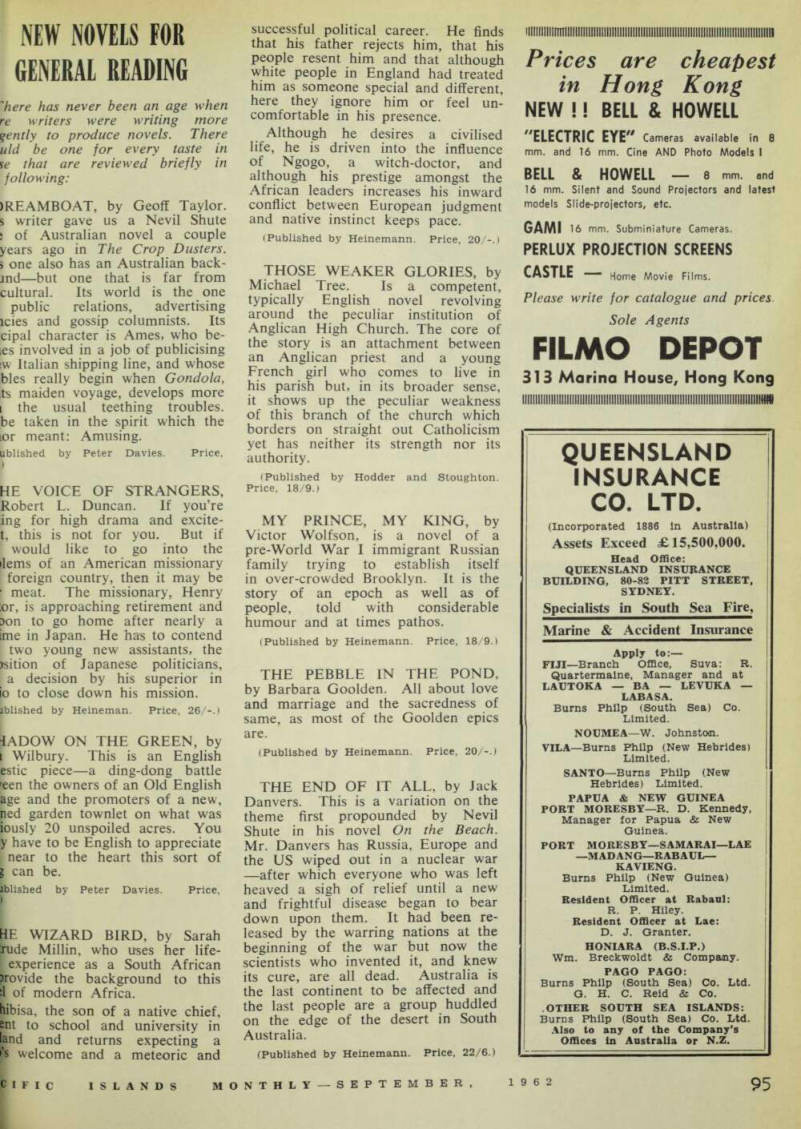
"here has never been an age when re writers were writing more gently to produce novels. There uld be one for every taste in se that are reviewed briefly in following: )REAMBOAT, by Geoff Taylor, s writer gave us a Nevil Shute ; of Australian novel a couple years ago in The Crop Dusters. 5 one also has an Australian back md—but one that is far from cultural. Its world is the one public relations, advertising icies and gossip columnists. Its cipal character is Ames, who be ics involved in a job of publicising iw Italian shipping line, and whose bles really begin when Gondola, ts maiden voyage, develops more i the usual teething troubles, be taken in the spirit which the tor meant: Amusing. by Peter Davies. Price, )
He Voice Of Strangers,
Robert L. Duncan. If you’re ing for high drama and excite t, this is not for you. But if would like to go into the ilems of an American missionary : foreign country, then it may be f meat. The missionary, Henry or, is approaching retirement and Don to go home after nearly a ime in Japan. He has to contend two young new assistants, the isition of Japanese politicians, ! a decision by his superior in io to close down his mission, iblished by Heineman. Price, 26/-.)
Jadow On The Green, By
Wilbury. This is an English estic piece—a ding-dong battle 'een the owners of an Old English age and the promoters of a new, ned garden townlet on what was lously 20 unspoiled acres. You jy have to be English to appreciate f near to the heart this sort of I can be.
Iblished by Peter Davies. Price, ) HE WIZARD BIRD, by Sarah [rude Millin, who uses her life l experience as a South African provide the background to this :1 of modern Africa, hibisa, the son of a native chief, ent to school and university in land and returns expecting a >’s welcome and a meteoric and
successful political career. He finds that his father rejects him, that his people resent him and that although white people in England had treated him as someone special and different, here they ignore him or feel un comfortable in his presence.
Although he desires a civilised life, he is driven into the influence of Ngogo, a witch-doctor, and although his prestige amongst the African leaders increases his inward conflict between European judgment and native instinct keeps pace. (Published by Heinemann. Price, 20/-.)
Those Weaker Glories, By
Michael Tree. Is a competent, typically English novel revolving around the peculiar institution of Anglican High Church. The core of the story is an attachment between an Anglican priest and a young French girl who comes to live in his parish but, in its broader sense, it shows up the peculiar weakness of this branch of the church which borders on straight out Catholicism yet has neither its strength nor its authority. (Published by Hodder and Stoughton.
Price, 18/9.)
My Prince, My King, By
Victor Wolfson, is a novel of a pre-World War I immigrant Russian family trying to establish itself in over-crowded Brooklyn. It is the story of an epoch as well as of people, told with considerable humour and at times pathos. (Published by Heinemann. Price, 18/9.)
The Pebble In The Pond,
by Barbara Goolden. All about love and marriage and the sacredness of same, as most of the Goolden epics are. (Published by Heinemann. Price, 20/-.) THE END OF IT ALL, by Jack Danvers. This is a variation on the theme first propounded by Nevil Shute in his novel On the Beach.
Mr. Danvers has Russia, Europe and the US wiped out in a nuclear war —after which everyone who was left heaved a sigh of relief until a new and frightful disease began to bear down upon them. It had been re leased by the warring nations at the beginning of the war but now the scientists who invented it, and knew its cure, are all dead. Australia is the last continent to be affected and the last people are a group huddled on the edge of the desert in South Australia. (Published by Heinemann. Price, 22/6.)