Family
p. 90 · Read in the full issue
The
Swiss
Price
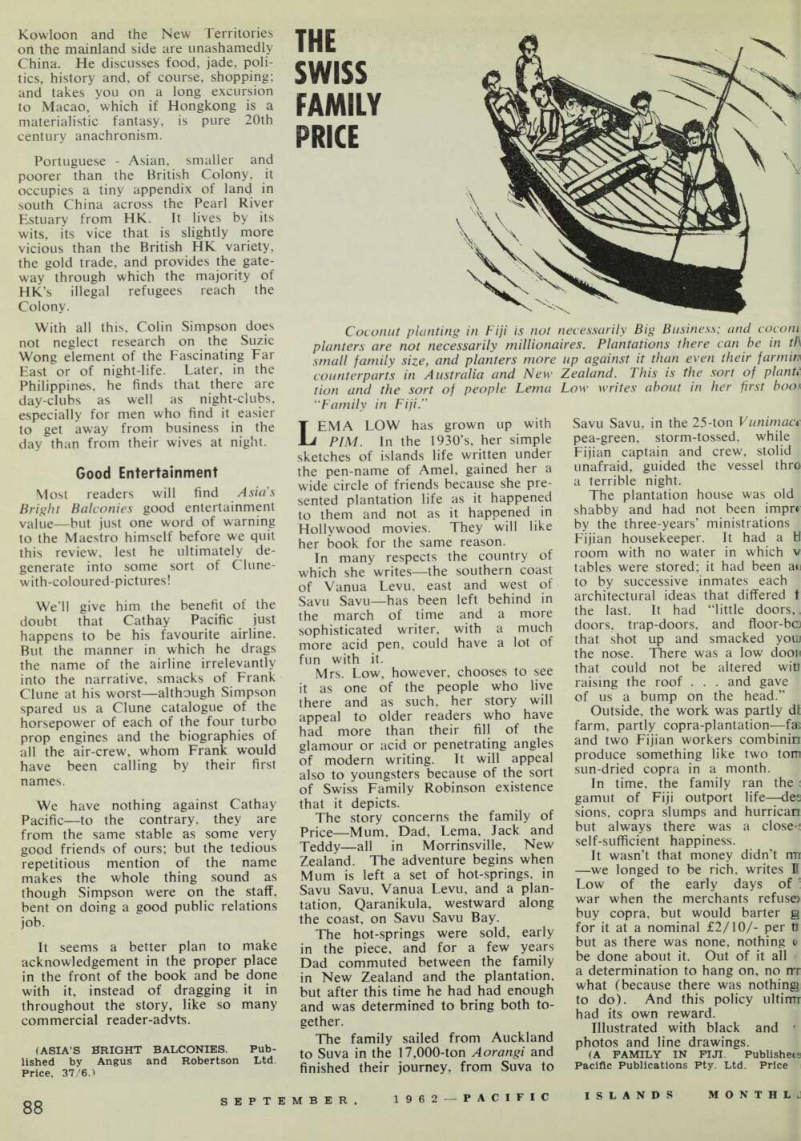
Coconut planting in Fiji is not necessarily Big Business; and cocom planters are not necessarily millionaires. Plantations there can be in th small family size, and planters more up against it than even their farmm counterparts in Australia and New Zealand. This is the sort of plants tion and the sort of people Lema Low writes about in her first boot “Family in Fiji.”
LEMA LOW has grown up with PIM. In the 1930’5, her simple sketches of islands life written under the pen-name of Amel, gained her a wide circle of friends because she pre sented plantation life as it happened to them and not as it happened in Hollywood movies. They will like her book for the same reason.
In many respects the country of which she writes—the southern coast of Vanua Levu. east and west of Savu Savu —has been left behind in the march of time and a more sophisticated writer, with a much more acid pen, could have a lot of fun with it.
Mrs. Low, however, chooses to see it as one of the people who live there and as such, her story will appeal to older readers who have had more than their fill of the glamour or acid or penetrating angles of modern writing. Tt will appeal also to youngsters because of the sort of Swiss Family Robinson existence that it depicts.
The story concerns the family of Price—Mum, Dad, Lema, Jack and Teddy—all in Morrinsville, New Zealand. The adventure begins when Mum is left a set of hot-springs, in Savu Savu, Vanua Levu, and a plan tation, Qaranikula, westward along the coast, on Savu Savu Bay.
The hot-springs were sold, early in the piece, and for a few years Dad commuted between the family in New Zealand and the plantation, but after this time he had had enough and was determined to bring both to
gether.
The family sailed from Auckland to Suva in the 17,000-ton Aorangi and finished their journey, from Suva to
Savu Savu, in the 25-ton V unimace pea-green, storm-tossed, while Fijian captain and crew, stolid unafraid, guided the vessel thro a terrible night.
The plantation house was old shabby and had not been impr* by the three-years’ ministrations Fijian housekeeper. It had a tf room with no water in which v tables were stored; it had been a«j to by successive inmates each architectural ideas that differed t the last. It had “little doors,, doors, trap-doors, and floor-bo that shot up and smacked yoiu the nose. There was a low doon that could not be altered witi raising the roof . . . and gave of us a bump on the head.”
Outside, the work was partly dt
farm, partly copra-plantation—fas
and two Fijian workers combinin produce something like two tom sun-dried copra in a month.
In time, the family ran the < gamut of Fiji outport life—des sions, copra slumps and hurrican but always there was a close-e
self-sufficient happiness.
It wasn’t that money didn’t rm —we longed to be rich, writes II Low of the early days of : war when the merchants refuse buy copra, but would barter g for it at a nominal £2/10/- per tt but as there was none, nothing o be done about it. Out of it all • a determination to hang on, no nr what (because there was nothing to do). And this policy ultinrr had its own reward.
Illustrated with black and T
photos and line drawings.
(A FAMILY IN FIJI. Publisheta Pacific Publications Pty. Ltd. Price