Fought The
pp. 73-77 · Read in the full issue
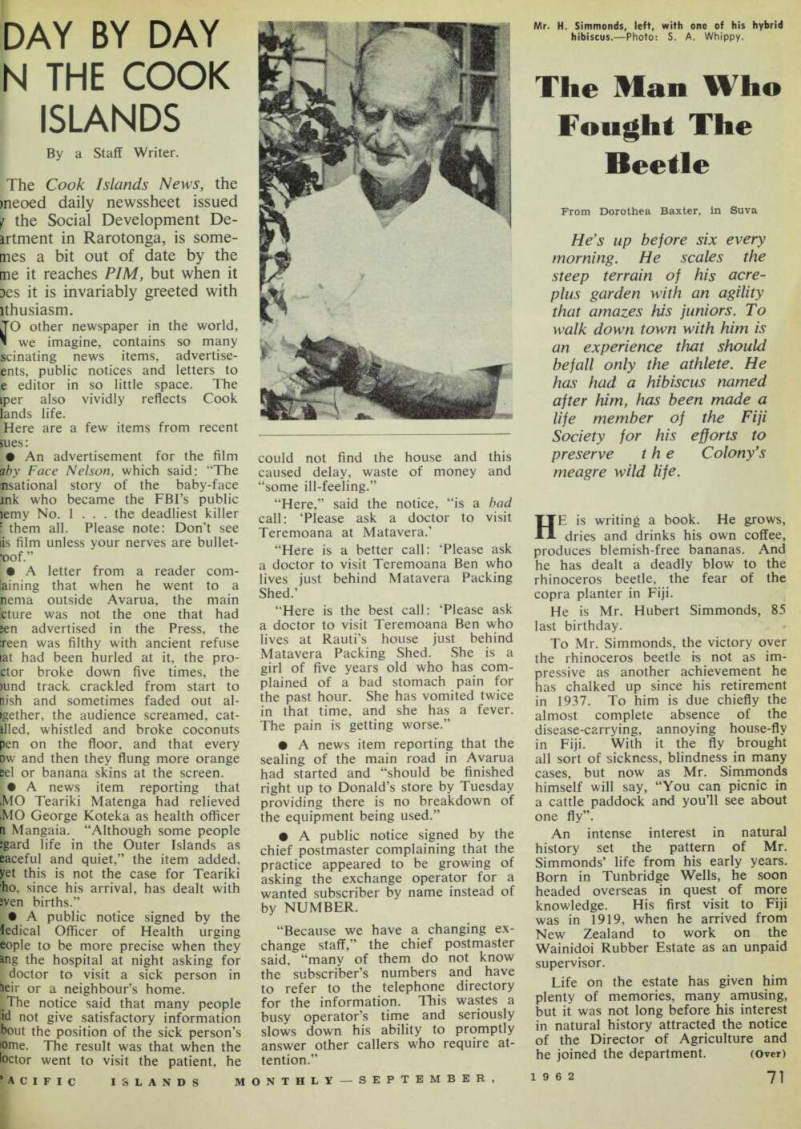


The Man Who Fought The Beetle
From Dorothea Baxter, in Suva He's up before six every morning. He scales the steep terrain of his acre
plus garden with an agility
that amazes his juniors. To walk down town with him is an experience that should befall only the athlete. He has had a hibiscus named after him, has been made a
life member of the Fiji
Society for his efforts to
preserve the Colony's meagre wild life.
HE is writing a book. He grows, dries and drinks his own coffee, produces blemish-free bananas. And he has dealt a deadly blow to the rhinoceros beetle, the fear of the copra planter in Fiji.
He is Mr. Hubert Simmonds, 85 last birthday.
To Mr. Simmonds, the victory oyer the rhinoceros beetle is not as im pressive as another achievement he has chalked up since his retirement in 1937. To him is due chiefly the almost complete absence of the disease-carrying, annoying house-fly in Fiji. With it the fly brought all sort of sickness, blindness in many cases, but now as Mr. Simmonds himself will say, “You can picnic in a cattle paddock and you’ll see about one fly”.
An intense interest in natural history set the pattern of Mr.
Simmonds’ life from his early years.
Born in Tunbridge Wells, he soon headed overseas in quest of more knowledge. His first visit to Fiji was in 1919, when he arrived from New Zealand to work on the Wainidoi Rubber Estate as an unpaid supervisor.
Life on the estate has given him plenty of memories, many amusing, but it was not long before his interest in natural history attracted the notice of the Director of Agriculture and he joined the department. (Over)
An acting entomologist, he ac imulated a tremendous amount of lowledge of the country and be ime acquainted with many dis iguished scientists who would never ive guessed that he was entirely jf-taught and not the product of a liversity.
The years of World War II found m at Adelaide in charge of the iological Control Section of the r aite Institute, but apart from that isence, his life since 1919 has been ent in the Pacific with regular visits England and spasmodic trips to Malaya and Africa and other omtries in connection with his work.
Shortly after his retirement from s post as Government Entomologist Fiji, Mr. Simmonds was asked by e Samoan Government in 1938 to How up the work of Dr. Karl riederichs, who had previously been igaged to make a search in the astern tropics in the hopes of find g some natural enemy to assist in e control of the rhinoceros beetle hich was first noticed in Samoa in 110. Dr. Friederichs’ work had sen interrupted when he was in rned in Madagascar at the outbreak r World War I.
Long Research
When Mr. Simmonds arrived in [auritius with his wife in 1939, he tamined the records of the wasp, 'olia oryctophaga, which had been tablished there to combat another linoceros beetle, and came to the inclusion that this wasp could not icceed in Samoa. [However, Mr. Simmonds was told lat in the Zanzibar Museum there as another scoliid labelled as a krasite of rhinceros beetles, and this asp proved to be named Scolia mcornis. World War II broke out ie day Mr. and Mrs. Simmonds left anzibar, and the only tests he could lake with the beetle were in )nclusive. Meanwhile he had successfully pded a strong colony of the [adagascar species, but at the end three years it had to be admitted lat it was a failure, as he had kpected.
It was then decided to risk a amble with Scolia ruficornis. When lis wasp was introduced into Samoa [more than justified the gamble, and now established in great numbers, Icreased export figures of copra rom Samoa—to the tune of 3,000 ms extra for the last 12 years— re Mr. Simmons’ answer to sugges ts that the scoliids do not breed
fast enough to hold their hosts in close check.
When the rhinoceros beetle was first discovered in Fiji in 1953 Mr.
Simmonds was asked by the then Director of Agriculture (Mr.
Harvey) to see what agencies existed in the Colony to check its spread.
For the next 18 months or so, Mr.
Simmonds busied himself, examining breeding places, studying possible predators, e.g., scorpions, centipedes, mongooses, mice, etc.
Finally, after about two years, during which the beetle continued
to spread in spite of poisoning cam paigns, Mr. Simmonds was asked to go into possible biological methods of control.
Fiji he knew would be a far more difficult country than Samoa in which to establish the parasite. In Samoa there had been an abundant supply of host beetle grubs, but in Fiji, the beetle was still patchy and a parasite could easily, after feeding, find itself in a district into which the beetle had not yet penetrated, and be lost.
It was immensely cheering then to Mr. Simmonds that the first
finite recovery of the parasite—at mi, on May 30 last—should incide so closely with the time ten to establish it in other, parently more favourable localities.
The discovery showed that the rasite was definitely established in ii and that it must have travelled considerable distance from where was released or bred. Three origins re possible: (1) Wainidoi, where 5 cocoons were placed in Decem r, 1959, a distance of about 12 les from Lami; (2) Deuba, where cocoons were placed in February, 59; or (3) the breeding nursery Dravo, about 15 miles away.
Fhe full effect of the introduction the parasite in Fiji will not be [ for several years yet, says Mr. amends. However, even at this ly date it is significant that the aring up of beetle damage in a [nber of places near Suva Dcides with the definite establish nt of the parasite. Naturally, this aring up is still in comparatively all numbers and as yet is by no ans generally distributed over the a where it has established itself, Mr. Simmonds is positive t the rhinoceros beetle will never completely eradicated, and is md, in the course of time, to reach i copra areas, he is confident the asite, together with other agencies d cleaning up of breeding places) I be able to keep it in close check, this knowledge that they are earmed must be very comforting the copra growers. fhe establishment of Scolia cornis has been described by the icrvisor of the Coconut Pests and eases Board (Mr. C. A. Stokes) “a triumph for Mr. Simmonds, ) has devoted the whole of his e in finding ways to overcome the ay obstacles with which he was sd at the Dravo breeding sites”.
'o Mr. Simmonds, Scolia cornis will always rank after ter chinensis in his personal scale achievement. While in Java, as t of his search for a parasite to ick the rhinoceros beetle, he ided to find out just why there e hardly any flies. nvestigations soon revealed the datory beetle, Hister chinensis, 1 Mr. Simmonds soon saw to it t it was introduced into Fiji.
Only those who remember Fiji years ago will have any idea of magnitude of the numbers of the Jase-carrying fly in those days, with the dysentery, typhoid and eye sctions that went with them,” says • Simmonds.