Cricketing New Caledonians Do
pp. 59-61 · Read in the full issue


Battle For The Ashes
From Fred Dunn, in Noumea Ninteen cricket teams —including seven women’s teams —are ; competing for cricket’s mythical Ashes in New Caledonia. The teams began competing on August 4, and their tournaments are due to end during the Foundation Day celebrations on September 24.
FOUNDATION Day is the anni versary of France’s taking pos session of New Caledonia in 1853.
The women’s teams are competing on Saturdays and the men’s on Sun days. Two cups will be presented to the winners of the finals.
With the possible exception of man hunting, cricket must be New Cale donia’s oldest sport. Together with jam tarts and plum pudding, it is a heritage left by members of the Lon don Missionary Society, who were firmly entrenched in the Loyalty Islands in the last century. The French finally forced them out, but their culture lingers on.
As now played, New Caledonian cricket probably differs much from the game played in the missionary days. Teams are generally 15 strong, the ball is made of latex, and the bats are home-hewn from any bit of wood that takes a player’s fancy.
Such fine points as l.b.w. and byes have been dispensed with; there are no fancy field placings and no “overs” in the strict sense of the term. The bowlers pitch from each end alternately—the first ball coming from one end, the second from the other.
On the other hand, the umpires—
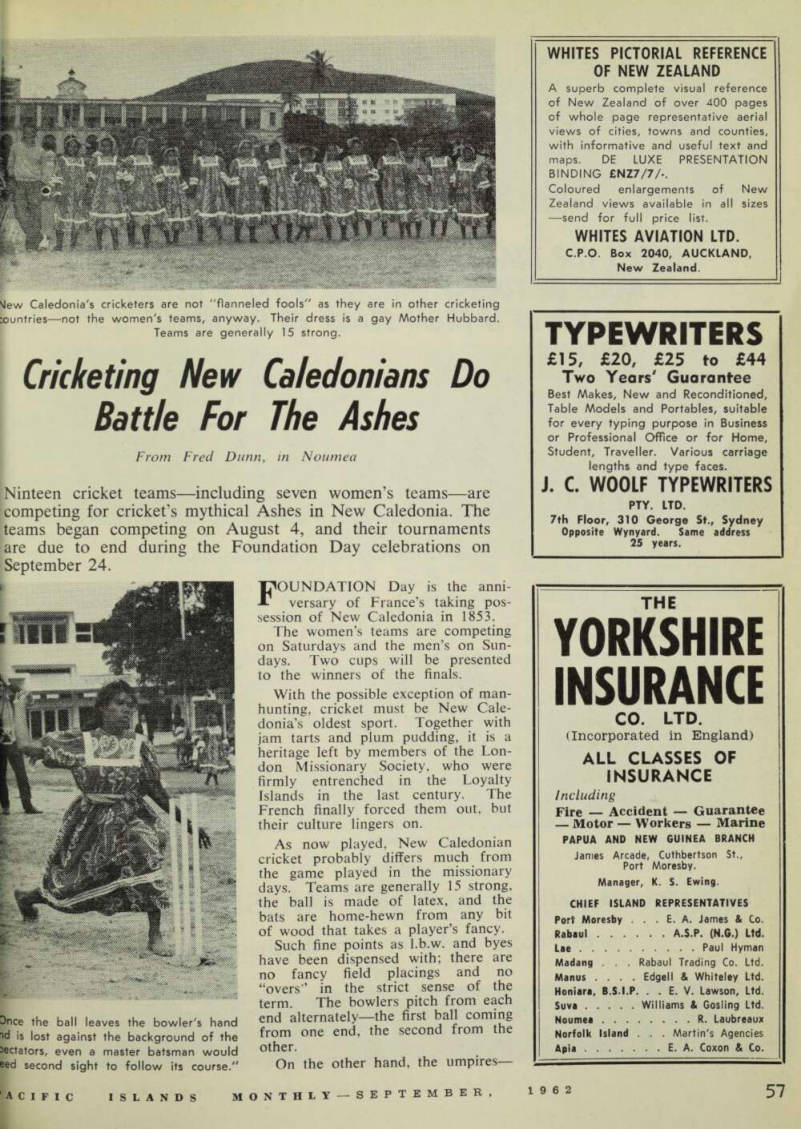
New Caledonia's cricketers are not "flanneled fools" as they are in other cricketing countries —not the women's teams, anyway. Their dress is a gay Mother Hubbard.
Teams are generally 15 strong.
Once the ball leaves the bowler's hand id is lost against the background of the [?]ectators, even a master batsman would eed second sight to follow its course."
in all cricketing countries—are tried (and tired) old men; and classic “Owzat?” and “out” calls, taught by the missionaries, have rived. here are four ways ot getting out owled out, caught out, run out I knocked out. Considering the to with which the game is played, Irisingly few wickets are lost by i last-named method.
Tie only stroke in any batsman’s I batswoman’s) repertoire is the \ swing. Indeed, it could hardly LOtherwise because once the ball [es the bowler’s hand and is lost Inst the background of the spee ds even a master batsman would p second sight to follow its course, lenever a wild swipe connects, the
batsman’s team-mates set up a con gratulatory chant.
Cricket as played by the women is the more picturesque, as the players wear their gayest Mother Hubbards. There may be some method in this as many a ball, slip ping through cupped hands, has dropped into the dress folds and the catch has been held.
It may not be too much of a flight of fancy to think that one day Australian cricket officials might do something to encourage the natives in the game. Gifts of old bats, balls
and stumps and some coaching would be welcome.
Tennis experts from Australia and New Zealand come here to instruct local tennis players. So why not something similar for native cricket?
Six cages, each containing an ants’ nest, were brought to Tikopia Island in the Solomons recently from Guadalcanal. The ants are to be used to try to control a beetle which has been eating Tikopia’s coconut
palm foliage.