"I Share Responsibility For
pp. 47-50 · Read in the full issue
The Ship Should Not Have Been Allowed to Leave
"I Share Responsibility For The Joyita Tragedy”
By Peter Plowman
I am firmly convinced that the loss of Joyita and the un >rtunate people who sailed on her was due to negligence on ly own part and that of other responsible officers of the Wes ;m Samoa Government.
[ the time of the Joyita tragedy J was a member of the Legisla (Assembly and of the Executive acil of Western Samoa. This in the days of preparation for net Government and members of Council were attached to various krnment departments, although had little authority. One of my Ifolios” was that of Member for ine. was a wartime member of the il Australian Navy. I had been mi ocean-going yachtsman in Aus i. •om 1951 to 1953 I had made royages to the Tokelaus to take people stores and bring back their a, as Officer-in-Charge and ptimes in addition as navigator, always in local small-ships, w background as a yachtsman in tralia, and my experience on the [Tokelaus run was behind me d the question of chartering the to came up. !r. R. D. Fearless, the newly tinted Tokelaus Officer, had been It in Apia for some time waiting ;et to the Tokelaus but no vessel [ then available. He then poached me with the proposition [the Joyita, which had been tied in Apia without work since the rious April, be chartered to do job. I took the matter up with then Acting High Commissioner, T. Smith, who cabled the NZ lartment of Island Territories, brmission was granted, provided I went in charge of the bdition. I went on board the lel to discuss preliminary details the charter with her skipper, •tain T. H. Miller, and to look ita over. soon came to the conclusion that was not in any fit state to make f>yagc of 260-odd miles and return sre is no anchorage in the telaus). tn experienced seaman develops a h-sense about neglect on a ship I Joyita reeked of it. The odour 1 confirmed by everything Miller
told me about maintenance—or lack of it—to engines and auxiliary pumps.
The engines had been turned over once a week but the clutches had not been engaged ahead or astern, or the engines given an extensive test because of lack of fuel. Miller’s plan to start a commercial fishing industry based on Canton Is., had folded up, and he had been virtually on the beach and hard up against it since arriving in Apia, months before.
I told him that the charter was off unless we could have a four hour trial at sea and unless a complete check of engines, pumps, running gear and radio were made.
In addition to these maintenance problems. Miller did not have the correct papers to make any charter to the Government. He did not, in fact, own the vessel, which was owned and registered in Honolulu, and a condition of his charter of it was that he should not sub charter.
I advised the Acting High Com missioner of the whole situation. His
immediate reaction was “if it is not good enough for you, then it is not good enough for us”. He advised the New Zealand authorities of this immediately, and they accepted the decision. [Nonetheless, the fact that there was no other way to take Govern ment officials to the Tokelaus was apparent and plans made to meet it.
The Joyita was chartered—illegally as it was shown at the subsequent inquiry—to Coxons, and the Western Samoan Government, which had qualms about chartering the vessel, nonetheless agreed to ship its public servants on it.] When the vessel was subsequently chartered to this private firm I had no part in it and was not con sulted. On the one occasion when I tried to intervene, I was diplomatic ally informed that it was no concern of the Government.
But as a result of that charter, a vessel that had been tied to a buoy for five months without main tenance, was allowed to leave Apia on a long sea voyage, without engine, radio and pump trials; moreover, she was allowed to leave with 25 persons on board and with a port and Customs clearance given by the authorities. Evidence was later given at the inquiry that the vessel could not be inspected because Joyita was a foreign registered vessel. My comment on this piece of bureau cratic wool-pulling is unprintable.
If the Government had chartered the Joyita, it would have been only after a detailed inspection for sea worthiness by the Harbour Master and a check on radio by the superintendent of the local radio station; and a trial run at sea to test the engines and propeller shaft pack ing glands. Bad leaks can occur in
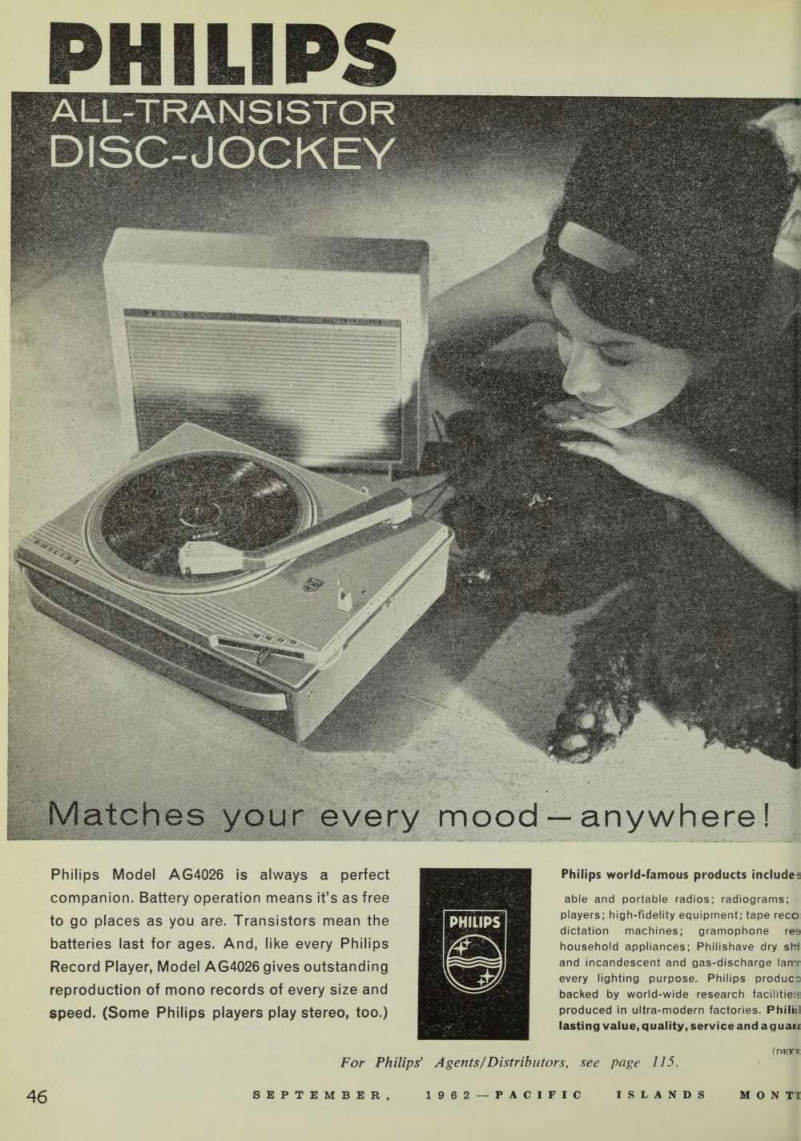
Mr Peter Plowman, who wrote this article.
For the history of the "Joyita" events, see p. 47. Photo: Samoana.
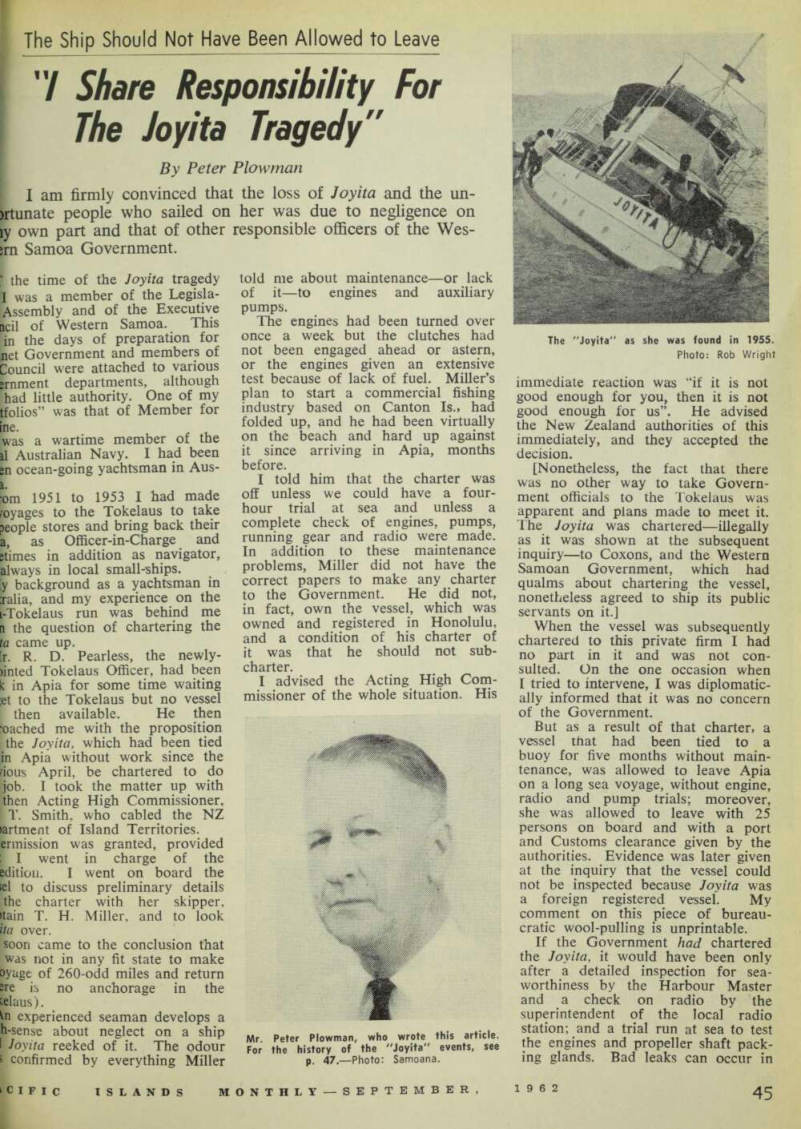
The "Joyita" as she was found in 1955.
Photo: Rob Wright
Jglands after a vessel has been up. owever, none of these things [done. Joyita was chartered, jugh Miller had no right to do and the vessel was allowed to e Apia apparently in the belief , as the deal had been arranged ately, the vessel’s state of sea hiness no longer concerned the orities. nd now we come to the disaster E, which must always remain a er of conjecture, tempered by s own private knowledge of the and of the man who commanded became convinced during the y week-ends we spent together iy home, that Miller was a fine lan. But beyond this he had a t belief in the vessel herself— Relieved, and told me and others y times, that she was virtually likable and that if anything >ened to her he would never
p her.
t the Commission of Inquiry, the mce that the vessel was from i at the time she was over- Imed by disaster was calculated he amount of fuel used. But to f mind this does not set the mce she got from Apia, because h sure that she was headed back Apia when she became flooded out of control. he heavy weather from the time left Apia until she was found lays later was continuously from east and damage to the vessel all on the port side. In my \ she must have been headed h, to be thus damaged. Once a el of the size of Joyita becomes irlogged and wallowing broad in a seaway, she could not ige her heading without a change weather or currents, feather and a 5 to 10 knot current 5 in a steady direction from the i over that whole period and I df believe that she could not have I more than 30 to 40 miles from a when she became out of trol. From this point she would c drifted close to the north end lavaii [one of the two main islands Western Samoa] and ended up days later just where she was nd.
I was shown in subsequent in igations after she was pumped \ that the key to the whole ister was the fracture of a pipe I pumped cooling sea water to engines. The subsequent flooding the engine room and the failure Electrical generating followed as a tter of course, Vith this set-up, it is not hard visualise what the reaction of
passengers and inexperienced crew would be when Joyita, in darkness, flooded, wallowing in a big sea, seemed about to sink and suck them to their deaths.
In 1928 I was wrecked at night in a heavy sea on a voyage in New Hebrides waters. The vessel was the 30-tons Boomerang, with two life boats, but the experienced crew of
12 had to be hammered into control to get the life-boats away in a seaman-like manner. I can well imagine what it was like with 25 people and only three small rafts— even Captain “Dusty” Miller probably could not have controlled the fight for the rafts under certain circum stances.
The sea in that area of Western
Samoa is full of sharks and I have sometimes passed through whole schools of them, which followed the ship for hours. My conclusion is that if the people from Joyita fought over the rafts on a flooded vessel, the sharks won the day if the big seas themselves didn’t.
Lord Maugham exceeded his journalistic licence when he “solved” the mystery with his unwarranted conjectures on the character of Dr.
Parsons, now dead and unable to defend himself. In Maugham’s story, Dr. Parsons injured Miller and then left him to his fate. (See May, PIM, p. 24). And Maugham mis quoted me when he said that I had found needles, sutures and a stethoscope in the scuppers on the deck of Joyita.
I was sent to Suva to inspect Joyita on behalf of the Samoan Gov ernment but by then she was pumped out and cleaned up and I was merely told what was found on her—this information later was passed on to Maugham.
Nonetheless, in spite of these corrections to Maugham’s story, I am convinced that Miller somehow or other, probably through accident, was out of action at the time that disaster struck and the main party were probably taking to the rafts.
If he had been in complete com mand of the situation, with his know ledge of his ship and the sea, his first action would have been to prepare and put overboard a sea anchor made from the timber stowed on the deck. Then, with his know ledge that Joyita was unsinkable, he might have permitted some people to take to the rafts, but he would
have kept them attached to the ship with a life-line.
None of these things was apparently done, but as an awning was found rigged and tied to broken parts of the super-structure, I am convinced that not everyone quitted the vessel at the one time but that at least one, and probably more, re mained on board after she became out of control. I think that one of those persons was Miller and that the other was his devoted Gilbertese leading-hand.
If they were 30-40 miles off Apia when all this happened, Joyita would, as I have said, have inevit ably drifted close to the north-west end of Savaii. Perhaps Miller was sufficiently recovered from what ailed him by this time, and as he would know that this would be the last chance he’d have of making land, it seems possible that he and his companion, or companions, would not be able resist the temptation of try ing to reach it—perhaps on a re maining raft (one was found later on islands north of Fiji), or on a raft made from the timber stowed on deck.
Disaster?
It was here that one small mis calculation or lack of knowledge of the strong five to 10 knot current running east to west, might have spelled disaster. Unless they left the ship at the right place, the rafts would have been set away from the northern end of Savaii and they would not have been able to make it.
Much has been made of the so called mystery of the chronometer
and sextant and a small part cash to the value of £l,OOO that missing when the Joyita wa covered. But it is easy enoui account for this in the conte the situation I have visualised.
When Miller tried to reach he would be by no means surf he would find the means of qj chasing the drifting wreck, and chronometer and sextant wei effect, his tools of trade, it have been instinctive for him t« them with him.
The parcel of cash was HI easily portable and it was s the action of common sense th: would be picked up and taken If all had gone well and Mille been saved, no doubt the owm the £l,OOO would have been than pleased.
Some journalistic fantasies w Japanese visitors boarded and the ship for supplies of sodden, sugar, flour, rice and drum kerosene, are easily dispose* Those who remained on boardl seamen and their first action be to jettison any cargo to he crease the buoyancy of the ves The official inquiry into the tragedy began in early Febi 1956, and was expected to last weeks. In fact it lasted 10 Previous to it I had gone to on behalf of the Samoan G» ment. Later I was called to m statement which was taken down shorthand typist.
In it I indicated that the lo Joyita, to my mind, was due t inaction of responsible office; Apia in not insisting on Miller ing the necessary precautions If giving him a port and Customs ance. I indicated the precautii which I have already set out ti that should have been taken.
The contention that this coul be done because Joyita was a f» vessel, I dismiss as an attemr cover up the negligence on the of those responsible.
Before the official inquiry be was told by the Attorney-G<f that, as my evidence was o( utmost importance. I would h to the last to give it, I wat called at all and I was told tH my evidence was much the sat that of the Assistant Harbour M of Suva, it was decided to dis with it so as “not to waste my t The whole inquiry still hi pungent odour to me and to other people concerned, also.
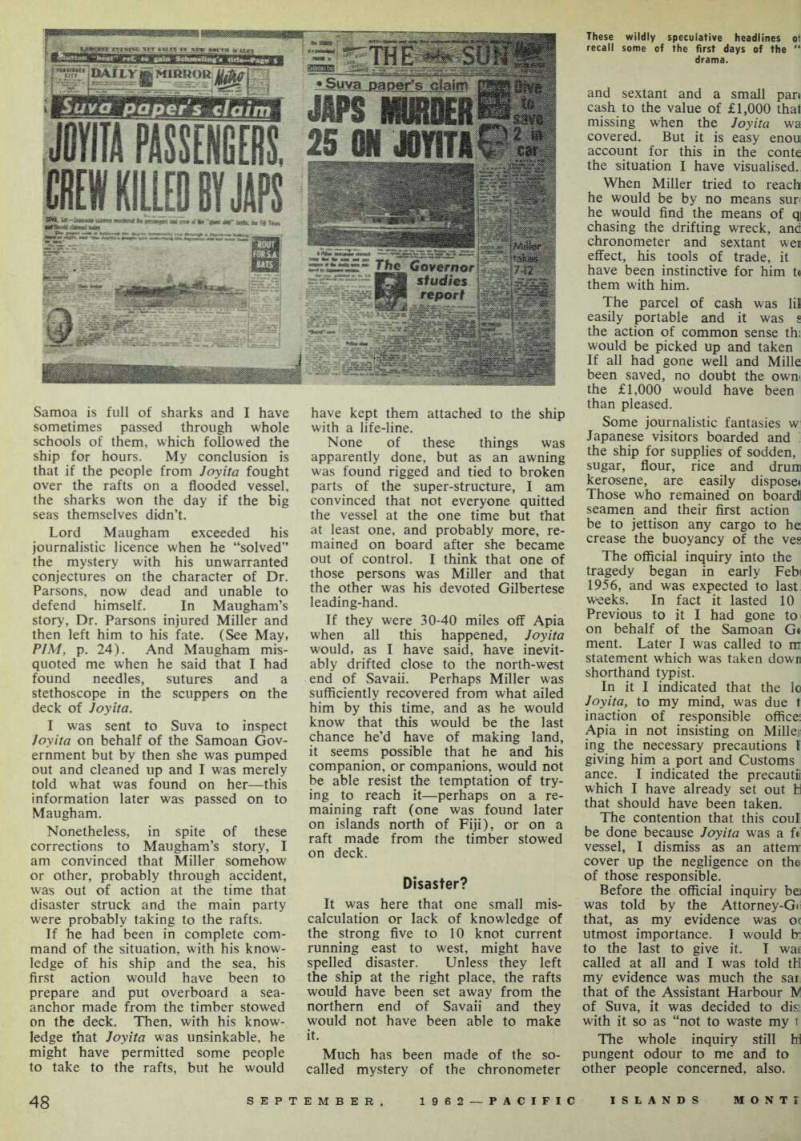
These wildly speculative headlines of recall some of the first days of the “ drama.