With Tolala
pp. 43-46 · Read in the full issue

vieng District Kiap, the man ponsible for having constructed the 5-known Kavieng to Kimadan ad along the east coast of New land in the early 1900’s. [t was along this road that Harry rdew, DO Kieta in the early ’2o’s, 0 later became the first Protector Natives in the Administration vice, issued instructions for each lit male native to plant 10 :onuts a year, an idea —so he told I—which had been customary in ne districts in Papua, whence he ne before joining with the Military pupation crowd.
Unfortunately, for future genera ns of the indigenes, the scheme was ►rt-lived. Count de Penha Garcia 1 Mdlle. Dannevig, of PMC— rmanent Mandates Commission of League of Nations—raised a cry protest to high heaven, termed it reed labour” and that was the I of it.
Incidentally, I was thumbing ough the pages of a novel the ler day with its scenes laid in Buka [ rather Kuba, as the place was ionally called) and which was Wished in 1933 and I came across following passage: The east coast of Kuba is rocky i forbidding. There is no friendly :horage for trading vessels on that
public confidence, and that confidence is really a PRO’s greatest asset.
FOOTNOTE: Apropos the name Kuba; I noticed a news item from Sohano in a recent New Guinea news paper where a District Agricultural Officer and his wife “have moved into their home at Kuba”. But I wouldn’t have a clue where that is. (Over)
Forty-eight
Years Ago
The month of September is ai letter month for both New Gt and Australia. Forty-eight years —in 1914—and on September II Australian Naval and Mil Expeditionary Force landed Kabakaul, New Britain, and tralians experienced their first em ment with the enemy in World I.
On the following day troops landed at Rabaul, and on 13tH official proclamation of the oo: tion of German New Guinea read, followed by an “all* pidgin-English translation, ei with the famous; “No more Kaiser. God Save ’um King”.
Ten days later the German A Governor, Dr. Haber, who e lished temporary headquarter Toma, surrendered conditional!
Kokopo. And the shooting w 1 New Guinea was over.
A writer of those days comme Reading the daily papers [ l9lB ] the occupation of Ge.
New Guinea—the first of Germ colonies to be wrested from the of the Hun—is apparently forg in the light of bigger events.
It is a great pity, as it was tralia’s first shot in the caus. freedom. For that reason, altogether from the memory a men who lost their lives, Septa 11, 1914, should be made historic date in the history of tralia.
That was written at Rabai, 1918. And very true, too. ! doubt if even the usually informed Quiz Kids would why September 11, 1914, shorn a Red Letter Day for Australia Well, the wheel of world e is bringing the old German c: back into the spot-light of ctr news. And what a modern, atd pattern is presented!
Quick Work A feature of this Expeditii Force—the first to be formes Australia in War I—was the sa action in its formation in Sydo Britain declared war on Gen on August 4; on the 11 tH recruits were signed on for sa abroad to sail under sealed cc Seventy-five per cent, of the t were raw, untrained men. Witi week they were equipped, as licked into some sort of shapei marched down to the Berrima ; Cockatoo Island Dock. At mil on August 18 they steamed
n Sydney and disembarked at n Island, opposite Townsville, re they had 10 days’ training ; eventually arrived at daylight on ember 11 at Kokopo, and the ling at Kabakaul was carried out the Naval Brigade, lespite the fact we live in a Speed now, I very much doubt the ity of Top Brass, plus all their fidiary planners, putting a force [action against an enemy some K) miles away only a month after g signed on for service, as was p with the AN&MEF on this
Ision.
lai News" [ thoughtful correspondent from aul sent me a copy of Tolai News other day and I was glad to see it it helped me to brush up my to. It is bi-lingual (Tolai lish) a small (5k in, x 8i in.) lication (see PIM, June, p. 126), ted by the Catholic Press at iapope and its editor, I understand iough his name does not appear) Stanis Boramilat, a well-known tity amongst the Tolais, hailing I the Toma district who, in ntally, has been appointed one of Liquor Inquiry Committee, which in its “investigations” on August faat appealed to me in this June of the News was the practical it contained. For in ce, the first article described the )rk of a Surveyor”, debunking the (held by many of the indigenes) he is “trying to steal” the land a the native people. i sets forth the correct procedure an aggrieved party to adopt to g the case before the court, and ires them on no account to
interfere with the surveyor’s “marks”.
It was a good sound practical set up and most topical in view of the many native claims which have been made.
Other topical items referred to the Native Women’s Protection (repeal) Bill, 1962; report of a court case where three men were fined for distilling spirits; report of a man lost overboard at sea and of a girl burned to death in a copra drier.
All good and instructive reading matter for the native people, down-to earth and without a lot of blah-blah.
Unfortunately I have not had the opportunity lately of seeing other publications for the native people, but if they approach the common-sense, practical standard of Tolai News they will undoubtedly assist the people in coming to grips with changing con ditions and help them to reorientate themselves to that state which western civilisation is determined they should acquire.
Not on the
Band Waggon
The General Secretary of the Methodist Overseas Mission, Rev. C.
F, Gribble, speaking at a meeting on July 29 in Sydney on “Why Not A Colombo Plan for the Pacific?” raised some logical points about the education of native people in NG, emphasised the work which was being done by the missions generally and stated that, whereas, in the Northern Territory missions received a Gov ernment grant of £B7O for every teacher, the NG missions only re ceived £4OO. Also, he said, the num ber of government school pupils was 21,119, but pupils in mission schools totalled 113,247. He wanted more financial support for the missions.
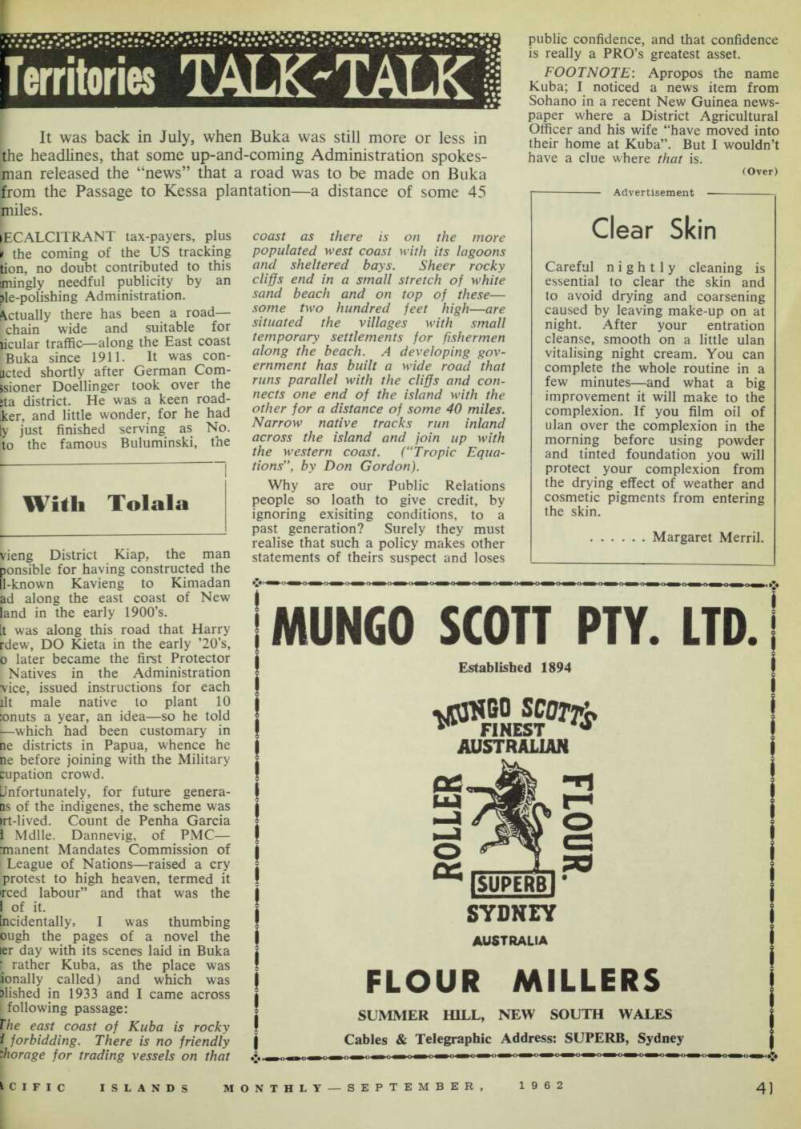
It was Gretna Green in New Guinea. The "ladies" were car ried off bodily by gents mounted on
horseback, although
some obviously were treated in cave man style. Well known plantation owners in volved took it all in the best of spirits at a recent Kokopo (New Britain) gym khana.
Undoubtedly the missions done, and are doing, a great despite, or perhaps because of, ( sectarian competition which is soc these days. But now, with Administration scraping the bo( of the grant bucket (which measly £2O million for this yean would seem as though some despM measures will have to be take general erudition is to be atts as a result of the recent urgina the UN.
If speed is to be the essence the contract (and I sincerely i it is not to be so) why not dJ some scheme whereby prii education is left in the hands of missions (with certain Governu supervision) and secondary, ten and technical education carried by the Government?
It is a thought.
The Liquor
Problem Being a prejudiced old B-4, I template with some considerable cern the repeal of prohibition alcoholic drinks for the native po of P-NG as a general measure..
But, if it has to be introduce order to obviate racial discrim tion, why not get the local brew/ to produce a beer with a II alcoholic content for native const; tion?
Spirits should most definitely] OUT, except in very special cases And this is not the advice oc amateur. I have done some drinking in New Guinea and quite au fait with the tricks ole trade, including taking cha:£ tablets before attending a cooi party.
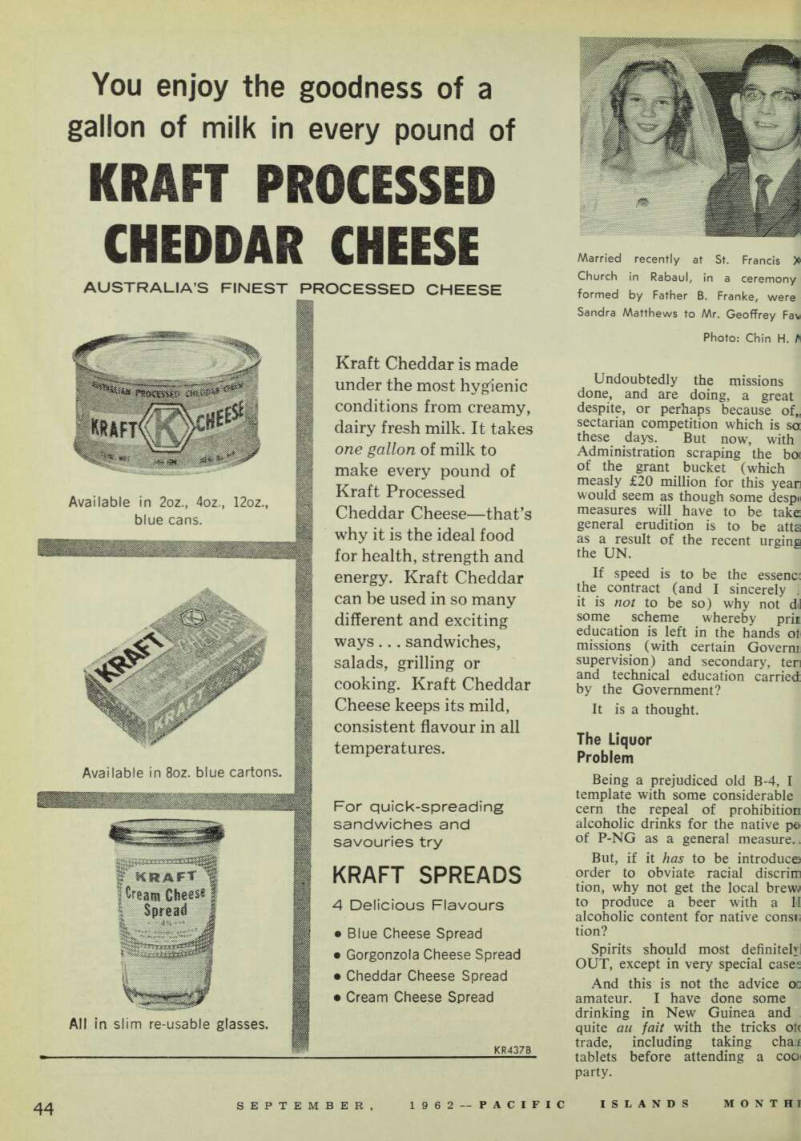
Married recently at St. Francis Church in Rabaul, in a ceremony formed by Father B. Franke, were Sandra Matthews to Mr. Geoffrey Fa[?] Photo: Chin H. [?]