Spotlight
pp. 27-32 · Read in the full issue

On The
Samoan Is.
By Stuart Inder
In reporting the developments
in the South Seas from month to month, as PIM does, it is easy to fall into the error of overlook ing the wood for the trees. rPHUS when I was leaning over the upstairs verandah of Aggie Grey’s Apia hotel after a good break fast one sprinkling morning recently, looking down into sunny Beach Road and out across the famous harbour shimmering in the early sun, it slowly began to dawn on me that here, right in front of me, were sights and sounds of special significance. Their sig nificance was in their very normalcy.
Here came a scattered, scampering group of Apia schoolchildren, in simple tunics of different colours, chatting as they made their way to school. Here, from the opposite direction, came a horse and rider at a canter.
A town taxi a late model American car with a left-hand drive, for Samoan traffic keeps to the right pulled up below the verandah and honked for the customer who a few minutes ago had telephoned from Aggie’s. The driver got out, beaming, to carry the bags, Rat-tat-a-ta-tat! came the sound of a sharp drum beat from across the harbour, and into view from behind
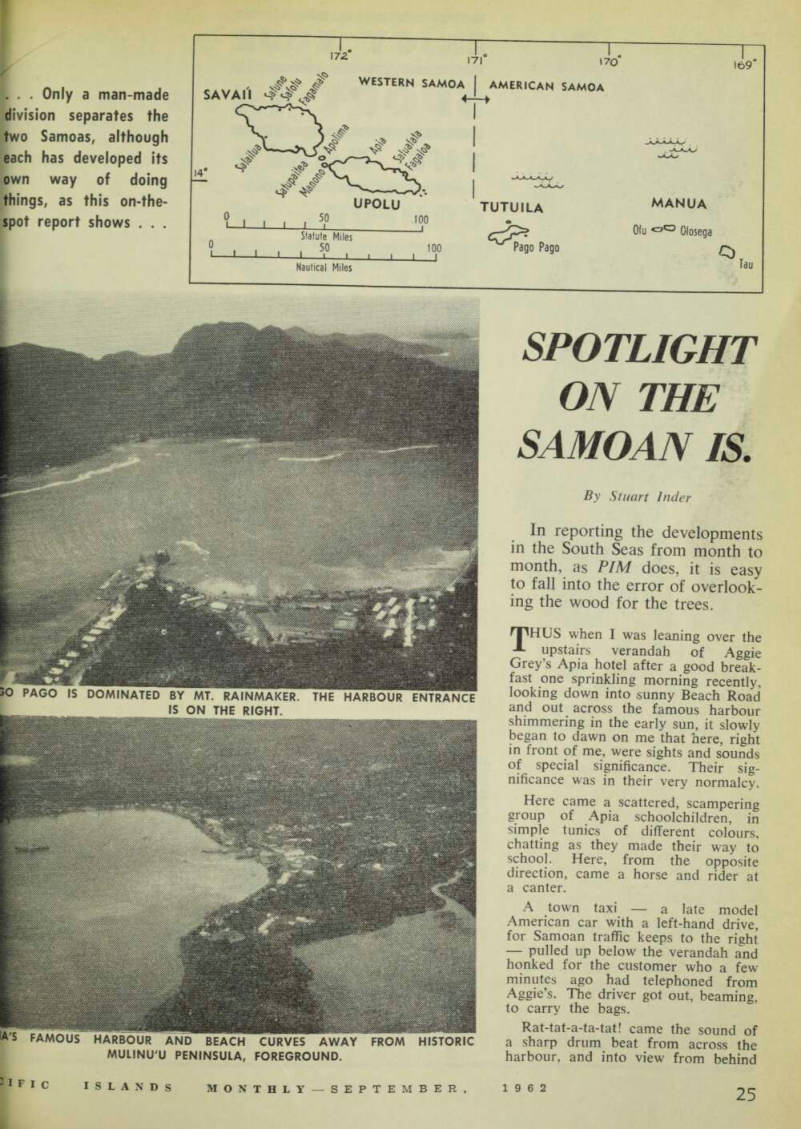
. . . Only a man-made division separates the two Samoas, although each has developed its own way of doing things, as this on-the spot report shows . . .
GO PAGO IS DOMINATED BY MT. RAINMAKER. THE HARBOUR ENTRANCE
Is On The Right.
[?]A'S FAMOUS HARBOUR AND BEACH CURVES AWAY FROM HISTORIC
Mulinu'u Peninsula, Foreground.
P that was busily loading bananas a Fautasi, a long boat with ly 30 men at the oars, all strain n time to the beat from the man he stern as they practised to R) the hide off American Samoan 5 at an international competition it Pago the following week (they in a walkover!). A bus rolled [seats well-filled with neatly ed, friendly-faced Samoans on way to the office or store, ese sights and sounds were the lendent State of Western Samoa, months after its flag flew free, i were the day-to-day noises of mly Polynesian group so far to (emerged as an independent self ning State after passing through iod of colonial rule, ty years of colonialism, 14 under lany, and 46 under New Zealand, brought the Samoans not to fehed nor turmoil, not to the for UN intervention, not to the lestroying roll of pawn for the [ politics of East and West, not parlous economy with a savage market and food shortages—but normalcy of living that was so lonplace that its very significance ould so easily overlook, re was the most exciting news in the South Seas today.
Problems—Naturally
ftainly Samoa has its problems it is almost trite to say so, for (country hasn’t. It is a truer ition of the real position in srn Samoa to ask what other ry after eight months of inde nce has fewer problems and a ter future outlook? I know of •cording to the requirements of
today,” said the New Zealand High Commissioner to Western Samoa, the widely experienced Mr. J. B. Wright, in his office later that morning, “Western Samoa was more than ready for independence.”
Although Mr. Wright didn’t say so.
New Zealand is given a big share of the credit for bringing the country to independence and for continuing to assist it financially (under the terms of the just-signed Treaty of Friend ship), But what Mr. Wright did say was that the Samoan character is responsible to a very big degree for the smooth changeover and for the tranquility which is Samoa’s today in comparison with other, less happy States.
“The Samoans have, certainly, the natural advantages of being one race with no racial problems brought in from outside,” said Mr. Wright. “And they have no border problems. But they have themselves to thank for being basically a sound people, who are also a conservative people, who have at the same time a strong political consciousness.”
And, he added, the Samoan leaders were aware of their problems, “which is important”.
“We have problems. I won’t mini mise them, but we will overcome them,” said Mr. G. F. D. Betham, Minister of Finance and Economic Affairs, in his office overlooking the harbour. Fred Betham, as he is popularly known, is one of the hardest working members of Cabinet.
“We know we want assistance, and we are out in the market places get ting it. We hope to get a grant from the United States, under its AID programme, we are already getting a lot of help from New Zealand of course, and as a result of us having joined the World Health Organisa tion in May we are now qualified to receive assistance from various UN funds and agencies.
“There are various foundations that may help us. And there are various schemes pending. But these things take time to arrange, and patience must be a virtue at that time.”
This complicated business of ar ranging for international assistance is, I gathered, probably the most im portant work going on in Western Samoa today, and because results can’t be got quickly there has been some local criticism that too little has been achieved. I found that some of the results will be obvious soon, and that things have advanced so far that Prime Minister Fiame Mataafa will soon make a world trip to tie up some ends or to push other matters on the spot.
Aid from Where?
Is there any danger that Western Samoa will in these negotiations find itself accepting aid from anybody but the West? Samoan observers of long experience are emphatic that there is none at all. They say Samoans are too conservative, too politically shrewd and too strongly steeped in Christian
[?]n Samoa is out in the market place [?]g for financial assistance. Photo [?]ed in Samoa recently was Dean es Ryerson, making inquiries on be [?]f the US Government in connection [?] grant that Samoa may get from
Aid.
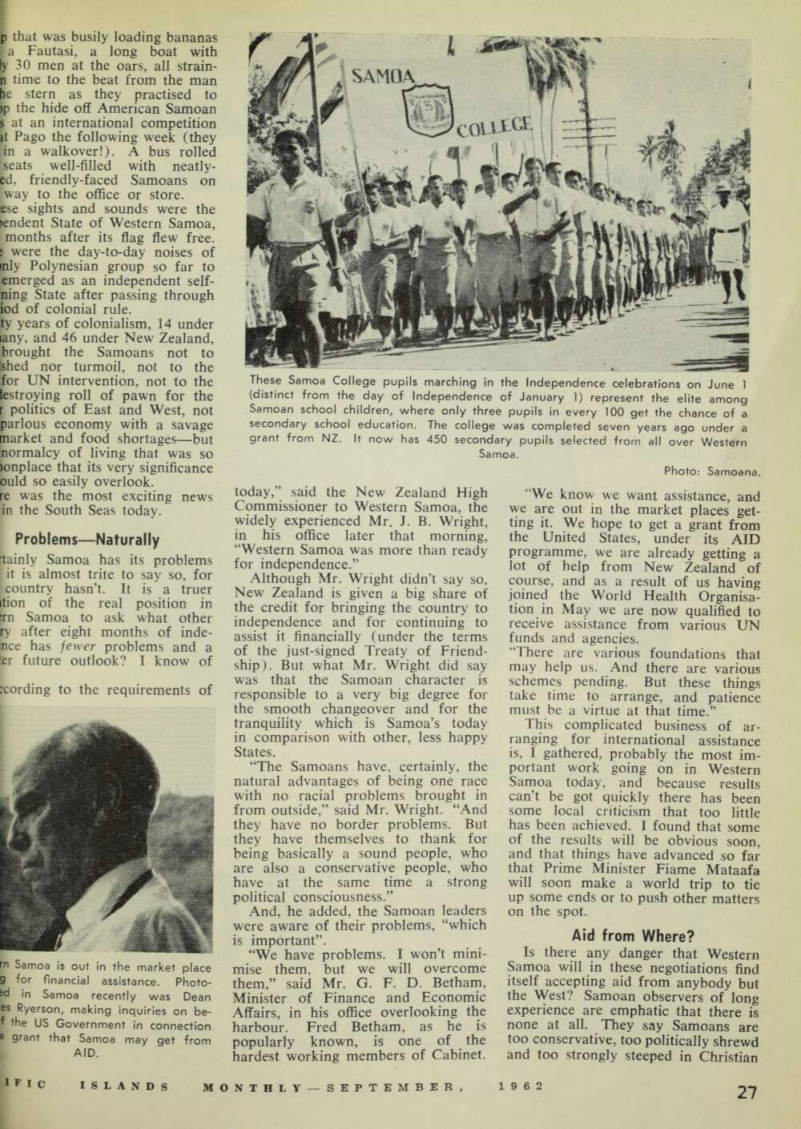
These Samoa College pupils marching in the Independence celebrations on June (distinct from the day of Independence of January 1) represent the elite among Samoan school children, where only three pupils in every 100 get the chance of a secondary school education. The college was completed seven years ago under a grant from NZ. It now has 450 secondary pupils selected from all over Western Samoa.
Photo: Samoana.
ciples ever to make such a move.
Imoa’s economic policy is not en y directed at obtaining inter nal help. Just what its economic pties are have yet to be deter -sd, with the help of a UN survey I shortly to arrive, but meanwhile [creased agricultural exports (and :r prices) look like getting the sr balanced more quickly than bdy realised. Mataafa has a 1 reserve of goodwill among the Dan people, to help him across [difficult period, but even his ds say that he will have to get kerall priorities working soon if to keep his full popularity, ist year exports were declining, Rational income diminishing and bked as if inflation might take a I The trade deficit for 1961 loa goes by the calendar year) £573,000 —which was more than le that for 1960. This year )a brought in exchange controls li have restricted 1962 imports D per cent, of those for 1960 (highest import year on record), (presenting the 1962 budget at ind of March, Mr. Betham an ted he was budgeting for a t of £260,000, which would have i met from very slim reserves.
Was “not a desirable result”, he (especially as it followed severe in expenditure, but he hoped f and increased production, plus nport cuts, would help make up ieway. i hopes are now well on the way ing achieved. ide figures for the first six bs of this year show imports at 4,357 and exports at £1,255,835 ich means the trade drift has arrested if these proportions lue.
Import Controls Still pcipal crops of copra, cocoa and las were all up and cocoa was [ so well that it looked like top the export figures for the first since 1958. And the Japanese la market might turn out to be ble. . Betham admits the situation is et good enough for Samoa to its import cuts, or to spend y on many things that need it. it things look much brighter they did,” he added, me Minister Fiame Mataafa is v busy man these days. He was a Cabinet meeting shortly after Tviewed him. iat was Samoa’s biggest prob- Education without a doubt, he The population was growing had to be educated. Samoa d many things; new buildings
for instance and an overseas wharf would be useful, but wharves were not so important when put against the need for educational advances.
Samoa also wanted its own university.
The Prime Minister referred me to the report on Samoan education by Professor T. L. Green sponsored by UNESCO, which spoke of staff short ages, the need for an economic policy to which educational plans could be geared and the general need for align ing objectives.
“We are getting some help on that,” said Mataafa as he went off to the Cabinet meeting.
I later saw a report of a survey of Western Samoan education by New Zealand’s Director of Educa tion, Mr, C. J. Williams.
Mr. Williams reported that there has been little improvement since 1953 in methods and standards of teaching; that the rate of educational progress has been slowing down over
the past few years; and that the goal of universal primary education is even further away than it was in 1959.
Among faults noted by Mr.
Williams were far too many village .schools with poor buildings, minimal facilities and lacking even the simplest equipment.
He said that despite an apparent keenness for education, there seemed to be no sense of urgency about educational advancement and that Western Samoa could not afford to maintain a leisurely attitude or pace.
“It seems clear that ... a con siderable increase in both Govern ment and private expenditure on edu cation is required over the next few years,” said the survey. “But al ready Government finances are sorely strained, can barely provide for the maintenance of essential services, and
Prime Minister Fiame Mataafa.
very little can be set aside for cational purposes.”
It would appear, therefore, tha raising of standards for educath other social services can come only by the provision of outsid* said Mr. Williams.
“The crime rate is not up independence—it’s down,” said S intendent of Police A, L. Pt “Except home brewing, that isi getting worse!”
West Samoa’s gaol populatic December 31 last year was which was below the country’s av of about 180. There are two On January 8 there was a g« amnesty, and the entire 130 released.
“It wasn’t very long befon gaols were stocked up again,”
Mr. Philipp. “We suddenly hai of them, but they were all termers and they didn’t last, four were familiar faces—four had been released in the amnest: Now the gaol population levelled off to a regular 100 says Mr. Philipp, which he thii excellent and which he belie’ partly due to more control h Samoans themselves in the vii Superintendent Philipp pointe that the Samoan in any case w a criminal type and that as ; there was nothing premeditated his crimes.
It was four years since I ws in Western Samoa, and to me; was now a friendlier feeling ; air. It was perhaps a lessen! the tension, although I had previously consciously felt any.
I compared notes with h dozen men of long experien Samoa. Some said they had n no change. Others agreed that) was a change, but so slight almost imperceptible.
Said one man, “I think whj happened is that the Samoans; meeting a European now aro to say to themselves: T am as as he is, but now that I know I am not going to be rude enoi remind him of it’.”
But I heard it summed ur better a little later when I oves a big Samoan policeman passii time of day with an American while the American waited for “ You know, we are indepc here now,” said the Samoan.
“So I understand,” saio American politely. “It’s good “Yes. We can do anything v now.”
“Oh. What do you do no T < you didn’t do before?”
“Well, nothing really. But ' independent now.”