lotion Now Australia's
pp. 25-26 · Read in the full issue
Commentary
Hand's Problem in
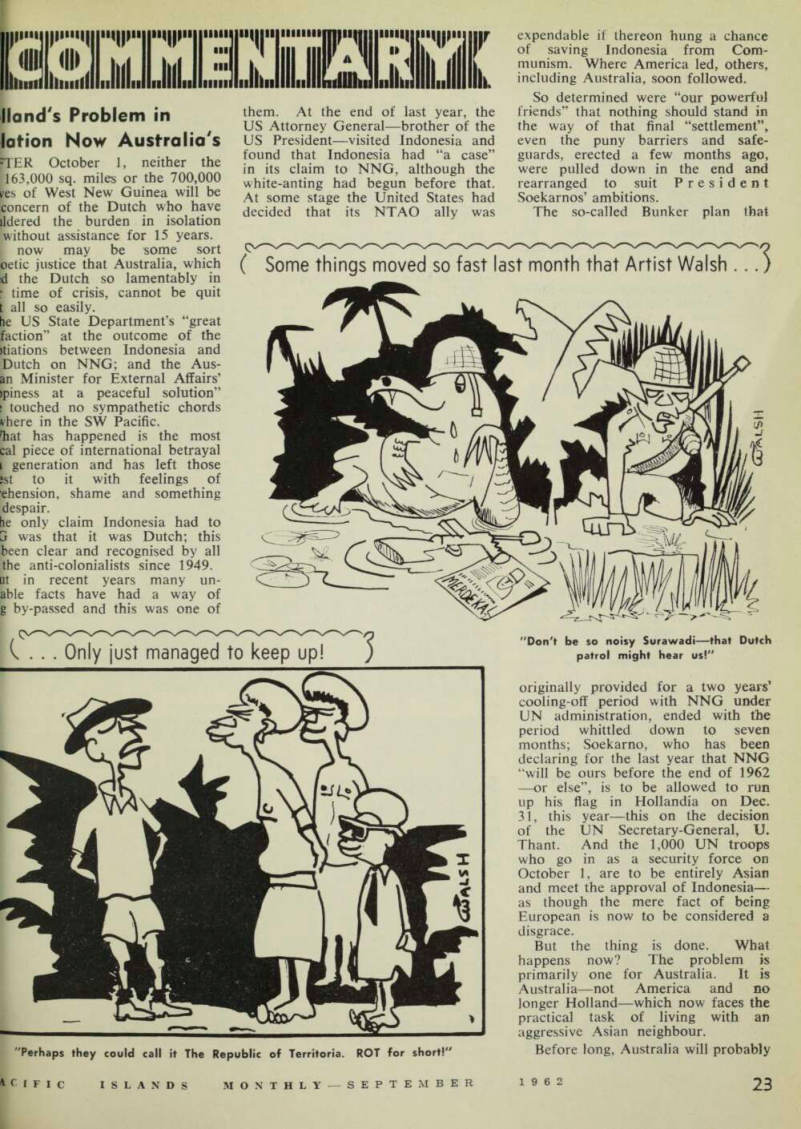
hER October 1, neither the 163,000 sq, miles or the 700,000 yes of West New Guinea will be concern of the Dutch who have ildered the burden in isolation without assistance for 15 years. now may be some sort oetic justice that Australia, which d the Dutch so lamentably in f time of crisis, cannot be quit t all so easily. he US State Department’s “great faction” at the outcome of the rtiations between Indonesia and Dutch on NNG; and the Aus an Minister for External Affairs’
Ipiness at a peaceful solution” t touched no sympathetic chords vhere in the SW Pacific.
Tiat has happened is the most cal piece of international betrayal i generation and has left those sst to it with feelings of •ehension, shame and something despair. he only claim Indonesia had to 3 was that it was Dutch; this been clear and recognised by all the anti-colonialists since 1949. ut in recent years many un able facts have had a way of g by-passed and this was one of
them. At the end of last year, the US Attorney General—brother of the US President—visited Indonesia and found that Indonesia had “a case” in its claim to NNG, although the white-anting had begun before that.
At some stage the United States had decided that its NTAO ally was
expendable if thereon hung a chance of saving Indonesia from Com munism. Where America led, others, including Australia, soon followed.
So determined were “our powerful friends” that nothing should stand in the way of that final “settlement”, even the puny barriers and safe guards, erected a few months ago, were pulled down in the end and rearranged to suit President Soekarnos’ ambitions.
The so-called Bunker plan that
originally provided for a two years’ cooling-off period with NNG under UN administration, ended with the period whittled down to seven months; Soekarno, who has been declaring for the last year that NNG “will be ours before the end of 1962 —or else”, is to be allowed to run up his flag in Hollandia on Dec. 31, this year—this on the decision of the UN Secretary-General, U.
Thant. And the 1,000 UN troops who go in as a security force on October 1, are to be entirely Asian and meet the approval of Indonesia— as though the mere fact of being European is now to be considered a disgrace.
But the thing is done. What happens now? The problem is primarily one for Australia. It is Australia —not America and no longer Holland—which now faces the practical task of living with an aggressive Asian neighbour.
Before long, Australia will probably
sign a Treaty of Friendship or Non aggression, with Indonesia—a piece of paper that will be valid only until the chips are down. Having had NNG awarded to him on a platter, President Soekarno will be the world’s most unusual dictator if he is content to rest on his laurels. , Will NNG, on the other hand, prove too big a mouthful for him to swallow? Will such economic and material progress as the Dutch have been able to introduce to the territory in the last 15 years, disintegrate and fade away? It’s possible; but unlikely. In this age, such wishful thinking rarely comes true.
Many people imagined, after Suez, that President Nasser would be un able to cope with the task, of running the canal; that under Egyptian management, the world’s most impor tant \vaterway would degenerate into a weed-filled, unusable ditch.
It didn’t happen. Nasser made the canal the show-case of his ability to] own this most valuable piece of Whatever else might be lacking in Egypt, nothing is denied the csdrial zone. who has successfully played .'the market of world opinion in tn£ last 15 years and won, would be a bigger fool than we have reason to believe, if he allowed NNG to revert to some kind of primitive, tribal Even if he cannot afford to keep it in the fashion to which it is j accustomed, he has only to continue to play both ends against the middle and he’ll get all the cash he needs for window-dressing. One thing that the deserving-poor amongst the new nations of the world can be sure of getting from both ideological camps is money.
' Although th e Dutch-educated native elite in West New Guinea that has been most vociferous in its anti-Indonesian view, is possibly more articulate and capable than similar groups in P-NG, its numbers are small and powerless. As well as powerless, members are now likely to become extremely bitter.
As Herman Womsiwor was quoted as saying, “I spit on the Dutch!” The rriaiss of the NNG people have no conception of what is going on and have ; been completely isolated from the Wrangling that has involved their country. Even if independence were given to them now, they could not rufi it without outside aid. NNG is a poor country without the natural resources that make administration easier.
After May I next year, Indonesia has at least six years to prepare these people for the referendum under which they are to select their
political future. Can anyone, doubt the outcome? With six years for brain-washing and propaganda, Indonesia can have few qualms about it. West Irian will be absorbed into the republic as the “independent”
South Moluccas were.
The qualms will be mostly Aus tralia’s. However much sham diplomatic pleasure her External Affairs Minister expresses over the end of the dispute, she does not like the idea of Indonesia squatting on her door-step. The haste over the “enclaves”, reported in this issue, is one sample of this.
What Indonesia does with those 700,000 Papuans in West Irian is going to continue to be of vital concern to Australia and to the nearly two million native people in her care. Handled the right way by the Indonesians, the West Irian Papuans could be 700,000 of the most effective weapons for President Soekarno’s next “new blow against Colonialism”. ☆ ☆ ☆
So They Drink: But
Where and How?
THE Australian Government’s in dulgent attitude in preparing to introduce liquor to Papua - New Guinea native people has posed many responsible natives with a problem they can’t answer.
No one has really asked them whether they want drink or not—and for people on the way to self determination, some purists may see this as a flagrant over-riding of native wishes. There is reason to believe that had a referendum been held amongst all adult natives, many re sponsible people and most of the women would have voted “no”.
It has already been seen, evidence given before the B Commission, that many native nesses confuse the Commision’;' poses [to discover ways and me;; relaxing prohibition] and think to decide whether liquor shou introduced or not. Surprisingly,, natives realise their own shortcc and are strongly against total n tion, while Europeans are eithi an open slather or complete: hibition. Amongst those who an open-go is the Director of I Affairs, Mr. J. K. McCarthy, other Europeans, also with Ion; dence in the country, are againi lifting of restrictions.
There are endless argument and against native drinking, the only reason why the be restriction is to be lifted is c racial discrimination, then thei; only two courses that can be sidered: The lid off everythini everyone, irrespective of race or or economic condition; or a coi prohibition on everyone, inc Europeans, Mixed Race or Asia If it were the latter, it would! ably empty the Territory of hr European population in short and this might be preferable long-term results of unres« native drinking. But these are issues and are now beside the If the only thing that must be is racial discrimination it is pu less arguing about permits, or i tions on spirits or confining dn to native clubs, or to the home, people will have to drink how like, what they like, where thee within the restrictions of the g liquor ordinance covering every* In that case, it seems high tim someone representing the public Papua-New Guinea took time consider the physical requireme increased numbers of drinken what is likely to happen in these if all restrictions are finally re They should take a look at dn conditions in the bars of place Fiji where the biggest proportf customers are Fijians and In until recently restricted to beer • ing.
P-NG has a far bigger popu than Fiji and it is obvious thae if the same proportions drink Territory, there is not a hotf there capable of holding them. .
And there are other problem! comparison with P-NG, thoi little Fiji racial prejudice, races there are used to dr] (and getting drunk) together.
NG they are not, and the fiti periments in this direction core explosive.