Indonesian Take-Over
pp. 17-149 · Read in the full issue
Australia's New Frontier With Asia
Indonesian Take-Over Problems For P-NG
From Our Canberra Correspondent
Australia will accept Indonesia’s assurances that she has b ambitions in East New Guinea—despite Indonesia’s broken mmises that she would not use force or threats of force to tin her objectives in West New Guinea.
IS is clear from the explanation which the Minister for External rs, Sir Garfield Barwick, on ist 21 gave to the House of esentatives on the handover of jtrlands New Guinea to the UN [next May, to Indonesia, rtainly, Sir Garfield gave Indo plain warning that even though S had forced acceptance of the [ion in NNG, Australia would [up for her rights in P-NG. [e will maintain the full integrity ir country and its territories, in i task we have pledged allies,” id. his I am sure Indonesia realises respects. I am sure that they e we are prepared to approach roblems affecting the area in a of continuing co-operation.
As far as No is concerned, we shall do so both in the period of UN administration which lies ahead and in the subsequent period of adminis tration by Indonesia.”
The “pledged allies”, of course, are Britain and the US.
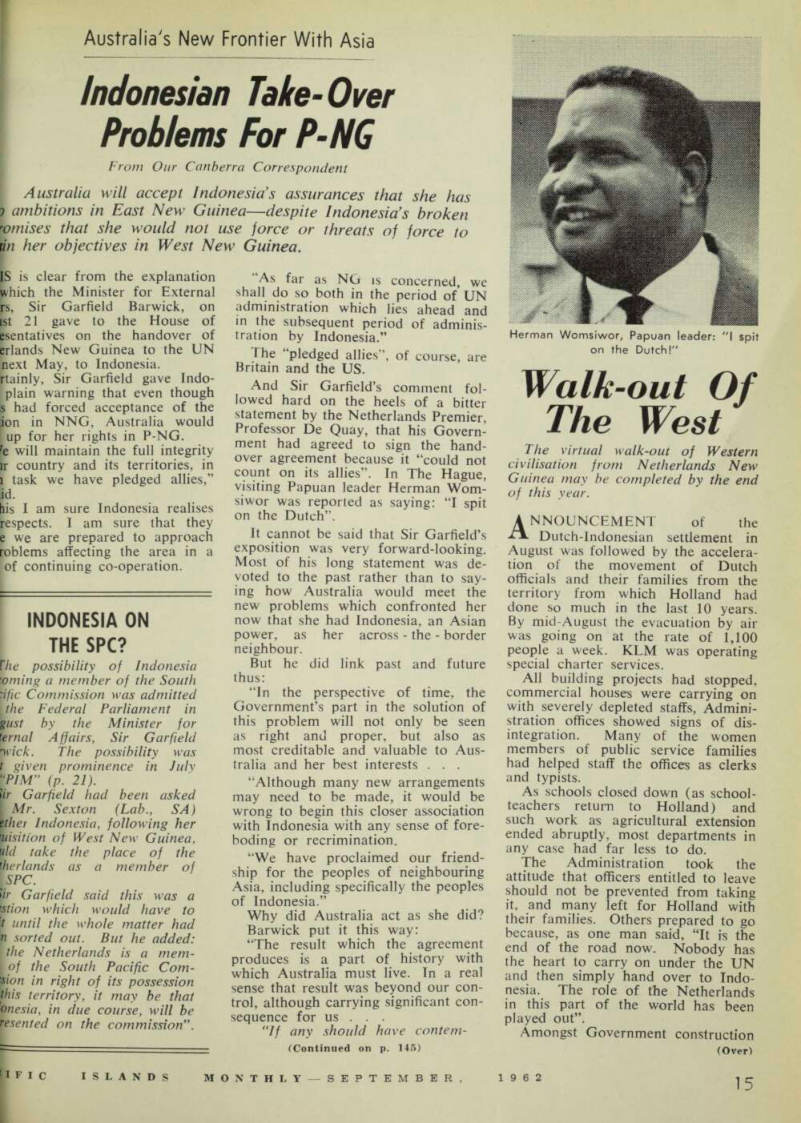
And Sir Garfield’s comment fol lowed hard on the heels of a bitter statement by the Netherlands Premier, Professor De Quay, that his Govern ment had agreed to sign the hand over agreement because it “could not count on its allies”. In The Hague, visiting Papuan leader Herman Wom siwor was reported as saying: “I spit on the Dutch”.
It cannot be said that Sir Garfield’s exposition was very forward-looking.
Most of his long statement was de voted to the past rather than to say ing how Australia would meet the new problems which confronted her now that she had Indonesia, an Asian power, as her across - the - border neighbour.
But he did link past and future thus: “In the perspective of time, the Government’s part in the solution of this problem will not only be seen as right and proper, but also as most creditable and valuable to Aus tralia and her best interests . . .
“Although many new arrangements may need to be made, it would be wrong to begin this closer association with Indonesia with any sense of fore boding or recrimination.
“We have proclaimed our friend ship for the peoples of neighbouring Asia, including specifically the peoples of Indonesia.”
Why did Australia act as she did?
Barwick put it this way: “The result which the agreement produces is a part of history with which Australia must live. In a real sense that result was beyond our con trol, although carrying significant con sequence for us . . .
"If any should have contem
(Continued on p. 145)
lated a military adventure, none f the countries of the West— nd particularly those with whom iustralia has the closest asso iation—were at any relevant me willing to maintain a Netherlands administration by ulitary means ” hat seems to explain the final [es of events. jut what of the background? Why America withdraw support from [Dutch?
D the long term there was the item belief that it would be im sible to muster sufficient Asian port in the UN for anything which Dured of “colonialism”. There was i the fear that denial of NNG Indonesia indefinitely could have fed into the hands of Indonesian nmunists. laid Barwick: “I believe that the •rts of the US and others, in ling Australia, have prevented the
outbreak of hostilities from which nobody in the area, including the Papuan inhabitants, could have profited.”
All in all, the main differences between the agreement which the Dutch and Indonesians signed on August 15 and the original proposals put forward by a former US diplomat, Mr.
Ellsworth Bunker, last March were differences of timing. , , The original Bunker plan provided for the transfer of admiinstraon from the Netherlands to a UN authority for a year and for the transfer to Indonesia during a further year.
It also provided for an opportunity for the Papuan people to make a free
choice on their ultimate political status.
Indonesian pressures succeeded in cutting the trasition times. while negotiations proceeded, hundreds of Indonesian paratroops were dropped at intervals m NNG.
Barwick’s view, these actions, although small, could have grown to the sta B e where outside powers would have been drawn in “and large-scale, embittering warfare introduced into area ”
After the signing of the agreement it was anno unced that the UN would pro bably take over from October 1 (after the agreement has been ratified by the General Assembly) and that although the handover to Indonesia
uld not be until May, Indonesia uld be allowed to fly her flag in territory from January 1. This ; decision was an extra sop to ;karno, who had boasted he would re NNG “by the end of 1961”.
Vfter Barwick’s statement on gust 21 the Acting Opposition ider, Mr. Whitlam, criticised this icy of capitulation, fhere were many islands in the :ific which were in dispute between erent countries; it was Australia’s y to see that orderly processes •e evolved for ensuring peace in area. dr. Whitlam also criticised Sir rfield for glossing over changes in vernment policy toward NNG. le recalled that two earlier listers for External Affairs, Sir cy Spender and Lord Casey, had rmed that Australia had a right a voice in any talks which would nge the status of the Territory, knd when from 1954 to 1957 posals had been put forward for tch-Indonesian talks in the pre ce of a third party—like the iker plan—Australia had opposed se propositions in the UN.
Tie forms of the House forced , Whitlam to follow on after Sir •field without the usual adjourn it in which to prepare a speech, lad there been a formal debate re would have been other criticisms ome of them from members on the vernment side who have serious ;rvations about the way Govern it external policy has worked in ;nt months. i notable omission from Sir Car d’s speech was anything which Id be interpreted as a forward k at the problems facing Aus ia.
'here was nothing on such vital blems as the treatment which Aus ia will accord refugees from NNG 3 wish to move to P-NG. iight thousand people from the itani area have expressed a wish move to P-NG before the trans . to Indonesia next May—an ex ple of the headaches which must t the Government.
Vhen such big groups seek asylum y pose problems both of resettle nt and of maintaining good rela te with the Indonesians, fhere are other problems of de ce, of the new agreement on ad iistrative co-operation which must ely replace the previous agreement h the Dutch.
Jut in the narrowly - balanced Itical condition of 1962, the Aus- Han Government is clearly tread warily and keeping out of any dement which it can possibly avoid.