Pacific Report
pp. 127-148 · Read in the full issue
The month’s round-up of news and pictures of people and svents, from PIM correspondents in the South Pacific.
i Customs Officer
:oled for Smuggling
Tie black market value of opium md in the possession of a Suva ;toms Collector was between TOO and £lO,OOO, although its :per value was less than £lOO. ♦erintendent J. Colclough said this the Magistrate’s Court at Suva in \f when Norman Frederick Lester Bcnell, 44, pleaded guilty to three irges involving the possession of urn and opium smoking equip at.
Uricknell, who was born at rrandera, NSW, 44 years ago, led the Fiji Customs Department a 95 1- ♦uperintendent Colclough told court how Bricknell approached ither Customs officer, the Suva larfinger (Mr. B. Thomas), with offer of £5 to be taken out ing, one evening, and how the r were subsequently shadowed by : Suva Harbour Master (Captain L. James). fhe charges against Bricknell were t he had in his possession on le 23, 359 tins containing pre ed opium, two opium bowls; and t he was knowingly concerned in f attempt at the fraudulent ision of the prohibition of the portation of 481.06 oz of pre *ed opium valued at £96/4/-.
Superintendent Colclough said it at the time of the offences icknell was secretary of the Fiji Irine Board, which is under the atrol of the Customs Department. [ had approached Thomas and ered him £5 to take him out ling. Thomas had been instructed tviously by the Comptroller of
Customs (Mr. D. W. Logan) to report any suspicious approach for the hire of the launch, and he had therefore reported the matter to his superior officer.
Arrangements were made to shadow Bricknell and his companion.
Bricknell and Thomas went fishing near the entrance to the main Suva Passage and while there Thomas asked Bricknell the purpose of the trip.
Bricknell replied that it was to pick up some Chinese medicine for a friend at Lautoka. Normally the medicine would not be allowed to enter the country. Thomas later put it to Bricknell that it was actually opium they were going to pick up and Bricknell agreed that was the case.
About 5.45 p.m., just on dusk, the Dutch ship, Van Noort, with a Chinese crew, which had previously arrived from Hongkong and Singapore left Suva wharf to sail to Auckland. When the ship was nearly abreast of where Bricknell was fishing, Bricknell rose to his feet and waved a green shirt at the ship.
There was an answering flash, at
which Bricknell ordered Thomas to pull up the anchor.
Their launch followed the Van Noort, and suddenly there was a splash over the side. Bricknell then recovered from the sea a parcel
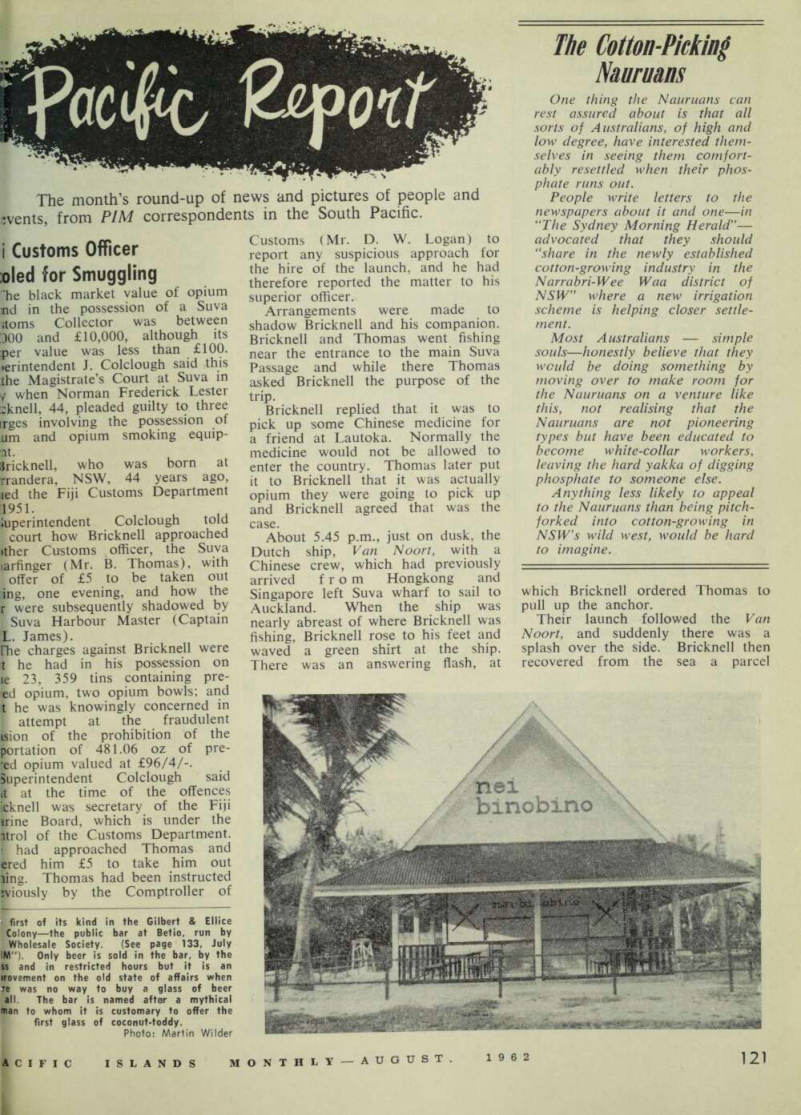
The first of its kind in the Gilbert & Ellice [?]Colony—the public bar at Betio, run by [?]Wholesale Society. (See page 133, July [?]M"). Only beer is sold in the bar, by the [?]s and in restricted hours but it is an [?]rovement on the old state of affairs when [?]re was no way to buy a glass of beer [?]all. The bar is named after a mythical man to whom it is customary to offer the first glass of coconut-toddy.
Photo: Martin Wilder
wrapped in sacking. This was later discovered to contain 359 tins of pre pared opium, two opium smoking pipe bowls and a quantity of Chinese herbal goods. Bricknell ordered Thomas to take the launch to the Bay of Islands. And this time Captain James was following in a private launch.
As the boats were approaching the jetty near the Naval Barracks a car signalled by flashing its headlights twice. Bricknell’s launch turned towards the flashes, and soon after Captain James flashed on a small searchlight. Bricknell was then seen to put overboard the parcel he had picked up from the Van Noort.
Captain James recovered the parcel and ordered Thomas and Bricknell to return to Prince’s Land ing.
The police later discovered that the flashing light on the shore was given by a local Chinese.
When Bricknell and Thomas re turned to Prince’s Landing Mr.
Logan told Captain James to repeat in front of Bricknell what he had seen. The tins were opened at that stage. Bricknell then said the whole thing was a fabrication.
Mr. Noel McFarlane, who appeared for Bricknell said his client had served with the RAAF in Britain during the Second World War as a rear gunner. He had two daughters, one aged 15 at school in Sydney, and the other 9, at school in Suva.
It was a sad and tragic ending to Bricknell’s career. The person be hind it was a Chinese trader whose name was known to the police.
Bricknell, in 1961, had borrowed some money from a Chinese trader and had repaid it, but had again borrowed this year because he was in difficulty over school fees.
“On that fatal Saturday the Chinese trader asked Bricknell to oblige him by picking up a parcel
from the ship, but Bricknell refu Mr. McFarlane said. “How when the Chinese trader saw later he agreed. The Chinese; it was Chinese herbs to be p up.
“He knew that he was < wrong, but had no money foolishly, stupidly and unaccoun did this completely crazy act.”"
The Magistrate (Mr. R. B Mawer) sentenced Bricknell to of nine months, three months* 12 months respectively on the charges, and ordered the terra be served concurrently, which m that Bricknell will serve 12 mo less remission for good conduo He said that sending Brickne prison was the only course he ■ adopt.
ifoka's £lO,OOO Fire
£5,000 Fire-Engine
new £5,000 Lautoka fire )ie has had its teething troubles. of all it was too big to fit into rfire station. Then, at its first ir fire, the succession of events :d have been comical, but for seriousness of the situation, Uled to the administrative block ite South Pacific Sugar Mills late tune it was discovered that the le would not be of much use. compound in which the build stood was not piped to fire Eants, and no water was available pt for the 250 gallons the engine aed. ihile this meagre supply lasted [brigade managed to get some "ol over the blaze, but the nph was short-lived. When the ran dry the engine had to go 7 for another supply, and while ;as away the fire quickly flared igain, and the entire office block [burnt to the ground, ne company’s official estimate of loss was £lO,OOO.
larai's White Hopes
the Games
Ken sportsmen of the Australian royer Voyager spent most of I recent stay in Samarai helping aan athletes in training for rtion for the Territory’s first imonwealth Games Team which go to Perth, WA, at the end of -year. tpyager is one of the warships jned to go to Perth for the aes and she visited Samarai on fway home from a tour of Far cern duty, in June, he athletes helped are a Papuan ;d Warrington, 19, a Samarai k, who is Milne Bay District’s t hope for the 100 yards sprint; f Moses, 20, an Administration jblteacher, who has an excellent ice of selection for the 440 and
iyards.
w Hebrides Talks
New York
i June New Hebrides took a big I forward in its radio telephone s when the Condominium Radio jneer made the first test tele ne call to New York, via Sydney Oakland in California.
Tiis radio telephone link has a requested by the Australian American Radio Communication horities, and if favourable circuits be maintained simultaneously on
all arms of the relay, it will be soon possible to make telephone calls from the New Hebrides to America.
The cost will be £6/15/- Aus tralian for a three-minute call, and the time of calls will be the same as for the Sydney circuit, from 3.45 p.m. to 4.45 p.m. local time. It may also be possible to extend the Sydney circuit to Europe. The cost for a three minute call to Europe would be £5/8/- Australian.
These radio telephone circuits to the United States and Europe are only temporary, and will be replaced by the facilities offered by the Commonwealth Cable, which is due for completion late next year.
Yellow Yolks Are
9/- Extra
Constant rain and lack of sun has greatly reduced New Caledonia’s seasonal vegetable crop. Tomato plants and many other vegetables which should now be reaching the local market have been destroyed and where normally most vegetable imports have ceased at this time of the year, this year New Caledonia has been importing carrots, lettuce, cauliflowers and tomatoes from Aus tralia and New Zealand.
In July, importation of carrots and cabbages was stopped which
makes the position worse for housewives as they now have t more than twice as much for 1 grown than they previously di imported vegetables.
Importation of foreign eggs, r Australian, has now been fort because there are now enough ing from local sources. House who have been paying about 6, dozen for Australian eggs now to pay 15/- per dozen for the variety but this does not caus« bother because the New Caled housewife would rather pay extra because of a dislike fo pale yellow of the Australian
No "Cracker Nights"
For New Caledonia
A move has been made ii Noumean Chamber of Commet stop the importation and sa! fireworks in New Caledonia a is expected that the High missioner’s Department will si bring down the necessary legisll The law will not apply to fire' intended for special displays b the fireworks which fall intc hands of local larrikins who a practice of throwing lighted! works into crowds.
Local newspapers have campaigning for years in this tion and although there is all a law forbidding the letting c fireworks in public streets, obvious that the local police ai capable of enforcing this law.
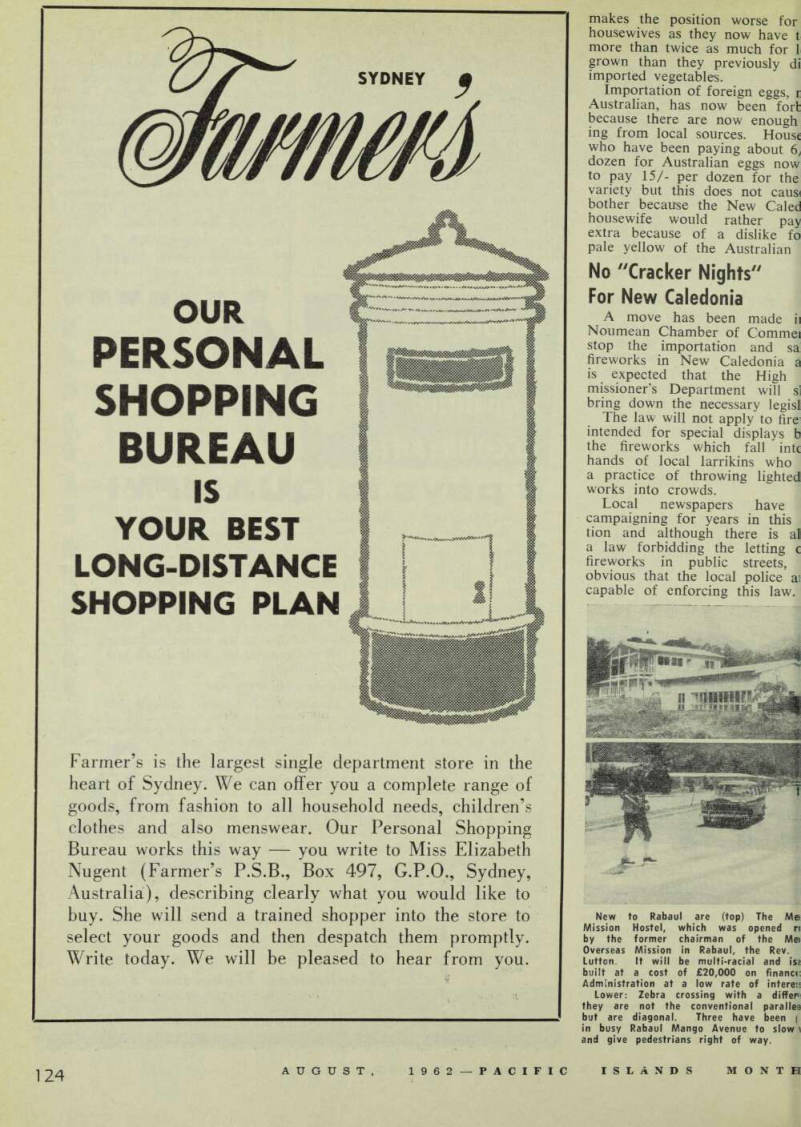
New to Rabaul are (top) The Me Mission Hostel, which was opened n by the former chairman of the Me* Overseas Mission in Rabaul, the Rev.
Lutton. It will be multi-racial and i$2 built at a cost of £20,000 on finance Administration at a low rate of intere:: Lower: Zebra crossing with a differ" they are not the conventional parades but are diagonal. Three have been in busy Rabaul Mango Avenue to slow \ and give pedestrians right of way.
i»w Caledonia is not alone with as was clearly seen in jey last Commonwealth Day’s [;ker night” when two people killed by fireworks and several ilings burnt down, but as yet the South Wales authorities have ttaken any steps to make sure this will not happen again next
Sugar for USA
Next 2i Years
appeared for a few days, at the of June, as if Fiji would miss i on the special American sugar
quota. It had hoped to get this order from United States, as its share of the vast order for sugar, taken from Communist, Yank-hating Cuba by Washington, and distributed among the world’s better-behaved sugar-growers.
US House of Representatives allocated the quotas in June, includ ing 50,000 tons for Australia, and 10.000 tons for Fiji, and sent the Bill to the Senate.
But the Senate revolted against an army of lobbyists from the world’s sugar producers—of whom the most provoking were from India—and “wiped” the whole Bill. The Senate pointed out that USA consumes 9.700.000 tons of sugar annually,
and it demanded that USA domestic producers should supply 5,800,000 tons.
The old law was expiring on June 30, and the two Houses went into hurried conference, and achieved compromise. Many of the quotas remained “out”; but Australia finally got 40,000 tons per annum, and Fiji the full 10,000 tons, until December 31, 1964. But the premium of 150 million dollars which the House had planned to pay as premium of foreign suppliers has been cut by 30 per cent., over the next 2i years.
The quota allotted Fiji will earn that country £1,500,000 before the end of 1964. There is no indication of what happens after that. Power
ful interests in USA would HI restore the sugar trade with C Communism or no Communisn
Manus Goes For Carved
Puks-Puks and Dollars
A Rabaul-based Agricu officer recently paid a visit native-owned plantation in
Admiralty Islands.
He found coconuts lying or ground beneath the trees and copra dryers had not been wc m weeks. In the village he s the reason for the sudden strike The luluai took him inside showed him a heap (“there scores of them!”) of hide* wrought wooden crocodiles.
Every able man in the village apparently turned from primar secondary industry and was h whittling at wooden puk-puks.
“I soon learned that the Amer at Manus were the cause of strike,” the agricultural officer “They were paying such high p for native carvings that this vil and I have no doubt there others, decided to give copra av Tracking-base Americans Manus, Buka and other isl probably have no idea their lar is disturbing the native econon but it’s high time someone told tl
Rarotonga Goes For
Road-Safety
During the last decade Rarotoi motor traffic has trebled—from licensed motor vehicles in 195 i 464 in 1962. The population increased to such an extent t was talk of a “population plosion”. These two factors rr sented increasing hazards for all users.
In 1955 motor traffic was inc: ing and there were many new dn who knew little, and cared less, at elementary road rules. Truck drii motorists, motor cyclists, cyclists* pedestrians consistently broke e rule in the book, often with orijj twists. Powerful new trucks along at 40 mph on the wrong of the road—the speed limit and still is 30 mph on the open and 20 mph through villages.
Vehicles shot out from side n on to the main highway, their dn neither reducing speed nor bothd to check if other traffic was appro: ing. Signals were rarely givenr Cyclists used both sides of : road with serene impartiality—so; times they carried passengers onr handlebars. These passengers f!
I cyclist and successfully blocked or her view.
Jtray horses cantered along the d, large pigs suddenly shot from I roadside scrub right into the h of an oncoming vehicle. night few motorists bothered *dip their headlights when other Sc appeared, cyclists sometimes ried hand torches, or more often, flights at all. Pedestrians straggled f over the road and stubbornly used to get out of the way at the »roach of a mere motor cyclist, meeting the rider to swerve around m and on the wrong side of the d. The dirt roads were narrow I badly pot-holed after heavy rain, sy had many blind corners and tow bridges.
'low, although the coastal road is I too narrow for the volume of ffic carried in the busiest sections, at strides forward in achieving d safety have been made, n August, 1955, two Maori ice officers began to instruct vers and cyclists in the rudiments the Highway Code. Later, drivers o still abused the rules were
prosecuted. In June, 1958, the Cook Islands’ first speed cop appeared in Rarotonga and soon made his presence felt. The schools instruc ted their pupils in road safety and the public was likewise informed through the mediums of radio and news-sheet.
Gradually, road manners im proved. Today some of the old hazards still persist, such as wander ing livestock and overloaded trucks, but most Cook Islanders have be come road conscious, Within the last two years some of the worst bends and corners of the road have been straightened out, Some new bridges were built and the coastal road widened at various places. Finally came the tar-sealing of the Island’s busiest two miles, the coastal road through Avarua, extend ing from Avatiu Harbour to the hospital.
One mile has been completed and work on the remainder is progress ing. The road was widened consider ably and the tar-sealing will eliminate the dust menace in Rarotonga’s most heavily populated area. (Over)
Progress In Society Islands
Etablissements Donald Tahiti plans to return to Raiatea, Society Islands, after a trading absence of 20 years. Their new building, above, is nearing completion, and will be opened early in September.
The Banque de Undo Chine has opened its office in Raiatea in this building.
The new wharf, to left of the Donald building, was completed three years ago, and is able to berth Islands vessels. Adequate wharf sheds and copra stores have been erected and the inner harbour is now a haven for the fishing vessels.
The new airstrip on Raiatea was completed and opened on June 14, with the inauguration of the RAI services by DC4.
rther concern for road safety shown during a meeting of [onga’s Island Council in mid- I when it was decided to cut I coconut trees overhanging the I road without compensation [ paid to the landowners, is measure was felt necessary riew of the constant danger of falling from overhanging trees injuring people passing on the ere seems no doubt about it— tonga’s roads are getting safer.
s Arms Amnesty
; Well Patronised
ii’s arms amnesty in June— I persons in illegal possession of , and ammunition could hand > to the police without fear of xmtion, had some surprises. >e amnesty was to bring in the ature arsenals of small arms, I of them of American origin,
acquired during the war, known to exist in North-Western Viti Levu.
Probably the police expected pistols, rifles up to .303 gauge and perhaps a shotgun or two. They wer e taken aback, however, at three of the pieces handed in — one .4 anti-tank rifle, and two machine guns Th anti . tank gun> wh i c h bore
Japanese marking s, was complete
with flame eliminator, and had been k t j e It was something sil £ Uar t ® the ,5 B oyes anti-tank rifle used by the British armed forces.
One of the machine-guns was Japanese and the other was German, and both were handed in at Levuka.
The Jap job was in fairlv good working order, and was complete with mounting. It was a .28 to .3 calibre. The German gun, also in fairly good order, was brought from Levuka to Suva under a police escort.
The police did not inquire too deeply into the circumstances of possession—after all it was an amnesty—but theorised that they had been souvenired somehow or other and brought back to Fiji by the Armed Forces, or in consign ments of captured arms.
Their appearance during the amnesty prompted the Deputy Com missioner of Police (Mr. T. A.
Handford), to remark that they would also accept field pieces. The natural inference from this is that if ever there is another arms amnesty those who have a few 25 pounders, or German 88’s tucked away in some odd corner, should hand them in then.
£29,000 to be Spent on
BSIP Airfields
A Colonial Development and Welfare Scheme for a grant of £29,000 has been approved to build airfields at Auki on Malaita and Kira Kira on San Cristoval, and to improve ground facilities at Hender son airfield near Honiara, BSIP.
The Auki field, which will be built first, will be between Gwaunaru village and the sea. The villagers have agreed to give the Government a lease of the land and to accept compensation for the trees which will have to be cut.
The field is expected to be ready in about March next year. Work on a road to the site began on June 25.
The improvement of ground facilities at Henderson airfield will include a hangar and workshop.
All this is in addition to plans to build airfields at Ocean Island and above Graciosa Bay at Santa Cruz, and to improve the Bonriki aero drome at Tarawa in the Gilbert Islands (July PIM, p. 163).
Henderson field is used by the overseas airlines, TAA and Fiji Air ways Ltd-, but the outport airstrips are in anticipation of a BSIP internal air service getting going- A private New Guinea air com pany has applied for a licence to carry on an internal air service in the Solomons, using a twin-engine, five-seater passenger aircraft; and there has been some interest from a New Hebrides company, also.
FVB Will Have Sydney
Telephone Number
The Fiji Times is the only Fiji listing in the Sydney telephone directory, and Pacific Publications Pty. Ltd., the Sydney agents for the newspapers, were required to answer
One of the largest lakes in West New Guinea is Lake Sentani (above), near the capital, Hollandia. It is about 20 miles long.
One of the odd things about this fresh-water lake is that sawfish, which normally live only in salt water, are found in it.
Scientists think that they entered it at a time long past when the lake was a long bay, open to the sea, and that they somehow adapted themselves and lived on when the land rose and the lake was cut off from the ocean.
These sawfish have a long flat "saw” with a row of sharp teeth on either side of it. They can be anything up to 12 feet long, from tail to end of the saw.
The one shown (left), is slightly less than than that and was caught in a fishing net and towed to the shore behind a canoe. The Lake natives do not eat the fish as they believe their ancestors' spirits have entered them but that does not prevent them selling the fish to town natives in Hollandia.
t of calls for information about The chairman of the Fiji ors’ Bureau (Mr. C. A. on) said that the publisher of (Mr, R. W. Robson) had told this during a recent visit to nder a proposal from Mr. R. A. lett, former FVB secretary, the au would soon be the second Fiji g in the Sydney directory, Mr. lett, now one of the principals Hewlett and Keeling and As ites, will disseminate tourist mation about Fiji, and answer iries about the Fiji tourist in ly for a fee of £A4OO a year. , fee will include a listing for bureau in the directory, le FVB at its June meeting led to accept the offer of Hewlett Keeling to act as their Aus in and New Zealand representa for the suggested fee. They idered the money would be well L as Mr. Howlett knew Fiji so lately, and because he had a [ spot” for the Colony. Howlett Keeling offered many other ces, but as the total cost was y to be in the region of £A2,000, FVB board decided that in the itime its budget could not stand o the additional expenditure.
; Radio Station
ler Fire
ie Norfolk Island Administra announced recently that it :d to extend its broadcasting ice and to increase the variety terns broadcast, is thinking of buying better pment and hopes to arrange with
the Australian Broadcasting Com mission to supply recorded music, plays and other items.
The service now goes on the air at 10 a.m. Mondays to Fridays. It begins with an announcer reading news bulletins taken down verbatim from ABC broadcasts the previous evening. This is followed by local news, including arrival times of ships and aircraft, and a weather forecast.
The Administrator speaks when he has anything of interest to say, but he does not speak very often.
The Norfolk Island Council, which is usually “ag’in” anything the Administration does, has long cherished plans to operate its own local radio transmitter, discussed the Administration’s latest . plans at a recent meeting.
One councillor said the people’s wishes were being ignored as a fifth of the electorate had petitioned the Administration to run its own broad casting station, which would give residents a better service with, so t h e miracle-working councillor alleges, no cost to taxpayers.
He added that, eventually, the Administration would inevitably introduce licences —presumably for radio receivers—whereas successful enterprise need not cost taxpayers anything.
The Administration broadcasting service also has its troubles. Last Christmas, a local resident objected to the playing of “Advance Australia Fair” over the network, declaring that the Administrator was infringing copy-right in the broadcasting of re cords, including that of Australia’s National Anthem.
This threw local authorities into a quandary and the playing of
records was suspended. It was also the practice of the Department of Civil Aviation to play recorded music before giving arrival and departure times of the weekly Sky master service. This was also stopped.
However, following correspon dence with the Territories Depart ment the Administration negotiated an agreement with the Australian Performing Right Association and now apparently records can be played without payment of royalties.
Hams Please Honiara
The Honiara Dramatic Society, known locally as the Honiara Hams, had a two-nights season of Oscar Wilde’s “The Importance of Being Earnest” in June. It was their best effort so far- Unfortunately, this type of enter tainment is always left to a few enthusiasts and although monthly play-readings are held in Honiara
One of the 17 homes for “advanced native” workers now near [?] mpletion at Rabaul on the site of the old German Botanical Gardens.
The houses will be available to Administration or privately employed [?] tives who desire to improve their standard of living. Tenants will be [?] le to purchase them on easy payments over a long period.
in the hope of bringing forth hidden talent, most people want to be in the audience and not behind the foot lights. Audience reaction in Honiara is always favourable; shows are looked forward to with enthusiasm; and no latecomers (wearing clogs), ever mar the effect of the opening of a play.
“The Importance of Being Earnest” was produced by Jean Cox who usually gives an outstanding performance herself on stage. The part of Lady Bracknell was played by June Glover with polish; Michael Birt, as John Worthing, JP, was a pillar of strength to the players; and Sylvia Widdas, making her first appearance on the Honiara stage, and although a mother of four daughters herself, played the part of John Worthing’s 18-year-old-ward convincingly.
The bit-players excelled themselves and set a high standard for future performances of the Honiara Hams.
A Little Bit of
Fijian History
Buried on Korowaqa Hill, Raki Raki, Fiji, are the bodies of at least half a dozen European pioneers, most of them forgotten long ago.
Their graves had been lost sight of, and most of them were over grown—until recently, when Mr.
Theo D. Riaz, a surviving pioneer of that area, and an indefatigable historian, appealed for help to the Governor’s wife and to the officials of the Colonial Sugar Company.
Lady Maddocks showed an immedi ate, active interest; and the graves have been adequately marked, and will get attention in the future. The people buried there, half a century ago, include: Mr. Butschow, chief engineer at the sugar mill at Penang, Mrs. Thomas Coster, wife of the mill manager, and her sister, Miss
Seagar.
Mr. Leask, who was secretai the Company, there.
Rev. C, F. Andrew, a well k missionary.
Mr. Sanderson, who was a r lawyer.
Mr. James Munday, a officer.
Mr. James Acklery, a storek In a long historical note su\ to the CSR Co.’s general ma in Fiji (Mr. John C. Potts).
Riaz says that the Rev. C Andrew was an early tutor a late Sir Lala Sukuna, and of notable Fijians, and that Ratu Madraiwiwi, the first Roko Tu presented Mr. Andrew with a to mark his appreciation ol training given his son.
Mr. Riaz adds that Charles E became chief engineer at the in 1908, and that he was a ne on his mother’s side, of that fs Commodore Goodenough, who a part in the signing of the De Cession in 1874; and Mrs. B was a niece of the Rev. Mr. An James Munday was bor Guernsey, served in World W and became police officer at RJ lady was to come out from Gu« to marry him; but she refus. do so when she learned that Munday had had a Fijian mii Mr. Munday thereupon corm suicide, Mr. Riaz says that Victor Hugo was exiled from B he was the guest of Mui family, on Guernsey.
Mr. Riaz, a well-known figir Suva, has lost his sight, but retained a remarkable memory a passion for accuracy; and! betide any storyteller who facts out of line—Historian then camps implacably on his' until the public record is set It is a pity that there is not an Historical Society in Fiji: interesting history is being la the generations change.
To Make Best Use
Of Fijians" Lands
Fijian land is safe for the H the Governor (Sir Ke Maddocks) told the Couno Chiefs when they assembled ah for their biennial conference..
Although a Land Develco Authority had been created tH not mean that the responsibiliti the Native Land Trust Board be altered. The duty of the bo< to administer Fijian land in thl interest of the Fijian owners.; The Governor, at the sames told the chiefs that land-owninjr
a particularly important task to irm in the drive for develop- They had to see that, ;;ver possible, their reserve lands so apportioned that as many oers as possible who wished to the land secured an economic tig with an assured security of lere the units could not make use of their reserve lands they d make the unused portions ible to Fijians, less fortunate Ithemselves, who were willing to .up leases.
' Company Operating
oniara
msfer of the old BSIP Trading uration to its new owners was leted by end of June and the registered British Solomons ng Co. was opened for business ily 2. ; four directors of the new any are Messrs. J. Close, >e, D. J. Gubbay and Katoh. j company’s new name avoids suggestion that Japanese sts are involved, and in course le no doubt most local residents orget that they are. Meantime, te of the fact that most people in the S-W Pacific have ;d that we must live and trade the Japanese, there cannot help 5 tender feelings in these islands : suffered so much at Japanese 20 years ago. i Chinese business community lewing the new firm with tension. But it is generallly ed that most of these people a jolt, anyway. Their stocks originality and variety and one ishment is much like all the
nd Chrome
ices in N. Caledonia
f subject of oil search in New onia was recently discussed in issemblee Territoriale. It was 1 that an American engineer, Joseph Hargoue, representing [entures Group, had made an ation to carry out oil search ies in New Caledonia. [has asked that the dossiers on r, negative, searches in 1953 1958 be made available to his > for study. The Group would terested in a straight-out grant •f oil search rights or would into an association with the government. lowing the discussion it was ited that the latter would be in est interests of the country.
The former oil searches carried out cost some fifty million francs— a good deal of it subscribed locally by private investors and government.
This figure of £350,000 brought negative results “but interesting archives”.
Also discussed by the Assemblee was New Caledonia’s one remaining chrome mine. The Minister of Mines pointed out that the exports of this mine had fallen from 60,000 tons in 1957 to 22,000 in 1961.
This resulted in about one-third of the working force of 240 losing their jobs.
The mine “La Tiebaghi” is one of the richest chrome mines in the world. It was formerly owned by British interests but as a result of the last war passed into American control.
It was pointed out by the Minister of Mines that New Caledonia produced chrome ore was com petitive but lost out on the world market because of the high freight.
Efforts are being made to place chrome in France but with no success as yet. France has it own arrange ments over chrome, buying Russian metal in exchange for Russian
acquisition of nickel. As the New Caledonian mine is an American affair, France is not likely to sacrifice anything for New Cale donian chrome production from the “Tiebaghi”.
The Minister underlined the impor tance of the Tiebaghi mine to New Caledonia’s economic set-up. He stated that whereas in former years the ton of chrome brought in £l5 in export duty, nowadays it brought in only one-half that sum.
NG Chinese and
The Pngvr
Are there two grades of Aus tralians—First Class and Second Class? This is the question being asked by several New Guinea born Chinese who, as naturalised Aus tralians, have tried in vain to join the Papuan and New Guinea Volunteer Rifles.
The Territorial-type PNGVR, successor to the pre-war NGVR which covered itself in glory during the fighting against the Japanese, is currently advertising on NG picture screens for recruits—hence the Chinese applications.
But several young naturalised Chinese who have gone along to join the Volunteers have been politely told “nothing doing”.
This has occurred in both Lae and Rabaul. Many Chinese elders are becoming increasingly upset.
They are probably over-sensitive in view of their own experiences with the pre-war NGVR. As one of them put it: “We tried several times at
the beginning of the last war to join the NGVR but were rejected because we were not naturalised Australians.
“We then joined together and formed an ambulance detachment which took the field alongside the 2/22nd Battalion during the battle for Rabaul.”
What he omitted to say, but which is known to be true, is that the Chinese Ambulance detachment members bought and provided their own uniforms and equipment; nor
did he mention that at leaj member, Mr, Chin Hoi Meei decorated—with the King’s Me* his loyal and selfless service Allies.
But he did mention that tl Ambulance members could m
The Rss & Ail A.
Since 1957 Australian natii has been offered to eligible 0 residents of NG, and the percentage of New Guinea’s 0 are now naturalised. Others co to become naturalised at the about 100 per year.
In spite of all the hoops intj citizens are put through, naturalisation, are they still re as security risks? Officialdom* said but the Chinese can’t be for feeling slighted, especially the PNGVR “help-wanted” m being screened in Chineses theatres.
Fijians in Their
First General Election
There is increasing interest! first all-races (including w general election in Fiji. The quick into action, have anm that they have already selec'c two nominated members. Thd the two cousins, Ratu Edwae Ratu George Cakobau, members of the CounciMi nominated by the Council of! in July.
At the same meeting, the < tacitly agreed on four othen:
The Tongan community living at Suva celebrated Emancipation on June 4 with a church service at the Holy Trinity Cathedral follow by a large feast at the Flying Angel Club. Three-year-old Gabriel B [?] cut this 100 -candle cake to mark the occasion, after Mrs. K. R. B [?] blew out the candles. Mrs. Baine’s mother, Mr. Felix Emberson, is [?] extreme right.
contest the seats for which jdates must be elected. ;ese are all retiring members— ugh one, Ratu K. K. T. Mara, present studying at the London )1 of Economics, Ratu George Ibau has been filling in for him, eep the Fijian quota of Legco ners at five.
Itu Penaia Ganilau, at present g Secretary for Fijian Affairs, be a candidate in the Western tituency (the western area of Levu, and the Yasawas). He is n of a big following, because s reputation as a soldier and as Iministrator, although he is well le his natural area, which aces Taveuni and the lower part anua Levu. had been thought that Ratu a would stand in the Northern iituency, among his own people, wer, he has agreed instead to »rt for that seat Ravuama falu, well known as an out n Fijian. Ravuama, a Bauan, no natural following in udrove but his high reputation forceful debater, who carefully ics the interests of the Fijians, d stand him well. 5 other two, Ratu Mara and sa Sikivou, will contest Eastern Central respectively. Ratu 's electorate takes in the iing Lau Islands; and, as he Lauan, he should not expect opposition. Similarly, Semesa, swa, will be offering himself to ellow Rewas, plus the Fijians ailevu and Suva, and can be led as already “past and post”.
[Jo Paratroops Could
Australia's Business
A Dutch Navy spokesman in West /W Guinea said early in July that Indonesian paratroops did not stop Ihdrawing in an easterly direction im Merauke they will cross the -der into Australian Papua—in iich event it will be up to the Aus lians to do something about it.
Dutch troops would not follow im into Australian Territory.
Since there are no frontier marks would be impossible for the para atists to know whether they had issed the line or not. ;t was the Australians’ affair to :p the Indonesians from entering istralian territory if the Dutch, who re taking no special measures, ild not stop them leaving Dutch ritory. fwo weeks previously, in Port jresby, the Administrator of P-NG, Donald Cleland, urged Papua w Guinea’s natives and Europeans ; to panic over what was happen ; in Dutch New Guinea. ‘There is absolutely no cause for y feeling of insecurity by the jple of this Territory,” he said in Press statement.
Phe statement was prepared in ily to the Port Moresby Town Ad ory Council, which at its monthly icting had carried a resolution urg ; the Administration to strengthen rt Moresby’s defences.
Sir Donald said in his statement ft “it is outside the province of the wn Advisory Council to advise me This matter.” the Council’s discussion on the ;st New Guinea situation lasted ne time, during which some lakers suggested that the Indo lian paratroop landings near irauke were having an effect on I share market movements of puan plantation stocks.
Sir Donald said in his statement it it was “completely unrealistic d silly” to relate the Merauke in lent with share movements.
Apart from the Port Moresby efforts, the Returned Service tn’s League in Papua-New Guinea s been campaigning to allow puans and New Guineans to enter [ropean CMF units in the Terri ry, and for an increase in strength the one-battalion, 900-man Pacific ands Regiment. The troops are lives, trained by Australians.
jpik Natives "Not
'orried by Indonesians"
The situation in Netherlands New pinea was not worrying New uinea Trust Territory natives, the
P-NG Administrator (Sir Donald Cleland) said at a Port Moresby Press Conference in July after re turning from a 10-day tour of the Sepik District with Lady Cleland.
“It seems to me that the further you get from the border (the Sepik District is next to NNG), the more you hear about the Indonesians,” he said.
On his tour, the Administrator visited Vanimo, Aitape, Lumi, Angu ganak, Nuku, Maprik, Telefomin, Ambunti, Wewak, Angoram and Yangoru.
At Vanimo, he inspected the new DC-3 airstrip being built by Army engineers. At Aitape, he told a meet ing of New Guineans that the Ad ministration would consider making money available to build a bridge over the Raihu River to open up po tential copra and coffee land.
Sir Donald told Lumi people that an agricultural officer would be posted to the district soon; and in Anguganak he officially opened a new hospital built by the Christian Mission in Many Lands.
Sir Donald also opened the Hawain River Bridge which provides the final link in the Wewak-Dagua road.
Extra Gusto at Noumea's
"Glorious 14th"
The “glorious 14th” (Bastille Day) was celebrated with extra gusto in Noumea this year because of the
presence in port of the French anti aircraft carrier De Grasse, which is on a world prestige cruise, A spectacular torchlight procession of soldiers, sailors, natives and children opened the festivities on the night of the 13th. A public ball— with a few subsequent car accidents followed the procession.
Next day, sailors from the De Grasse paraded (showing how well drilled they are), sports meetings were held, and there was a mon ster parachuting dispky at Magenta aerodrome. The De Grasse left for Darwin on July 17. n , t n ns* r n j UN Plan TOT P - NG CdilGu “TU\\A\rU n ImpOSSIDIG , Childish “Impossible”, “ridiculously childish” and “jet-age haste” were some of the expressions used by prominent Papua-New Guinea residents last month to describe the United Nations mission’s proposal that Australia should establish a 100-member Par liament m the territory by 1964. , Mr ; Cra >8 Port Moresby solicitor, a resident for 10 years and a former member of the P-NG Legis lative Council, said he did not think a Parliament was possible by 1964.
It was also unnecessary.
“I think the local gentlemen (natives) would agree with me that they are much better off under a be nign Federal Government,” he said.
“Australia should thumb her nose to the rest of the world and carry on with her good job. Australia is pay
This is the class of 1962, School of Practical Nursing Hospital of American Samoa. Members graduated April 6, 1962. They are not only graduates of the School of Practical Nursing but they are also graduates of the High School of American Samoa. Currently, they are employed at the Hospital of American Samoa and proudly wear the white uniform. From left to right— Standng: Fiaigoa Misipeka, Tauvaga Gago, Elesiva Misa'alefua, Antoinette Shimasaki, Tinousi Serna, Siniva Tiapula. Sitting: Tu'i'olo Lemau, Fa'ava Fonati, Fa'au'uga Su'esu'e, Sarona Aotoa.
ing the piper and should be allowed to call the tune.”
A senior administration official, who wished to remain anonymous, said the idea for a 1964 Parliament was “ridiculously childish.” Austra lia should put her foot down and tell the mission she knows what she is doing and can do it without rush ing things the way the Mission wants it. The idea is highly dangerous and impracticable.
Mr. B. E. Fairfax-Ross, a non official member of the Legislative Council since its creation in 1954, said: “Apart from the difficult ques tion of public funds, at this stage of the Territory’s development, a legis lature of 100 appears unnecessarily large.
“And until higher education is more widespread there would be ob vious difficulties in obtaining so many members who could play a useful part in the legislature.”
Summing up the UN proposals, he said: “It appears that the Mission suggests a jet-age haste be injected into the safer, and I believe the ulti mately more beneficial, Australian plan for the Territory.”
Mr. I. F. G. Downs said that un less Australia continued its “big brother” role, the Territory would face “internal anarchy and external aggression”, Mr. Downs is a member of the Legislative Council and presi dent of the P-NG Highland Farmers’ and Settlers’ Association.
“What confronts us now, under the pressure of the Afro-Asian club (and I mean club in both senses of the word) is naked aggression from Dutch New Guinea after Indonesia has gained control,” he said.
War Against Malaria
In S-W Pacific
Papua-New Guinea malariologist, Dr. Jan Saave, of Port Moresby, has a better chance than most to have his name entered in NG history books if a new eradication campaign by his department lives up to expecta tion.
Using the anti-malarial Camoprim, an all-out experimental attack is being made on the disease in Nissan Island where, by virtue of its isolation, an ideal opportunity exists to study malaria control under clinical con ditions.
Camoprim has already been used with marked success in some parts of Africa; it is expected to yield equally good results in TPNG.
The Nissan campaign will take the form of Camoprim dosage in con junction with intensive spraying of native houses over a period of about eight weeks.
The campaign will be under the direction of a young Continental malariologist, Dr. Carl Reichmann.
Last week in Rabaul Dr. Saave reported that following intensive anti-malarial operations on the East Coast of New Ireland the incidence of the disease had dropped to less than one infected person per 100 head of population.
Some time ago, Dr. Saave is re ported to have said, “We don’t expect ever to eliminate the anopheles mosquito.
“But we do hope to see the time when there’ll be anopheles mos quitoes but no malaria.”
Recent “crash” training of anti malarial spraying squads support his contention, no less than 29 selected natives having graduated in Rabaul during July. These have now been sent out to various parts of the terri tory to undergo six months’ solid field work after which they will take over squads of their own.
But for all its success. Dr. Saave’s work is no bed of roses.
In some villages his spray squads have been faced with deserted houses, in others with locked doors.
In one area marks left by the sprayers on house walls have been carefully cut out and affixed to walls of other newly built houses by natives not wishing to “offend” the European medicine.
Yet the work still goes on and is producing exemplary results.
The new Nissan project will forge
another link in the fight to the d( against malaria.
Meanwhile on July 7 a Fre malariologist, Monsieur P. Ma; passed through Rabaul en route f: Manila where he is based with World Health Organisation, Honiara, BSIP.
While in Rabaul M. Me examined the Administratii Malaria Institute there and nounced himself greatly impress M. Martin’s assignment in Solomons is to set up an Insti of Parasitology and Entomology job which he expects will take least three months.
Gesture of Thanks
Leads to Drivers Death
Edward Goisavost, an oil tai driver, of Noumea, was killed New Caledonia’s winding, nar Boghen Pass early last month s he turned to wave thanks to ana truck driver who had pulled the mountainside to allow his tai to pass.
As Goisavost turned to wave,
Mr. P. Martin, French malariologist attached to WHO, has gone to Honiara where he will set up a Parasitology and Entomology Institute. (See this page).
edge under the tanker’s front i\ gave way and the tanker lied 300 feet down a ravine. :avost was killed instantly, ne Boghen Pass connects Noumea the mid-island centre of Bourail. ;as well known to servicemen in last war when the military :orities considered it so dangerous much of it was made a manned, table highway.
It Destructors Win
iaul Case
vo top legal men, a chemist and ace of top medicos from Mac lie St., Sydney, swelled Rabaul’s I guest list for two weeks in for a court case (civil) which ed more public interest than any r case in recent years, le case continued for eight days at its end in a 5,000 word judg t, Territory Supreme Court ce R. Smithers found for the de ants. le case: New Britain Plantations (a Burns Philp subsidiary) v. P. ames and Co. of Rabaul, their ator, D. Tudehope, and pest ig company W. A. Flick and Co. ydney. le issue: Whether or not the de ants through negligent or ex ve spraying of a plantation ling at Londip, NB, did render house uninhabitable and so satu i with dieldrin insecticide that pants, Mr. and Mrs. W. Briggs, • affected in health, or in other Is, poisoned. le amount claimed by N.B. Plan ns was £6,500, being allegedly rniount paid by them for medical other expenses in connection the Briggs’ illness. It was under- J that further litigation might e if a decision were to be handed a in favour of the plaintiffs, le matter began in April, 1957, i operator Tudehope was called ) Londip to spray a termite in tion. le Briggs shortly afterward ted the house on the recom- Jation of their doctor, Rabaul’s Sibthorpe, whom they had con d because of various symptoms, r. Sibthorpe diagnosed their com it (her diagnosis was substantiated Dr. Calov of Macquarie St., icy) as dieldrin poisoning, ime time later Mr. Briggs died mother complaint, quite uncon -5d with the alleged poisoning, and Briggs continued the case alone. early July, 1962, the matter t before Judge Smithers, with ml solicitor, Mr. Dudley Jones,
representing the plaintiff and well known Sydney barrister, Mr. J.
Staunton, instructed by Messrs. N.
Brady of Sydney and F. N. W. Shand of Rabaul, handling the defence.
It became a question of whether Judge Smithers would accept the plaintiff’s contention that her illness was, in fact, dieldrin poisoning, or whether the defence could convince him it was not.
In the event of the first contention being upheld, the case would become a clearcut instance of a house that had been sprayed too well and be come dangerous to human life. A large number of drums of the poison had been used but it was an argu able point as to whether each drum had been full, part-full on nearly empty.
Defence doctor from Macquarie St., Dr. J. Anderson, had no hesitation in pronouncing the other doctors diag nostically wrong.
The Briggs’ illness, known as pur pura, manifested itself in bluish coloured patches on the skin. How
ever, Dr. Anderson had never known a case of purpura which could be associated with dieldrin poisoning.
In the outcome Mr. Justice Smithers accepted the evidence of Dr. Anderson, holding that poisoning of the Briggs couple could not be proved and therefore he could not hold that the house had been ren bered uninhabitable through the Flick spraying.
Territorian Victims of
Alitalia Air Crash
Four New Guinea employees of TAA were among the 95 persons who perished in Alitalia’s fatal jet airliner crash in India early July.
They were: James Mellowes, an Engineer stationed at Rabaul; Kerry Craig, a reservations officer of Madang; Peter John Thompson, a clerk of Lae; and Richard John O’Carroll, a pilot of Lae. (Over)
The 10,000 ton Australian-owned liner "Wanganella" at Suva on July 9, in the course of her last Pacific cruise before going to her new owners. The tourists “spent up big". “Wanganella" was back in Sydney on July 25 on her last voyage on the Australia-New Zealand run.
Mcllwraith McEacharn Ltd. sold the liner to the Hang Fung Shipping and Trading Company Ltd., Hongkong, in May for an undisclosed price. The vessel has traded across the Tasman since its maiden voyage in 1933, except for service as a hospital ship in the Pacific from 1941 to 1945. In future it will carry tourists between New Zealand and the Far East, calling at Australia and some Pacific Islands. There is now no passenger ship on the Australia-NZ service.
Mellowes, a former flight geant who had participated ii Berlin airlift, went to Austral 1951, spending 12 months Qantas before being transfem Lae and Port Moresby, He s up with TAA when that airline over from Qantas, and befor death had been stationed in R 1 for 20 months. He was going seas to visit his aged moth' Birmingham, UK.
Kerry Craig, previously stat at Honiara, BSIP, also served TAA at Lae before being transl to Madang.
Peter Thompson, who joinei airline about two years ago, w his way to visit members o: family in England. On the w; planned to take a trans-contii holiday and had booked on tb fated plane only as far as Vienr John O’Carroll, a mountain* enthusiast, planned to gather goc vice from fellow passenger He: Harrer, the famous Austrian n taineer who had just spent six m in West New Guinea, during thi as he hoped to spend part c forthcoming leave on the Au Alps. (Dr. Harrer left the pla Bangkok.) Another identity familiar to territorians was Captain Do Dunn who with his wife and dau also lost his life in the crash. Q Dunn had made many flights h out of the territory in DC6’s.
Under an agreement withe Italian airline, TAA staff met were able to travel Alitalia at re; fares but on condition that should be off-loaded if full-R customers wanted their seats, of the victims had Sydney on the Alitalia jet the previously but were off-loade Bangkok because of an unexj demand for seats in India—from sengers from India and Pakistaj ing to get into the United Kira before the new immigration came into effect at the beginni July.
Dutch, Indus Confer
On Bunker Plan
Secret negotiations between i land and Indonesia on the futu: Netherlands New Guinea ente3 “promising new stage” late followed an agreement betweo two countries for a settlement * NNG dispute.
During the month, the nesian Foreign Minister (Dn bandrio) flew to Washington* talks on the NNG situation. HI
er a meeting with the US Secretary State (Mr. Dean Rusk) that they i discussed the problem and some iects of the Bunker plan, fhe Bunker plan, put forward by . Ellsworth Bunker, a former US lomat, provides for a phased nsfer of administration from Hol d to Indonesia under United tions auspices, with guarantees ;r for native self-determination.
Dr. Subandrio later met Mr. nker and the Dutch Ambassador the United States (Dr, J. H. van ijen), who heads the Dutch team the secret negotiations.
According to the New York Times, i negotiations were expected to itre on the specific details of how i transfer of administration would made and how and when a plebis & would be conducted. If no new igs cropped up, the negotiations re expected to become more for il and to move to UN headquarters New York.
Meantime, another 800 Dutch ops have landed in W-NG and )re Indonesian paratroops have ided in the South-East, around trauke where a curfew was im sed in mid-July. It was stated by * Dutch that Indonesian infiltrators re entering the town after dark, late July, the Dutch announced
that they would evacuate 7,000 women and children to Holland, on a voluntary basis.
CPAL Britannia Crash
A Canadian Pacific Airlines Brit annia aircraft on its way from Van couver to Sydney, crashed and burned at Honolulu on July 22, killing 27 people. There were 13 survivors.
The plane had left Honolulu for Nadi, Fiji, but turned back to Hono lulu shortly after take-off when one engine failed. On landing, the plane appeared to swerve and the fuselage broke in half. The survivors were all in the tail section.
Nickel Recession Means
Uncertainty in NC
Many people in New Caledonia are facing an uncertain future because of the world recession in the nickel trade. Japan is expected to require only 500,000 tons of nickel from New Caledonia this year—less than half of last year’s supply.
The Assemblee Territoriale had counted on a maximum of 800,000 tons in this year’s budget. This would have brought in 52 million francs (£260,000).
Of the 500,000 tons expected to be exported, 200,000 tons are included
in the contract held by the Nickel Co., leaving only a possible 300,000 tons for the small miners.
Only three Japanese ships have been listed to lift this year’s ore; and only one nickel carrier, Caronte, is now in service in New Caledonia.
The Quebec was laid up several months ago and the Tayo was laid up in recent weeks.
The Nickel Co. recently laid off 250 more workers, making a total of 500 dismissals since the water-jacket furnaces were closed down a few months ago.
Most of the latest men to be laid off are labourers—mainly unmarried Tahitians and Wallis Islanders. They had been working on the construction of the new Bessemer furnace to re place the water-jacket furnaces, and on the new electric furnace. Both of these jobs are nearly finished.
The local papers have been de manding that the Government re patriate workers unable to find work, especially the Tahitians. But few of the Tahitians probably want to be re patriated.
Gold Development In
Fiji and Papua
The announcement of President Kennedy, late in July, that the United States would not take steps to increase the world price of gold —in other words, to devalue the dollar—has not discouraged the Paci fic’s two main gold enterprises—Lo loma and Misima.
Applications for the new issues (400,000) of 2/6 shares in Pacific Islands Mines Ltd. (Misima Island, Papua) went to allotment late in July. The company apparently is still confident that it can develop a rich mine at Misima, at the prevailing price of gold.
There have been exciting rumours of the discovery of rich gold at depth at Vatakoula, in Fiji. Two directors of Emperor Mines and Loloma Mines, Messrs. Ring and Theodore, returned to Australia from Fiji late in July, expressing much pleasure with what they had seen. One is re ported to have said, before leaving Fiji, that the new discoveries had greatly extended the profitable life of the mine.
Exchange quotations for Emperor shares did not move during the month, but Loloma quotations in creased sharply.
P-NG Liquor Commission
Appointments to the Liquor Com missioner were announced in Port Moresby on July 23, the chief one being that of the Chairman, Judge Robert F. Nelson, of the County Court, Victoria.
Territory members of the Com mission are; Ralph Ormsby, Stipen diary Magistrate of Rabaul; Stanis Boramilat, a cocoa grower and vice president of the Local Government Council, Vunadidir, New Britain; the Rev. Percy Chatterton, of the LMS, Port Moresby; Mase Rei, salesman employed by Burns Phiip, Port Moresby, and a member of the Fair fax Local Govt. Council; the Rev.
Fr, O’Hanlon, director of education for the Roman Catholic Mission, New Britain; Mrs. Thelma Price, welfare officer and member of Port Moresby Town Advisory Council. Secretary of the Commission will be R. J.
Daugherty, a legal officer of the P-NG Crown Law Department.
The Commission’s terms of refer ence are: (a) To enquire into means and methods by which the law of total prohibition on the con sumption of intoxicating liquor by Papuans and New Guineans may be relaxed; (b) To examine the present liquor laws and recommend a com prehensive Licensing Ordinance to provide for: (1) The estab lishment of a single Licensing Commission; (2) Adequate ma chinery to carry out the means and methods of relaxation of total prohibition; (3) Adequate penalties for breaches of the law relating to liquor; and (4) Stricter control over the supply and sale of intoxicating liquor generally.
Suva—Little Aden
Of the Pacific
Fiji may become a shopp mecca for tourists. The Legisla Council in July took the first on the long road towards freeim number of luxury items from diu The Government has agreed! consider the proposals, and them on to the United Kingt; Government. Later, there will I to be some sort of an agreen with GATT if the measure is become really effective. The ; step will be to make appropn amendments to the Customs Dr Ordinance.
The move, inspired by Mr. J Falvey, seemed to be welcomed: the Government, and Financial Secretary (Mr. H. .
Ritchie). But, as a good servant, Mr. Ritchie did not deo himself wholeheartedly behind move. However he said he sidered that the United King*; would not have any objection.
The goods which Mr. Fas felt should be allowed in duty\ from all sources were cameras other photographic goods, transs and other portable radios, binociu watches, lighters, electric raif genuine jewellery and “other having a special appeal to visa to the Colony”. He later a*f television sets, which are only ' ported, anyway at present, to see tourists under drawback of duty/
Some of the 55 men who were recruited in Suva to replace the Spanish crew of the ship "Retriever", just before they left for Auckland, NZ, on July 6. (See page 103).