This Australia
pp. 97-101 · Read in the full issue

Odd, Odder, Oddest
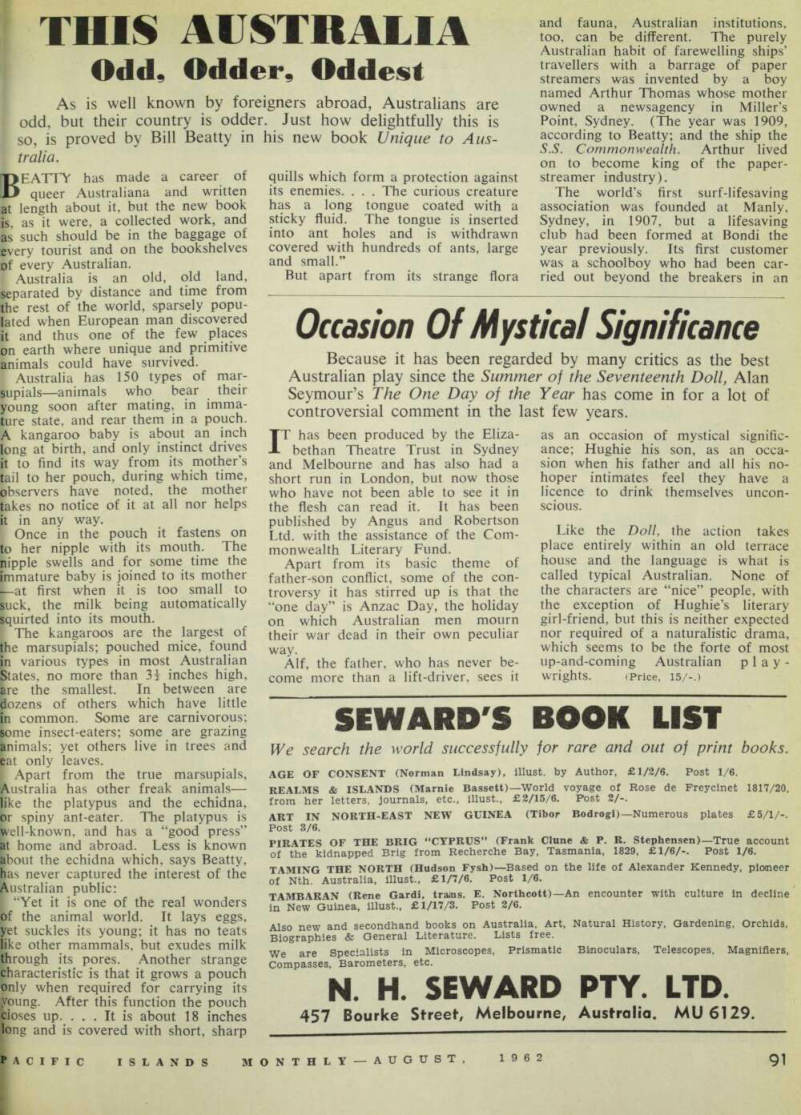
As is well known by foreigners abroad, Australians are odd, but their country is odder. Just how delightfully this is so, is proved by Bill Beatty in his new book Unique to Aus tralia.
BEATTY has made a career of queer Australiana and written at length about it, but the new book is. as it were, a collected work, and as such should be in the baggage of every tourist and on the bookshelves of every Australian, i Australia is an old, old land, separated by distance and time from the rest of the world, sparsely popu lated when European man discovered it and thus one of the few places on earth where unique and primitive animals could have survived.
Australia has 150 types of mar supials—animals who bear their young soon after mating, in imma ture state, and rear them in a pouch.
A kangaroo baby is about an inch long at birth, and only instinct drives it to find its way from its mother’s tail to her pouch, during which time, observers have noted, the mother takes no notice of it at all nor helps it in any way. [ Once in the pouch it fastens on to her nipple with its mouth. The nipple swells and for some time the immature baby is joined to its mother [—at first when it is too small to suck, the milk being automatically Squirted into its mouth, f The kangaroos are the largest of the marsupials; pouched mice, found in various types in most Australian States, no more than 3i inches high, are the smallest. In between are dozens of others which have little in common. Some are carnivorous; some insect-eaters; some are grazing animals; yet others live in trees and tat only leaves. [ Apart from the true marsupials, Australia has other freak animals— like the platypus and the echidna, or spiny ant-eater. The platypus is well-known, and has a “good press” at home and abroad. Less is known about the echidna which, says Beatty, has never captured the interest of the Australian public: 1 “Yet it is one of the real wonders of the animal world. It lays eggs, yet suckles its young; it has no teats like other mammals, but exudes milk through its pores. Another strange Characteristic is that it grows a pouch only when required for carrying its young. After this function the pouch Closes up. ... It is about 18 inches long and is covered with short, sharp
quills which form a protection against its enemies. . . . The curious creature has a long tongue coated with a sticky fluid. The tongue is inserted into ant holes and is withdrawn covered with hundreds of ants, large and small.”
But apart from its strange flora
and fauna, Australian institutions, too, can be different. The purely Australian habit of farewelling ships’ travellers with a barrage of paper streamers was invented by a boy named Arthur Thomas whose mother owned a newsagency in Miller’s Point, Sydney. (The year was 1909, according to Beatty; and the ship the S.S. Commonwealth. Arthur lived on to become king of the paper streamer industry).
The world’s first surf-lifesaving association was founded at Manly, Sydney, in 1907, but a lifesaving club had been formed at Bondi the year previously. Its first customer was a schoolboy who had been car ried out beyond the breakers in an
undertow. He said his name was Charlie Smith, and he grew up to become the poineer trans-Pacific avia :ar. Sir Charles Kingsford Smith.
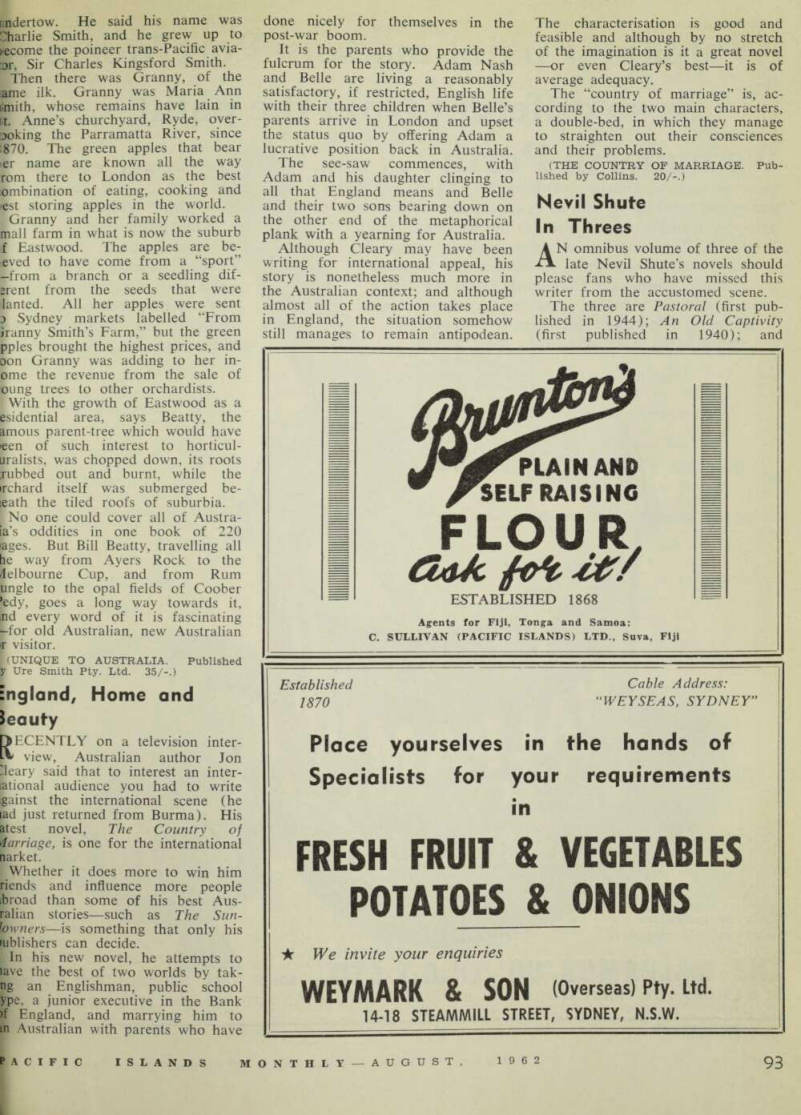
Then there was Granny, of the ame ilk. Granny was Maria Ann ilmith, whose remains have lain in lit. Anne’s churchyard, Ryde, over poking the Parramatta River, since 1870. The green apples that bear er name are known all the way rom there to London as the best ombination of eating, cooking and »est storing apples in the world.
Granny and her family worked a mall farm in what is now the suburb f Eastwood. The apples are be teved to have come from a “sport” .-from a branch or a seedling dif erent from the seeds that were •lanted. All her apples were sent a Sydney markets labelled “From Jranny Smith’s Farm,” but the green pples brought the highest prices, and non Granny was adding to her in ome the revenue from the sale of oung trees to other orchardists. > With the growth of Eastwood as a gsidential area, says Beatty, the amous parent-tree which would have •een of such interest to horticul aralists, was chopped down, its roots Tubbed out and burnt, while the Tchard itself was submerged be icath the tiled roofs of suburbia.
No one could cover all of Austr ia's oddities in one book of 220 [ages. But Bill Beatty, travelling all he way from Ayers Rock to the delbourne Cup, and from Rum ungle to the opal fields of Coober *edy, goes a long way towards it, nd every word of it is fascinating hfor old Australian, new Australian r visitor. [(UNIQUE TO AUSTRALIA. Published w Ure Smith Pty. Ltd. 35/-.)
England, Home and
ieauty
KECENTLY on a television inter view, Australian author Jon Jleary said that to interest an inter lational audience you had to write [gainst the international scene (he lad just returned from Burma). His atest novel, The Country of Carriage, is one for the international narket. [ Whether it does more to win him fiends and influence more people ibroad than some of his best Aus ralian stories—such as The Sun !owners—is something that only his •üblishers can decide.
In his new novel, he attempts to lave the best of two worlds by tak ng an Englishman, public school ype. a junior executive in the Bank )f England, and marrying him to in Australian with parents who have
done nicely for themselves in the post-war boom.
It is the parents who provide the fulcrum for the story. Adam Nash and Belle are living a reasonably satisfactory, if restricted, English life with their three children when Belle’s parents arrive in London and upset the status quo by offering Adam a lucrative position back in Australia.
The see-saw commences, with Adam and his daughter clinging to all that England means and Belle and their two sons bearing down on the other end of the metaphorical plank with a yearning for Australia.
Although Cleary may have been writing for international appeal, his story is nonetheless much more in the Australian context; and although almost all of the action takes place in England, the situation somehow still manages to remain antipodean.
The characterisation is good and feasible and although by no stretch of the imagination is it a great novel —or even Cleary’s best—it is of average adequacy.
The “country of marriage” is, ac cording to the two main characters, a double-bed, in which they manage to straighten out their consciences and their problems.
(The Country Of Marriage. Pub
lished by Collins. 20/-.)
Neyil Shute
In Threes
AN omnibus volume of three of the late Nevil Shute’s novels should please fans who have missed this writer from the accustomed scene.
The three are Pastoral (first pub lished in 1944); An Old Captivity (first published in 1940); and
requiem for a Wren (published 055).
They show Shute in his various noods. Pastoral is a simple war tne love story of a bomber pilot nd a young WAAF signals officer Iho kept radio tabs on him and his juadron while they were on dssions.
The other two novels are Shute in is metaphysical mood. Old Cap- Vity is a mixture of reincarnation, ie Norse legends of the discovery the New World and modern nation. Mr. Shute was a great diever in there being more things heaven and earth than dreamed in any of our philosophies and this and numerous of his other ♦vels, indulged in what, in other nters, might have been written off fantasy. It was probably this •ange out-of-this-earth quality com ned with authentic technical and ientific detail that got him readers Dm so many stratas of society.
Requiem for a Wren was also in lute’s other-dimensional mood, •itten during his Australian period, is the story of two brothers and sir wartime exploits in England, d one girl. The threads of the )ry come together only back in istralia but by that time the novel s already had an unhappy ending almost before it had a beginning. (THREE OF A KIND. Published by Inemann. 22/6.)
or Youngsters Who
font to Know
kADS and some Mums will find " the latest additions to the Study •ok series of as much interest as ;ir small sons and daughters will, four smart numbers, with plenty coloured illustrations, the subjects irered are Weather; Radio; Tele xphs; and Roads.
Fhe books trace the history of all :se subjects from ancient times ht up to the perfected present, r example, the Chinese tried to ecast weather over 3,000 years ) using the stars instead of the fntific instruments of today; while i first roads in Europe were just cks made by Old Stone Age man \ a time when Europe was still the grip of the waning Ice Age. fhe books about Radio and Tele iphs are equally interesting for mgsters with inquiring minds. All books are suitable for home or 100 l libraries,
Fhe Study Book Of Radio; The
Jdy Book Of Telegraphs: The
Jdy Book Of Roads; And The
JDY BOOK OF WEATHER. Published pie Bodley Head Ltd. 12/- ea.)
The Perry Mason
Of Rome
A WORKING knowledge of Roman " history is a help if you are to tackle John and Esther Wagner’s The Gift of Rome, and the fact that the authors have thought it necessary to give a foreword of explanation em phasises this.
The story covers the background and events that lead up to the trial of Cluentius, a rich business man, on charges of poisoning brought by his step-brother.
Cluentius is defended by Cicero, an attorney and a man of high rank, and the latter stages of the story cover the trial itself.
The novel abounds in the family mayhem that seemed to be part of Roman life in 55 BC or thereabouts, with mothers knifing their sons in the back metaphorically and other wise; and brother feuding with brother. (THE GIFT OP ROME. Published by Heinemann. 20/-.)
The Gubbys Outlast
Author Timms
WHEN one of Australia’s most prolific writers, E. V. Timms, died in 1960 with his last and 11th novel of his Australian saga un finished, his widow stepped in and completed the job for him. It ap pears now as The Big Country.
The 10 other Timms’ Australian novels—he had written 14 other books with different settings—have taken in pretty nearly every State in the Commonwealth at some time or another. Each had a pioneering or historical background, and all had related characters, although the two who get the prize for staying the whole distance are Martha and Henry Gubby, who have turned up in all of them with the unexpectedness of a recurring decimal.
In The Big Country, Martha and Henry, now in their eighties, decide to take up station owning in the Far West of NSW.
Here, Mr. and Mrs. Timms take on the half-caste problem through Jenny, whose aboriginal mother had been abandoned by her run-away sailor father before she was born.
The father meantime had struck it rich, married again and had set himself up in respectable state not too far from the Gubbys. When the latter engaged Jenny as house keeper, the stage was set for the denouement of the Timms’ drama. (THE BIG COUNTRY. Published by Angus and Robertson Ltd. 22/6.)