The Month's New Reading
pp. 93-94 · Read in the full issue
With Judy Tudor
Filling The Blanks On New Guinea Maps
It might be some consolation to the Dutch when they finally quit New Guinea that they were responsible for filling in the last large white patch still remaining on the map of the big island.
THE task of evaluating the data collected by the Dutch scientific expedition to the Star Mountains in 1959 will likely outlast the Dutch ; stay in this part of the world but in the meantime the gap will be bridged by the publication of a “ popular” book by the leaders of the expedition, L. D. Brongersma and G. F. Venema.
In this— To the Mountains of the Stars—the authors give an over-all r account of the expedition and its t achievements, leaving the more [ learned treatises to follow in due course.
The book is probably one of the most magnificiently illustrated that [ has been produced on any New Guinea subject, which compensates [to a degree for the fact that the [narrative itself is at times confusing [and always a bit heavy-in-hand.
The heaviness may be due to its I translation from the Dutch; or simply because it was written by I scientists who were interested primarily in facts and not in their I presentation. It could have been ; a more exciting and a more human I document with a little different approach.
The Star Mountains and the area surrounding them, which provided [ the last big blank on the map of the New Guinea mainland, are as near as possible to the centre of the I island, just east of the border with I Australian New Guinea.
Mt. Juliana, which forms the I summit of the Star Mountains, is I one of the four permanently snow [ capped mountains of West New 1 Guinea (the others being Carstensz, ; Wilhelmina and Idenburg), and was [first sighted in 1909 by the Military i Exploration Team from a point near ■ the confluence of the East and West : Digul Rivers. It was named after |j the Dutch Princess (now Queen) I who had been born earlier in 1909.
But nonetheless, although Mt. Juliana was known to be there, no white man had ever penetrated the wild country that surrounded it, or reached its summit.
The idea of a Dutch expedition to fill in the blank map began in 1953 when the Netherlands Associa tion for Research in the Natural Sciences in the East and West Indies and the Royal Netherlands Geographical Society decided to pool resources for a joint expedition to explore the central mountains region.
Almost six years went into the preparations and in these they had the full co-operation of the New Guinea administration. Because it was planned from the outset that the ex pedition should have full air support, the first task was to choose an air strip as close to the unknown country as possible.
The Sibil Valley, from aerial surveys, seemed the obvious choice and the airstrip was completed there as early as 1957. When the mem bers of the expedition finally reached it in 1959 they made their base camp on a hill nearby called Mabilabol, with support camps stretching away south along the route of the Digul River to Tanah Merah from which the whole party had proceeded on the expedition.
Throughout, the expedition was supplied by aircraft, backed up by helicopters—probably the first time the latter had been used in an ex pedition of this sort —and was pro tected by a small detachment of
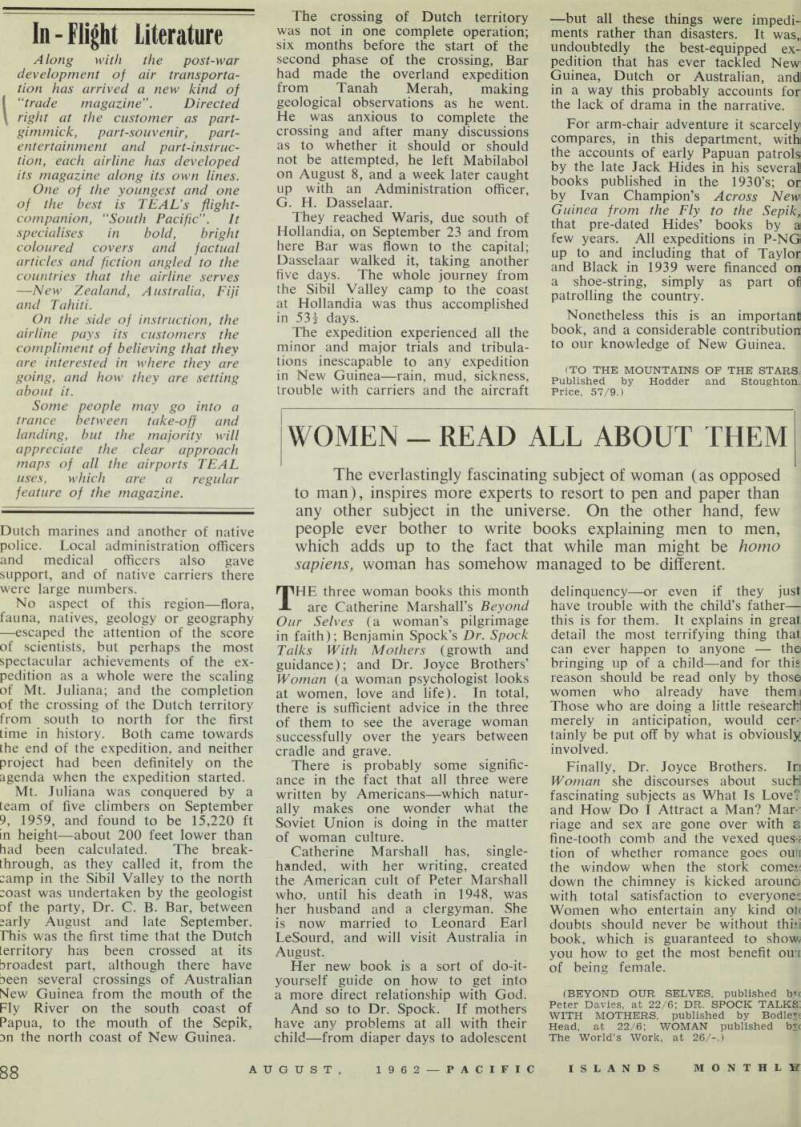
Mt. Juliana, 15,200 ft West New Guinea peak which was climbed by five members of the expedition in September, 1959.
Dutch marines and another of native police. Local administration officers and medical officers also gave support, and of native carriers there were large numbers.
No aspect of this region—flora, fauna, natives, geology or geography —escaped the attention of the score of scientists, but perhaps the most spectacular achievements of the ex pedition as a whole were the scaling of Mt. Juliana; and the completion of the crossing of the Dutch territory from south to north for the first time in history. Both came towards the end of the expedition, and neither project had been definitely on the agenda when the expedition started.
Mt. Juliana was conquered by a team of five climbers on September 9, 1959, and found to be 15,220 ft in height—about 200 feet lower than had been calculated. The break through, as they called it, from the :amp in the Sibil Valley to the north :oast was undertaken by the geologist of the party, Dr. C. B. Bar, between *arly August and late September.
This was the first time that the Dutch territory has been crossed at its broadest part, although there have been several crossings of Australian Mew Guinea from the mouth of the Fly River on the south coast of Papua, to the mouth of the Sepik, Dn the north coast of New Guinea.
The crossing of Dutch territory was not in one complete operation; six months before the start of the second phase of the crossing, Bar had made the overland expedition from Tanah Merah, making geological observations as he went.
He was anxious to complete the crossing and after many discussions as to whether it should or should not be attempted, he left Mabilabol on August 8, and a week later caught up with an Administration officer, G. H. Dasselaar.
They reached Wans, due south of Hollandia, on September 23 and from here Bar was flown to the capital; Dasselaar walked it, taking another five days. The whole journey from the Sibil Valley camp to the coast at Hollandia was thus accomplished in 53i days.
The expedition experienced all the minor and major trials and tribula tions inescapable to any expedition in New Guinea—rain, mud, sickness, trouble with carriers and the aircraft
—but all these things were impedi ments rather than disasters. It was,, undoubtedly the best-equipped ex pedition that has ever tackled New Guinea, Dutch or Australian, andl in a way this probably accounts for the lack of drama in the narrative.
For arm-chair adventure it scarcely compares, in this department, with the accounts of early Papuan patrols by the late Jack Hides in his several! books published in the 1930’5; or by Ivan Champion’s Across New Guinea from the Fly to the Sepik , that pre-dated Hides’ books by a few years. All expeditions in P-NG up to and including that of Taylor and Black in 1939 were financed on a shoe-string, simply as part of patrolling the country.
Nonetheless this is an important! book, and a considerable contribution to our knowledge of New Guinea.
(To The Mountains Of The Stars.
Published by Hodder and Stoughton, Price, 57/9.)