Magazine Section
pp. 83-84 · Read in the full issue
Pacific Islands Monthly
When The First Mail Came To Pitcairn , It Was . . .
A Red Letter Day For The Last "Bounty" Mutineer
By Robert Langdon
Since 1941, when Sir Harry Luke, then the Governor of Fiji, sent Mr. H. E. Maude to Pitcairn Island to establish the island’s first post office, Pitcairn has done a thriving trade in the sale of postage stamps.
Stamp collectors all over the world write to Pitcairn for its stamps, which provide the island with its only I source of Government revenue. (Pitcairners themselves sell curios and baskets to passengers aboard passing I ships and make money that way).
MANY of the stamps so far issued have had motifs inspired by events in the island’s history. But the authorities have yet to issue a stamp to commemorate one of the most moving incidents in Pitcairn history—the arrival of Pitcairn’s first piail boat.
I This event, which I recently found recorded in the Calcutta Journal for fuly 20, 1819, took place on January 18. 1819, when Captain James Henderson, of the merchant ship Hercules, delivered a letter to John Kdams.
I Adams was the last of the nine Bounty mutineers who settled on Pitcairn in 1790 with six Polynesian men and 12 women.
I The letter was from Adams’ brother Jonathan, a London water- Inan, whom the mutineer had not leen for 32 years. Adams had been on Pitcairn for 30 years.
I Captain Henderson’s ship was only the fifth to visit Pitcairn since the arrival of the mutineers—the others being the American sealer Topaz in 1808, HMS Briton and HMS Tagus in 1814, and the American whaler Sultan in 1817. 1 The visit of the Hercules was a direct result of the visits of the Briton and Tagus, and was due to the interest in the Pitcairn com munity of the Admiralty Secretary, Sir John Barrow, who published the first full-length account of the Bounty mutiny in 1831, I Following the visits of the Briton and Tagus, Barrow wrote an article for the Quarterly Review in which he urged his countrymen to help the
Pitcairners by sending out tools, agricultural implements, seeds, books and writing materials, plus a zealous missionary and “a few persons cap able of teaching the useful trades and professions”.
“On Pitcairn’s Island,” Barrow wrote, “there are better materials to work upon than missionaries have yet been so fortunate as to meet with, and the best results may reasonably be expected.”
Not surprisingly, it was not long before Barrow’s article came to the attention of the London Missionary Society, which looked around for a missionary to go to Pitcairn.
But no suitable person could immediately be found, so the society had to content itself with sending a box of religious books to John Adams.
The box of books, plus a letter from Adams’ brother, who had been found working as a waterman for the London Assurance Company at Wapping, were eventually handed to Captain Henderson, of the Hercules, for delivery.
It is not clear from the records whether Captain Henderson received these articles in England or in India.
But it is known that they were delivered at Pitcairn while the Hercules was on a trading voyage from Valparaiso to Calcutta.
It was on this voyage that Captain Henderson gained a minor place in the hall of fame, for on the day before he arrived at Pitcairn he discovered an uninhabited island which is now known as Henderson Island. (This island is the source of the miro wood from which the Pitcairners now make many of the curios to sell to passengers in passing ships).
Writing of his visit to Pitcairn, Captain Henderson said: “On getting within two or three miles of the shore, we observed a boat coming off, which was very small, being one given them by an American that had touched at the island about 18 months before. (Over)
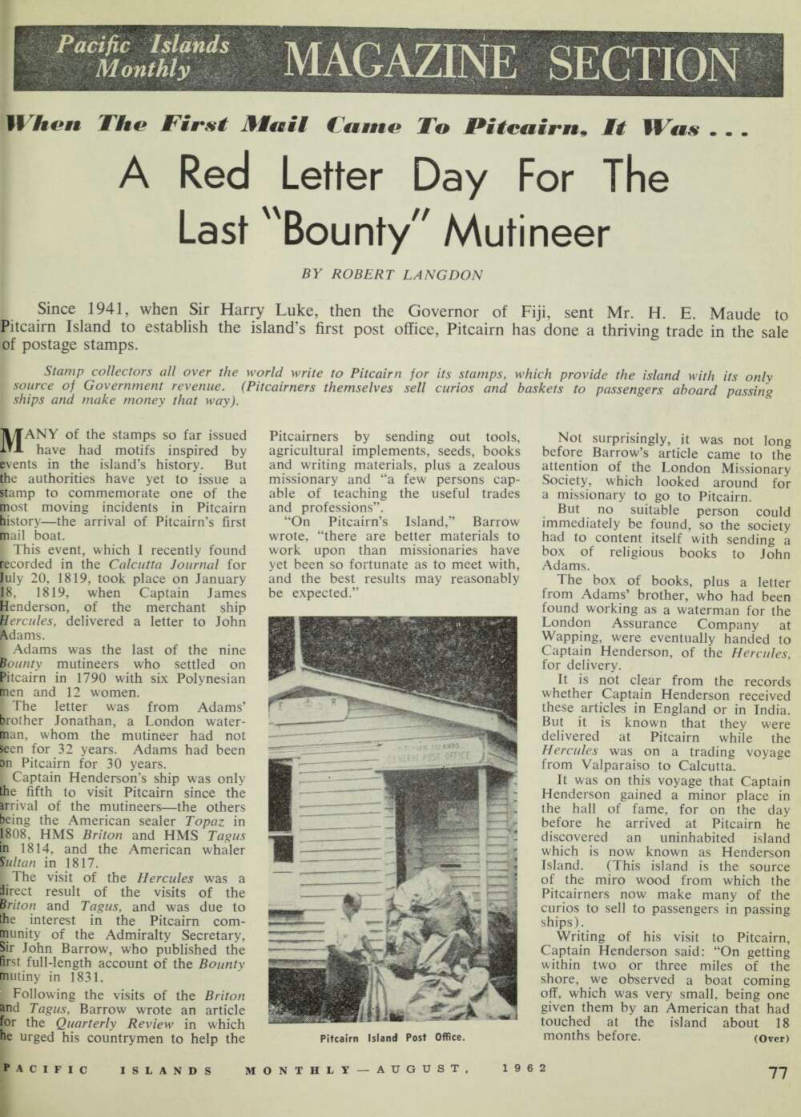
Pitcairn Island Post Office.
“On approaching us the first thing they asked was whether we were a man-of-war or a merchantman, American or English.
“On being answered that we were a trading ship under British colours from India, they came on board, nine in number and all young men.
“After breakfast I went on shore at 7 a.m. and was received by old Mr. Adams and all the other in habitants of the island; but not be fore the islanders that were in the boat with me had given a shout or cry peculiar to themselves to signify my being a friend.
“I delivered to Adams the box of books from the Missionary Society of London and a letter from Adams’ brother, who is still living at Wapping in London.
“I read this letter to him, giving him a description of his family, men tioning the death of one sister and the prosperity of another.
“This affected him much and he often repeated that he never expected to see this day, or, indeed, one of his countrymen more.”
Captain Henderson said he was then led up the rocks to the village where Adams, who was 57, told him the story of the mutiny of 30 years before.
Later, Adams wrote a letter to his brother in which he was moved to say: “I this day have the greatest pleasure in my life since I left my native country, that is of receiving your letter dated October 13, 1817.
“I have now lived on this island 30 years and have a wife and four children, and considering the occasion that brought me here, it is not likely I shall ever leave this place.
“I enjoy good health, and except the wound which I received from one of the Otaheitans when they quarrelled with us, I have not had a day’s sickness.
“I understand it is the intention of the Missionary Society of London to send a person here to instruct us in the Christian Religion; I can only say I have done everything in my power to instruct them in the path to Heaven, and, thank God, we live comfortably and happy and not a single quarrel has taken place these 18 years ...”
Captain Henderson said that as Adams’ sight was failing, he gave him the glass of his sextant to use as a reading glass.
He also gave the islanders a pitch pot, one or two spades, a saw, and a few knives, forks, plates and pairs of shoes. But he could not supply them with the things they needed
most—agricultural implements, toe and cooking utensils.
However, soon after he arrived i Calcutta in April, 1819, Captai Henderson took it on himself to sta: a fund to aid the Pitcairners.
The fund at first was not much o a success, but after some Pra publicity, including an excellei article by Captain Henderson bin self, the contributions flowed i liberally.
On July 13, 1819, the CalcuU Journal reported that 3,000 rupe* had already been spent on supplu and that many other items had bee provided.
The Calcutta Journal added th.j Captain Henderson had undertake to deliver these gifts to Pitcairn o his next voyage to Chile.
Although no record of Captai Henderson’s second visit to Pitcaii appears to have come to light, the:? is an interesting relic of the visit the Public Record Office, London.
This is a logbook of the Bourn covering the period from Novembc 3, 1787, to July 17, 1788, which JoH Adams gave to Henderson, and whio' Henderson gave to a British navv officer in Valparaiso, who presente: it to the Admiralty in 1827.
The logbook (a transcript of whiei is in the Mitchell Library, Sydney contains no information of value students of the Bounty mutiny as is merely a copy of nautical das from the official log, with obserw tions on the crew’s duties.
But it is interesting because til internal evidence suggests that it wv kept by Fletcher Christian, of whoj no other personal relics of his voyai in the Bounty are known to har survived.
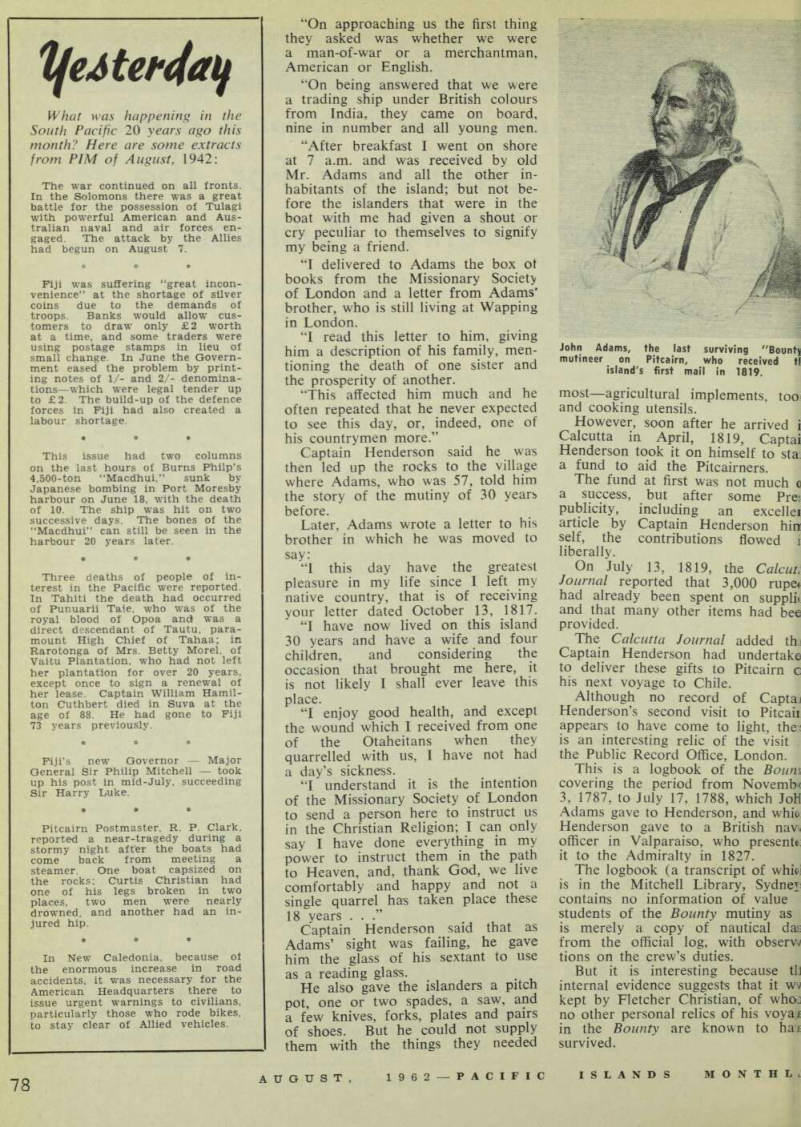
John Adams, the last surviving "Bounty [?] mutineer on Pitcairn, who received t [?] island's first mail in 1819.