Swift Moves Alter Whole
pp. 65-67 · Read in the full issue

Japan's Interest Arouses New Zealand
S. Pacific Banana Outlook
Probably the most surprising economic discovery of the year in the South Pacific Islands is that Japan, if guaranteed supplies, will come right south to the Tropic of Capricorn for bananas, and will take them in large quantity.
PHE South Central archipelagoes— L especially Fiji, Samoa and onga—always have been almost un mited producers of first-class fruit; jt hitherto there has been only one tarket —New Zealand.
In very recent times, that restless, and indefatigable sales lan of his country’s produce, render Prince Tungi, of Tonga, ;gan probing the Japanese markets -and learned that Japan wants Inanas. Fiji sat up with a jerk.
In recent months, Mr. Eric evington, Fiji’s new hard-working evelopment Commissioner, has ;en rather desperately seeking new, lick-acting industries for Fiji, to Mrect the growing economic un ilance created there by a too rapid ipulation growth. In May, at the rst hint of Japan’s banana hunger, [r. Bevington flew north; and in me at least two parties of alert lung Japanese fruit wholesalers rrived in Fiji, Samoa and Tonga, I examine possibilities.
Japan definitely was interested in inana supplies; but this was not [thing simple and easy to arrange.
Supplies to Japan of this important foodstuff must (a) be guaranteed and (b) must be of high quality and without blemish.
Japanese Demand and Supply
Japan gets more than half her enormous banana needs from Formosa, and the balance of the same seasonal production is found easily enough in the tropical and sub-tropical lands of the North Pacific. It is in the North Pacific’s off-banana season that Japan comes searching south of the equator.
It seems that Japan has been searching for some time, and her needs are not yet filled. There have been increasing shipments from Ecuador, but they are not sufficient.
The Japanese population growth is now under control, but the Japanese standard of living is rising steadily, and that demands more bananas.
Indications are that the present combined production of Fiji, Samoa and Tonga, after supplying New Zealand, is far short of the potential Japanese demand; and the three Administrations now are giving the whole subject very close attention, in consultation with Japanese mer chants. Especially Fiji, whose need for a new industry of this kind is really urgent.
Fiji May Need Big Planning
Fiji’s governmental and com mercial interests now are examining the possibilities very closely.
Already, it is clear that if this is to be a worth-while development, the whole industry needs review, and the foundations must be put deeper, and widely extended.
There do not appear to be nearly enough banana-lands and banana growers immediately available to take care of Japan’s needs, if Japan’s needs are to be big enough to have a perceptible effect on Fiji’s economy.
Mr. Bevington, in July, appeared to be in the forefront of the necessary inquiries and examinations.
Half a dozen Fiji Government Departments appeared to be involved, especially the Native Land Trust Board and the Department of Agri culture.
It is not only a question of grow ing bananas—but also of producing bananas of high quality and un blemished skins. It is hoped that the bananas will be grown by Indians and Europeans, as well as Fijians, and that machinery for instructing and helping growers will be created quickly.
There is urgency in the steps being taken in Fiji—but almost equal liveliness in the preparations under way in Tonga and Samoa.
NZ May Have to Bid Against Japan Until now, banana production in these groups has been conditioned by the New Zealand demand; and the latter has been only a very small part of the potential. Nonetheless, as is well known, Fiji rarely, in recent years, has been able to fill the NZ quota. It has seemed almost as if the banana-growing interests have been afraid to develop, in case they should find themselves with large over production.
The Japanese inquiry has caused a mighty new stir. It has stirred the NZ importing interests, which suddenly see themselves in com petition with Japan in the only market capable of supplying New Zealand. Hitherto shy and coy when meeting the banana-suppliers, the New Zealanders have already made firmer offers for bigger quotas.
New Zealand proposes to increase
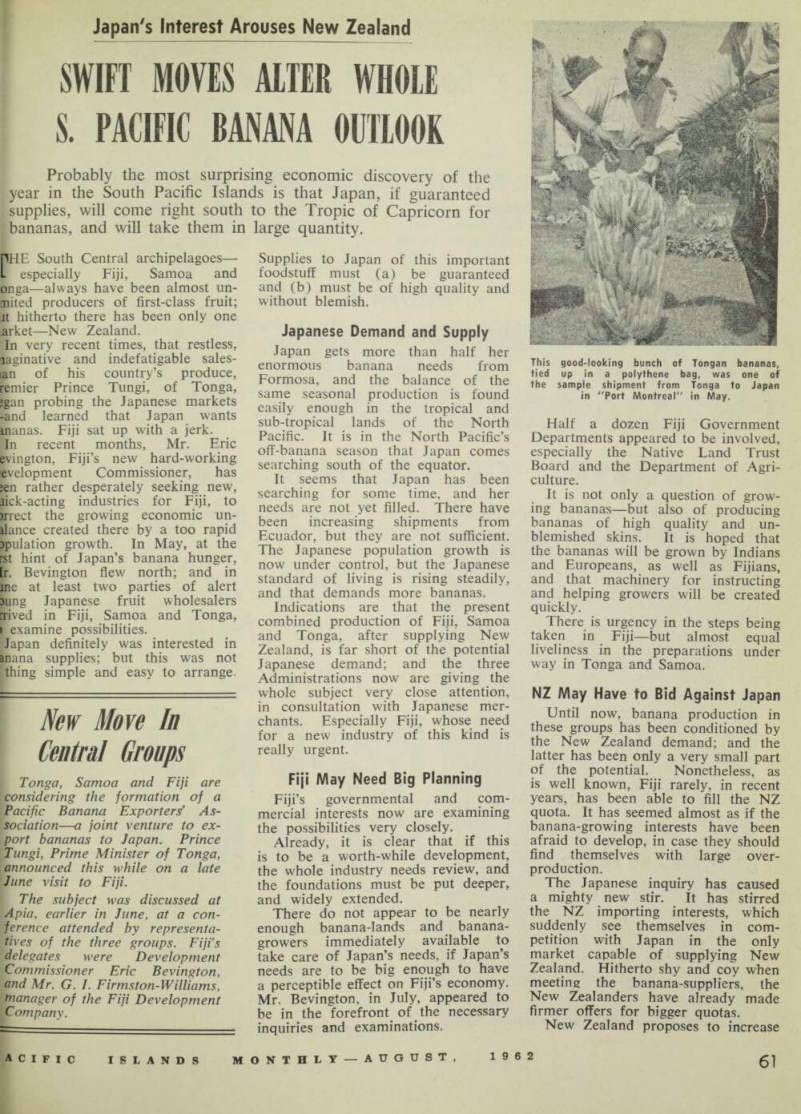
This good-looking bunch of Tongan bananas, tied up in a polythene bag, was one of the sample shipment from Tonga to Japan in "Port Montreal" in May.
t banana purchases from Fiji by V least 30,000 cases to 180,000 ses a year, said NZ Trade Minister dr. J. R. Marshall) after the Fiji cvelopment Commissioner (Mr. ric Bevington) and Mr. J. N. ilvey, MFC, visited NZ in June for ide talks—chiefly about bananas.
Mr. Marshall said that a “mini um” of 180,000 cases a year would i exceeded in most years. However, Z had a limited market and, when iporting bananas, she had to take to account her traditional suppliers, pecially Western Samoa.
However, all parties agreed that e Fiji grower should be assured a market, and the NZ consumer ■ at least a minimum quantity from ji- At the end of the second year, e contract will be reviewed, to e if the minimum quota can be creased.
Messrs. Bevington and Falvey also scussed the expansion of mutual ade, particularly in timber, which
the Fletcher Timber Company interests in Fiji have already started to export to New Zealand. It is hoped that timber will eventually become an annual £3-4 million export earner.