territories TALK-TALK
pp. 55-60 · Read in the full issue

There is not much doubt, in my mind, but that the Tolai people have won the palm for being the most consistent litigants in the Lands Zlaim Stakes in TNG. Whether this is because of their greater sophisti cation or not is, perhaps, a moot point.
J the pre-War II years there were arguments over the Lakunai Air pi there were also arguments be xn the Matupis and Nodups over rden areas on the slopes of Mount ither; and occasionally survey pegs re removed and many headaches ised by native claimants for alleged i-payment for land areas, en •achments and what-nots, rhe loss of land records, as a uli of two World Wars, added to [confusion and no wonder Lands les Commissioner McCubbery, in se days of native appeasement, ; a thankless job dealing with such ims as the recent one regarding d surrounding the Rabaul town fWien I read about it in a local f newspaper, I fossicked among [sparse records and came across fawn Planning survey map of the haul township, made by the Ger ns in June, 1913. wrvey pegs of the townsite area [clearly shown, together with land nted to the Norddeutscher Lloyd [that retained by the Landesfskus I Deutsch Neu Guinea (Crown d), as well as three areas at the t of Namanula (south-east of the tanical Gardens) held by the tholic Mission, the Methodist Mis n and Heinr. Rud. Wahlen, Land Side the town boundary is marked jgeborenenland (native land). fhat brings the picture fairly well Ito-date. Well, within fifty years I today. Surely Australia has prds of any acquisitions since our upation—4B years ago. When one isiders the consistent over-riding itrol exercised by the appropriate stralian military and/or political tertment, responsible for New inea since our occupation, it is ural to assume that there are prds of every NG land transaction sved away somewhere amongst the ity archives of Bureaucracy. point which should be remem ed (although not a technical one) that the German Governor (Dr. hi), who was a judge during the u Guinea Kompagnie’s adminis tion before his appointment as vernor, was a stickler for accuracy [were most German officials), and
was also a great protector of native interests. The Tolai people gave him the name of Patuan, the most com plimentary title in their language.
Incidentally, the German defini tion of Crown Land ( Landesfiskus) was “being void of human life and unclaimed by any chief.”
With Tolala
A Coincidence Extract from Granny’s ( S.M.H .) Column of 28/6/62:
“Remembrance. Only 12 Or
15 people, mostly widows, are expected at a quiet ceremony at the Cenotaph at 10 a.m. today.
“It marks the 20th anniversary of the sinking of the Japanese transport Montevideo Maru, with its battened-down cargo of over 1,000 Australians bound from Rabaul to Japan. Each year widows and mothers make this un publicised visit to the Cenotaph, lay a few flowers, and go their ways.”
“Arrivals”
SM.H. Shipping News, 29/6/62: “Yesterday: Montevideo Maru, from
Adelaide, 6.36 a.m.” It departed for Japan on 30/6/62.
The name, at any rate, lingers on.
From My Mail Bag
One of the “perks,” as well as the pleasures of writing Talk-Talk, is the diverse character of my corre spondence from a variety of indi viduals, living in many countries.
Some reminiscing, critical, censoring, complimentary; all welcome for they give me a fair cross-section of readers’ opinions.
Let me share some of them, picked at random, with my readers: Here’s one, written from near the “Forgotten Islands” (May T.T.) and dated the middle of June: “Thank you for the very pleasant moments you have given me. ... Re the ‘For gotten Islands’; A trawler patrol re turned from there last week and a successful spraying campaign was carried out by Mr. B. Campbell, which lasted three weeks. This patrol was the first to visit the ‘Westerns’ since August last year, so you see, the ‘Westerns’ are not exactly over run by officialdom. Why these islands are not included in the Madang or Sepik district is still a puzzle to me as there is a shipping service between these places and not between the ‘Westerns’ and Manus. . . . The Catholic Mission (now from Kavi eng) also visited the Westerns again for the first time last year, after many years of absence, and did so again about a month ago. . . , The palatial buildings on Manus you men tion may soon (so the grapevine has it) pass into the control of the De partment of Supply. The Navy may pull out and the D. of S. will use the base as part of the satellite track ing station to be built with USA dollars. ... If it wasn’t for the col-
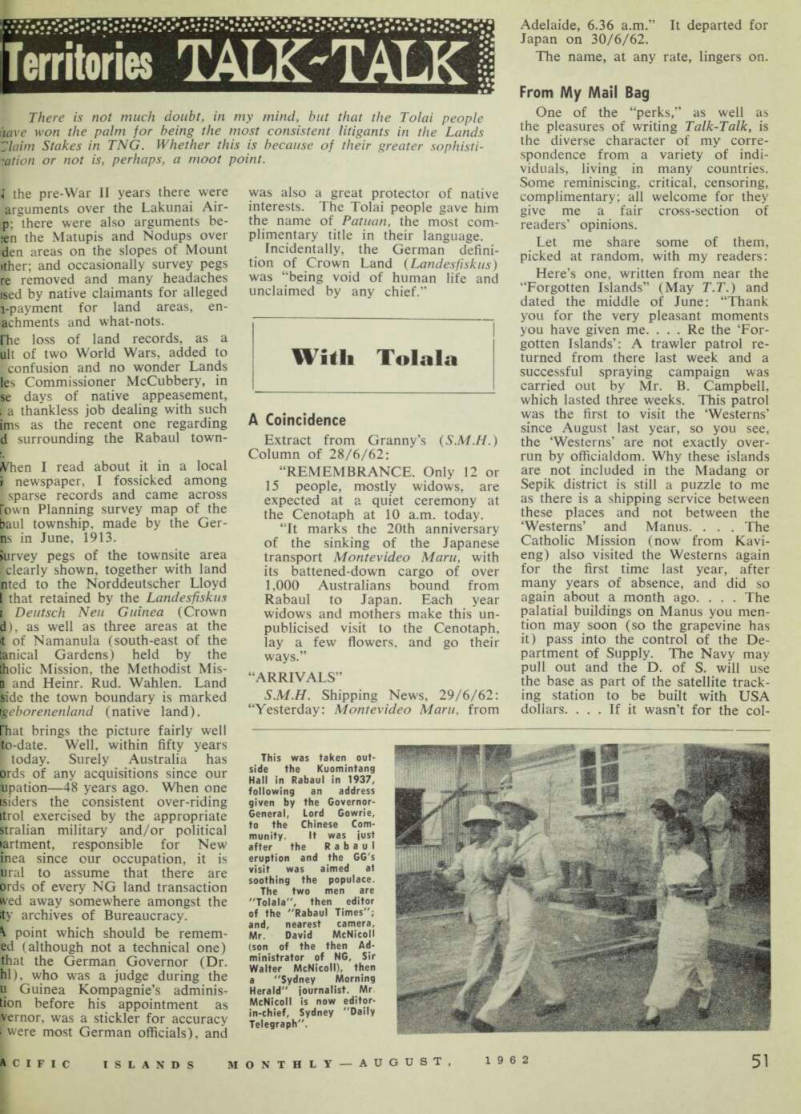
This was taken out side the Kuomintang Hall in Rabaul in 1937, following an address given by the Governor- General, Lord Gowrie, to the Chinese Com munity. It was just after the Rabaul eruption and the GG's visit was aimed at soothing the populace.
The two men are "Tolala", then editor of the "Rabaul Times"; and, nearest camera, Mr. David McNicoll (son of the then Ad ministrator of NG, Sir Walter McNicoll), then a "Sydney Morning Herald" journalist. Mr McNicoll is now editor in-chief, Sydney "Daily Telegraph".
ction of taxes I wonder if the offi als would ever go to the ‘Westerns’?” a om Melbourne Side |From John Ahearn (previously in abaul and Port Moresby, and now \ Melbourne): “I was indeed in fested at reading your mention of p Lakunai races. . . .Yes, you were ght in your assumption that I had jtired. In point of fact, it is only alf right. I retired from Vacuum il 18 months ago, after 39 years E service. The following day I dned National Safety Council of justralia. . . J. M. David, Bank of [SW manager, whom you mentioned I your story, I believe has been dead )r quite a few years, but the particu ir meeting has recalled to my mind a amusing incident. A very skilful der, who was far more clever than is opponents and fully versed in all le tricks of the game, was called efore the stewards. The charge: )ul riding. The decision of the ewards: Guilty, fined £5, and placed Jcond instead of first. When the bairman announced our decision, ) the jockey in a very loud voice he oubted our parentage! Result: A irther fine of £10!
“I still maintain contact here with ame of the pioneers. E. A. (‘Pard’) lustar, the pioneer of aviation in
f he Territory, still as alert as ever.
He’s doing a job for an insurance company, having retired a couple of years ago from his rank of Group Captain, RAAF.
“lan Grabowsky, another pioneer pilot and former Guinea Airways manager, retired from Ansett-ANA some six months ago. He is now compiling a history of aviation in the Territory for Department of Civil Aviation. Despite the loss of both legs, he is very cheerful, active and mobile.
“Graham Mirfield, formerly of WRC, Rabaul engineering and Mioko plantation, still going strong. You
will recall how his wife ‘Bicky’
Schmidt, was killed in an air-crash near Bitapaka. ‘Mirf.’ suffered a broken neck.
“Lady Jean Phillips, Monty’s widow, is living in New Zealand, but comes to Melbourne every now and then. J. N. Montgomery, who was chief geologist for Oil Search, has retired from the oil business and is living at Mt. Eliza. I recently saw a much-beloved Territorian, Rev.
Father McEnroe, MSC, better known in Papua and Wau/Lae than the Rabaul side. Years have told on him. He’s 73, I believe he said, but still as delightful a character as ever.
He’s at Hindmarsh, South Australia.”
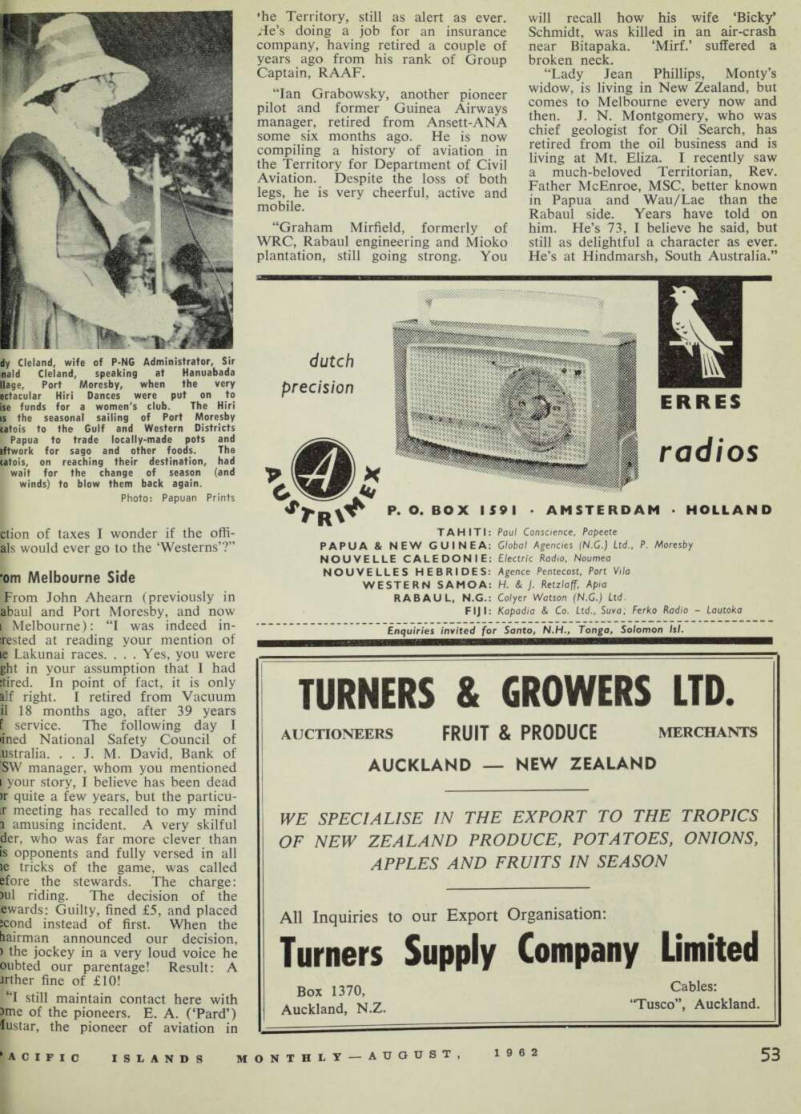
[?] dy Cleland, wife of P-NG Administrator, Sir [?] nald Cleland, speaking at Hanuabada collage. Port Moresby, when the very [?] ectacular Hiri Dances were put on to [?] ise funds for a women's club. The Hiri [?] s the seasonal sailing of Port Moresby [?] katois to the Gulf and Western Districts [?] Papua to trade locally-made pots and [?] ftwork for sago and other foods. The [?] katois, on reaching their destination, had [?] wait for the change of season (and winds) to blow them back again.
Photo: Papuan Prints
(om Germany
SFrom Hans Mannsfeld, previously inager of Arawa plantation, in the nugainville district, and now living iGermany: “You wanted to know 10 is still alive of the old-timers Hamburg’s New Guinea Club. 111, the most outstanding figure is sinr. Rud. Wahlen, former Swedish »nsul for New Guinea, probably the ost successful pioneer, now 90 years I age and still going strong. His finger brother, Julius Wahlen (for ;r manager in Maron), does not me very often to the club. fThe second oldest member, Her mann Bolten, died just two months 0 He had American citizenship d could retain his property. He id several visits to the Islands be een the wars and he may still be own to some of the old-timers in 3 Baining district. [He owned a tiber mill at Nambung in the linings.] |‘Other members are Theodor von jin (branch manager of Hernsheim ICo. at Kavieng); Hans Jacobs j-anch manager of Hernsheim & I. at Manus); Paul Weimer (stores anager of H&Co. at Rabaul); Thol lanager Nordd. Lloyd at Rabaul); iroder (Police-master at Kavieng); so various others from the Caro les, Marshalls and Samoa, as well iNaval officers—all of them well r er 70 years of age. *‘Do you remember Paul Drege id Archie Baldwin of Kieta in 1914? hen 1 was staying with them a few inths before the last war, I re ember they mentioned your name. ‘You wanted to know about my Iglish. Well, I have spent half my ie in the colonies. After my second iy in New Guinea, I turned to Ist and South Africa and was re itriated from there only in 1948. ow I am fulfilling a job here as lerpreter at NATO headquarters, it I intend to retire next year to y home town, Hamburg.” om U.S.A.
John G. Troster, in California IT. June) in writing about his job 1 Emirau Island with the Marine 3rps Group, says: “My job was ie of the Group of Radio-Radar Beers. Actually, I never got off the ound. At that time radar was still lite a secret (there were times when ings went wrong when the whole ing was pretty secret from me, o?), so radar people were not al wed to fly over enemy territory for ar of being captured. So I was )t allowed to see Kavieng or Rabaul.
“We bombed either Kavieng or abaul about daily and then at night nt up ‘hecklers’ whose mission was
to drop one bomb at a time all night long—every half hour or so. One plane at a time for several hours, then another plane would go out and relieve that one and drop one at a time.”
You’re telling me! I remember the many nights I spent in dug-outs listening to these “naggers”, but we didn’t call them “hecklers”—that was too nice a word!
He goes on to relate how he endeavoured to get permission to travel in Papua and New Guinea and see something of the interior, but most of his inquiries were futile. “I can’t
get much of anything out of the Australian consul here in San Fran cisco.
“I am an amateur radio operator and whenever I talk to Islands hams I always mention that I keep up on their latest doings by reading PIM.
Of course, they are always familiar with the publication and it is a good topic of conversation.”
Curse of Conformity Amongst the John Citizens of the world it is called: “Keeping up with the Joneses”; amongst world tribunals the term has changed to “political
expediency.” To use a Harold M; millan phrase: “Winds of Chang But, whatever you call it there is m a general tendency to accede to general opinion; to fit in to a glol jig-saw puzzle, or pattern.
In short; to conform—or else.
Fashion proclaims that we m recognise and condone our worm folk mincing about in tight-fitt; matador pants and flat-heeled she or knee-displaying skirts and spi heel shoes. And . . . But I’d bet end there.
The latest condonation, appea ment or taking the line of least sistance comes from no less a pers than Sir Hugh Foot and his colleag; on the recent UN Trusteeship Miss; to New Guinea. The “recommen tions” contained in their report ( doubt with tongue in cheek), h; occupied much space in the Austral!
Press. This has given the newspap a peg on which to hang their f ourite editorial policies, quite ii spective of regard for native welf —and I repeat “native welfare,” spite the fact Sir Hugh suggests tl “native” is a dirty word.
I make no comment on the practical and absurd recommen tions of the UN Mission and a hope that Australia may have intestinal fortitude to tell the T Trusteeship Council to go jump i Lake Success, which is so handy them.
The United Nations should kn by now that Australia’s first c sideration, as a Trustee, is the F Guinea people and not a conglon ate crowd of bankrupt, crackpot c formists, fearful of witnessing; primitive people entering our o modern civilisation under sens* conditions and peacefully—which possible, given reasonable time.
Mr, and Mrs, Lucius Hui after their mast at the Roman Catholic Church, Port Moj on June 16. The bride was formerly ’
Cecilia Pon. —Photo; Papuan Prints..;