Without Independence
pp. 45-46 · Read in the full issue
Nz Offers Cook Is. Self-Government
Even New Zealand—not usually regarded as one of the Colonial villains—is feeling the heat of United Nations pressure. It has driven NZ Minister for Island Territories, Mr.
F. L. A. Gotz, to Rarotonga, Cook Islands, twice in the last few months.
IE was there in April on a routine visit. He went back again in ily to deliver to the Cook Islands egislative Assembly, on the 12th of lat month, a long prepared speech, early designed as the policy NZ (tends to follow in dealing with her Smaining Pacific Islands Territories.
The Cook Islands has been a New saland dependency since 1901, but Dked more closely than, for tample, the Australian Territory of apua is to Australia. Cook Islanders •e New Zealand citizens and have ee entry to the Dominion; there I also what amounts to a Customs lion. New Zealand makes sub antial monetary grants to the ooks.
However, so far as the United ations Organisation is concerned, b Cook Islands are still victims of jlonialism and as such should be eed. If this is what the Cook landers eventually decide that they i)uld like, no doubt New Zealand >uld be happy to oblige as the roup has been of considerable ex nse to the Dominion and no par jular benefit.
But what Mr. Gotz went to offer em was, in effect, the best of two bids. This is what he said, in rt: “A few weeks ago the New aland Cabinet discussed what steps ght to be taken in the next few ars, and my principal purpose in ending this session of the As nbly is to let you know the views
[my Government.
“We feel that our aim should be (establish full internal self-govern :nt in the Cook Islands as soon this is reasonably possible.
“We think that, within the next 3 or three years, you should be a position to assume the control wour own affairs, with your own Bisters, your own chairman of sembly, and with the widest isible powers of legislation. ‘We have in mind a change in [ role of the Resident Com moner, from that of the admini »tor of the territory to the position
of a constitutional head of the gov ernment, somewhat like the Governor-General in New Zealand, but probably with different powers.
“Please do not imagine that it means that we
want to cast you out of the family. On the contrary, I think our re c e n t actions have shown clearly that we wish to do whatever is right for the Cook Islands, in accordance with the wish of the people,
and we hope that our close and friendly relations will continue.”
Mr. Gotz said three other plans for the future government of the Cook Islands had been suggested.
The islands could become: • Fully independent like Western Samoa, a NZ trust territory until the beginning of this year. 9 Fully integrated with New Zealand. • A member of a Federation of Polynesia.
Speaking of the possibility of in dependence, Mr. Gotz said: “We may have had some doubts as to whether a country as small as Western Samoa could stand alone, but the people wanted independence and we freely gave it to them. Only the future will show whether Samoa will succeed or not.
“Now, Western Samoa is 12 times the size of the Cook Islands, it has six times the population, it has two large islands only a few miles apart and it has a large income from ex ports. In spite of this, Samoa is going to have difficulties.
“You must consider how much more difficult it would be for the Cook Islands to operate as an in dependent country, with 15 tiny islands hundreds of miles apart, a
small population and a relatively small income.”
On full integration with New Zealand, Mr. Gotz said; “This would mean that you would receive the same treatment as, say, the Province of Taranaki. All the laws of New Zealand would then apply here—not only some which you would like, but also a number which you would probably not like. Under this system, you would, in place of a Legislative Assembly of your own, have repre sentation in the NZ Parliament.
“What would that representation amount to? The Cook Islands on their own would not be big enough to have even one Member of Parlia ment; you would have to share one member with Niue and the Tokelaus.
Mr. Gotz said that people who had put forward a Federation of Poly nesia as a solution to future govern ment had suggested that it embrace the two Samoas, Tonga, the Cooks, Niue and possibly other Polynesian islands.
“A federation is a group of states,”
Mr, Gotz said, “each with its own government looking after local affairs and a central government dealing with matters of national interest.
“At first sight this might seem a
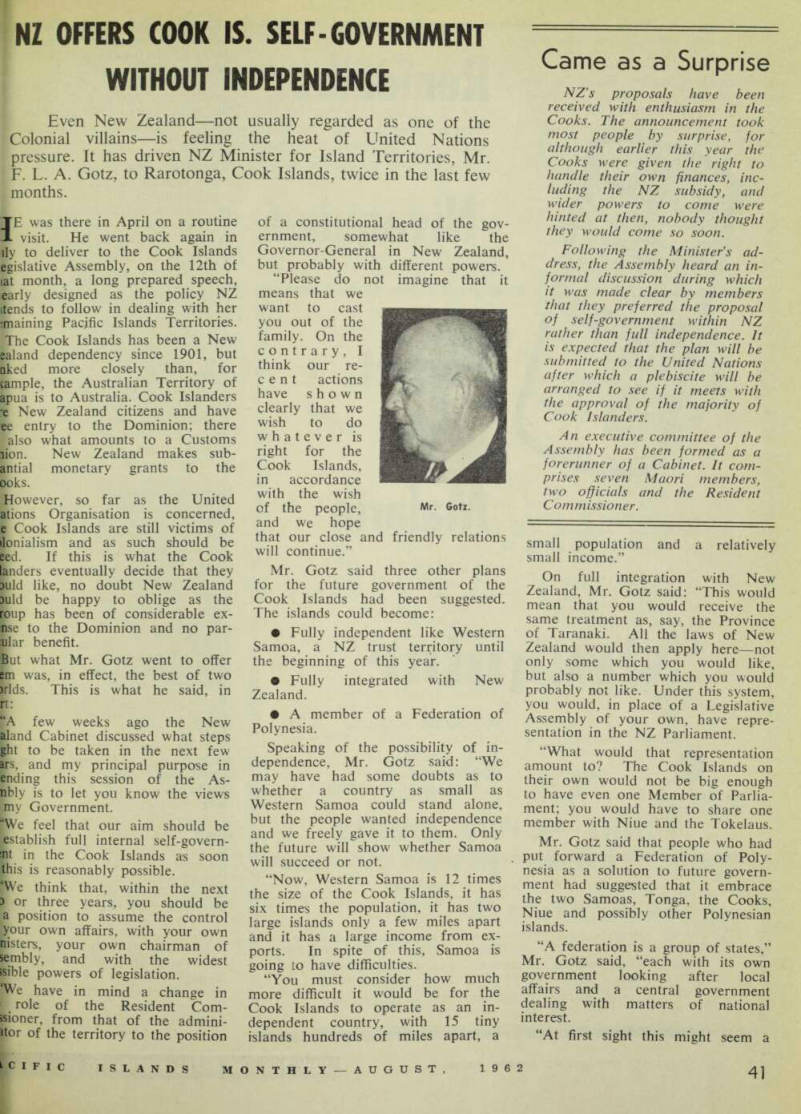
Mr. Gotz.
practicable proposition, but tl would be enormous difficulties cause of the smallness and the scattered nature of the vai islands. The biggest say in the cei government would naturally gc the larger island groups, which 1 plenty of problems of their own “You have a hard enough tass get all of your Assembly membei Rarotonga once a year. How n more difficult would it be for representatives of dozens of isll to assemble for meetings?
“For these, and many o reasons, I don’t think the feder; idea can be seriously considers present.”
Mr. Gotz said he thought it w, be in the best interests of the 0 Islands people to keep the pn link with New Zealand, but to full internal self-government.
“Under such an arrangement,, said, “you would retain your Zealand citizenship, and you w manage your own affairs within Cook Islands, while New Zes would be responsible for such ms as external affairs and the stitutional law of the Cook IslJ “The new financial arranger have brought you very close to* government now, and there are a few steps which would have t taken to reach that state. If tl the wish of the people, we shall towards this goal as soon as posss Mi. Gotz said that a changes would undoubtedly have to soon was the abolition of sepj representation in the Assembly European residents of the Islands.
“Discrimination in any form i likely to be accepted by the U Nations,” he said, “nor do we it ourselves, and we shall ha'i merge the European and I electoral rolls.
“This would mean that, v each electorate, Maoris or Euroc could stand for the Assembly\ both Maoris and Europeans 1 vote together.” [There is one member ok Cook Is. Council, elected by pea n s to represent Eun interests; but in the past, Europeans (notably Mr. WV Watson), have stood for the electorate, and been successful Mrs. Pat Parer, who marries Ray Parer after World War 1 turned to Sydney in affl years’ residence in New Guineas: left by ship in July for Gen where she expects to reside fon time.