interest In Sport
pp. 33-34 · Read in the full issue
Stimulated By Suva Games
From our Apia Correspondent With the first South Pacific ijames now only a year away fthey will be held in Suva in he early part of September), nterest in athletics is quicken ig here in Western Samoa. rHERE is a growing interest in sport generally in Samoa, and romoters of the South Pacific Games an be satisfied that their aim in en ouraging amateur sport is being chieved.
Although activity is still on the rganisational level, as far as athletics if concerned, it is certain that once n athletics association is properly stablished and a federation of sports odies set up, there will be a surge f interest among the younger people.
Samoa has the potential to produce
first class athletes if coaching is pro vided. According to leading athletics official, Mr. L. Cook, it is intended
to set up coaching schools in Apia and Saleimoa after the end of Rugby and Athletic Championships scheduled for later in July. “I hope we can also extend the programme through the District Schools,” said Mr. Cook.
A committee has completed work on a constitution for a Federation of Sporting Bodies and this is likely to be approved and the Federation be come active shortly. “A most im portant function of the Federation, apart from being the body which will deal with Games officials in Fiji, will be the raising of funds to provide for fares, uniforms and accommodation for the Samoan team sent to Fiji,” said committee member H. A. Leve stam.
Unlike amateur athletics, tennis is well established in Western Samoa and interest is noticeably keener this year with the prospects of a trip to the Games next year.
Five clubs are currently partici pating in A and B grades of the inter club championships with 160 players turning out each Saturday.
The standard of men players is reasonably good but it will be hard to find a ladies’ team strong enough to do well in Fiji.
Rugby football is well organised
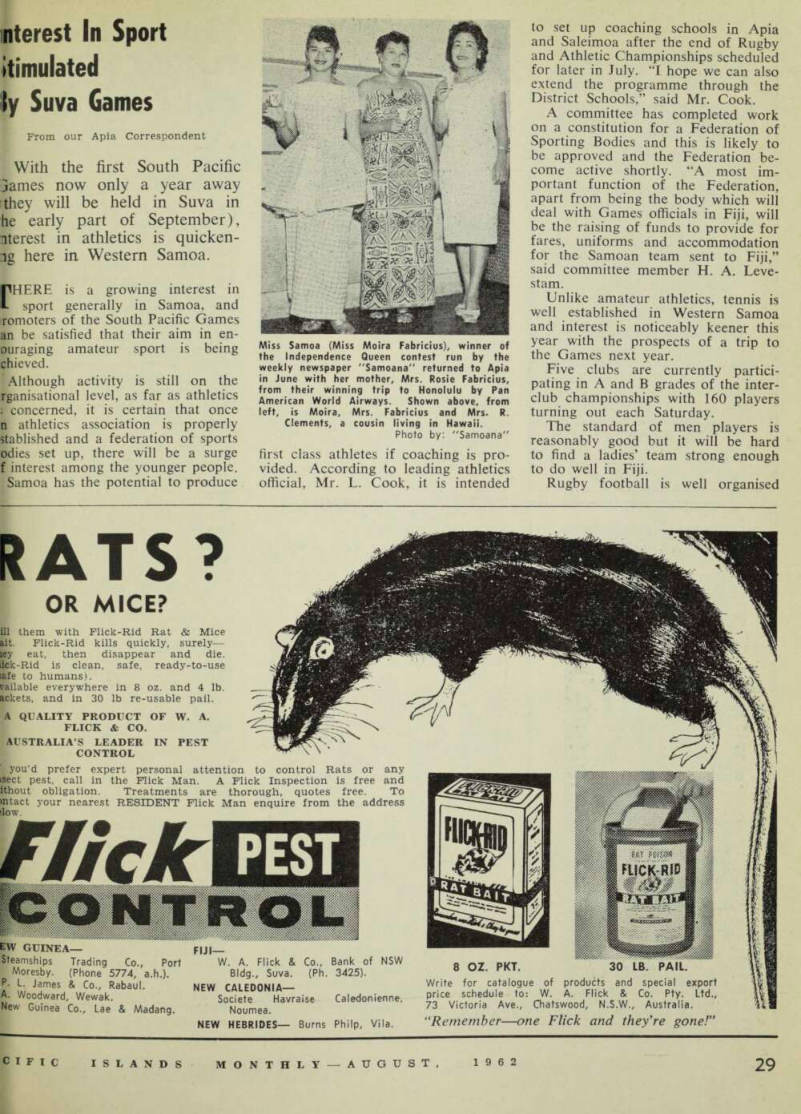
Miss Samoa (Miss Moira Fabricius), winner of the Independence Queen contest run by the weekly newspaper "Samoana" returned to Apia in June with her mother, Mrs. Rosie Fabricius, from their winning trip to Honolulu by Pan American World Airways. Shown above, from left, is Moira, Mrs. Fabricius and Mrs. R.
Clements, a cousin living in Hawaii.
Photo by: "Samoana"
and financial and Samoa can field a strong team. Soccer is not yet played on any organised basis, al though Samoan teams have played well against teams from visiting war ships; organised hockey competitions have been played for several years now and this sport is attracting more players each year. * * * On his return at the beginning of July from a four-months’ study course in Australia, Assistant Public Service Commissioner, Samuelu Atoa, was full of praise for his hosts. “Australia is a wonderful country and the people there were kind and hospitable to me,” he said.
He expressed amazement at the number of foreign students studying in Australia under the Colombo Plan and United Nations and Common wealth fellowships.
Together with him on a Public Administration course were five Indo nesians, four Burmese, one Filipino, one Singalese, and one from Sarawak.
Atoa is a graduate of the Brigham Young University in the United States, and did a crash training course in New Zealand last year.
“This extra experience in Australia gives me a wider basis for comparison and will be of great assistance in my work especially in the field of per sonnel and supervision.
“I think Samoa should make the most of any scholarships offering from Australia, and send more of our people there for experience and train ing,” he said. * * * According to figures released by the Union Steam Ship Company, freight handled at Apia by lighterage for the first six months of this year is up on the figures of 1961 but less than those of 1960.
Total freight handled inward and outward for the first six months of 1962 was 50,945 tons. This compares with 45,655 for a similar period last year and 54,895 tons for that period in 1960.
Banana exports have shown a steady increase over the period for the last three years, the figures being 244,767 cases (1960), 255,256 cases (1961) and 347,134 cases this year.
Copra exports for the six months period have fallen by over 20 per cent, since 1960. The figures are 7,528 tons (1960), 7,668 tons (1961) and only 5,673 tons this year. The price of £56/12/6 a ton at the begin ning of July was the lowest for many years.
Cocoa figures are more cheering and show an increase from 1,932 tons in 1960, to 2,464 tons last year and 2,406 tons this year.