Opportunities
pp. 31-32 · Read in the full issue
There Still Are Rich
In P-Ng
Now that Steamships Trading
>. Ltd., of Papua, has taken
er Messrs. Colyer Watson
few Guinea) Ltd.—see PIM
[July, p. 35—the three “big lows” in Papua and New tinea trade and industry are—
Ins Philp (New Guinea) Ltd., Who
iave been there since before World Kar I, and whose activities cover al most every aspect of trading, planting nd transportation.
R. Carpenter And Co. Ltd., Who
ave been active similarly in all fields 1 Papua and New Guinea since the plenties, and who now operate in lew Guinea as New Guinea Co. Ltd, nd Coconut Products Ltd., and in apua as Island Products Ltd.
Maships Trading Co. Ltd., Who
ave been active in all trading, planting nd transportation in Papua since the wenties; and who now, by acquiring kntrol of Colyer Watson (New Guinea) p., and its big establishments at abaul, Madang, Goroka and Lae, be ime competitors of the other two in le Trust Territory.
JE invested capital of each of [ the three groups is well over ,000,000. liere are a number of smaller, : healthy concerns competing with big companies for whatever trade industry arise from the exploita- I of P-NG’s economic resources n mainly as income from £l7 lions’ worth of exports per um) and from the expenditure of
Australia’s free annual gift of at least £l5 millions.
In spite of the Indonesian spectre on its western frontier—now merg ing with the UNO phantasmagoria to form a political nightmare—the richness of the field still keeps speculators hovering around.
Investors can see great oppor tunities there, but are increasingly timid. They await some kind of assurance from Australia of political security—but they hear only the screeches of the Soekarnos in the west, and the extraordinary blather of the equally unpredictable men of UNO, in the East.
Political uncertainties aside, the stories of what was accomplished in New Guinea and Papua after World War I by Walter Randolph Carpenter (founder of W. R.
Carpenter & Co. Ltd.), Captain A. S.
Fitch (founder of Steamships Trad ing Co. Ltd.) and R. A. Colyer (founder of Colyer Watson (NG) Ltd.), among others, show that that great Territory still is a land of golden opportunity.
Mr. Colyer’s story has not been told here previously.
The Story of R. A. Colyer Rupert Alexander Colyer was a well-educated Australian youth when, over 50 years ago. he left Sydney, in the service of Pacific Cable Board, to become a Morse operator in the old building beside the lagoon in Suva, Fiji, That was his first glimpse of the tropics.
In Suva, he met Neville Walker, the pretty daughter of the well-known Suva Postmaster; and they soon were married. From that happy match came two sons. Eric and Keith, now both well known in the Colyer Watson organisation.
Young Colyer returned to Australia just prior to World War I, and entered
the cattle industry in Queensland.
When war came, he joined up and served overseas—in Mesopotamia, among other places—in the AIF.
War conditions made of him a tough and thrusting individualist,
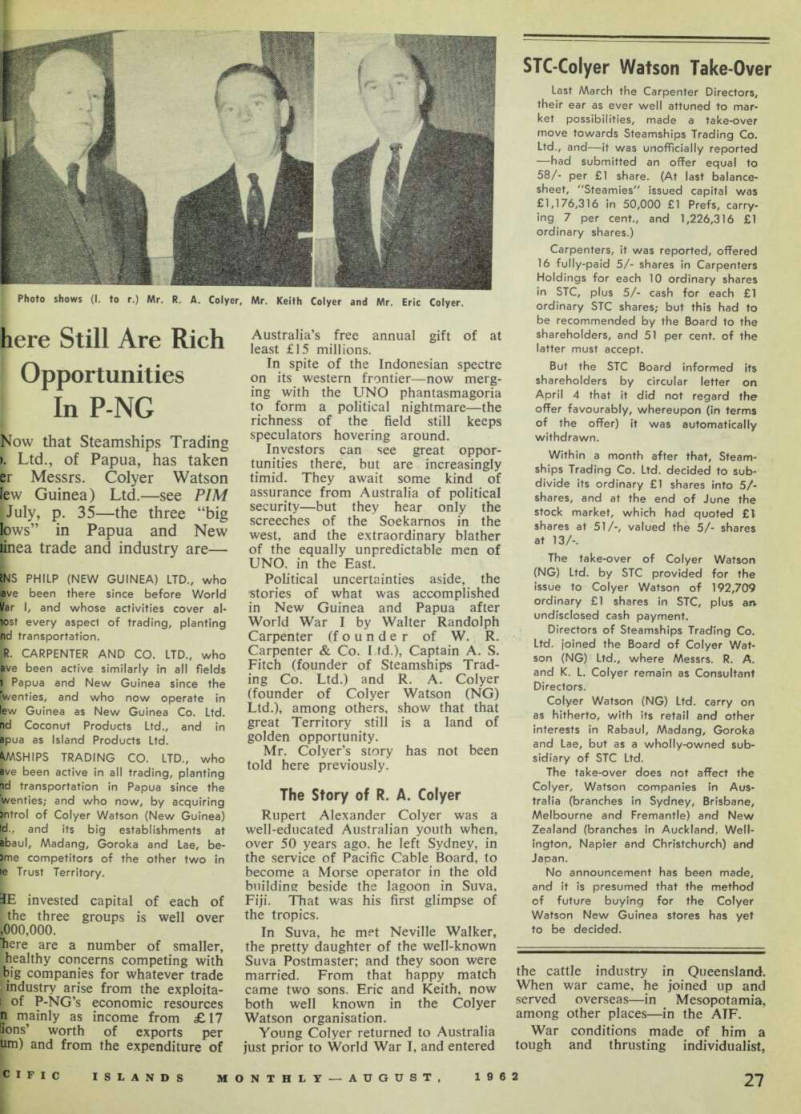
Photo shows (I. to r.) Mr. R. A. Colyer, Mr. Keith Colyer and Mr. Eric Colyer.
who sought for opportunity, found it in the growing world derr for cattle by-products. By 192 C was established in Auckland, 1 Zealand, as an exporter of hides Soon afterwards, RAC for Colyer Watson and Co. Ltd., of ' Zealand. Mr. Watson was a ju partner, who retired some 15 ago. The new company extende< operations in New Zealand as ar porter of hides, skins and tallow, then to Australia, where it regisl as Colyer Watson Pty, Ltd.
The Co. found that the den overseas for tallow always accompanied by a demand for c« A valuable agent in Italy, who be hides and tallow largely, extn from Mr. Colyer an undertakin supply him with South Seas coj That started something. The O Watson Co. could not buy c from the established interests at thing like favourable terms. \ it did buy, it had difficult arranging freights. Then, as newcomers in the Islands trade not welcomed.
Colyer Watson Pty. Ltd. fc back. Greenwood and Laws be< its copra-buying agents in Guinea; and presently it establl Colyer Watson (New Guinea) in Rabaul, and brought Mr. G Spensley across from New Zei to manage it. (Mr. Spensley among the 300 civilians caugh the Japanese and who disappear Rabaul in 1942.) The Nord Deutcher Lloyd ol the new Co. the agency for the German ferighters, Bremerhaven Freiderun —controversial compe in New Guinea shipping in Thirties—and very soon C Watson (NG) Ltd. was buying c and importing, and trading. Irr year, it exported 22,000 ton copra in the “German ships”.
After the 1942 evacuation, anr Pacific war, the Co. went back New Guinea, and expanded ste= R.A. took a very active pa the re-establishment and was as by his sons in the developme; the cocoa, coffee and peamr dustries—and it is worthy of: that the STC-CW agreement pro that Colyer Watson Pty. Ltd., oft tralia, will continue to market those products handled by O Watson in New Guinea.
Otherwise, the Colyer Watsonr panies of Australia and New Ze, continue their old-time busines exporters of hides, skins and —and Mr. R. A. Colyer, a hah hearty 72, goes off to take a leit; look at some other Continents;