Against The Global Background
pp. 24-25 · Read in the full issue
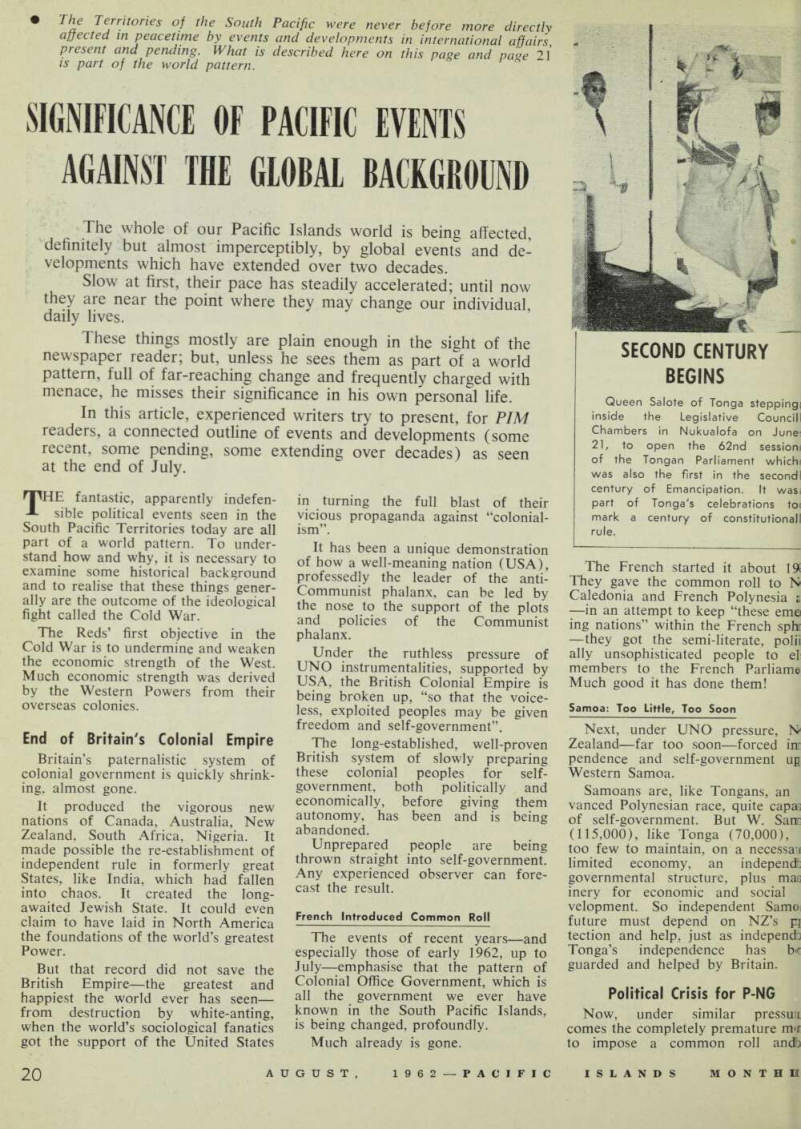
Significance Of Pacific Events
The whole of our Pacific Islands world is being affected, definitely but almost imperceptibly, by global events and de velopments which have extended over two decades.
Slow at first, their pace has steadily accelerated; until now they are near the point where they may change our individual,
daily lives.
These things mostly are plain enough in the sight of the newspaper reader; but, unless he sees them as part of a world pattern, full of far-reaching change and frequently charged with menace, he misses their significance in his own personal life.
In this article, experienced writers try to present, for PIM readers, a connected outline of events and developments (some recent, some pending, some extending over decades) as seen at the end of July.
THE fantastic, apparently indefen sible political events seen in the South Pacific Territories today are all part of a world pattern. To under stand how and why, it is necessary to examine some historical background and to realise that these things gener ally are the outcome of the ideological fight called the Cold War.
The Reds’ first objective in the Cold War is to undermine and weaken the economic strength of the West.
Much economic strength was derived by the Western Powers from their overseas colonies.
End of Britain's Colonial Empire Britain’s paternalistic system of colonial government is quickly shrink ing. almost gone.
It produced the vigorous new nations of Canada, Australia, New Zealand, South Africa, Nigeria. It made possible the re-establishment of independent rule in formerly great States, like India, which had fallen into chaos. It created the long awaited Jewish State. It could even claim to have laid in North America the foundations of the world’s greatest Power.
But that record did not save the British Empire—the greatest and happiest the world ever has seen— from destruction by white-anting, when the world’s sociological fanatics got the support of the United States
in turning the full blast of their vicious propaganda against “colonial ism”.
It has been a unique demonstration of how a well-meaning nation (USA), professedly the leader of the anti communist phalanx, can be led by the nose to the support of the plots and policies of the Communist phalanx.
Under the ruthless pressure of UNO instrumentalities, supported by USA, the British Colonial Empire is being broken up, “so that the voice less, exploited peoples may be given freedom and self-government”.
The long-established, well-proven British system of slowly preparing these colonial peoples for self government, both politically and economically, before giving them autonomy, has been and is being abandoned.
Unprepared people are being thrown straight into self-government.
Any experienced observer can fore cast the result.
French Introduced Common Roll The events of recent years—and especially those of early 1962, up to July—emphasise that the pattern of Colonial Office Government, which is all the government we ever have known in the South Pacific Islands, is being changed, profoundly.
Much already is gone.
The French started it about 1£ They gave the common roll to N Caledonia and French Polynesia s —in an attempt to keep “these erne ing nations” within the French sphr —they got the semi-literate, polii ally unsophisticated people to el; members to the French Parliame Much good it has done them!
Samoa: Too Little, Too Soon Next, under UNO pressure, N Zealand—far too soon—forced inc pendence and self-government ug Western Samoa.
Samoans are, like Tongans, an vanced Polynesian race, quite capas of self-government. But W. Sam (115,000), like Tonga (70,000), too few to maintain, on a necessan limited economy, an indepencfc governmental structure, plus mas inery for economic and social velopment. So independent Samoi future must depend on NZ’s p i tection and help, just as independo Tonga’s independence has b<c guarded and helped by Britain.
Political Crisis for P-NG Now, under similar pressun comes the completely premature nur to impose a common roll andb
tarliament” upon the still primitive lives of Papua and New Guinea.
Seen against the recommendations the UNO (Foot) Mission (dealt th on pages 13, 23 and 137), the inning of P-NG’s Australian Czar, [inister Paul Hasluck —whom we ve sometimes seen as a visionary, icing the political cart before the ucational horse instead of behind -appears as sober and restrained.
On Australian television, in the ening of July 21, the ABC showed long interview with Sir Hugh Foot, New York, wherein he was invited defend some of his more extreme jommendations.
It is a pity that New Guinea folk uld not have seen that poor, Dgical, unconvincing exhibition— ;y would have revised the favour le impression they got of the ntleman in April.
During July, there were signs that ;re will be created soon an Austro- Guinea non-political organisation, [ support the Australian Govern ;nt in whatever steps it may take restrain these wild men of UNO. f Nothing should be allowed to interfere with the Australian plan, long under way, to create an en during New Guinea - Australian friendship. That friendship is some thing that the sinister forces which direct so many UNO activities will take steps to prevent.
Why should Australia, in its ad inistration of its Islands depen ncies, suffer the interference and imiliations which British and other lonial Powers have accepted in the st few years at the hands of the ofessional theorists and unpractical earners, who cling nowadays like irasitical lice around the well mrished structure of UNO?
Indonesia for N. Guinea!
As July passed, the urgency and mplexity of the P-NG political oblem was not lessened by the donesian threat on the Territory’s ;stern border.
Soekarno screeched and postured; donesian parachuters were gathered i and publicly spanked in West New uinea; the Soviet Deputy Premier ikoyan kowtowed in Djakarta, hat a farce!
But beyond any doubt, there will i Indonesians in West New Guinea Rcially by 1964.
The Netherlands will be glad to •andon this (to them) expensive id economically useless region—as on as a formula is found to save e face of the Dutch, and provide a larantee that West New Guineans ill have the same opportunities as
Australian New Guineans for self determination.
The headache of which the Dutch will rid themselves will just naturally be transferred to Australia.
Indonesia, in or out of West New Guinea, cannot be trusted. In itself, it is of little consequence; but geo graphically and politically it provides an extension into the still peaceful South Pacific of Muscovite Com munism, shaping—and being shaped by—the political ambitions of the Afro-Asian bloc.
Next: Fiji, Solomons, New Hebrides?
After P-N Guinea can we expect that Fiji, the Solomons, New Hebrides, will long be left alone?
They are a natural prey for inter national mischief - makers. Britain, herself politically be-devilled, is in no condition to give them the pro tection they soon may need.
Fiji now is peculiarly vulnerable.
British Colonial Office failure, long ago, to make adequate provision for a mixed population, expanding rapidly in peculiar circumstances, has opened the way to dangerous socio-political activities.