UN Proposes Political
p. 23 · Read in the full issue
Advances For Nauru
The time has come for Nuru to be given a Legislative Council, with a Nauruan majority.
FHE four-man UN Mission to Nauru, led by Sir Hugh Foot, lys this in its report, submitted to le Trusteeship Council in July.
The report makes these main aints: • The Nauruans have serious omplaints about their not being ppointed to higher posts in the administration. • An advisory committee should e set up immediately to report, in, ay, six months, on the establishment f a Legislative Council and/or Executive Council. A Council of ine members might be adequate to ct as both Legislative and Executive Council. • There should be a meeting at ;ast once a year between an elected Council and the British Phosphate Commission so that all questions of lie island’s economy can be discussed horoughly, and the Nauruans can
feel they are in partnership. At present the company “lives and operates in a world of its own; the Administration is aloof and strangely separate from the Local Government Council”. • The picture of Nauru as one of peace and security was a deceptive picture, for it was really a “false paradise” due to the fact that “these gentle people are dominated by the knowledge that their present happy state of affairs cannot continue” after their phos phate wealth dries up in 30 years. • Since there was no doubt that the community could not continue in Nauru when the phosphate is exhausted, the Australian Govern ment must now take the initiative and present the Nauruans with a detailed plan to either (a) establish them in an island of their own (b) settle them in a suburb of an Aus tralian city. Further indecision can do “nothing but harm”.
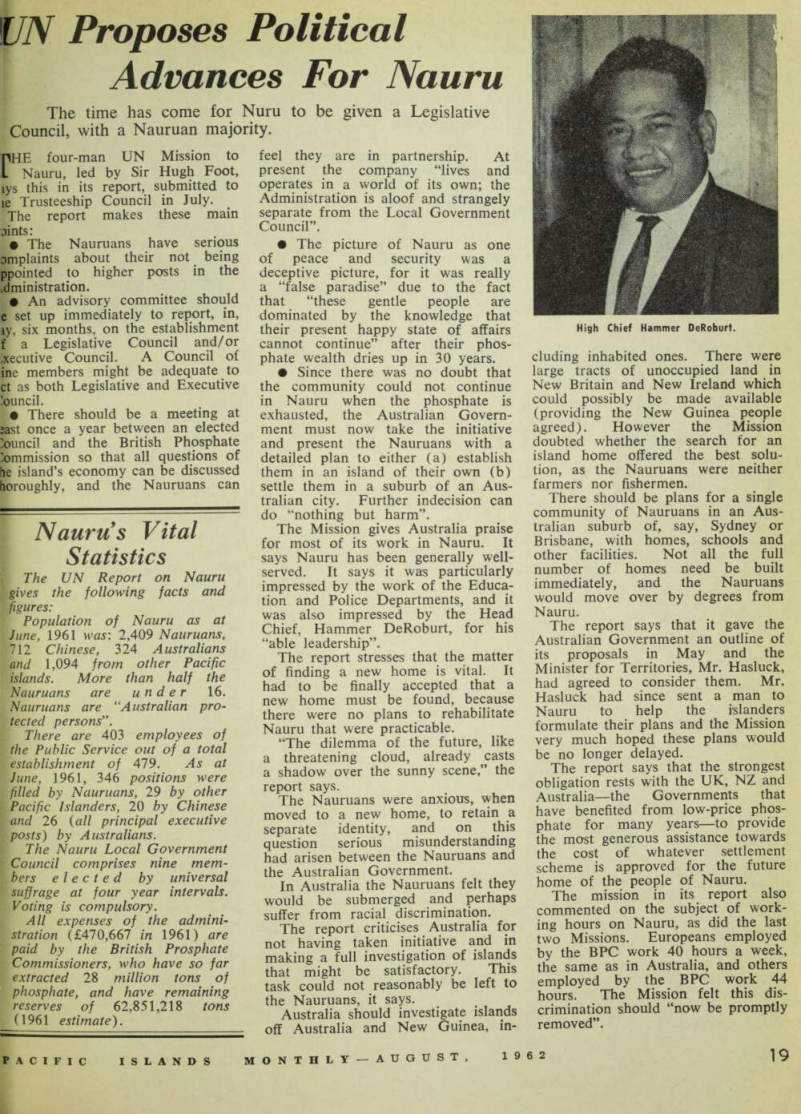
The Mission gives Australia praise for most of its work in Nauru. It says Nauru has been generally well served. It says it was particularly impressed by the work of the Educa tion and Police Departments, and it was also impressed by the Head Chief, Hammer Deßoburt, for his “able leadership”.
The report stresses that the matter of finding a new home is vital. It had to be finally accepted that a new home must be found, because there were no plans to rehabilitate Nauru that were practicable.
“The dilemma of the future, like a threatening cloud, already casts a shadow over the sunny scene,” the report says.
The Nauruans were anxious, when moved to a new home, to retain a separate identity, and on this question serious misunderstanding had arisen between the Nauruans and the Australian Government, In Australia the Nauruans felt they would be submerged and perhaps suffer from racial discrimination.
The report criticises Australia for not having taken initiative and in making a full investigation of islands that might be satisfactory. This task could not reasonably be left to the Nauruans, it says.
Australia should investigate islands off Australia and New Guinea, in-
eluding inhabited ones. There were large tracts of unoccupied land in New Britain and New Ireland which could possibly be made available (providing the New Guinea people agreed). However the Mission doubted whether the search for an island home offered the best solu tion, as the Nauruans were neither farmers nor fishermen.
There should be plans for a single community of Nauruans in an Aus tralian suburb of, say, Sydney or Brisbane, with homes, schools and other facilities. Not all the full number of homes need be built immediately, and the Nauruans would move over by degrees from Nauru.
The report says that it gave the Australian Government an outline of its proposals in May and the Minister for Territories, Mr. Hasluck, had agreed to consider them. Mr.
Hasluck had since sent a man to Nauru to help the islanders formulate their plans and the Mission very much hoped these plans would be no longer delayed.
The report says that the strongest obligation rests with the UK, NZ and Australia—the Governments that have benefited from low-price phos phate for many years—to provide the most generous assistance towards the cost of whatever settlement scheme is approved for the future home of the people of Nauru.
The mission in its report also commented on the subject of work ing hours on Nauru, as did the last two Missions. Europeans employed by the BPC work 40 hours a week, the same as in Australia, and others employed by the BPC work 44 hours. The Mission felt this dis crimination should “now be promptly removed”.
High Chief Hammer DeRoburt.