Population Decline
pp. 22-150 · Read in the full issue
Poses Problems For Pitcairn
By a Staff Writer
“What has happened to Nor folk Island we don’t want to hap pen to us—and we don’t intend to let it happen!”
THE speaker was John Fletcher Christian, 66, Chief Magistrate of Pitcairn and great-great-great grandson of the master’s mate of the Bounty. He wasn’t exactly mutinous when I saw him in Sydney in June, but he was certainly concerned at what the future might hold for Pit cairn—for those notorious winds of change have been blowing there of late, too.
Just what had happened to his kin folk under Australian administration on Norfolk Mr. Christian didn’t elu cidate, but it was clear he thought Norfolk had a wishy-washy kind of political arrangement at best and that Pitcairners could be expected to show a little more independence.
Norfolk is an Australian territc controlled by the Australian Dep ment of Territories, Canberra, wH appoints an Administrator to island. Norfolk has its own isll council, which, through choice, in an advisory capacity, although ; empowered to act as a local govt ment body. Norfolk Islanders h said they want more independence run their own affairs, and will shoe be given a referendum to enable tH to indicate exactly what they want. Norfolk’s population was at the 1961 census—almost equi divided between the sexes.
Fiji Responsibility
Pitcairn is the responsibility of Governor of Fiji, Sir Kenneth M docks, who uses a commissioc based in Suva, Mr. Reid Cowell, a go-between. The island’s Educat Officer is also designated the viser”. The Education Officers o: the last few years have been pointed for terms of two years.
However, because of Pitcairn’s moteness and small population, lo affairs are handled on the spot, w the Chief Magistrate handling co cases and the Island Council attea ing to other matters. The Colon Office view is that the Chief Mat trate, who is head of the Coum is head man on Pitcairn and that less disputes are serious enough i be referred to Suva, the Chief Majf trate, with his Council, should hr the authority to settle problem However, that is not always the vi\ on Pitcairn.
Over the years, problems hir
(Continued on page 144)
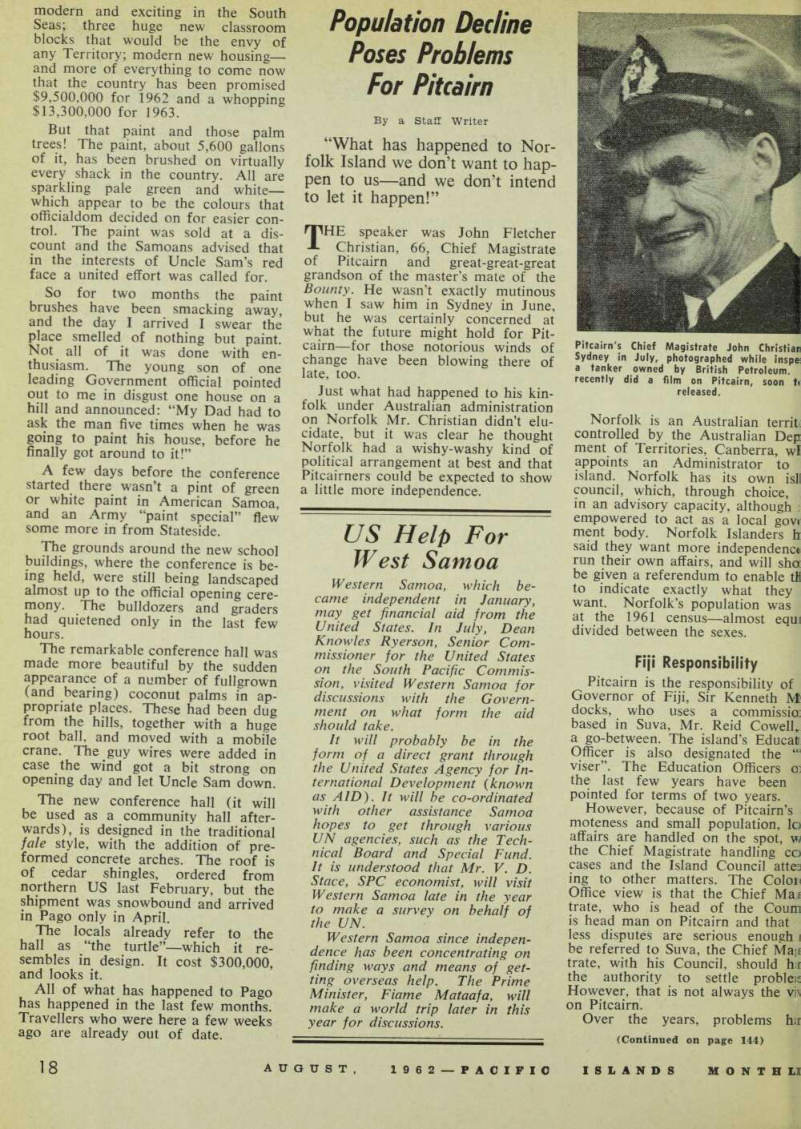
Pitcairn's Chief Magistrate John Christian Sydney in July, photographed while inspe [?] a tanker owned by British Petroleum. [?] recently did a film on Pitcairn, soon t [?] released.
been settled satisfactorily, mostly through “going down the middle”, ac cording to John Christian. But in Sydney Mr. Christian said he felt the present system wasn’t clear-cut enough. It wasn’t always clear in everyone’s mind that the Chief Magistrate was in top authority, and there had been one education officer who had believed his position as “ad viser” meant he had supreme authority.
“It worries me,” said Mr. Chris tian. “Why should this kind of thing be left to the good sense of the island people. We should have some kind of Government establishment that puts the whole situation beyond doubt.”
Mr. Christian said he discussed the matter with the Colonial Office when he was in London and they had as sured him that he had authority enough. But he still wasn’t sure if the present system was the best.
Mr. Christian said one change that should be made was to see that every Education Officer-Adviser be a Seventh-day Adventist. The entire island population is Seventh-day Ad ventist, although not all are prac tising. Mr. Christian said one of the same religion would be more likely to fit in with local opinions on various matters, including activity on the Sabbath (Saturday).
Despite local doubts thus cast on its efficiency, there is probably not much chance that the Colonial Office will alter the present arrangements for governing Pitcairn, or give a
guarantee that Education Officers will be Seventh-day Adventists.
Education Officers are sought by advertisement, and if a Seventh-day Adventist applies who has the best qualifications of all those who apply, he would certainly get the position, says the Government, But if none ap plies, or those who do apply do not meet the standard, then nothing can be done.
Some people have suggested that the Seventh-day Adventist Church, when the teacher’s position is vacant, should itself find a suitable applicant of a high standard.
On the other matter of political changes, the authorities point out that Pitcairn virtually has self-govern ment anyhow. The Council handles the revenue. Pitcairn’s population pattern is not the kind that will create any pressures. It is more likely to simply fade away.
Pitcairn’s population has been cut in half in the last 30 years. Present population is 115, with a male work force comprising only 22. The men are required for the manning of the boats which go out to meet the pass ing ships, hand over the mail (which is the main revenue producer) and sell curios; and for other hard work on the island.
Pitcairn’s problem is that there is not enough activity on the island to keep the young people there. They go off to New Zealand to work and don’t come back. NZ gives them right of entry without quibble.
The present Education Officer, Mr.
S. A. Kinder (he was formerly on Niue) recently put out an appeal for Pitcairn islanders living abroad to come home and help the island out of its manpower shortage (PIM July, p. 39) but it’s not thought likely that the appeal will have much success.
Mr. Kinder said there was “a good living” available for islanders who came home, and investigations were being undertaken to find an overseas market for the Pitcairn curios. But much more may well be needed to attract the Pitcairners away from the bright lights and higher pay of NZ and Australia, and in this case the future of the famous island of the Bounty mutineers might well be in doubt.