Beep! And The Pacific
pp. 19-20 · Read in the full issue
Became Weird
From a Roving Staff Writer
“It was weird—just weird,” said Apia’s Aggie Grey—and that just about summed up the South Seas’ view on America’s high altitude bomb explosion at Johnston Island on July 8.
“riIHE Shot” was a whopper H- A bomb sent up 325 miles above Johnston at the end of a $700,000 Thor missile. It was exploded from the ground after the missile had got it to the right altitude in probably 15 to 20 minutes.
Amateur observers with ordinary Japanese transistor radio receivers, Air Radio stations with the latest equipment and many of the 20,000 men whom America had used in the Pacific to help get The Shot into the air, track it and analyse its resuits, heard the dramatic few moments of the final countdown from April Weather, codename for the Johnston Island control station. a i i u im U 7 *u u 11 j’ l ■^ eep ’ Wlt h the beep, all the radios went momentarily dead.
Then almost clear across the Pacific, the sky was lit up For those on the nearer islands—such as Samoa 2,000 miles from the high altitude blast— ve descriptions generally tallied.
Right on the “beep”, a bright red area appeared from low in the southwest to high in the west. Then there was light yellow tinged with violet
and a sugestion of green at the edges.
In a few moments blue-white rays appeared in the north and climbed up quickly, fanning out as they went.
Soon all the rays began extending along curved rainbow-like lines. The white rays persisted for 10 minutes before they reddened and faded. The whole auroral display had lasted about 15 to 20 minutes.
In Apia, Mrs. Grey was awakened from a sleep by girls who were cer tain that somebody’s copra store—or even the hotel itself—had burst into flame.
On a hill in Pago, a watcher, mouth agape, exclaimed “Holy cow!” as the sky lit up, and had his in voluntary statement recaptured on a friend’s tape recorder, to his later embarrassment.
In Suva, the Fiji Times switch board was flooded with callers want ing to know what was happening out there. In the Cooks, somebody claimed they could see “the curvature of the earth silhouetted” (which they couldn’t).
Most people remarked on the white lines seen flashing through the aurora, or white curving lines seen moving quickly.
What they were seeing were par ticles spiralling at a terrific rate along the path of the world’s mag netic field—they were in a sense see ing the magnetic field “made visible.”
One man who was especially in terested in observing the results of The Shot was J. Gordon Keys, ob server-in-charge of the Apia Obser vatory, Western Samoa.
Mr. Keys, a New Zealander, is probably the only qualified observer who has witnessed the three high altitude H-bombs that the US had
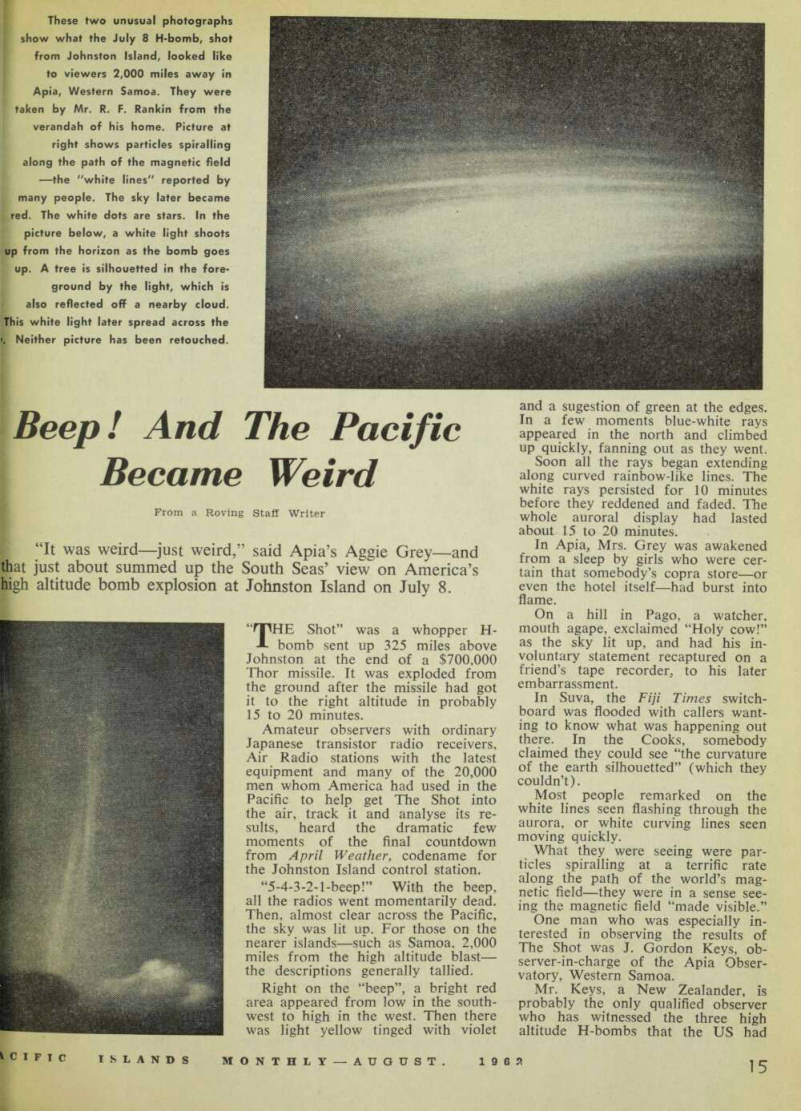
These two unusual photographs show what the July 8 H-bomb, shot from Johnston Island, looked like to viewers 2,000 miles away in Apia, Western Samoa. They were taken by Mr. R. F. Rankin from the verandah of his home. Picture at
right shows particles spiralling
along the path of the magnetic field —the "white lines" reported by many people. The sky later became red. The white dots are stars. In the picture below, a white light shoots up from the horizon as the bomb goes up. A tree is silhouetted in the fore ground by the light, which is also reflected off a nearby cloud.
This white light later spread across the Neither picture has been retouched.
exploded in the Pacific up to July 8 and be in a position to talk about them. He is bound by no oath of secrecy as are most American ex pert witnesses and he has already published details of his observations on the first two explosions. He will publish details on the third.
The first two US Pacific high alti tude bombs were exploded in August, 1958. The first one, August 1 (code named TEAK) exploded 50 miles above Johnston Island and the second, August 12 (codenamed ORANGE) was 27 miles up.
TEAK made special history be cause the US had neglected to tell the world that she was going to ex plode it, with the result that when radio communications were disrupted for almost 48 hours, upsetting airline schedules and communications, there was a fierce outcry. When ORANGE was exploded 12 days later, the US, chastened, had already announced the details of time and place.
When that unexpected first high altitude H-bomb went off from John ston on August 1, 1958, Gordon Keys was at the door of his house in Apia saying goodbye to a guest.
It was nearly midnight, and sud denly the sky was alight with an auroral display not greatly unlike the latest. The white lines of the path of the magnetic field were not so noticeable.
Trained observer Keys took all the visual details down, then later studied the record of the magnetogram at the observatory. The machine had been working and the line on the paper showed a sudden and abrupt change in the direction of the world’s mag netic field, Gordon Keys was ready with his eyes and the machine for the explo sion that followed later, and again for the third explosion this July. By late July he was preparing for a fourth bomb. He has technical ex planations for those interested enough to know just what the three explosions did. The paper records of the machine are quite different with the three bombs.
The July 8 explosion 325 miles up, had an initial disturbance of greater magnitude than those of either of the first two shots, and recovery of radio communications in the third bomb was much more rapid. There was in fact less interference, but what in terference there was went farther, quicker.
The July 8 bomb disrupted com munications in peculiar ways. Samoa radio could work Canton and Hono lulu for instance, yet couldn’t get Nadi, and there were similar compli cated, most widespread effects, all around the Pacific But they didn’t last as long as the 1958 explosion.