The Lunacy and Glory
pp. 101-102 · Read in the full issue
That was Crete
It is probably not altogether coincidence that the biggest mcies of both World War I and World War II vitally con 'ned Australians and New Zealanders; or that one man was ? architect of both.
- man was Winston Churchill; tie lunacies, Gallipoli and although not even the people said the highest price then are to think of the three facts in lat juxtaposition. the time, the exigencies of loment, patriotism and the lay delusion that High Authority know what it was about, id the issue. It is only in post-mortems, when historians writers vie with one another t cause and effect right on the hat an over-all picture emerges, by then it is too late, s said that Australia and New id found their nationhood on beaches of Gallipoli. The on of Anzac is something the iticists still weave stories d; the bungling, the amateurish ing of the whole campaign, the of direction and intention, are
all forgotten—perhaps as it should be—in the memory of deeds of great courage.
Crete, 26 years later, just as futile, just as bungled, follows on the Gallipoli story.
One of the best accounts of the 1941 campaign in Crete, and the preliminary skirmishings in Greece which preceded it, is Battle for Crete by John Hall Spencer.
Spencer, an ex-regular Royal Marines officer, spent two years in intensive research with access not only to British, Australian and New Zealand records but also to German accounts, and he has corresponded with commanders and private soldiers of all forces. The result is a cohesive story of the whole episode which pulls no punches but dims none of the glory.
He recounts something of the con fused negotiations between Anthony
Eden, Churchill’s emissary, and the Greeks as to whether the British should be called upon to help defend their country; some obvious cloak-and-dagger manoeuvring in Athens by a British General for the same purpose; and the extra ordinary confusion that existed be tween the British War Cabinet and their commanders in the field as to whether Crete should be defended or not.
When the Germans made their first assault on Crete on May 20, 20.000 troops of the garrison of 29.000 were evacuees from Greece, and badly equipped.
Most of them had lost machine guns, mortars and even rifles. Many Australians were without hats and other articles of clothing; few had blankets or any mess kit or personal gear. During daylight hours they sat under the olive trees and licked their wounds and watched the German Stukas play merry-hell over Canea; and at night they huddled together for warmth.
There were, however, diversions in this brief respite. Their behaviour, says the author with fine under statement, was “not of uniform quality”. They looked on the wine when it was red and some “developed a taste for raki, the absinthe-style liquor common to the Levant”.
Three of them tried to shoot Prince Peter, who was General Freyburg’s Greek Liaison Officer,
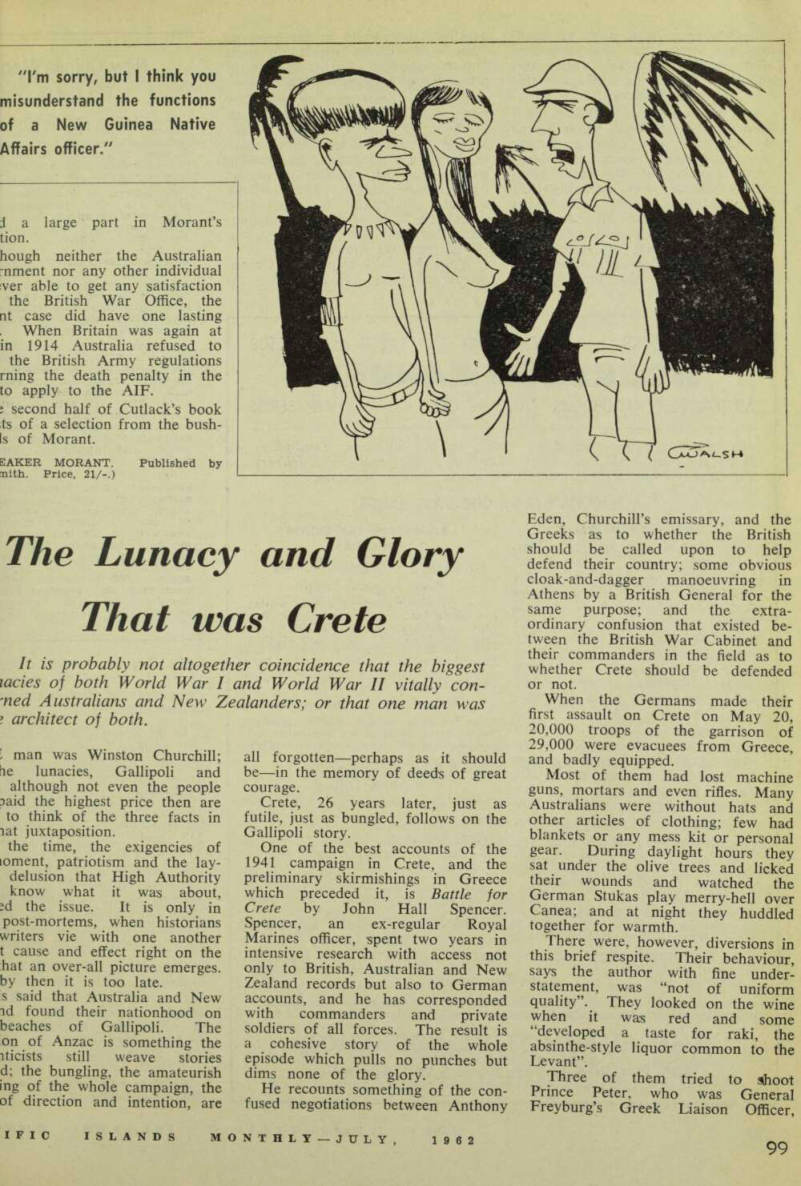
"I'm sorry, but I think you misunderstand the functions of a New Guinea Native Affairs officer. "
and because of their habit of shooting out any light that appeared after dark a general order was published ordering that “this practice cease forthwith”.
One reason for Australian restlessness was that their whole Corps Headquarters was missing, having been evacuated direct to Egypt from Greece; but the more compelling reason was probably just their Australian nature. When put to it they fought like gods—or demons; when they were idle, they took to their own wild ways and were intolerant of authority, especially of the kind that Spencer
describes somewhere in his book as “that mild hauteur which has been known to afflict British officers in proximity with Dominion colleagues”
The New Zealandens on the other hand seemed to be far less obnoxious in their “off-duty” behaviour. They appear to have done nothing more exhilarating than indulge in “bathing parties in the Mediterranean or bask in the sun”. The author’s special admiration of the New Zealanders is quite plain throughout the story—and not without reason, as the narrative shows, When the Navy ships from Greece discharged their human cargoes at
Suda Bay, a British officer sto( where the road forks and said “Ne Zealanders to the left; Australia! to the right”.
In this lottery, the New Zealand? got Maleme and Canea; the Au tralians Rethimnon and Iraklio; Later regiments of Black Watcl York, Lancaster and Leicester Reg ments and Greek battalions joine the Australians; and companies of tt 2/7 and 2/8 Infantry Battalioi AIF, went to the Kiwis at Suda Ba: But, by and large, the big end ( the stick fell to the NZ-ers, as th Maleme sector contained the mot important airfield and they er countered German troops landed fe glider as well as by parachute.
Historically the battle of Crete/ important as it was the first air borne assault of a defended island Spencer’s book confirms a legen( in which any Britisher, Dominior or Mother Country, can take pri& —at least in their fighting men. I (BATTLE FOR CRETE. Published M Heinemann. Price, 37/3.)