Coconut Radio
pp. 93-94 · Read in the full issue
School’s In! On The Coconut Radio
From Elspeth Robbins, in Suva For some reason I always become a little misty-eyed when I listen to Correspondence School of the Air. The mental picture conjured up is probably quite incorrect—but I think of children isolated in some lonely, gale-lashed lighthouse or study ing in some remote farmhouse cradled in the snow-covered alps or way across the arid, parched outback of Australia, and this always brings a lump to my throat.
HERE in Fiji, of course, the mental picture is different. One might almost envy the children who, when released from their lessons, can race bare-footed and carefree along the palm fringed, golden sands of their coconut plantation islands.
But the most interesting feature of Fiji’s school broadcasts is not the Correspondence School of the Air which is designed for English-speaking children who cannot attend school, but the broadcasts directly beamed to the schools themselves.
To appreciate the difficulties which beset the Fiji school broadcasts, one must capture a little of the local atmosphere. The mixture of races, creeds, languages and customs is the most striking feature of the popu lation of Fiji.
The housewife going about her shopping will hear people speaking in English, Fijian, Hindustani, and here and there some of the language
of other Pacific Islands, and also Chinese.
To cater for these people, the Fiji Broadcasting Commission station in Suva has regular Fijian and Hindi programmes, in addition to those in English.
How then does the school broad casting system cope with this multi racial, multi-vernacular problem?
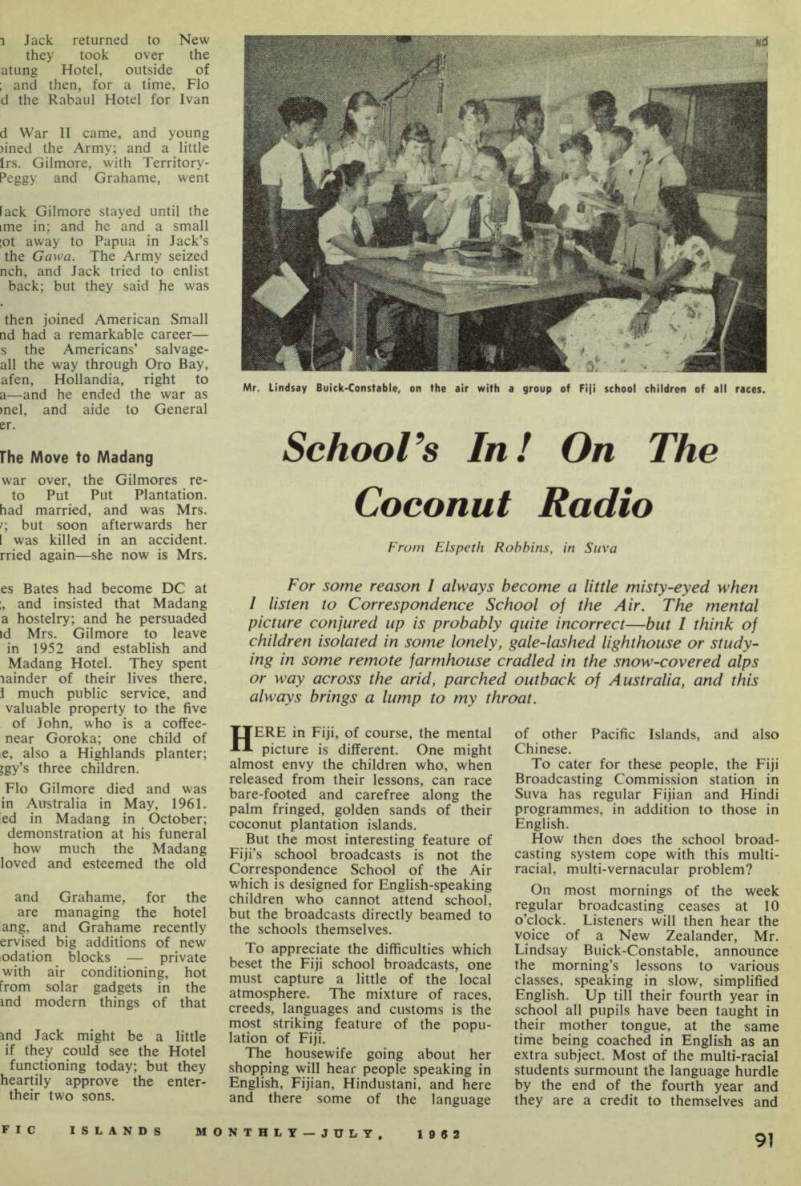
On most mornings of the week regular broadcasting ceases at 10 o’clock. Listeners will then hear the voice of a New Zealander, Mr.
Lindsay Buick-Constable, announce the morning’s lessons to various classes, speaking in slow, simplified English. Up till their fourth year in school all pupils have been taught in their mother tongue, at the same time being coached in English as an extra subject. Most of the multi-racial students surmount the language hurdle by the end of the fourth year and they are a credit to themselves and
Mr. Lindsay Buick-Constable, on the air with a group of Fiji school children of all races.
to the monumental patience and methods of the Education Depart ment and school broadcasts.
Broadcasts to schools first com menced in Fiji in 1956. Although he came to Fiji with a wealth of ex perience behind him in New Zealand, Mr. Buick-Constable had to start from scratch. For instance, villages fortunate enough to possess a radio often had only the simplest know ledge of its mechanical workings.
Pamphlets were prepared to show the teachers the best position to put the receiver in the schoolroom, and how to link up the aerial for best re ception.
Singing lessons had instant appeal, for part-singing is a distinctive fea ture of vocal music in Fiji. As a mbstitute for a piano (such things ixist in Fiji, but mainly in the towns) Dur versatile teacher provided a leries of bottles filled with water to rarious levels.
In early broadcasts, “Boy Boy”, a •adio fairy, was introduced as a gim nick to sustain the children’s listen ng ability. So great was “Boy Boy’s”
Dopularity he received about 3,000 fan mail letters one year—6o to 75 a day at times. Many of the school pupils of 1956 are now fledgling young teachers in Training College and they still giggle a little self consciously about “Boy Boy”, for he 10 longer exists. Now there are real pupils in the radio classroom.
It is tremendously interesting to listen to these half-dozen children who take part with the teacher in .he studio each morning, and to hear their gradual mastering of a foreign tongue as they progress through each class.
Sound Trouble Many English sounds do not exist in Hindi, Fijian or Chinese. Little Johnny Chinese is truly velly velly sad about those “R” sounds that will turn into “Ls”. Joni Fijian and John Indian ripple “Rs” off their tongue easily, but they each find their par ticular hurdle. Rogue “Ps” turn into “Fs”, and “sh” becomes a long hiss.
Not only do the pupils have to learn new sounds but also rhythm, pauses and stress or accents on parts of words. To overcome this, “jingles” are learned each week. Difficult sounds are cunningly introduced to ensure the children of each race have adequate practice in saying the words they find most difficult to utter.
Mr. Buick-Constable now has trained assistants chosen from locally born people. A radio teacher must have a good radio voice and per sonality. He also needs the ability to cope with a great deal of paper
work, duplicating and tape record ing behind the scenes.
Every opportunity is taken to bring to the classroom the voice of an expert, and guest speakers from many parts of the world, and with inter esting occupations, are featured wherever possible.
Mr. Buick-Constable’s present as sistants are Alan Gopalan, son of a well-known Suva doctor, and Jemesa Roborobolevu. Alan spent 17 years of his school life in New Zealand, Jemesa has also been overseas, to England, where he went on a British Council Scholarship.
All Ages Listen Fiji has broadcasts for secondary school pupils, too. The BBC prob ably never envisaged the varied listen ing audience that would gather at the radio in tiny Fiji for 45 minutes each afternoon to listen to its spe cially prepared broadcasts for sec ondary schools. By this time students have completely mastered the lan guage difficulty, and the emphasis of the broadcasts is on English litera ture and social studies.
“Did you hear how she said it?” my neighbour (a MA) asked, poking her head through a hole in the hibiscus hedge. I knew imme diately she was referring to a passage from Macbeth.
We are both avid afternoon listen ers to the rich, resonant voices of some of England’s most experienced Shakespearean players, and there is many a housewife who admits to taking the transistor radio to the bedroom while she has her afternoon rest.
Not only housewives, but pilots from the RNZAF station at Laucala Bay, the crews of ships at sea, nuns and patients from Makogai and other isolated Mission stations, and patients in the local hospital all derive much pleasure in going back to school for the all too short after noon session, and have expressed so in appreciative letters to Mr. Buick- Constable.
Probably some 30,000 pupils in up to 400 schools scattered over a wide area of the Pacific are being reached by radio in some form or another.
While all the radio-linked schools benefit from the radio lessons, the deepest appreciation comes from the most remote areas where the Euro pean voice is still seldom heard except by radio. Many a lonely out post teacher expresses the feeling of being better linked with the world, and not forgotten.