Magazine Section
pp. 89-92 · Read in the full issue
Pacific Islands Monthly
Are Those Pacific Treasure Stories More Fancy Than Fact?
Sydney Writer Robert Langdon Takes A
Long, Hard Look
Back in the early 1820’s when the South American patriot General San Martin was closing on Lima, Peru, to free the people from the rule of Spain, the wealthy Spaniards of Lima •red their valuables in a fortress at Callao, four miles away, for safe-keeping.
This, it seems, was the starting point for most of the melodramatic stories that have snowballed down the s about buried treasure on islands in the Pacific, and a few others elsewhere.
WORDING to these stories, )me of the Spanish treasure tolen from Callao by pirates the Spaniards sought to ship k to Spain.
I in true-blue pirate style, it uried on lonely, far-off islands the pirates found it too “hot” idle for one reason or another, ong the islands which are d to have caches of Spanish re are Cocos Island, 500-odd west of the Panama Canal; named island in the Marianas; ad Island, 700 miles off the of Brazil; Pinaki atoll in i Polynesia; Hat Island (Vatu in Fiji; and Suwarrow Island Cook Group. cles on the Pinaki and Hat treasures appeared in PIM iy (PP- 76-77) in which one writers took me to task for ng the authenticity of the treasure, among others. (See Feb., p. 21). a result, I made a thorough gation of all the Pacific e stories, and now I am than ever convinced that, with possible exception of the ■ow story, none of them is Ay chief reason for this un tie, spoil-sport outlook is There appears to be no :e that any treasure ever was from Callao in the 1820’s, is what is alleged in the case :e of the islands. tecondly, most of the stories the various islands are vague, here they contain details that
can be checked, the details are almost invariably wrong. • Thirdly, most of the stories are suspiciously similar. • Fourthly, despite numerous expeditions to the various islands, no reliable reports of the finding of treasure have ever been made. • Fifthly, although many of the treasure-seekers have had “authentic” maps, the maps have always proved to be useless.
One of the few facts in the various stories that is undisputably true is that the Spaniards DID store their wealth in a fortress at Callao during the revolutionary wars.
Proof of this is to be found in Lord Cochrane’s Narrative of Services in Chile, Peru and Brazil, published in London in 1858.
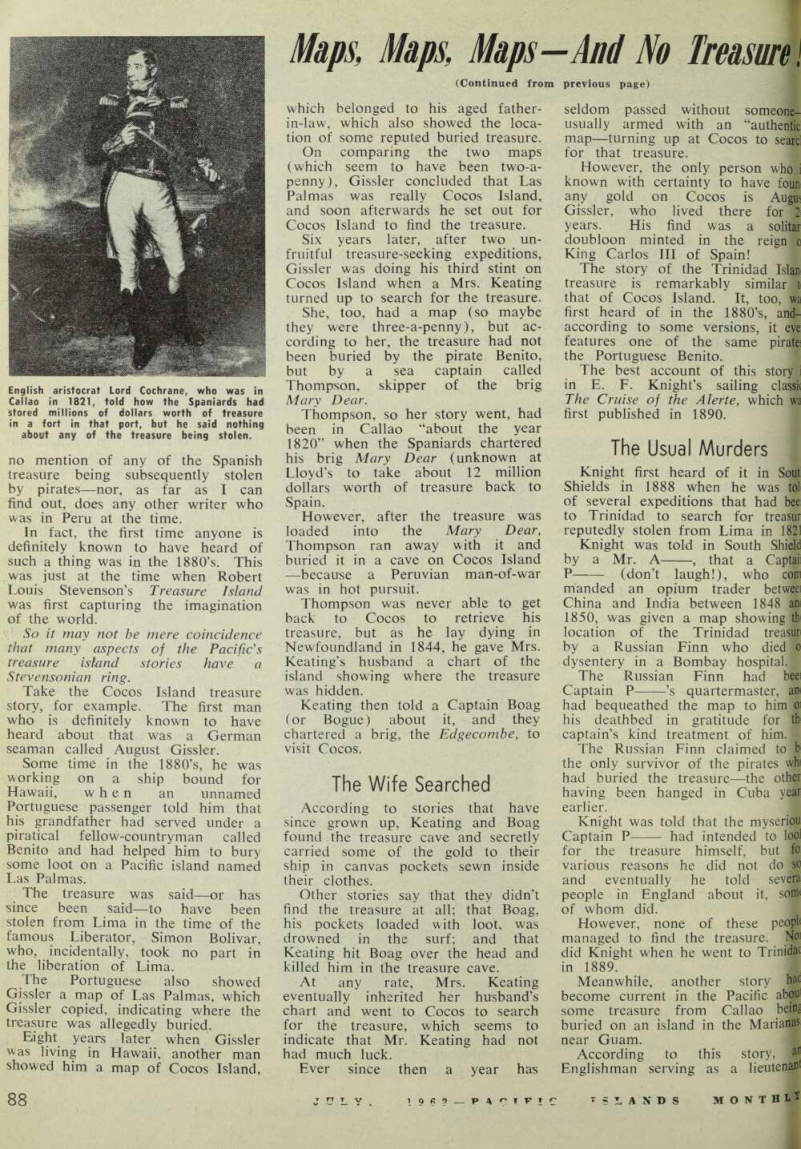
Lord Cochrane, an English aristocrat, was in Callao as com mander-in-chief of the Chilean Navy when General San Martin pro claimed the independence of Lima on July 28, 1821.
At that time, the Spanish treasure was still stored at Callao—and it remained there until San Martin allowed the Spaniards to remove it three weeks later, much to the chagrin of Lord Cochrane.
Writing of this incident, Lord Cochrane said: “The Spaniards today (August 19, 1821) relieved and reinforced the fortress of Callao and coolly walked off unmolested with plate and money to the amount of many millions of dollars—in fact, the whole wealth of Lima—which, as has been said, was deposited in the fort for safety”.
Lord Cochrane, however, makes
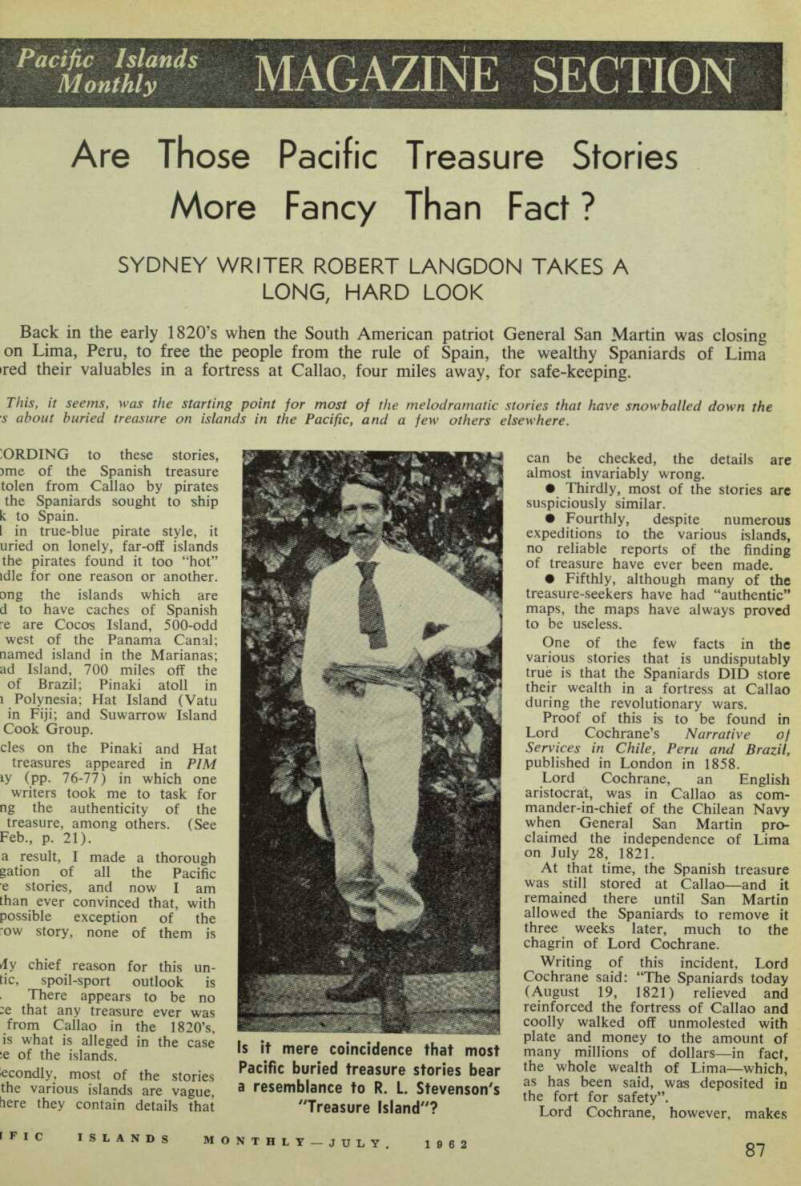
Is it mere coincidence that most Pacific buried treasure stories bear a resemblance to R. L. Stevenson's "Treasure Island"?
no mention of any of the Spanish treasure being subsequently stolen by pirates—nor, as far as I can find out, does any other writer who was in Peru at the time.
In fact, the first time anyone is definitely known to have heard of such a thing was in the 1880’s. This was just at the time when Robert Louis Stevenson’s Treasure Island was first capturing the imagination of the world.
So it may not be mere coincidence that many aspects of the Pacific’s treasure island stories have a Stevensonian ring.
Take the Cocos Island treasure story, for example. The first man who is definitely known to have heard about that was a German seaman called August Gissler.
Some time in the 1880’s, he was working on a ship bound for Hawaii, when an unnamed Portuguese passenger told him that his grandfather had served under a piratical fellow-countryman called Benito and had helped him to bury some loot on a Pacific island named Las Palmas.
The treasure was said—or has since been said—to have been stolen from Lima in the time of the famous Liberator, Simon Bolivar, who, incidentally, took no part in the liberation of Lima.
The Portuguese also showed Gissler a map of Las Palmas, which Gissler copied, indicating where the treasure was allegedly buried.
Eight years later when Gissler was living in Hawaii, another man showed him a map of Cocos Island,
which belonged to his aged father in-law, which also showed the loca tion of some reputed buried treasure.
On comparing the two maps (which seem to have been two-a penny), Gissler concluded that Las Palmas was really Cocos Island, and soon afterwards he set out for Cocos Island to find the treasure.
Six years later, after two un fruitful treasure-seeking expeditions, Gissler was doing his third stint on Cocos Island when a Mrs. Keating turned up to search for the treasure.
She, too, had a map (so maybe they were three-a-penny), but ac cording to her, the treasure had not been buried by the pirate Benito, but by a sea captain called Thompson, skipper of the brig Mary Dear.
Thompson, so her story went, had been in Callao “about the year 1820” when the Spaniards chartered his brig Mary Dear (unknown at Lloyd’s to take about 12 million dollars worth of treasure back to Spain.
However, after the treasure was loaded into the Mary Dear, Thompson ran away with it and buried it in a cave on Cocos Island —because a Peruvian man-of-war was in hot pursuit.
Thompson was never able to get back to Cocos to retrieve his treasure, but as he lay dying in Newfoundland in 1844, he gave Mrs.
Keating’s husband a chart of the island showing where the treasure was hidden.
Keating then told a Captain Boag (or Bogue) about it, and they chartered a brig, the Edgecombe, to visit Cocos.
The Wife Searched
According to stories that have since grown up, Keating and Boag found the treasure cave and secretly carried some of the gold to their ship in canvas pockets sewn inside their clothes.
Other stories say that they didn’t find the treasure at all; that Boag, his pockets loaded with loot, was drowned in the surf; and that Keating hit Boag over the head and killed him in the treasure cave.
At any rate, Mrs. Keating eventually inherited her husband’s chart and went to Cocos to search for the treasure, which seems to indicate that Mr. Keating had not had much luck.
Ever since then a year has
seldom passed without someone usually armed with an “authentic map—turning up at Cocos to searcl for that treasure.
However, the only person who i known with certainty to have fotin any gold on Cocos is Angus Gissler, who lived there for 2 years. His find was a solitar doubloon minted in the reign c King Carlos 111 of Spain!
The story of the Trinidad Islan treasure is remarkably similar t that of Cocos Island. It, too, wa first heard of in the 1880’s, and according to some versions, it eve features one of the same pirate: the Portuguese Benito.
The best account of this story i in E. F. Knight’s sailing classit The Cruise of the Alerte, which wa first published in 1890.
The Usual Murders
Knight first heard of it in Soul Shields in 1888 when he was tol of several expeditions that had bee to Trinidad to search for treasur reputedly stolen from Lima in 1821 Knight was told in South Shield by a Mr. A , that a Captaii P (don’t laugh!), who com manded an opium trader betweei China and India between 1848 am 1850, was given a map showing p location of the Trinidad treasur by a Russian Finn who died p dysentery in a Bombay hospital.* The Russian Finn had beei Captain P ’s quartermaster, am had bequeathed the map to him oi his deathbed in gratitude for th captain’s kind treatment of him.® The Russian Finn claimed to b the only survivor of the pirates whs had buried the treasure—the other having been hanged in Cuba year earlier.
Knight was told that the myseriou Captain P had intended to 100 l for the treasure himself, but fo various reasons he did not do jso and eventually he told severa people in England about it, soffit of whom did.
However, none of these peoplt managed to find the treasure. Noi did Knight when he went to Trinidac in 1889.
Meanwhile, another story H become current in the Pacific aboui some treasure from Callao being buried on an island in the Marianas near Guam.
According to this story, al ] Englishman serving as a lieutenant
English aristocrat Lord Cochrane, who was in Callao in 1821, told how the Spaniards had stored millions of dollars worth of treasure in a fort in that port, but he said nothing about any of the treasure being stolen.
Peruvian Navy got wind of treasure that was loaded in a n brig for shipment to Cadiz, ping aboard the brig with a band in the dead of night, zed the ship, sailed her out llao Harbour and eventually d the Marianas where the e was buried. :ourse was then steered for jlu, but when quarrels broke mong the crew, the English ant, with his two officers and boy, left the ship in a boat setting it on fire, of the officers was murdered brown overboard before the cached Honolulu, where the >rs claimed they were victims shipping disaster, r, the lieutenant and the other hired a schooner—whose i, believe it or not, was >son —to go to the Marianas se their treasure. the voyage, however, •son suspected their motive, the lieutenant overboard, went b his effects, and lo! found rt of the island where the e was hidden. But, alas, the of the island was omitted, i afterwards, Captain Thomp ;hted another brig, the master ich was a friend of his, and ir agreed to search for the
treasure together. The surviving pirate was to be given a share of the loot, if he pointed out the hiding place.
This, however, did not fit in with the pirate’s ideas of fair play, and in a fit of despair at being so rottenly treated, he filled his pockets with lead and iron bolts and jumped overboard.
Captain Thompson was thus left with the chart of a treasure island, but no one to tell him where it was.
Many of the elements of this story and the others turn up again in the tale of Pinaki. The chief difference is that when this tale was first re corded, the treasure was said to have been stolen from Peru during the war with Chile in 1859-60.
This, however, seriously weakens the story, as Peru and Chile were not at war during those years.
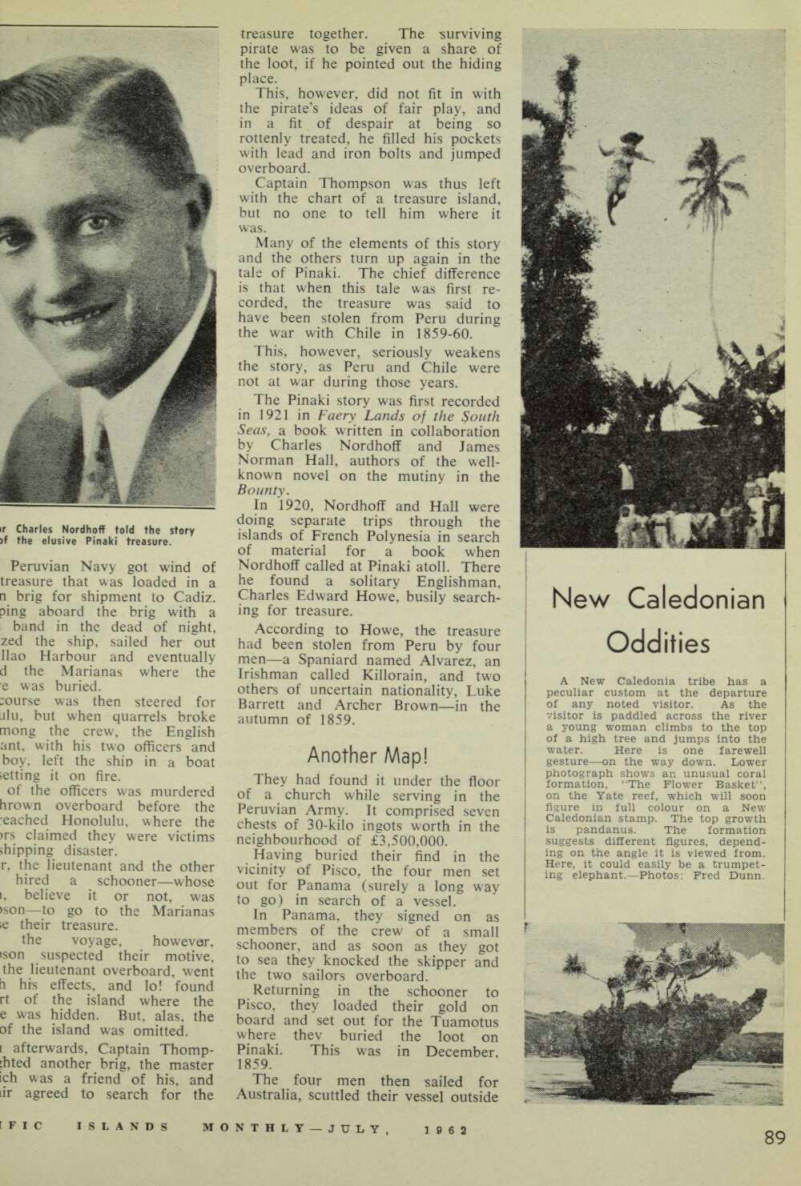
The Pinaki story was first recorded in 1921 in Faery Lands of the South Seas, a book written in collaboration by Charles Nordhoff and James Norman Hall, authors of the well known novel on the mutiny in the Bounty.
In 1920, Nordhoff and Hall were doing separate trips through the islands of French Polynesia in search of material for a book when Nordhoff called at Pinaki atoll. There he found a solitary Englishman, Charles Edward Howe, busily search ing for treasure.
According to Howe, the treasure had been stolen from Peru by four men—a Spaniard named Alvarez, an Irishman called Killorain, and two others of uncertain nationality, Luke Barrett and Archer Brown—in the autumn of 1859.
Another Map!
They had found it under the floor of a church while serving in the Peruvian Army. It comprised seven chests of 30-kilo ingots worth in the neighbourhood of £3,500,000.
Having buried their find in the vicinity of Pisco, the four men set out for Panama (surely a long way to go) in search of a vessel.
In Panama, they signed on as members of the crew of a small schooner, and as soon as they got to sea they knocked the skipper and the two sailors overboard.
Returning in the schooner to Pisco, they loaded their gold on board and set out for the Tuamotus where thev buried the loot on Pinaki. This was in December, 1859.
The four men then sailed for Australia, scuttled their vessel outside
ir Charles Nordhoff told the story >f the elusive Pinaki treasure.
Cooktown and went ashore with a tale of shipwreck.
After going through such gold as they had brought with them, they went to work on the Palmer gold fields, where Alvarez and Barrett were killed in a skirmish with aborigines.
Brown and Killorain were both later gaoled for 20 years for man slaughter. Brown died in prison, but Killorain served out his term and afterwards spent most of his time either stealing or trying to earn enough to get back to Pinaki.
In May, 1912, at the advanced age of 87, he had still not raked up the necessary and was working as a watchman at Rushcutters Bay, Sydney.
Meanwhile, Howe (the Pinaki treasure-seeker) had come to Sydney for treatment for an infected spear wound, sustained in a brush with a native on the New Guinea gold fields.
As luck would have it, Howe got lodgings in the same boarding house where Killorain was staying, and one night he lent Killorain a few shillings to get to Rushcutters Bay.
Several months later—in Decem ber, 1912, to be exact—Howe got a message to go to Sydney Hospital where he found Killorain on the point of death and anxious to repay the loan that Howe had made to him. (Shades of Captain P and the Russian Finn!) Killorain’s repayment was in the form of a map of Pinaki atoll (that had been sewn in the lining of his coat) and a circumstantial story about the theft of the treasure buried there.
Useless Chart
Howe told Nordhoff that his immediate reaction was to dismiss the story as nonsense, but on check ing the story with friends in Cook town and Peru he became convinced it was true.
However, Howe’s enquiries ap parently weren’t very thorough, for in February, 1912—only three months later—he was put ashore at Pinaki by a small cutter.
When Nordhoff called at the atoll in 1920, Howe had dug trenches all over the island but had not found the treasure. Killorain’s chart, he said, had been of little use to him because it referred to trees that had been cut down by natives of neighbouring Nukatavake.
It is not clear from subsequent
literature how long Howe stayed on Pinaki, but it seems that in 1926 he was deported from French Polynesia as an undesirable alien.
One story says that he eventually realised that Killorain’s map was really a map of another island, that he went to this island, found the treasure, and got into trouble with the French authorities when he tried to get away with some of the treasure without notifying them.
The same source—George Hamil ton’s The Treasure of the Tuamotus —says that in 1930 Howe turned up in Sydney again where a journalist called William Edwards became interested in his story.
Three years later Edwards or ganised an expedition to search for the Pinaki treasure on Howe’s other island (unnamed, but near Makemo), but no treasure was found.
Meanwhile, Howe had disappeared into a cloud of blue smoke and he does not seem to have been heard of since.
As for the story of treasure which allegedly exists on Fiji’s Hat Island, it seems that this has been passed down by word of mouth for many years and that it is only since World War II that it has been published.
Many of the details of the pub lished stories differ widely, but the following “facts” are common to all of them: • Until his death on Hat Island in 1909, there was a man called Thompson who had lived there for many years who believed that the island contained some treasure. • The treasure had been buried on the island by Thompson and two companions who had been wrecked in the vicinity in a barquentine which had come from South America. • Somewhere along the line (the versions differ) Thompson killed two men over the treasure. • In the last few years of his life, Thompson’s mind became de ranged and he would never allow any Fijians to land on the island.
In view of this last fact, and also because there is apparently no evidence of a barquentine ever hav ing been wrecked near the island, it may be that the story of Hat Island’s treasure was merely a fig ment of Thompson’s disordered imagination.
It is possible, in fact, that the story may have grown up in his mind after hearing or reading about his mythical (?) namesake, Captain Thompson of the brig Mary Dear!