[?]W Zealand Seeks To
pp. 75-77 · Read in the full issue
Increase Long-Standing
Trade With The Pacific
New Zealand manufacturers are looking at the Pacific ids as a natural outlet for the products of their growing stries. They see the basis of a logical mutual trade to fit both.
W ZEALAND trade mission— r 20 strong—visits the Islands and August to tell of the range of goods produced, the Union Steam Ship Corn island trader Tofua, and by lAL and TAI) the mission Fiji, Niue, American Samoa, Samoa, Tahiti, New Cale nd the New Hebrides. Apart splays ashore, the Tofua will ;ed as a trade display ship, nission is led by Mr. R. H. of Christchurch, president Canterbury Manufacturers’ ion.
Zealand and the Pacific Is ave traded with each other ny years. Now, because of ig industrialisation, New is producing a wide range iufactured goods which will Islands’ buyers.
Many Advantages
quality and competitive prices ly two of the advantages by the New Zealand Trade to the Pacific in buying from ealand. Manufacturers draw i to quick delivery by air i, handy servicing facilities, : benefits of increasing two de.
Zealand has traditionally been cer from the land, but since War 11, the level of export as helped to dictate a policy iisive industrialisation. From t New Zealand had to match 1 goods in quality and price, esult New Zealand industry vn in range and efficiency, the products of New Zealand are offered to islands in the from which New Zealand >pical produce amongst other vhich cannot be produced in ealand’s temperate climate, coffee, bananas, pineapples, oconuts and copra have long ipped to New Zealand, and
foodstuffs, including dairy produce and meat, bought in return.
There are many products from New Zealand industries which will meet the needs of developing Pacific territories. Treated timber is used in housing projects; special earth moving and agricultural machinery, chemicals, medical preparations, hard ware, electrical appliances, plumbing supplies, paints, footwear and cloth ing, and many other products are available.
Thorough inspection of meat and dairy produce, and manufacture to the specifications of the New Zealand Standards Institute ensure that over seas customers receive goods of the high quality they have come to ex pect.
New Zealand is well situated to supply the South Pacific, and is the nearest source of supply of manu factured goods to most island groups.
The speedy and regular sea and air services offer advantages to the Is lands buyer. If necessary, goods can be ordered in smaller quantities— there is less need to hold large stocks of perishables. New Zealand goods arrive fresh. Spare parts of machines and appliances are readily available and only a few hours away by air freight. Skilled New Zealand tech nicians are close at hand if quick servicing is required.
Quick Servicing
Air and shipping lines of New Zealand and other countries operate regular and direct services from New Zealand throughout the South Pacific.
Return services carry Islands’ produce for the New Zealand market. By concentrating on and studying Pacific trade, these organisations operate specially designed and equipped craft to serve the two-way trade.
New Zealand manufacturers are now intensifying their efforts to meet the particular requirements of the markets in the Pacific. New Zea
(Continued on p. 75)
jroximity enables salesmen to acific territories regularly to their wares, and to study re :nts and learn consumer tastes ferences. *apidly growing Pacific tourist las created a demand for foodstuffs such as are pro y New Zealand. Besides meat •y produce New Zealand offers range of canned and deep ielicacies. Air freight has al roved economic for carrying od supplies to tourist centres, pplying tariffs on imported Vew Zealand, and British Is ritories and Western Samoa, n the Commonwealth pre system. Trade between New and other Pacific islands is f on a Most-Favoured-Nation r trade between New Zealand itories in the Pacific is sub- Fiji is New Zealand’s largest in the South Pacific, exports in 1960 amounting to 0,000. In the same year ex- Western Samoa amounted to 000; to Tonga £NZ304,000; rench Polynesia £NZ149,000. exports to New Caledonia y £NZ2,OOO; but in the first iths of 1961 this figure rose 0,000. Exports to the New in 1960 were £NZ4,OOO. >tal in 1960 of trade in both 5 between New Zealand and ritories on the mission’s was £NZ4,035,000. rowth of two-way trade be e Islands and New Zealand is logical and necessary by of the New Zealand Trade They believe that New proximity and the nature oducts each has to offer the i good basis on which to ex i two-way trade.
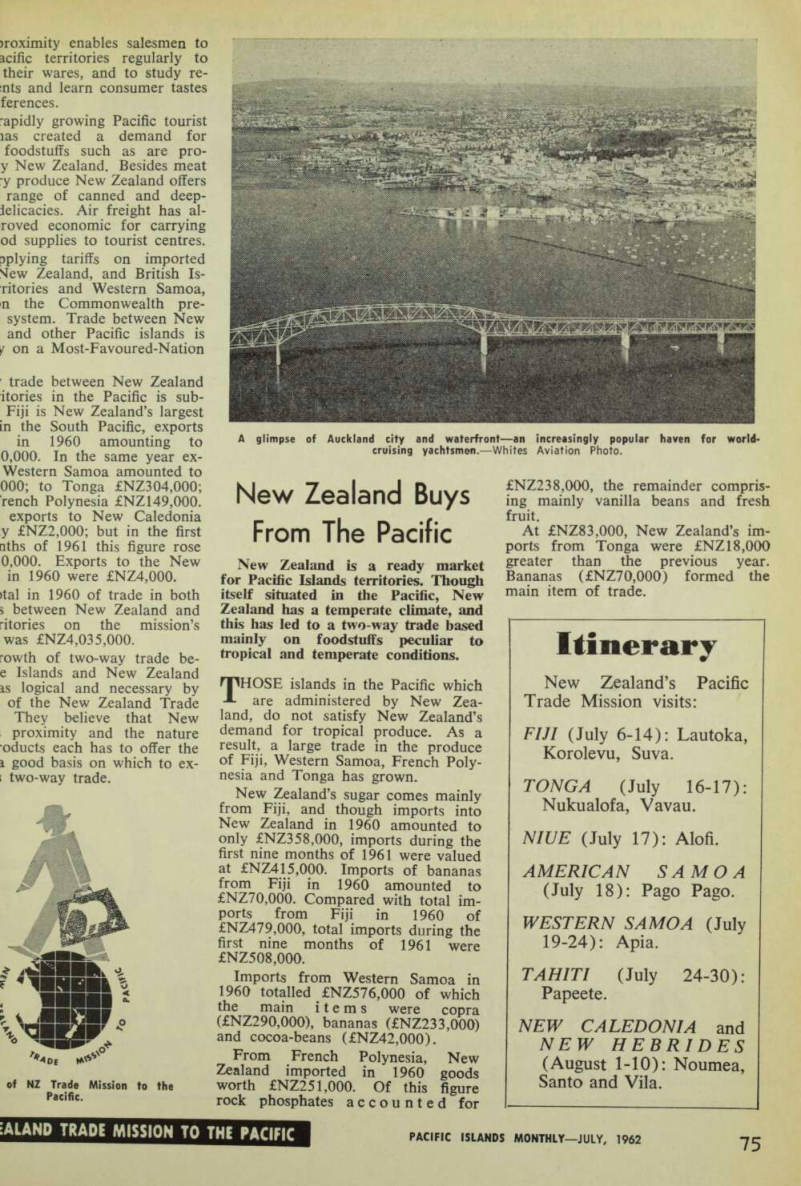
of NZ Trade Mission to the Pacific.