Farming And Fights Bureaucracy
pp. 63-67 · Read in the full issue

The Belligerent Squire of Zenag Old-Timer “Mick” Leahy Demonstrates Farming And Fights Bureaucracy
By R. W. Robson
A few people in P-NG shake their heads dolefully over hael J. Leahy. “His feuds have wrecked his public use jss,” they say. “It’s a pity. Dear old Mick!”
X maintain that Mick Leahy ic most interesting, wholesome have met in thirty years’ in New Guinea. Maybe it mse I share with him a ion of petty bureaucrats; and racy naturally flourishes in a that gets a free annual Gov t hand-out of over £l5 I, like most people, accept :racy as an inescapable phe >n, like the fruit fly or a cold
in the head, and try to live with it.
Mick fights it.
Mick insisted that Australia’s pig headed engineers, having insufficient knowledge of New Guinea conditions, put the Markham Bridge in the wrong place; and he had many good reasons to support his claim.
When, as a member of the Morobe District Council, his request for sound data to justify the present siting of the bridge produced nothing, he ex pressed his opinion of gentlemen-in-
office and walked out of the Council.
On May 3, I accompanied Mick Leahy in a car from Lae to Zenag.
The Markham was running a banker; and from near the south end of the bridge, until we began to climb to wards the Wampit, we ran through about two miles of flood water from the nearby river, covering the road in places by 12 inches.
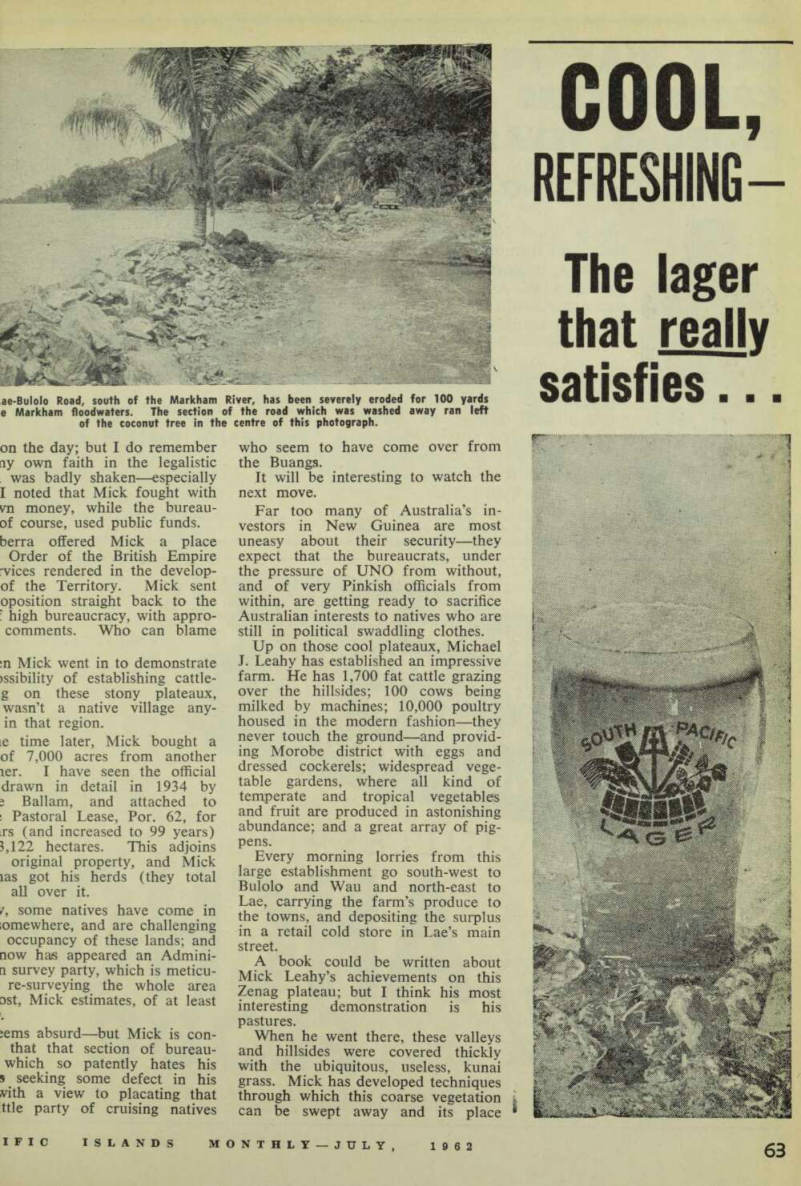
In one place, the eroding Markham has cut about 100 yards of formed road completely away, and a tem porary track of corduroy and rock has been built around the gap, through a swamp.
Mick grinned wryly. “That’s exactly what I told them would hap pen,” he said. “And it will keep on happening. If they’d built the bridge near Nadzab, as I urged, they’d have cut out all this useless country, and the road to the Bulolo would have gone up over those ridges, fairly straight and a reasonably easy grade.”
Back Went the MBE!
After World War 11, when he had finished with goldmining, exploring and soldiering, Mick put his all into a cattle-farm at Zenag (or Mumeng) —he had faith in the clean, new pastoral country at 4,000 feet.
A few years later, the deadly Queensland cattle tick appeared, and Mick’s herds were threatened. Mick insisted that the scourge was intro duced through the carelessness of certain officials of the Department of Agriculture; and with the aid of Ter ritory lawyer Dudley Jones, he con vinced the Territory’s Supreme Court that his claim was just. The Chief Justice awarded him some £4,000 damages. The whole Territory, which has a delicate sense of justice, ap plauded.
Regarded with Suspicion
But the bureaucrats carried the case on appeal to Australia, and the verdict was reversed.
I do not remember the legal points
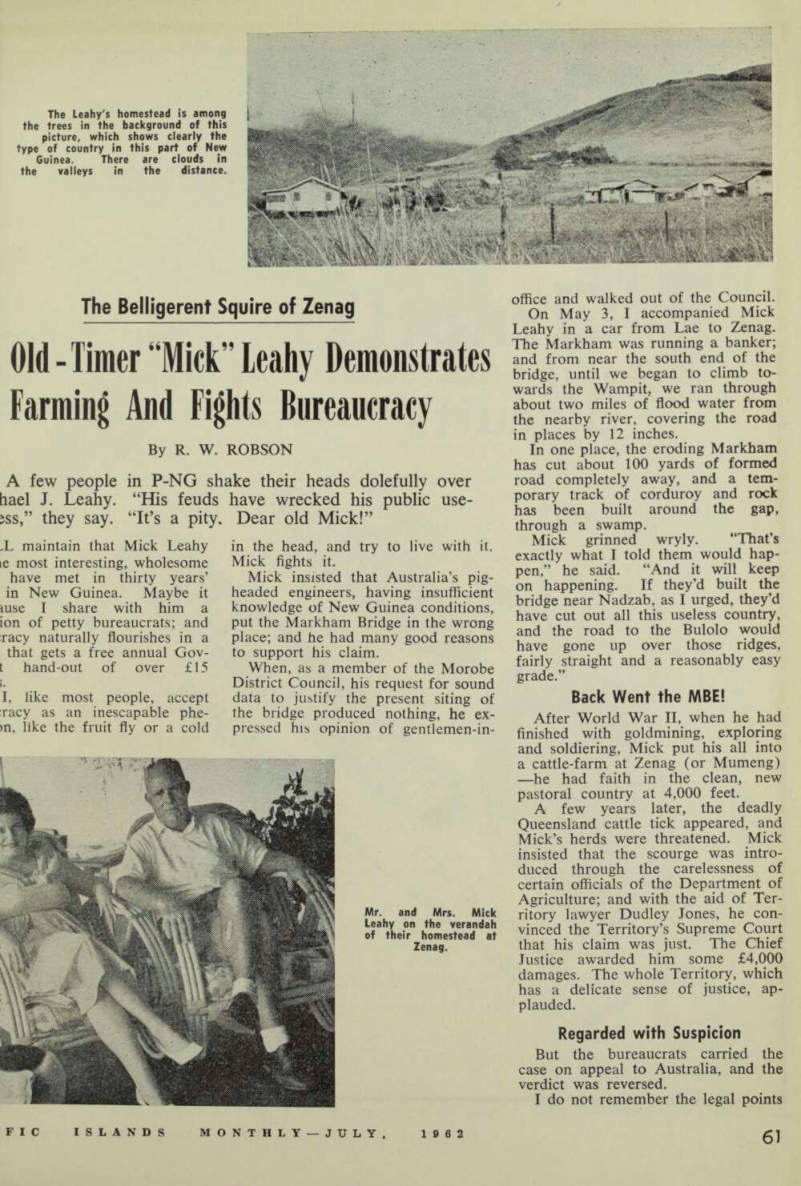
The Leahy's homestead is among the trees in the background of this picture, which shows clearly the type of country in this part of New Guinea. There are clouds in the valleys in the distance.
Mr. and Mrs. Mick Leahy on the verandah of their homestead at Zenag.
on the day; but I do remember ay own faith in the legalistic was badly shaken—especially 1 noted that Mick fought with money, while the bureau of course, used public funds, berra offered Mick a place Order of the British Empire rvices rendered in the develop of the Territory. Mick sent oposition straight back to the : high bureaucracy, with appro comments. Who can blame ;n Mick went in to demonstrate >ssibility of establishing cattle g on these stony plateaux, wasn’t a native village any in that region. ie time later, Mick bought a of 7,000 acres from another ier. I have seen the official drawn in detail in 1934 by 2 Ballam, and attached to I Pastoral Lease, For. 62, for ts (and increased to 99 years) 3,122 hectares. This adjoins original property, and Mick ms got his herds (they total all over it. /, some natives have come in lomewhere, and are challenging occupancy of these lands; and now has appeared an Admini n survey party, which is meticu re-surveying the whole area Dst, Mick estimates, of at least jems absurd—but Mick is con that that section of bureau which so patently hates his s seeking some defect in his vith a view to placating that ttle party of cruising natives
who seem to have come over from the Buangs.
It will be interesting to watch the next move.
Far too many of Australia’s in vestors in New Guinea are most uneasy about their security—they expect that the bureaucrats, under the pressure of UNO from without, and of very Pinkish officials from within, are getting ready to sacrifice Australian interests to natives who are still in political swaddling clothes.
Up on those cool plateaux, Michael J. Leahy has established an impressive farm. He has 1,700 fat cattle grazing over the hillsides; 100 cows being milked by machines; 10,000 poultry housed in the modern fashion—they never touch the ground—and provid ing Morobe district with eggs and dressed cockerels; widespread vege table gardens, where all kind of temperate and tropical vegetables and fruit are produced in astonishing abundance; and a great array of pig pens.
Every morning lorries from this large establishment go south-west to Bulolo and Wau and north-east to Lae, carrying the farm’s produce to the towns, and depositing the surplus in a retail cold store in Lae’s main street.
A book could be written about Mick Leahy’s achievements on this Zenag plateau; but I think his most interesting demonstration is his pastures.
When he went there, these valleys and hillsides were covered thickly with the übiquitous, useless, kunai grass. Mick has developed techniques through which this coarse vegetation can be swept away and its place
[?]ae-Bulolo Road, south of the Markham River, has been severely eroded for 100 yards [?]e Markham floodwaters. The section of the road which was washed away ran left of the coconut tree in the centre of this photograph.
by grasses and legumes of it strength and aggressiveness the kunai, and of sufficient to feed and fatten fussy e-farming in New Guinea has I a stage where it is a story f. Sufficient to say here that „eahy is running, for dairying ;s, the Illawarra Milking Short ind for general grazing Polled rds, with a bit of Brahmin ; through the breeds, there have just arrived in New , from Australia, three Santa iis bulls, two of which have » M. J. Leahy’s herds at Zenag, e to brother Jim Leahy’s herds oroka. Mick is emphatic that ds will benefit much from this ction of the famous Shorthorn tn cross from Texas’s famous lanch. future of cattle-farming in is still obscure. Production cale sufficient to justify freez r export is not in sight; but •reduction is increasing, and be sufficient to take care of rritory’s needs in meat, even h higher native living stan ncrease meat consumption.
Leahy thinks his biggest ry in pasturage is the Brazilian (Stylo) which is bigger and n every way than the Towns icerne, which it somewhat re s. Cattle take it eagerly, and opping its seeds all over the s, where it displaces the Mick found one Stylo runner t long. He established this aluable plant from half a dozen ;ent him in a postal envelope xiend several years ago. >ng the many tropical grasses gumes which now are flourish these flats and hillsides (the so stony that they are useless griculture but they support ;s excellently) are paspalum am, kikuyu, molasses grass, grass, pangola, elephant grass, ima. There does not seem any future pasturage problem ag. dr. Leahy seemed to be demon ic certain farming and animal idry values for the good of the >ry, I asked him what real help I had from the Department of Iture. I gathered that he has s troubles with that section of dom; but he said that in recent tie had received much help and kindness from individual 5. he will go down in history as □tstanding New Guinea farm r who battled through in spite eaucracy.