[?]erritories TALK-TALK
pp. 55-58 · Read in the full issue
It has often been stated that primitive people have a uliar gift of anticipating events. Some call it prophetic on; extra sensory perception or a sixth sense. The down arth realist brushes it off with the one word: Coincidental.
- it what you may, my own perience with primitives bears j fact they are in possession tie acute faculty which we whites have lost—if we ever i I first went to Buka in the i days (1912) the expatriate ion there was of a more or ternational character; There Paul Schmidt, a German I relieved); Gustav Thurm, Teuton; Eric Sjoberg, a Swede at Petats; a French priest at and a Chinese trader at ly after my arrival a delega »f kukurais (chiefs) from Buka villages approached me, all seriousness asked me when ;lish were coming to take over nd. Such a question put to a ;r in a German colony was te. It was not the French, i or Chinese they were in in; only the English, phatically denied such a pos and in all good faith. The s departed, but I could feel vas an atmosphere of in y amongst them, as though ;re saying: Methinks he doth too much. n a few months Burns Philp’s 1 Plantations had acquired n Bougainville at Soraken, Peopasino and Arigua. Several s came to me then, repeated stion, with knowing nods, and maintained my negative atti- Yho was I to know that Der s just around the corner?) ! War I, and eventually the of Australian troops in New and the occupation of Kieta. ;00, the kukurais to me again.
Id you so,” they said, ed to assure them of my ignorance at the time of their ling. They were not im came the impending invasion ml by the Japanese in 1942.
Tolai luluais asked me what lappen. I was optimistic. The Mild take Rabaul, but even ?e driven out again, I told hey shook their heads. Rabaul vmed; it was finished, they as le. How true they were! Not
a house remained standing at the end of the three and a half years.
And now ... we have the people from Bougainville and Manus asking the UN Visiting Mission for the transfer of the Trusteeship to the USA, which delegate Dalmas H.
Nucker, in no uncertain language, told them was impossible. What hap pened? Shortly afterwards an official announcement stated that the US would establish “tracking stations” in Buka and Manus, entailing astrono mical expenditure!
Europeans, inured to the vagaries of international politics, nuclear war fare and all the nerve-wracking “ad vantages” of our present generation,
With Tolala
can fully realise there is no associa tion whatsoever with the Buka and Manus requests and the establish ment of tracking stations in those areas.
But will the native people realise that? Will they laconically accept such establishments as an answer to their own wishful thinking and which their sixth sense assured them would eventuate? . . . Could be . . . Coinci dental? ... I expect so.
The Importance
Of Names It was in the January issue of PIM (p. 71) that I asked, parenthetically, as to the origin of the name Herbert shohe, now known as Kokopo and one-time capital of German New Guinea.
From Hans Mannsfeld, an old time German resident of the colony and now living in Germany, I re ceived the answer. He writes: “I cannot remember that this nomenclature was ever discussed in the German time but I was always under the impression that it was some sort of homage to Bismarck.
The name of one of his two sons was Herbert (the other’s Bill) and if I am not mistaken it was Herbert who served as Secretary of State un-
der his father and resigned when the Old Man was dismissed by Kaiser Wilhelm 11. The mountain behind Herbertshohe, named by the natives Vunakorkor, got also a European name, viz., Varzin, which was Bis marck’s old family estate in Pom mern.”
One of these days historians (Aus tralian, Indonesian or Chinese!) will be searching for the origins of island place-names, and with what a prob lem they will be faced!
Careless journalism creates much unnecessary confusion. Not so long ago I was reading an article in a Sydney paper where a lady, who held a “one day seminar on Ethno-Musi cology” which, in common parlance, is the study of non-western music, was repeatedly reported as making tape-recordings of native music in the Duke of Norfolk Islands, which ob viously were intended to be the Duke of York Group, between New Britain and New Ireland. Authentic geo graphic names in the Islands are suf ficiently confusing at times without inventing names through slovenly re porting.
Confusion in Place Names And this is what I mean by the confusion: Any NG resident glancing at a map of the Territory must be aston ished at the unfamiliar names given to many of the island groups.
For instances: Nissan is also often shown as Green Island, also Sir Charles Hardy. Carterets appears as Kilinailau, also known as Green Island and Niue Island. The Mort lock group appear as Tauu and also Marqueen and the Tasmans as Nuku manu. The Witu (or Vitu) group used to be known as the Franzos ische or French islands. The Port lands appear as the Tingwon group.
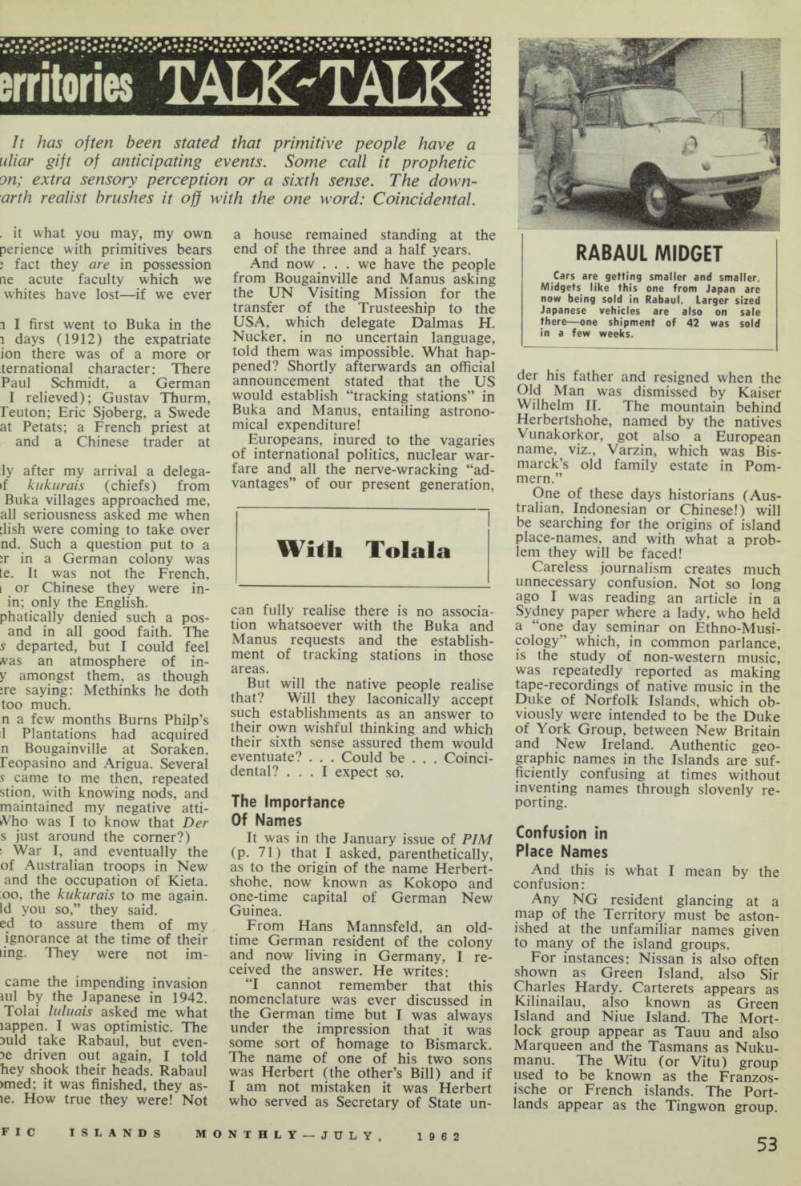
Rabaul Midget
Cars are getting smaller and smaller.
Midgets like this one from Japan are now being sold in Rabaul. Larger sized Japanese vehicles are also on sale there—one shipment of 42 was sold in a few weeks.
Island appears as Wuvulu. ly not Vuvulu, you might ask, most maps there is constant >n with native names contain letter “W”. reason for this (and I don’t ny memory has played me s that in about 1911 the Ger- Iministration issued an order native place names with “W” be spelt with a “V”. In some s charts and maps have been in some the old spelling still . Witu, Wanimo and Kae ire examples of the obser n Walis Island (Aitape coast tape as it was called up until le late ’2o’s) there is further •n, for it is often shown as m error carried down from charts which showed the old ’ (resembling “f” without the is really a subject which re lose investigation by the ap -2 authorities so as to arrive ; specific standardisation of rnies. It is a wonder to me ias not been done before, hange of national control, I is attributable for much of usion. We had New Britain, land and Duke of York; then the change to Neu Pommern, ;cklenburg and Neu Lauen id then back again to their names. te a portion of a geographi cnption of the Bismarck ago, published in a Sydney )k in 1918: large and valuable islands of tain. New Ireland, New Han l the numerous smaller ones, ing them—the Admiralty, Exchequer, Hermit, An
chorite, French, Gerrit Denys, Sir Charles Hardy, St. John, St. Matthias and Squally Islands and innumerable others of little or no importance—are comprised in the collective term of the Bismarck Archipelago. The aggre gate area of these islands is about 20,000 sq. miles.”
Can you pin-point all of them?
As a postcript, I would like to sug gest to my colleagues of the Terri torial Press that they give more at tention to the correct spelling of place-names in their routine reporting of events.
Without trying to appear a pom pous purist, I would point out that on many occasions the names of vil
lages and plantations in their reports have been frightfully mutilated and— at times—almost unrecognisable. I remember the time when the local paper was accepted as a dictionary and a gazeteer. I don’t know whether that would apply these days.
Rackets in
Stamps
After reading the story about Tongan stamp errors (PIM June, p. 29) I am more than ever convinced that something should be done to tighten up the possibility of errors in stamp over-printing becoming so pre valent.
It is some years ago now that I
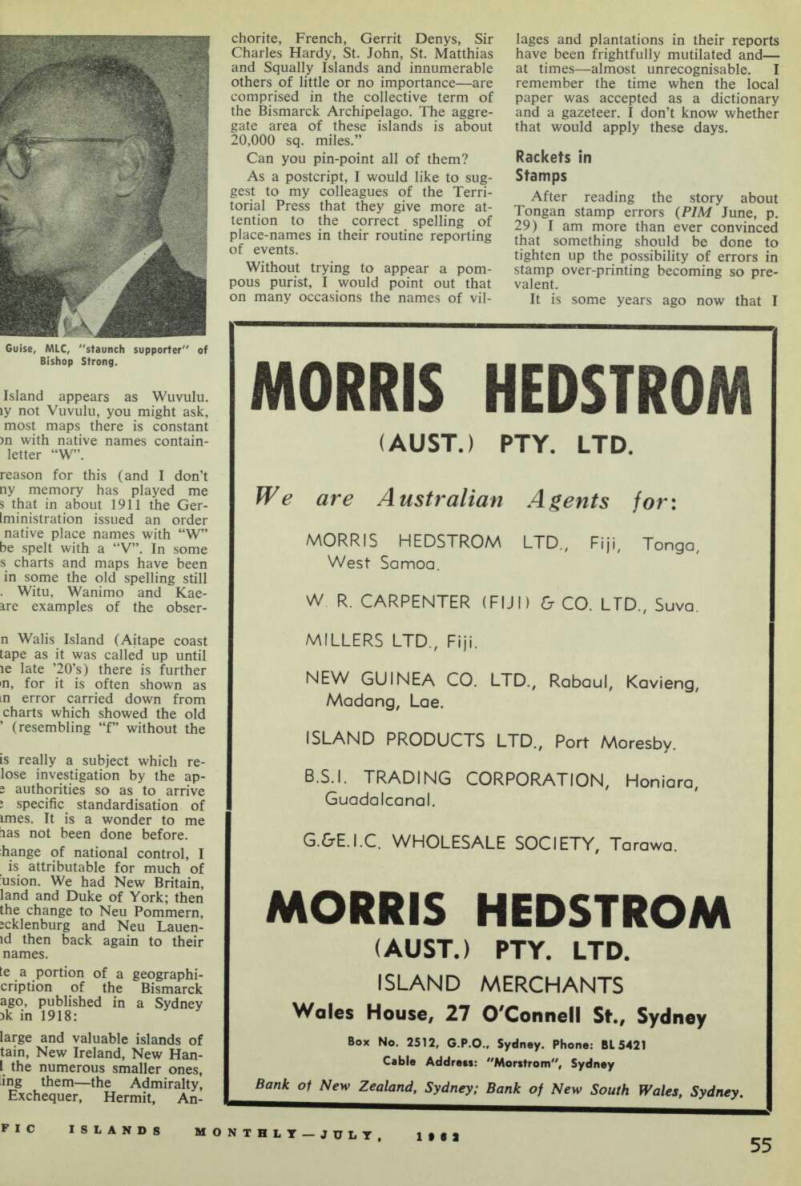
Guise, MLC, "staunch supporter" of Bishop Strong.
described in my Talk Talk how I was approached in Rabaul to “over print” some of the old German “yacht series” with the GRI sur charge. At the time I was engaged in the printing office, which held the type used in the original overprint ing, and so I realise what potentiali ties exist for this kind of fraudulence.
Insofar as “errors” have occurred in the Pacific 1 note that invariably the “overprinting” is from hand-set type and printed on hand-fed machines—not the modern automatic feed. The loophole, of course, exists in the fact that there is a time lag before surplus issues, over and above the official issues, are discovered. The question naturally arises then as to how are you going to control subse quent issues when type faces are stan dardised and obtainable from any type-founders.
These are features for philatelists to guard against. And I leave it to them to nut out some sort of control, or system, to protect themselves against these possible Surcharge Racketeers.
They Want it
Both Ways
Reports of the debate in the P-NG Legco on the repeal of the Native Women’s Protection Ordinance indi cate some opposition. And so this racial discrimination policy seems to be getting somewhat out of hand. It seems to be all right in certain as pects, but not in others. Surely that is evidence in itself that racial dis crimination cannot be thrown over board in a matter of a year or so. (And, perhaps, the dusky belles are not keen themselves on such pro tection!)
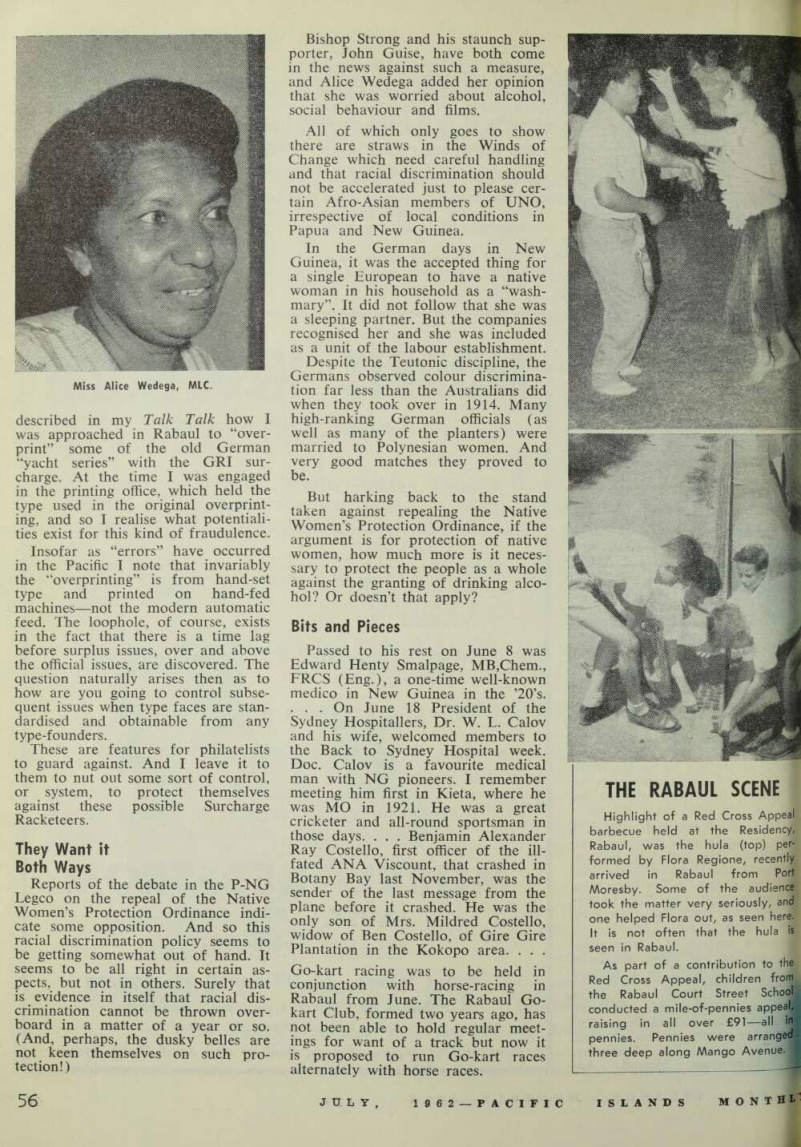
Bishop Strong and his staunch sup porter, John Guise, have both come in the news against such a measure, and Alice Wedega added her opinion that she was worried about alcohol, social behaviour and films.
All of which only goes to show there are straws in the Winds of Change which need careful handling and that racial discrimination should not be accelerated just to please cer tain Afro-Asian members of UNO, irrespective of local conditions in Papua and New Guinea.
In the German days in New Guinea, it was the accepted thing for a single European to have a native woman in his household as a “wash mary”. It did not follow that she was a sleeping partner. But the companies recognised her and she was included as a unit of the labour establishment.
Despite the Teutonic discipline, the Germans observed colour discrimina tion far less than the Australians did when they took over in 1914. Many high-ranking German officials (as well as many of the planters) were married to Polynesian women. And very good matches they proved to be.
But harking back to the stand taken against repealing the Native Women’s Protection Ordinance, if the argument is for protection of native women, how much more is it neces sary to protect the people as a whole against the granting of drinking alco hol? Or doesn’t that apply?
Bits and Pieces Passed to his rest on June 8 was Edward Henty Smalpage, MB,Chem., ERGS (Eng.), a one-time well-known medico in New Guinea in the ’2o’s. . . . On June 18 President of the Sydney Hospitallers, Dr. W. L. Calov and his wife, welcomed members to the Back to Sydney Hospital week.
Doc. Calov is a favourite medical man with NG pioneers. I remember meeting him first in Kieta, where he was MO in 1921. He was a great cricketer and all-round sportsman in those days. . . . Benjamin Alexander Ray Costello, first officer of the ill fated ANA Viscount, that crashed in Botany Bay last November, was the sender of the last message from the plane before it crashed. He was the only son of Mrs. Mildred Costello, widow of Ben Costello, of Gire Gire Plantation in the Kokopo area. . . .
Go-kart racing was to be held in conjunction with horse-racing in Rabaul from June. The Rabaul Go kart Club, formed two years ago, has not been able to hold regular meet ings for want of a track but now it is proposed to run Go-kart races alternately with horse races.
Miss Alice Wedega, MIC.