Memorable
pp. 43-45 · Read in the full issue
Visit To The Cooks
From a Special Correspondent “Memorable and unusual” were the words used by a ship load of New Zealand tourists who recently made a three weeks’ tour of the Cook Islands, includ ing the seldom visited atolls of the Northern Cooks, and Niue.
THEY travelled aboard the 2,893 ton Moana Roa in the first direct voyage by a passenger ship from New Zealand to the Northern Cooks in almost 60 years. The last visit was when a New Zealand parliamentary party visited the atolls during a tour of the South Pacific in 1903.
The latest visit was also due to politics. The Moana Roa carried the New Zealand Minister of Island Territories, Mr. F. L. A. Gutz, and other VlP’s. The 30-odd tourists who also went along, saw islands never visited by tourists and enjoyed entertainments and cere monies which were especially arranged for the VlP’s. The view of the tourists was unanimous: “The experience of a lifetime”.
The Moana Roa is designed to handle heavy exports of citrus and other fruit during limited seasons, and to provide year-round facilities for passengers and general cargo.
She usually maintains a monthly service from Auckland to Raro tonga, the islands of the Southern Cook Group, back to Rarotonga, and finally to Auckland.
Her commander is Captain R. A.
Frazer, previously chief officer and acting master of the Maui Pomare.
The ship accommodates 40 pas sengers in 14 double, and three four berth cabins.
First port of call was Rarotonga, where students from N i k a o Teachers’ Training Centre and Tereora High School formed a guard of honour on the wharf, and contingents of Boy Scouts and Girl Guides, members of the Boys’
Brigade and Junior Missionary Volunteers lined up in front of the Administration building, where there was an official welcome. The official party made an extensive tour of the island.
The section of the tour embracing the Northern Cooks began with a visit to lonely Penrhyn Island, nine degrees south of the Equator and 190 miles from the nearest land.
There the programme was the same as occurred later on Manihiki, Rakahanga, and Pukapuka, the other atolls visited in the Northern Group.
The Minister was challenged in
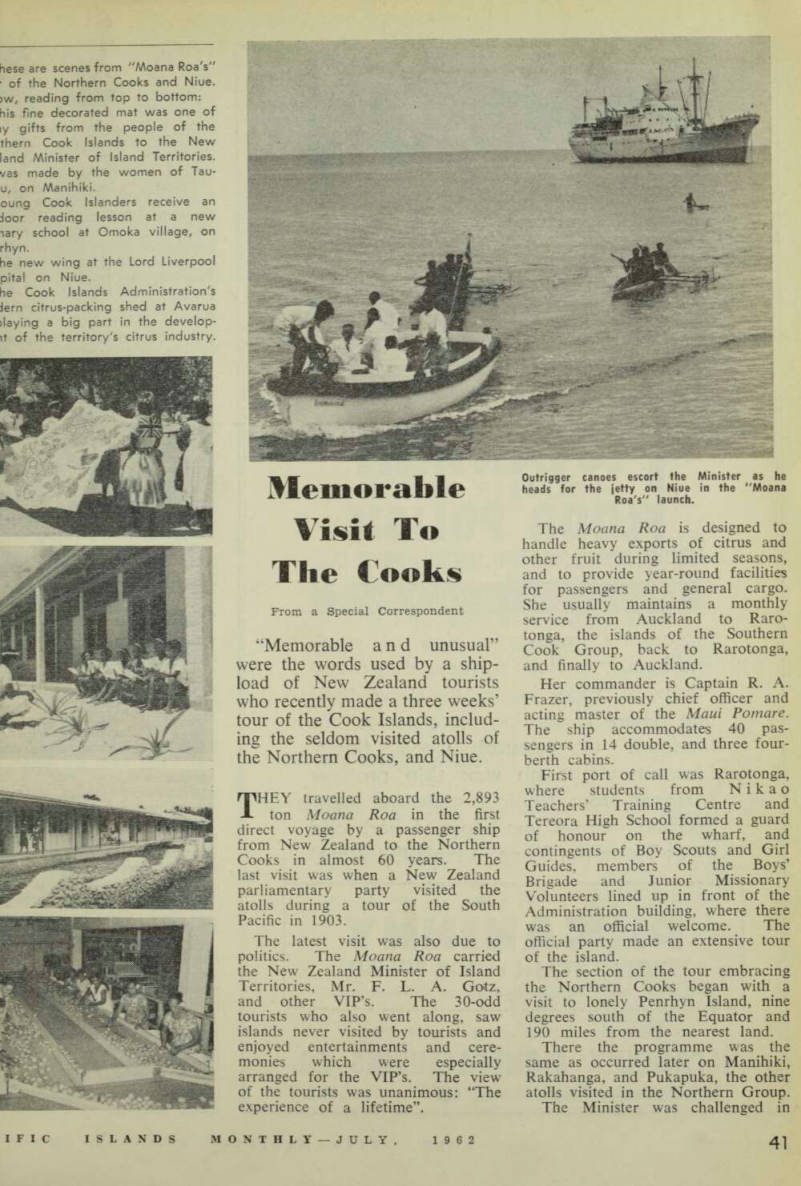
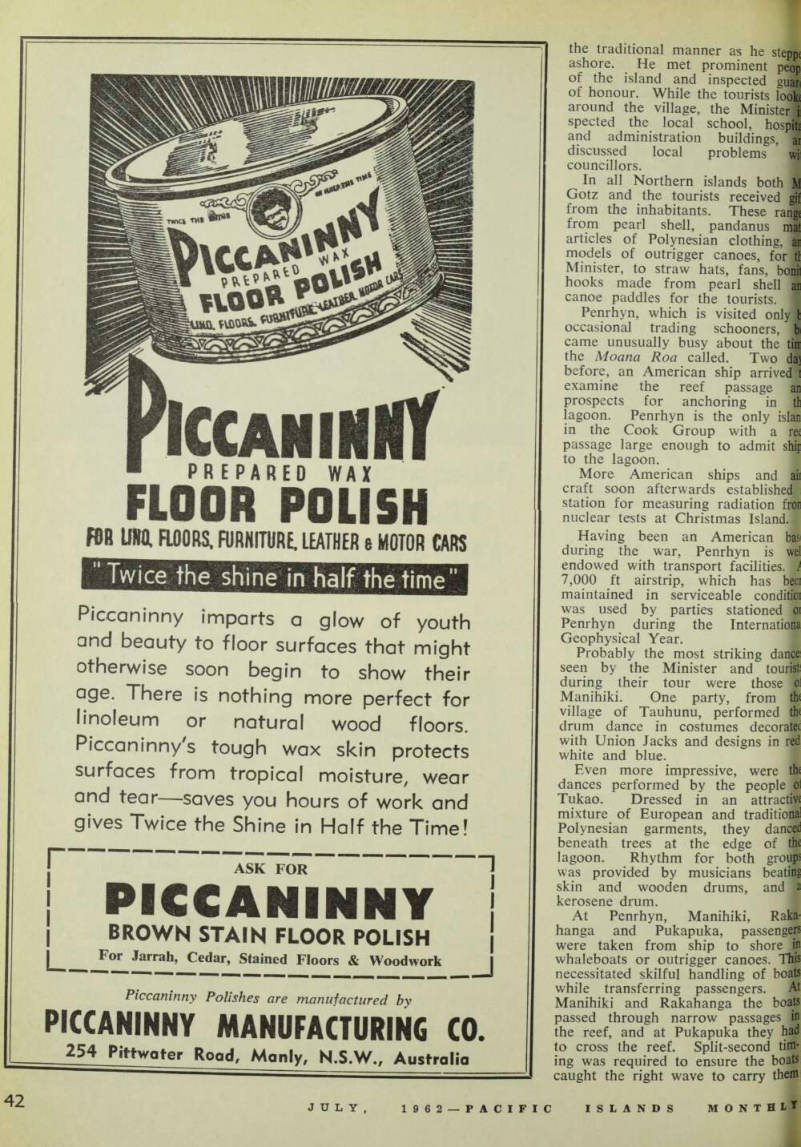
[?]hese are scenes from "Moana Roa's" of the Northern Cooks and Niue. [?]w, reading from top to bottom: [?]his fine decorated mat was one of [?]y gifts from the people of the thern Cook Islands to the New land Minister of Island Territories, vas made by the women of Tau ru on Manihiki. [?]oung Cook Islanders receive an door reading lesson at a new [?]ary school at Omoka village, on [?]rhyn. [?]he new wing at the Lord Liverpool [?]pital on Niue. [?]he Cook Islands Administration's [?]ern citrus-packing shed at Avarua [?]laying a big part in the develop ment of the territory's citrus industry.
Outrigger canoes escort the Minister as he heads for the jetty on Niue in the "Moana Roa's" launch.
the traditional manner as he steppe ashore. He met prominent peop of the island and inspected guan of honour. While the tourists look around the village, the Minister jj spected the local school, hospita and administration buildings, ar discussed local problems wil councillors.
In all Northern islands both M Gotz and the tourists received gif from the inhabitants. These range from pearl shell, pandanus mat articles of Polynesian clothing, an models of outrigger canoes, for tt Minister, to straw hats, fans, bonit hooks made from pearl shell an canoe paddles for the tourists. I Penrhyn, which is visited only b occasional trading schooners,' bf came unusually busy about the tim the Moana Roa called. Two daj before, an American ship arrived t examine the reef passage an prospects for anchoring in th lagoon. Penrhyn is the only islan in the Cook Group with a ree passage large enough to admit ship to the lagoon.
More American ships and air craft soon afterwards establishedfi station for measuring radiation fron nuclear tests at Christmas Island.!
Having been an American basi during the war, Penrhyn is wel endowed with transport facilities. / 7,000 ft airstrip, which has beer maintained in serviceable conditioi was used by parties stationed oi Penrhyn during the Internationa Geophysical Year.
Probably the most striking dance; seen by the Minister and tourist; during their tour were those ol Manihiki. One party, from the village of Tauhunu, performed the drum dance in costumes decorated with Union Jacks and designs in red, white and blue.
Even more impressive, were the dances performed by the people ol Tukao. Dressed in an attractive mixture of European and traditional Polynesian garments, they danced beneath trees at the edge of the lagoon. Rhythm for both groups was provided by musicians beating skin and wooden drums, and a kerosene drum.
At Penrhyn, Manihiki, Raka hanga and Pukapuka, passengers were taken from ship to shore in whaleboats or outrigger canoes. This necessitated skilful handling of boats while transferring passengers. At Manihiki and Rakahanga the boats passed through narrow passages in the reef, and at Pukapuka they had to cross the reef. Split-second tim ing was required to ensure the boats caught the right wave to carry them
h. Pukapuka, an atoll of unbelievable beauty, was for the tourists that blue s, golden sands, vast groves of trees, and houses of grass and io really existed outside of /ood. jrican writer Robert Dean : lived on Pukapuka for many His daughter Johnny, now Carl Hebenstreit, author, and sian dancer, and occasional >utor to PIM, travelled from mga to Pukapuka on the i Roa with her husband and nail children. She was return i Pukapuka, where she spent irs of her childhood, to stay month or two. the islands visited, the tourists Pukapuka was the least d by the twentieth century. ;nuine Polynesian atmosphere indoubtedly enhanced by the strations of traditional skills sports—Polynesian wrestling, g baskets from palm fronds, ig flying fish in hand nets, g coconuts, lighting fires by g pieces of wood together, ng palm trees, and driving fish ets—provided to entertain the er and tourists. apuka was the last port of call Northern Cooks, and then the i Roa headed for the NZ terri af Niue, 300 miles east of Sme, Mr. Gotz travelled to the in a motor launch escorted by •utrigger canoes, and walked :n lines of cheering school :n to the administration offices, a meeting of the Niue Island
Legislative Assembly, Mr. Gotz ex pressed gratitude to the many hundreds of New Zealanders who, during their terms as officials on Niue, had worked hard for the future of the island and the progress of the people.
“Making the first steps towards progress is like starting a canoe,” said Mr. Gotz. “It is difficult to get a boat moving but once it is started it gathers speed rapidly. The canoe of Niuean progress is now moving but I want it to sail even faster. We will do our utmost to train as many Niueans as possible to take up positions occupied by Euro peans.”
The highlight of the visit to Niue
was a massed war dance by school boys dressed in traditional warrior garb and daubed with black paint, and singing and dancing by some 140 people from the village of Hakupu.
Mr. Gotz said that New Zealand was proud of the work done in improving health services in the island territories. “Once we were most ashamed of the high rate of infant mortality,” he said. “Now we can be proud of the fact that the infant mortality for Niue and the Cook Islands are lower than the New Zealand Maori rate.”
The tourists meanwhile voted Niue as fascinating a port of call as the beautiful Northern Cooks.
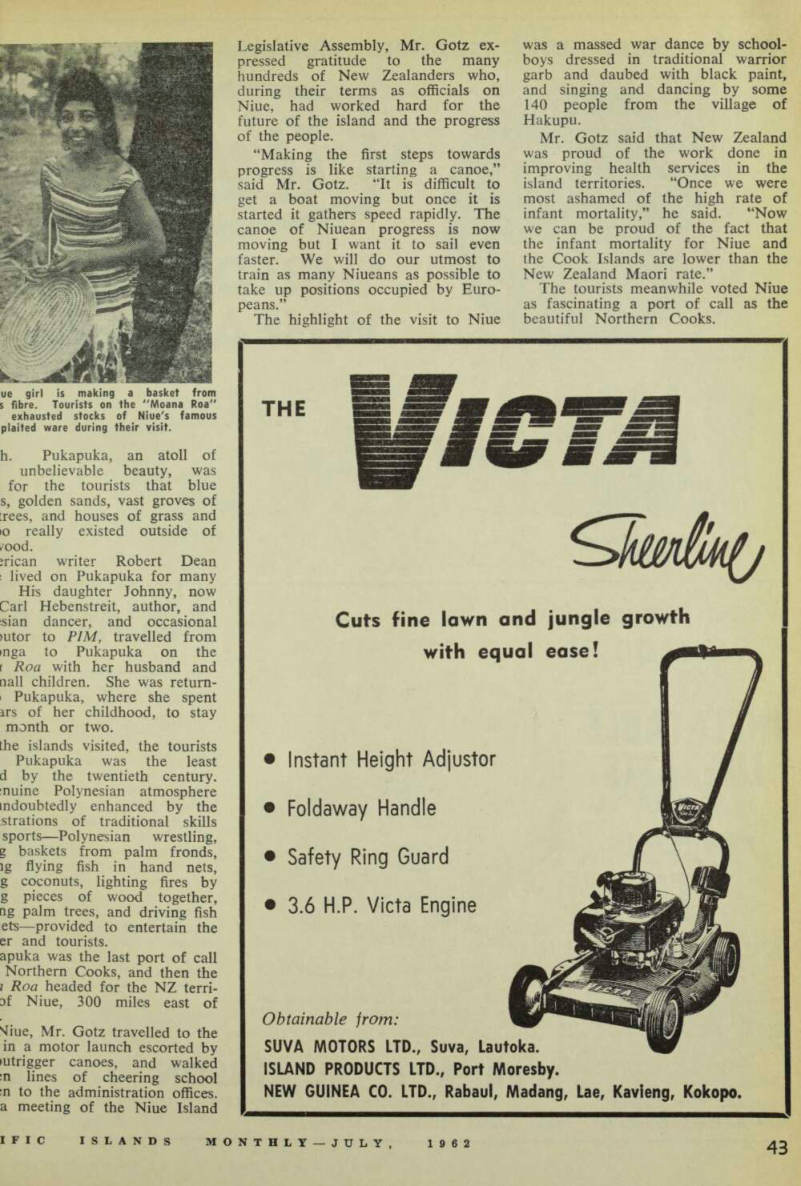
[?]ue girl is making a basket from [?]s fibre. Tourists on the "Moana Roa" exhausted stocks of Niue's famous plaited ware during their visit.