Spanner Speaks
pp. 26-169 · Read in the full issue
For P-NG's Mixed Races
By a New Guinea Correspondent If the self-termed Euronesians will allow themselves to be led, Harry Spanner could be the man who will show them the way to better living conditions and wages.
" i^^ r HEN you're white you're right; When you're brown stick around; When you're black stay right at the back . . .”
So quotes Henry Lewerissa, dis appointed and bitter Ambonese-born partisan for naturalisation among the NG territory’s mixed races.
Since his plea for naturalisation of both Asian and self-termed Euronesians was answered in 1957 by the granting of naturalisation rights to the former only, Henry Lewerissa has faded out of the lime light in favour of more forceful speaker Harry Spanner, another born of mixed race.
Spanner’s father, though, was an Australian—as if that makes any difference.
If any leader exists for these forgotten people, scattered through out the Territory, Harry Spanner is that leader . . . educated, a logical speaker of good presence, Spanner knows his people’s failings— and needs.
Most, the motley of mixed races
(Filipinos, Malayans, Japane Germans, Australians, British, Dutc Spaniards, Italians and Indian need wage equality with whites, f “We want to be paid on ability Harry Spanner says. “If one' our people holds an educati certificate he should be paid sals equal to any white holding the sai qualification.”
Should, is right, but not accordi to a recent advertisement in Territory newspaper (see reprodi tion). The Government maintains DOES pay job applicants on abili thus apparently claiming the uniq distinction in this case of assessi ability before sighting the applican Without doubt more equital wages would make Harry Spannc job of uniting his disunited peo] and raising their living standards less tedious one.
In Rabaul, NB, where live mi of the Territory’s apparently I wanted”, about 300 Euronesiansl housed in squalid “Malaytown” lo since condemned out of hand by t Council of Social Services, w wrote a scathing report on the re dents’ plight back in January, 19( “Unhealthy”, “substandard”, “rai shackle”, “dangerous to health”, we some of the opinions of a su committee of investigation. This Harry Spanner’s second most impc tant target—to urge his people save to build their own homes. I Currently a privately sponsof scheme is afoot to provide a foi stage dwelling equal to the shrunk purses of the Euronesian peop The first stage, a 24 ft x 20 ft dwe ing with concrete walls, doors, shi ters and water tank will cost in t vicinity of £450, rising with impro\ ments to a home of 7i squat “built as a European house”, ai costing £l,OOO.
(Continued on p. 167)
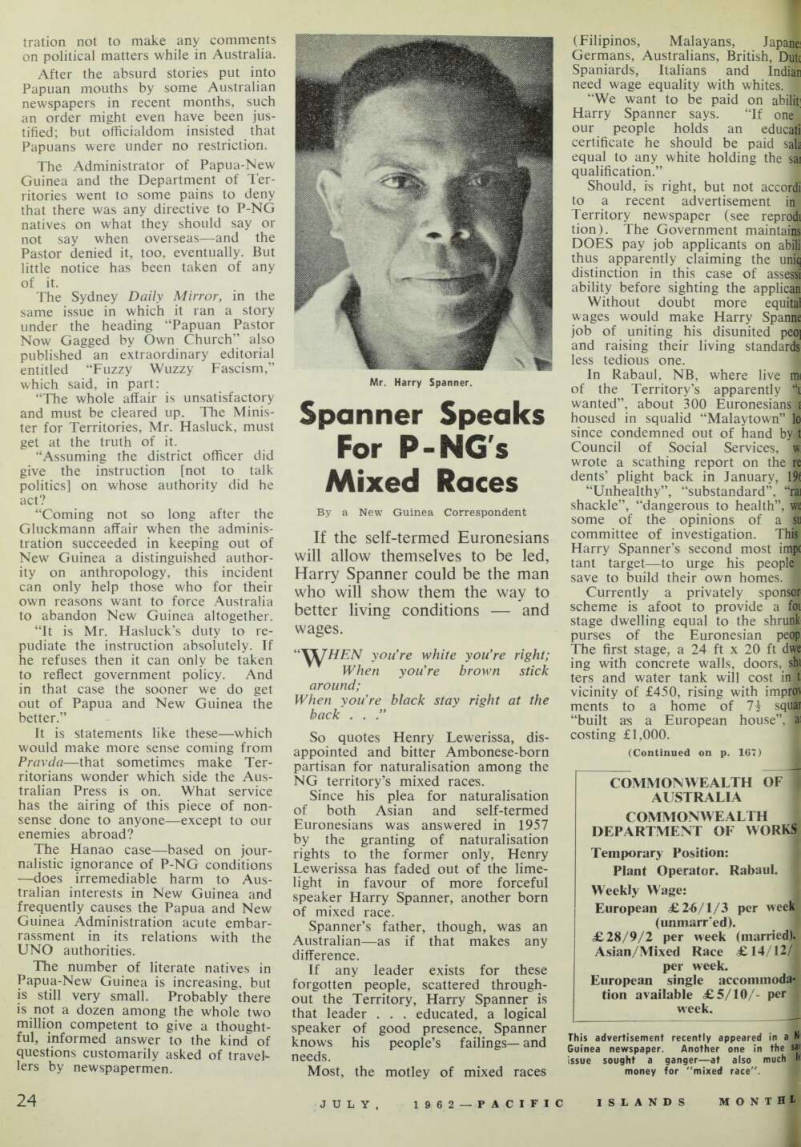
Mr. Harry Spanner.
irry Spanner and his Kombiu cohorts are now exhorting d race members to enter into a ing-savings scheme which will to better housing. “Exhorting” is making a house-to-house (or :-to-shack) appeal to the mixed to help themselves, hey need driving, counselling,” ner admits. “Each man and an is through virtue of mixed itage an individual, not always )le of working with others.” anner’s understanding of his e may go further than that of y Lewerissa, who himself is a naturalised Australian through i of his Ambonese parentage, rissa maintains his people are tious and want the respect of citizens. ut what can they do when they no country they can rightfully home?” Lewerissa asks. “My e receive Australian basic wages They can never live in Aus . We are here for life. r e want security. If—when—we granted naturalisation rights, at 200 locals would apply. There others, affiliated with us, in ;ng, Manus and Madang. Some em would apply.” inner is more conservative. “We the right to be naturalised,” he “but I couldn’t estimate how would exercise that right. It 1 be a matter for the indivi > •wever, the Euronesian is not so trodden as to affect his spirits ;ly. “We are irresponsible some ,” Spanner says. ‘To most of us always sunshine.” mes visited by the Council of 1 Services, though ramshackle, mostly models of cleanliness lomely pride. About 20 per cent.
Elabaul’s Euronesian populace a motor vehicle, about 10 per own their own homes, all homes :quipped with refrigerators.
He, like Lewerissa and George have risen to positions of councillors—though the feeling it this is meant more as an Ad tration sop to their vanity than real appreciation of their worth citizens. Others distinguished selves as soldiers—self-enlisted "ing the last war, two receiving ations of MM and DSM. Most part in sports and are good solid ns.
A minority, as in most unwanted, contribute to petty crime.
Why can’t these people become naturalised? Why are they not paid wages commensurate with their vary ing abilities? PIM has asked these questions often over the years, and they are the questions Spanner wants answered.
Meanwhile, Spanner is undaunted, and looks forward to the day when Euronesians are beyond slights, and are regarded as a progressive people with full citizenship rights—as they are in other parts of the South Pacific.