Nauruans Now Say They
pp. 17-18 · Read in the full issue
Want Independence
From our Canberra Correspondent Newest proposals from the Nauruan people on their future —for the setting up of a sovereign State—seems destined to get no further than other plans which the Nauruans have put up.
HEAD Chief Hammer Deßoburt announced the plan in a Press statement when he was in Canberra for talks before going to New York as an adviser to the Australian dele gation to the UN Trusteeship Council.
He urged creation of a sovereign Nauruan nation governed by the Nauruans in their own interest, but related to Australia by a treaty of friendship.
This would be similar to the Treaty of Friendship proposed be tween New Zealand and Western Samoa, and the one that binds Britain and Tonga.
Nauru wanted Australia as a “big brother,” he said.
Without attempting to spell out the details of a treaty, the Nauruans would expect it to indicate the man ner in which the two nations could co-operate.
It would cover such matters as
trade, treaties, postal agreements, extradition, the extent to which Aus tralia would be willing to act for and give advice on Nauruan external relationships, and political, trade and financial matters.
“We should hope that the earlier offers by Australia, the United King dom, and New Zealand to finance the cost of re-settling Nauruans in those three countries are an indica tion that finance could be made available for the establishment of a sovereign nation, following agree ment on the method of creating our new state,” he added.
“We have already expressed our wish to live in peace with all nations.
But we desire that the creation of the Nauruan nation should do noth ing to weaken Australia’s potential to defend herself against aggression.
“We should consider it appropriate that a treaty of friendship should
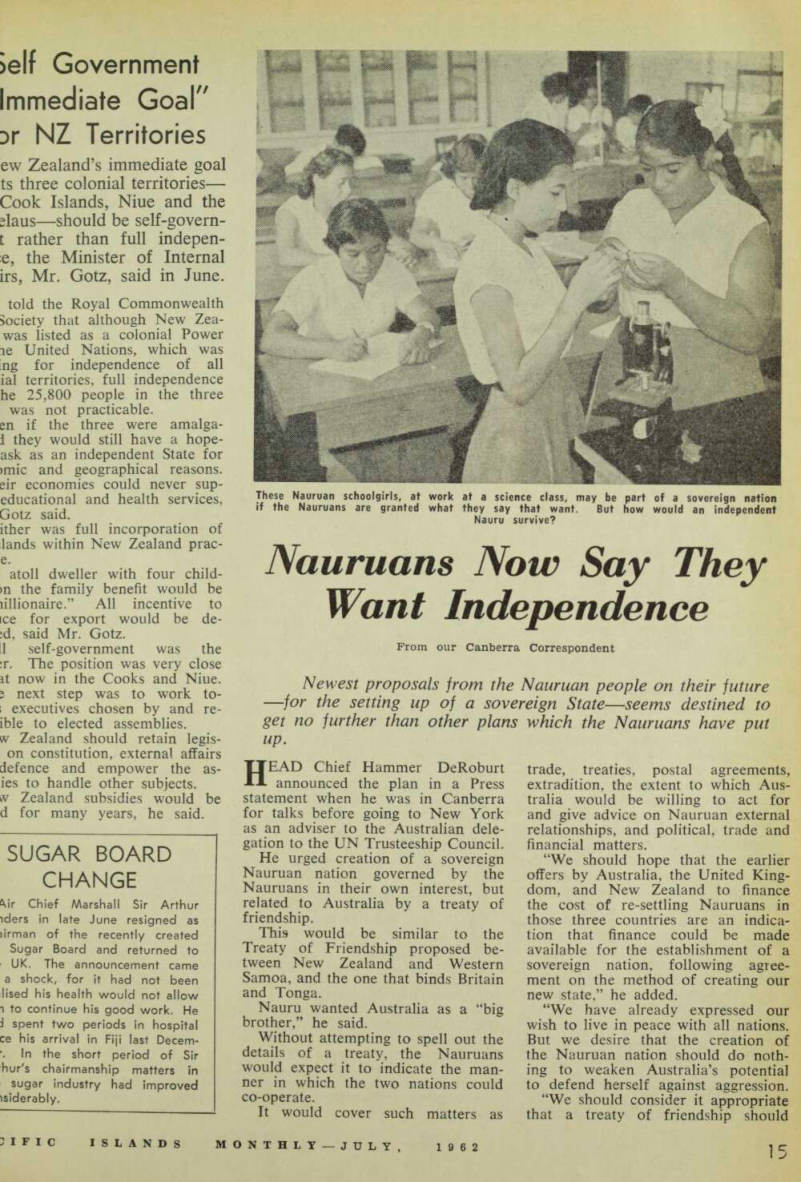
These Nauruan schoolgirls, at work at a science class, may be part of a sovereign nation if the Nauruans are granted what they say that want. But how would an independent Nauru survive?
examine ways and means of preserv ing Australia from attack.”
Chief Hammer Deßoburt put his plan before Territories Minister Paul Hasluck. The Minister told him that he (the Minister) could not commit the Australian Government in any way.
He pointed out that there were obvious difficulties in the way of im plementing the proposals as they stood.
But he promised to discuss them further with the Head Chief on his return from New York and with other Nauruan leaders who would then be in Australia.
Chief Deßoburt’s talks with the Minister were only part of a series which he held while in Canberra.
Apart from long talks with Aus tralian officials, he discussed his island’s problems with British and New Zealand officials.
All the indications are that the sovereign nation proposal did not get a very enthusiastic reception.
Most people in Canberra were inclined to write off the scheme as another of the “pie-in-the-sky”
Nauruan dreams which have delayed the day when someone must get down to tin tacks on determining the future of the Nauruans.
The “sovereign nation” proposal did not touch the hard core of the basic problem—where to put the Nauruans when their phosphate de posits are worked out 30 years hence.
Because a nation” must have a home.
"Nebulous"
Indeed, some of those to whom Chief E>eßoburt put his proposition gained the impression that he him self was aware of this flaw in the argument, but that he felt obliged to put the brief given to him by the island’s people.
The basic truth is that Australia, the UK and NZ are waiting for some specific alternative from the Nauruan people to the proposal which the three Governments have made for re-settlement in the metropolitan countries.
So far, the three Governments feel, the islanders have come for ward with only nebulous proposals.
But they are unlikely to commit themselves publicly until after Head Chief Deßoburt has had a chance to put his case to the Trusteeship Council, and the report of the recent UN Visiting Mission to Nauru is tabled. This will be at the end of June or early July.
Any suggestion of an enclave would be politically out.
And the Nauruans’ proposal for an
island for themselves seems to be foundering on practical realities.
No one has yet been able to sug gest an island on which the Nauruans could establish a viable economy without elbowing some existing com munity out of its own home.
Even then, most officials who have studied the problem cannot see how the Nauruans—used to a per capita income comparable with that in Aus tralia and New Zealand—could settle down to a normal tropical island economy.
That suggests that although the Trusteeship Council will air the Nauruan problem, it is unlikely to put forward any solution, and that the next move will still be up to the Nauruans—to put forward some specific proposal.
A late report from New York on June 29 said the UN Mission in its report had proposed that a model village of Nauruans be established in/or near an Australian city, prefer ably Sydney or Brisbane, or that an island be made available to the Nauruans off the Australian or New Guinea coast.
Both schemes should be put to the Nauruan people for a considera tion, but in any case a decision should be reached within 12 months, as it was important that the matter be finalised.