Padfic Commerce and Produce
pp. 159-160 · Read in the full issue
The Hamac Story
’. Hotels Sold To
Sangara Co.
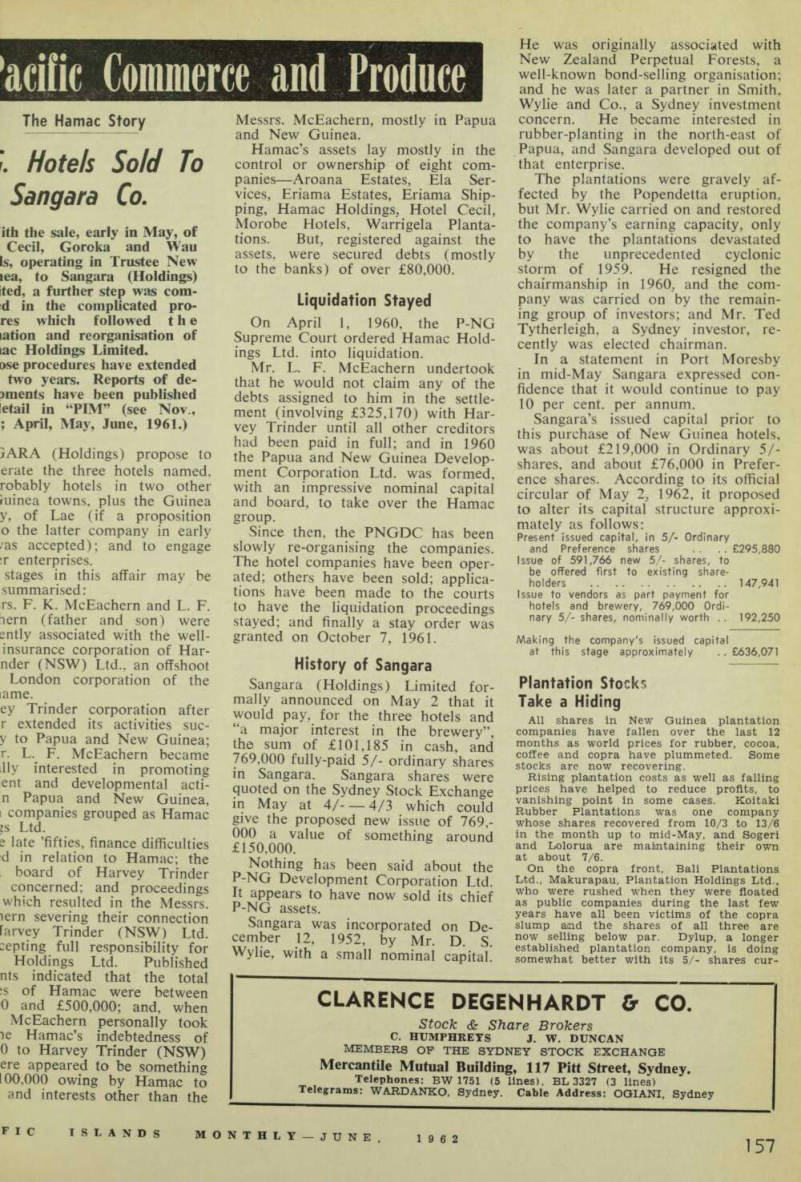
ith the sale, early in May, of Cecil, Goroka and Wan Is, operating in Trustee New lea, to Sangara (Holdings) ited, a further step was com d in the complicated pro res which followed the tation and reorganisation of lac Holdings Limited. »se procedures have extended two years. Reports of de sments have been published letail in “PIM” (see Nov., ; April, May, June, 1961.) }ARA (Holdings) propose to erate the three hotels named, robably hotels in two other ruinea towns, plus the Guinea y, of Lae (if a proposition 0 the latter company in early /as accepted); and to engage ;r enterprises. stages in this affair may be summarised: rs. F. K. McEachern and L. F. iern (father and son) were ently associated with the well insurance corporation of Har nder (NSW) Ltd., an offshoot London corporation of the lame. ey Trinder corporation after r extended its activities suc y to Papua and New Guinea; r. L. F, McEachern became illy interested in promoting ent and developmental acti n Papua and New Guinea, 1 companies grouped as Hamac is Ltd. e late ’fifties, finance difficulties d in relation to Hamac; the board of Harvey Trinder concerned; and proceedings which resulted in the Messrs, lern severing their connection larvey Trinder (NSW) Ltd. -epting full responsibility for Holdings Ltd. Published nts indicated that the total :s of Hamac were between 0 and £500,000; and, when McEachern personally took ie Hamac’s indebtedness of 0 to Harvey Trinder (NSW) ere appeared to be something 100,000 owing by Hamac to and interests other than the
Messrs. McEachern, mostly in Papua and New Guinea.
Hamac’s assets lay mostly in the control or ownership of eight com panies—Aroana Estates, Ela Ser vices, Eriama Estates, Eriama Ship ping, Hamac Holdings, Hotel Cecil, Morobe Hotels, Warrigela Planta tions. But, registered against the assets, were secured debts (mostly to the banks) of over £BO,OOO.
Liquidation Stayed
On April 1, 1960, the P-NG Supreme Court ordered Hamac Hold ings Ltd. into liquidation.
Mr. L. F. McEachern undertook that he would not claim any of the debts assigned to him in the settle ment (involving £325,170) with Har vey Trinder until all other creditors had been paid in full; and in 1960 the Papua and New Guinea Develop ment Corporation Ltd. was formed, with an impressive nominal capital and board, to take over the Hamac group.
Since then, the PNGDC has been slowly re-organising the companies.
The hotel companies have been oper ated; others have been sold; applica tions have been made to the courts to have the liquidation proceedings stayed; and finally a stay order was granted on October 7, 1961.
History of Sangara
Sangara (Holdings) Limited for mally announced on May 2 that it would pay, for the three hotels and “a major interest in the brewery”, the sum of £101,185 in cash, and 769,000 fully-paid 5/- ordinary shares in Sangara. Sangara shares were quoted on the Sydney Stock Exchange in May at 4/- 4/3 which could give the proposed new issue of 769,- 000 a value of something around £150,000.
Nothing has been said about the P-NG Development Corporation Ltd.
It appears to have now sold its chief P-NG assets.
Sangara was incorporated on De cember 12, 1952, by Mr. D. S.
Wylie, with a small nominal capital.
He was originally associated with New Zealand Perpetual Forests, a well-known bond-selling organisation; and he was later a partner in Smith, Wylie and Co., a Sydney investment concern. He became interested in rubber-planting in the north-east of Papua, and Sangara developed out of that enterprise.
The plantations were gravely af fected by the Popendetta eruption, but Mr. Wylie carried on and restored
the company’s earning capacity, only
to have the plantations devastated by the unprecedented cyclonic storm of 1959. He resigned the chairmanship in 1960, and the com pany was carried on by the remain ing group of investors; and Mr. Ted Tytherleigh, a Sydney investor, re cently was elected chairman.
In a statement in Port Moresby in mid-May Sangara expressed con fidence that it would continue to pay 10 per cent, per annum.
Sangara’s issued capital prior to
this purchase of New Guinea hotels, was about £219,000 in Ordinary 5/shares, and about £76,000 in Prefer ence shares. According to its official circular of May 2, 1962, it proposed to alter its capital structure approxi mately as follows: Present issued capital, in 5/- Ordinary and Preference shares .. £295,880 Issue of 591,766 new 5/- shares, to be offered first to existing share holders 147,941 Issue to vendors as part payment for hotels and brewery, 769,000 Ordi nary 5/- shares, nominally worth .. 192,250 Making the company's issued capital at this stage approximately . . £636,071 Plantation Stocks Take a Hiding All shares in New Guinea plantation companies have fallen over the last 12 months as world prices for rubber, cocoa, coffee and copra have plummeted. Some stocks are now recovering.
Rising plantation costs as well as falling prices have helped to reduce profits, to vanishing point in some cases. Koitaki Rubber Plantations was one company whose shares recovered from 10/3 to 13/6 in the month up to mid-May, and Sogeri and Lolorua are maintaining their own at about 7/6.
On the copra front, Bali Plantations Ltd., Makurapau, Plantation Holdings Ltd., who were rushed when they were floated as public companies during the last few years have all been victims of the copra slump and the shares of all three are now selling below par. Dylup, a longer established plantation company, is doing somewhat better with its 5/- shares cur
rently being quoted around 5/6. At the end of its last financial year on January 31, it recorded a net profit of £30,482 in comparison with a profit of £49,904 the previous year.
Prospects for Steamships Trading
It is being predicted that 1961-62 will be the best year ever for Steamships Trading Company, big Papuan plantation, trading and coastal shi~rinsr company.
STC was recently the subject of a take over bid by W. R. Carpenter and Co.— the offer being rejected by directors who did not consider the offer adequate.
STC £ 1 preference and ordinary shares will shortly be split into 5/- units; there has also been a suggestion that preference shareholders might be invited to convert their shares into ordinaries.
An extraordinary general meeting of shareholders will be held on May 30, when shareholders will be asked to approve the splitting of shares into smaller units; and an increase in nominal capital from £2 million to £5 million.
The Prospects for Copra
According to the monthly report issued by the Papua-New Guinea Copra Market ing Board in early May, there are no early prospects for an improvement on the world copra market.
Supplies of copra, in spite of the alleged droughts in Philippines and Indonesia, have improved since March —much of the extra amount coming from Indonesia.
About 7.000 tons of stock-piled coconut oil was released in the United States in April following a similar release in March. Another 5,000-,7,000 tons will become available in early June.
There is still something like 60,000 tons of this oil to be disposed of, and although it is mostly taken up by American con sumers it affects the European market also because oil and copra that would normally go to USA is diverted there.
New Guinea is (Literally)
Burying its Wealth
According to an Australian economist, Mr. E. K. Fisk, who recently visited P-NG, native village communities who are earn ing a far bigger cash income than they can spend, are cacheing it away in the ground to the tune of about £250,000 per annum.
He said that there was a constant drain on silver and paper currency which dis appeared from circulation without a trace.
Investigations showed that villagers put it in bags or boxes and buried it.
It is calculated that average earnings of the entire native population is about £6 per year per head, which proves con clusively that they have still not lost the secret of how to live without money.
Rabaul Native Welders
Show Their Skill
The Standard US Welding Society Test, a practical one and acknowledged as the world’s most rigid, did not beat three Rabaul native trainees.
They are Izumi, Akai and Jack Packe
who with their boss, Bert Price of Rabaul Welding & Construction Co., successfully sat for and passed the test.
All four were tested on penetration butt welds, vertical up-fillets and overhead penetration welds which were timed for speed, and judged for appearance, pene tration and solidity.
The test was conducted by Mr. Julian Lee of Department of Works, Port Moresby, and was open to all welders interested in working on government con tracts.
The three native boys were trained from “go to whoa” with RW & C and now, as coded welders, are qualified to undertake steel constructional welding anywhere in the world.
“This is a remarkable achievement for the boys,” Mr. Price said. “I had the greatest difficulty in passing the test my self”
According to examiner Lee, 15 mainland welders also tried for passes, only two being successful.
Fiji Trade is in
The Red
In 1961 Fiji’s imports still ran a long way ahead of exports in value according to provisional figures. The balance the wrong way was more than £4,000,000.
The figures were, 1960 in brackets: Imports £17,184,678 (£16,404,292); ex ports £13,126,662 (£15,515,679).
The December, 1961, figures showed that imports were worth £ 1,297,491, compared with £1,709,287 in 1960; and exports were £1,760,268, against £2,607,618 in December, 1960.
The main December exports were: Un refined sugar, £1,109,622; coconut oil, £202,575; unrefined gold, £101,533; copra cake, £18,944; and bananas, £9,162.
BGD: More from Timber,
Less from Gold
Last reports show that Bulolo Gold Dredging Ltd. is getting about 50,000 US dollars’ worth of gold each month from its leases in the Morobe district of New Guinea, mostly from its remaining dredge.
This is the last trickle from the good old days when eight BGD dredges took millions every year from one of the richest river flats ever found.
However, if its gold income is dwindl ing away, BGD Ltd. is doing nicely in the timber business, based on the pine forests which clothe the Bulolo ridges. The company regularly receives dividends from its half of Commonwealth-New Guinea Timbers Ltd.
In the nine months to February 28.
BGD Ltd. got a profit of 428,500 US dollars (less depreciation and income tax) from timber and gold in New Guinea, plus 105,000 dollars from interest and other dividends.
It would be interesting to know how much net profit the well-managed BGD Ltd. has taken out of New Guinea since establishment over 30 years ago. It surely has been the Territory’s biggest single money-maker.