Algerian Refugees
pp. 141-145 · Read in the full issue
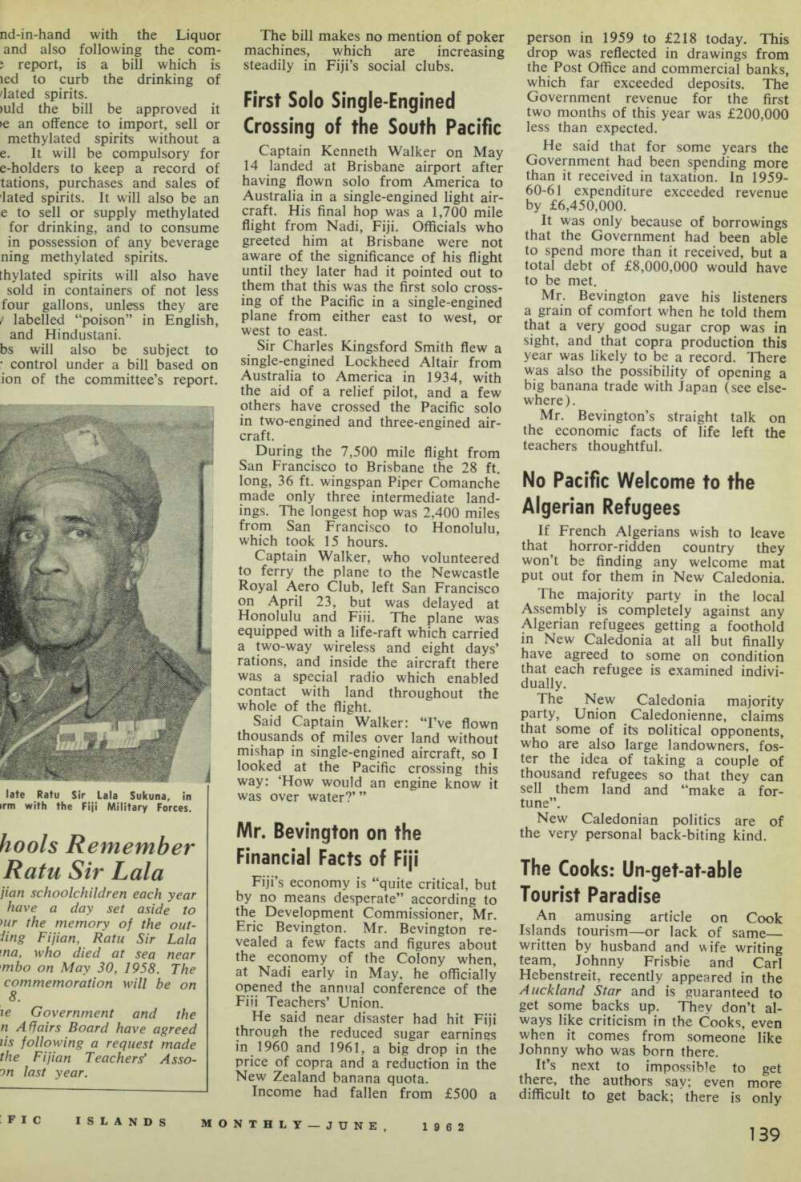


hools Remember Ratu Sir Lala
jian schoolchildren each year have a day set aside to >ur the memory of the out iing Fijian, Ratu Sir Lala ina, who died at sea near mbo on May 30, 1958. The commemoration will be on 8. xe Government and the n Affairs Board have agreed lis following a request made the Fijian Teachers’ Asso on last year.
The bill makes no mention of poker machines, which are increasing steadily in Fiji’s social clubs.
First Solo Single-Engined
Crossing of the South Pacific
Captain Kenneth Walker on May 14 landed at Brisbane airport after having flown solo from America to Australia in a single-engined light air craft. His final hop was a 1,700 mile flight from Nadi, Fiji. Officials who greeted him at Brisbane were not aware of the significance of his flight until they later had it pointed out to them that this was the first solo cross ing of the Pacific in a single-engined plane from either east to west, or west to east.
Sir Charles Kingsford Smith flew a single-engined Lockheed Affair from Australia to America in 1934, with the aid of a relief pilot, and a few others have crossed the Pacific solo in two-engined and three-engined air craft.
During the 7,500 mile flight from San Francisco to Brisbane the 28 ft. long, 36 ft. wingspan Piper Comanche made only three intermediate land ings. The longest hop was 2,400 miles from San Francisco to Honolulu, which took 15 hours.
Captain Walker, who volunteered to ferry the plane to the Newcastle Royal Aero Club, left San Francisco on April 23, but was delayed at Honolulu and Fiii. The plane was equipped with a life-raft which carried a two-way wireless and eight days’ rations, and inside the aircraft there was a special radio which enabled contact with land throughout the whole of the flight.
Said Captain Walker: “I’ve flown thousands of miles over land without mishap in single-engined aircraft, so I looked at the Pacific crossing this way: ‘How would an engine know it was over water?’ ”
Mr. Bevington on the
Financial Facts of Fiji
Fiji’s economy is “quite critical, but by no means desperate” according to the Development Commissioner, Mr.
Eric Bevington. Mr. Bevington re vealed a few facts and figures about the economy of the Colony when, at Nadi early in May, he officially opened the annual conference of the Fiii Teachers’ Union.
He said near disaster had hit Fiji through the reduced sugar earnings in 1960 and 1961, a big drop in the price of copra and a reduction in the New Zealand banana quota.
Income had fallen from £5OO a
person in 1959 to £2lB today. This drop was reflected in drawings from the Post Office and commercial banks, which far exceeded deposits. The Government revenue for the first two months of this year was £200,000 less than expected.
He said that for some years the Government had been spending more than it received in taxation. In 1959- 60-61 expenditure exceeded revenue by £6,450,000.
It was only because of borrowings that the Government had been able to spend more than it received, but a total debt of £8,000,000 would have to be met.
Mr. Bevington gave his listeners a grain of comfort when he told them that a very good sugar crop was in sight, and that copra production this year was likely to be a record. There was also the possibility of opening a big banana trade with Japan (see else where ).
Mr. Bevington’s straight talk on the economic facts of life left the teachers thoughtful.
No Pacific Welcome to the
Algerian Refugees
If French Algerians wish to leave that horror-ridden country they won’t be finding any welcome mat put out for them in New Caledonia.
The majority party in the local Assembly is completely against any Algerian refugees getting a foothold in New Caledonia at all but finally have agreed to some on condition that each refugee is examined indivi dually.
The New Caledonia majority party, Union Caledonienne, claims that some of its nolitical opponents, who are also large landowners, fos ter the idea of taking a couple of thousand refugees so that they can sell them land and “make a for tune”.
New Caledonian politics are of the very personal back-biting kind.
The Cooks: Un-get-at-able
Tourist Paradise
An amusing article on Cook Islands tourism—or lack of same— written by husband and wife writing team, Johnny Frisbie and Carl Hebenstreit, recently appeared in the Auckland Star and is guaranteed to get some backs up. They don’t al ways like criticism in the Cooks, even when it comes from someone like Johnny who was born there.
It’s next to impossible to get there, the authors say; even more difficult to get back; there is only
one hotel in Rarotonga and it’s really the pub with no beer, like the song says. (But you can get it at the hospital at bargain rates.) “There are no nightclubs, restaur ants or coffee houses. Even the natural surroundings are undeveloped.
There is no sports fishing, no water ski-ing, no surfing, and only two spots in which to swim, “Of course, this sort of ‘get away from it all’ vacation might be just the ticket for certain rugged indivi duals, the kind who accompany a Hillary or Heyerdahl on their trips, but the average tourist is likely to wish he’d never left his television set.
“If you tire of Rarotonga itself, there are the other 14 islands of the Cook group. But they are scat tered over 850,000 square miles of wind-tossed ocean and you had first better be sure you: “1. Are a good sailor, and “2. Have plenty of time.”
Carl and Johnny think it might always be like this—a tourist para dise with no tourists—because a lot of people like it that way. They aren’t interested in seeing new hotels spring up on Rarotonga’s beaches; they don’t want to see endless cara
vans of visitors circling the island, cameras clicking. They like it as it is (and they may have something there).
Japanese to Enter Cooks
Tuna Market
The Japanese are to take part in a tuna industry based at Rarotonga, Cook Islands. A canning factory is to be built at Rarotonga by Island Foods Ltd., a subsidiary of W. Gregg and Co., Dunedin, and the Japanese will provide boats and crews to sup ply it.
Final details of the joint Japanese- New Zealand venture were being worked out in May, according to a NZ correspondent. Part of the deal is that the Japanese must help to train Cook Islanders in their boats.
Each boat will train four Cook Islanders each year and use them at the end of their training to re place Japanese crew members. Even tually full crews will be Maori, under the scheme. However, boat and sale of profits from the catch would still belong to Japan, Meanwhile, the Cooks’ Director of Fisheries, Mr. Ronald Powell, is still going ahead with his plan to train Cook Islanders for tuna fishing. He is using Japanese fishing equipment.
Big P NG Expansion
In Broadcasting Services
Papua-New Guinea is on the thres hold of vast expansion of its broad casting services. The expansion is to be a combined effort by the P-NG Administration and the Australian Broadcasting Commission, and it is planned to give the Territory natives a blanket radio coverage to enable them to hear news and official mes sages.
The appointment announced last month of Mr. Lyle Newby as P-NG Director of Information will mean that the Administration’s broadcast ing activities will be stepped up.
The Administration erected in Rabaul last year its first radio sta tion—a very small station of low power for the benefit of the local natives. Others will now follow, and the Administration plans to establish
perhaps 30 of these small statk in all parts of the Territory. 1 stations will give out news, gove: ment announcements, and music a use the vernacular.
Side by side with this expansii the ABC is planning expansion] its own. The appointment in M of Mr. Geoff Luck as Journalist!
Charge of ABC news broadcast!
P-NG, and the appointment of t natives, Boe Arua and Christi Rangatin, as cadet journalists, was I first move. Mr. Luck was regioj journalist in Port Moresby frl 1956-1958. He was then the si ABC journalist in the Territd which had employed one man thi since 1949. Now as from May I ABC news service in P-NG empl( three European journalists and t natives, and plans to employ t native cadets each year. After 1 ritory experience cadets will given general experience in Austra before returning to New Guin The ABC shortly plans to of a new transmitter in Rabaul, e ploying its own staff, includi a journalist, who will provide a ne service for the New Guinea Islai area. Power of the VLT6 short-we transmitters at Port Moresby I also been stepped up to give a b ter coverage.
NG Highlands Dunantina
Plantation Sold
It was announced early in M that Mr. Graham Kingsford Sm: had purchased the Dunantina cofl plantation, several miles out of Q roka, which was developed in rec£
by interests associated with Pacific Post. It was advertised le in April for £12,500. Mr. brd Smith resided in Goroka t for a few years in the ’fifties, ig and trading, and then trans to Sydney. His new pur of course, means that he re to the Highlands, with faith future.
'alia Has First Honour
the Bounty Cup
folk Islands inaugural bowls ment for “The Bounty Cup” pronounced success in May, rs turned up from Australia ew Zealand, and the NSW team le honour of having its name ed on the cup as the first cup will be kept on Norfolk le names of the winners each nscribed on plaques to be at to it. The Bounty Cup is a :ul replica of the famous her sails of beaten silver. ; manufactured by a firm of r jewellers.
Bounty Tournament will be lar event between Norfolk, New d and Australian bowlers and ected to develop into one of >st important of the South Seas g events.
Javy Sounds
son Harbour
hydrographic survey vessel, \ Paluma under the command utenant-Commander Mike Cal- AN, arrived in Rabaul’s Simp larbour early May to begin eying the deepwater port. ma entered the harbour using r-old charts. Since 1948 no ;te survey of the harbour has nade.
Commander Calder said Paluma completely delineate the har coastline in the next six to weeks. With the aid of a motor boat which will take ; soundings Paluma would over almost every foot of >n Harbour and nearby Greet iir. ipped with asdic, sonar, and ounders the Paluma will chart >ositions of jetties, buoys, rocks irtime wrecks which may have position over the years, iding weather does not hold vork Paluma hopes to chart eas in Kimbe Bay before mak ck for Sydney in August. year the survey ship un -3 a total of 26 shoals and five
reefs, previously uncharted, in the China Straits area.
Notices to Mariners were duly issued notifying of these navigational hazards.
Further work was carried out around Rodney Entrance, south-west of Port Moresby. Until the Paluma made this survey ships’ captains were dependent upon charts based on data collected by Captain Owen Stanley 110 years ago.
Freemasonry On The
N. Guinea Mainland
Freemasonry flourishes in New Guinea. Madang has had a lodge for some years; and now there are sufficient members (26) in the Sepik area to form a lodge.
Lodge Sepik, No. 498, sponsored by Madang, was consecrated on Saturday, May 12, by R.W. Bro. T.
Strachan, Deputy Grand Master; and the following were installed as the first office-bearers: master, J. H.
Evans; senior warden, F. E. Nie menen; junior warden, R. R. Cole; chaplain, P. S. Enders; treasurer, D.
Sharp; secretary, R. P. Laybutt; direc tor of ceremonies, R. Webb; senior deacon, J. D. Nitz; junior deacon, W.
T. Brown; inner guard, A. C. M.
Christie; stewards, J. D. Martin, E. N.
Fay and J. H. Lang; tyler, D. Shep herd.
Order to Return Child
Aboard Missing Cutter
Australian police in late May were interested in the 32 ft. Sydney cutter Isis, which it was believed might be headed east across the Pacific from Sydney, An attractive young American woman, Mrs. Jane Martindale, told a Sydney Divorce Court on May 22 that she believed her estranged hus band Walter Lafayette Martindale, 33, was aboard the Isis with their 21months-old daughter, Liane Tiare, She asked that the child be returned to her custody pending divorce pro ceedings.
Mr. Justice Dovey made an order for Martindale to return the child and empowered police to take possession of her from Martindale.
Mrs. Martindale told the court that she and her husband had married in Tahiti in 1958, where they had lived for some time. They left there for Australia in January, 1959, intend ing to settle permanently. She claimed she had to leave her husband be cause of his conduct and had given him access to the child.
Martindale had called for the child
ay 19, and when he had failed urn she learned that the Isis :ft its moorings in Sydney, and ossibly headed for Queensland.
Justice Dovey said it seemed iking the child in the yacht in ircumstances was “exposing her ve risk of injury”, side the court, Mrs. Martindale he believed the Isis now had rew members off the 43 ft.
Diana, and that it was prob leading for Tahiti. The cutter a double ender, gaff rigged, 1 all white with a blue stripe, ith white sails with no mark- The cutter carries no name
Developing Boroka
stances Port Moresby
lodern new store has been built ms Philp (New Guinea) Ltd. )ka —the flourishing new suburb :t Moresby, about four miles the north east —and it should ;n for business within a few There is some very up-to-date p m e n t such as serve-yourself rs, a bottle department which ideally delivers cartons of beer, and a type of insulated which is said to be the most ful of the modern devices for ;ing the heat of the tropical i a big flat roof. There now ire Europeans living in Boroka i all Port Moresby. The new re is in the next block to Mr.
Morrisey’s modern Boroka and new shops are being there in all directions.