i Plain Speaking by
pp. 123-141 · Read in the full issue

Pacific Report
The month’s round-up of news and pictures of people and ;nts, from PIM correspondents in the South Pacific.
iter in the Cooks
visit to the Cook Islands in of NZ Minister of Island Ter >, Mr. F. L. A. Gotz, was the unity for some plain speaking Vlr. Gotz. The forthright Mr. who was making his first visit Cooks as Minister, didn’t pull inches, especially on his refer to the Cooks’ agricultural US.
Gotz knows quite a lot about agriculture himself, as for irs he was manager of the NZ lion Estates in Western Samoa efore that he was a rubber in Malaya.
Gotz also referred to Cook ’ “resentment” of seconded from New Zealand. He said lerstood that some people re their employment with the istration. But at present these were necessary to the effi idministration of the islands, e NZ hoped to train enough teople to replace all of them s was a long term plan “and innot yet foresee its final jnent”.
Gotz said that although he recommend the Cook Islands tive Assembly be given greater of the Territory’s finances, ited to make it clear that this not include jurisdiction over Service staff and salaries, would continue to be con by the Public Service in don. ;aid the offer of greater con er finances by the Assembly, ie fact that the number of ship pupils sent to NZ for education would be increased six to 16, was a guarantee ve are doing as much as we » make these islands self
ed and self-supporting.”
Gotz said the Cook Islands make the fullest possible use land. Every scrap of usable id to be brought under cul
tivation, and there should be im proved methods of agriculture.
Speaking at a combined meeting in Rarotonga of members of the Island Council, Fruit Advisory Board and Legislative Assembly, the Mini ster said that in various deputations he had had in NZ in the last few months he had met many grouchers, including “the biggest lot in NZ— the dairy farmers”, but in Rarotonga he had met yet another set of grouchers—the Cook Islands’ fruit growers. He said from all the depu tations he could come to only one conclusion—that “all growers con tinued to live, yet every one of them produced at a loss!”
He said Fruit Distributors were a much maligned firm, yet the firm was set up when marketing of tropi cal fruit was in a state of chaos and was for the protection of Islands growers. He said he could assure the meeting the firm was not per mitted to make a profit of more than five per cent. Under a new agree ment now before the Government the Government would have access to the firm’s accounts and the Gov ernment was taking all possible safe
guards to see there was no exploita tion. Growers need have no fears.
In distribution, the company was doing an excellent job.
Mr. Gotz said he knew that the Cooks produced wonderful bananas, but unfortunately NZ didn’t see any of them. Where were they? The trouble was that the Cooks wanted 5/- a case more than anybody else got, but there was supply and de mand operating in NZ. It was no use anybody talking about the “wonderful market possibilities”.
Cook Islands grapefruit were so big that they were unsaleable at 2/3 each in NZ. There were many other problems, but always the Cooks had to remember that the buyers set the prices.
Mr Gotz said last year he had been instrumental in NZ restricting imports of Australian oranges from 200,000 cases to 80,000 cases (as far
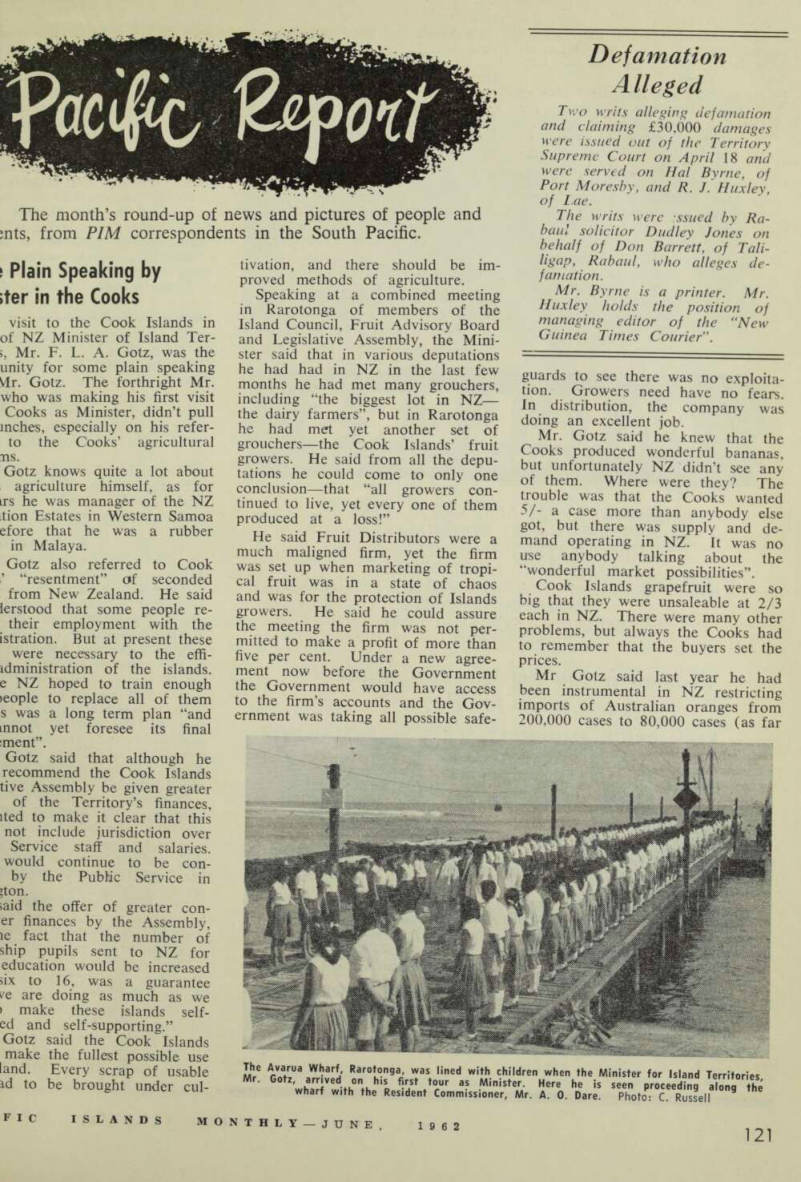
The Avarua Wharf, Rarotonga, was lined with children when the Minister for Island Territories Mr. Go tz, arr ived on his first as Minister . Here he is see " along the wharf with the Resident Commissioner, Mr. A. O. Dare. Photo: C. Russell 9
as he could remember the figures) to help protect Islands industries, although NZ preference was for Australian oranges.
He didn’t agree that the future of the Cooks depended on citrus. He believed it depended on copra.
He said tomatoes were a cash crop, but he was going to stop the import of Cook Islands tomatoes into NZ from the end of October each year when the NZ glasshouse tomatoes started to come in, until the following April. He said; “I know you were sending tomatoes to NZ before there were any glasshouses in NZ, and speaking as a politician I am sure you will appreciate that if there is anything I do which will be adverse to the interests of those people, they will not have me as
their Minister. You do not have a vote but they do!” (Mr. Gotz has in his electorate probably most of the glasshouse tomato growers in NZ.) Mr. Gotz said he planned to do something about establishing a Cook Islands Copra Board, in the interests of growers in the outer Islands, He also would do something about building a new hospital in Rarotonga to replace the “'shocking institution they call the hospital . He planned to do something about a water sup ply line for the whole island, , T ■■ T i
L3!Lpgrr3 Idiks Uh Img
p rft U| pmc Kj pw Guinea
Rrodigms Ot Imgw Uuirga
The people of P-NG should quickly be given control over decisions on
their development, according to ] D. G, Bettison.
Dr. Bettison, who is head of New Guinea Research Unit of School of Pacific Studies at the A tralian National University, openei series of public lectures at the A 1 on the prerequisites of independel for P-NG.
“The right of decision in plann and organisation, if handed to local people, would bring tt modern leaders down to earth,”l
said. I
“In a position of responsibility tj are faced with real and serious issi they cannot be irresponsible. J “Energy otherwise wasted in nationalist movement geared ori| ally to generation of dislike I ‘foreign oppression’ and in build political values not based on real! of the country’s problems, mighlj put to constructive activities.” J Dr. Bettison said Australia J likely to win the gratitude and afl tion of the P-NG people m generously and genuinely if tf power of decision was transferred them when their leaders’ attitude I still favourable.
Discussing acceptance of mod institutions, Dr. Bettison had this say: “In most P-NG societies, c( munity leaders or ‘Big Men’ obi their position by achievement. A j Man’ is a successful man, and i sequently influential.
“There appear to be no sen handicaps to the introduction! political organisations that allow participation of individuals. I On the march of civilisation m Territory, Dr. Bettison said that the past three years in Goroka stc the demand had switched from be to hammers, chisels, shoes, dob tinned foods and high-class cigarfl “Twist tobacco is still sought,! one has to be rather discreet to wfi one offers it,” he said.
its made by Mr. E. K. Fisk, Research Fellow in Economics, econd lecture in the series in of providing roads, bridges arketing facilities to permit an tural export economy is ening”, but there is no other ' a viable economy, ntive to earn money may be the major difficulties in intro a cash economy in P-NG. people are extracting the ils of living, food, housing and g, from their tribal income, andard of living is substantially in many of the poorer areas a and Java where money in s much higher. y communities have more than they know how to use. symptom of this is the arance annually of about ►0 in silver and notes, buried en away. her problem for the Territory, ; limited areas of good land, explosive rate of population certain to develop quite soon, Fisk described rapid develop f a native agricultural cash y as the major economic need ndependence. third lecture, Dr. F, J. West, Research Fellow in Pacific in the Research School of Studies, forecast that within 5 years Papuan leaders would see results in their lifetime.
Vest said that without aban the basic policy of slow and advance, greater emphasis dc given to educating the al nerging elite. e is emotional distaste for an it whether we like it or not emerged, or is emerging, in he said. choice is whether it remains yled elite, by western stan norant and naive, or whether ics an educated one. iree possible solutions—state dim the Australian Common-
wealth, a Melanesian Federation, or an independent nation—only the third is really practical.
“And independence means that P NG might be unfriendly.
“But an elite, educated by Australia and given opportunities for the em ployment, inside or outside govern ment, of its talents, is the best in surance policy that P-NG would re main in some special treaty relation ship.
“This policy has its dangers.
“Undoubtedly the efficiency of government would decline.
“An elite might throw up Black Neros to exploit their more back ward fellows; its members might be reluctant to do technically necessary but socially inferior jobs.
“It would certainly be to some ex tent anti-colonial, although some anti colonial feeling is necessary to achieve unity in P-NG.
“We have to accept these things and to avoid defining political de velopment by its being an exact copy of our own.”
New Caledonian Assembly
In Fiery Session
The newly-elected Assemblee Ter ritoriale of New Caledonia met for the first time on April 26 and in spite of the fireworks in the first days of the session, it was still sitting in mid-May.
The Assemblee elected as its pre sident, M. Antoine Griscelli, a re tired teacher, a veteran of the last war and a de Gaullist, and of course a member of the majority party, Union Caledonienne.
He introduced three motions to the Assemblee.
That the remaining Vietnamese in New Caledonia be repatriated im mediately; That a 40-million francs pro gramme of works for the local unemployed be commenced forth with; and That France should be invited to recall the present Governor, M.
Pechoux.
The first two motions were passed with only the usual wrangling; and on the third, the 18-men Union Caledonienne had it on its own the other parties ignoring it. (And up to the end of May, so had Met ropolitan France.) About midnight following the opening session a charge of dynamite was exploded at the entrance to the office of the Union Caledonienne’s newsheet, Avenir Caledonien. As a precaution against any further trouble, armed guards were put on the Governor’s residence and gov ernment offices. ( PIM , May, p. 19.) Later in the session there was a long debate on a proposal to dispatch a mission to Paris to sound out the Central Government on its feelings towards the newly elected Assemblee.
After a great deal of argument it was decided that the Vice-Presi dent of the Conseil du Gouvernement, M. Rock Pidjot, M. Griscelli and a retired public works engineer, M.
Albert Satragne, should go.
On the same plane M. Maurice Lenormand, leader of the Union Caledonienne also departed—but in his other capacity, as a Deputy of the French Chamber of Deputies, which would shortly be in session.
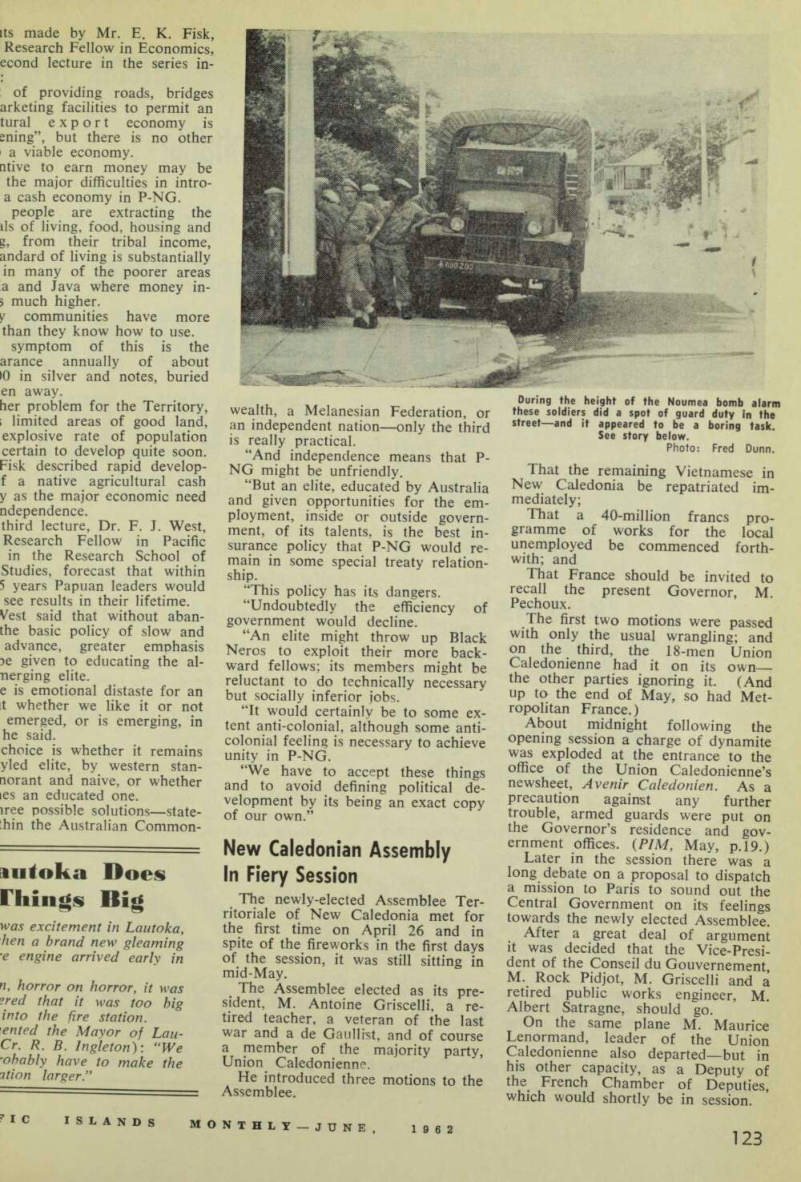
During the height of the Noumea bomb alarm these soldiers did a spot of guard duty in the street—and it appeared to be a boring task.
See story below.
Photo: Fred Dunn.
ob Done in
ividing Tongan Land
:y Tongan male on reaching e of 16 and becoming a tax is entitled to an allotment of land of 8£ acres and a town two-fifths of an acre, obtains the grant by applying e Minister for Lands who r grants it out of the estates noble in whose area the young resides, or occasionally from land. He pays 8/- annual and has a life tenancy, ly Tongans—especially those in town—don’t bother to e their statutory right to this ut for those who do, a big job rk has been going on in the w years. The Cadastral Sur :am, as it’s called, began work nga under Mr. D. L. Leach 1957 and completed the field at the beginning of this year, stage is the documentation, g of plans and preparation of ts five years’ work on 68,000 af arable land it has marked ,500 lots—each lot having try pillars of reinforced con rith a number moulded to the i putting these pillars in posi an cause headaches, particu vhen trying to fix in ground consists of hard coral or rock, n transferred to paper the is of these pillars are the narking points which help to ap the mosaic of an over-all work has taken the team all Fonga, from Tongatapu to ou. The Survey is controlled first instance by astronomical dangulation, some telurometer theodolite and chain, and final breaking down, compass ain survey for the individual team has been led by three ir Europeans, with locally staff of 50 Tongan surveyors ave earned high praise for vork during this operation, has also had to be a labour it times numbering up to 100.
-Hopping Scientists
n the Job
Danish schooner Noona Dan, is carrying out extensive c research in the Indo ;lago, called briefly at Rabaul May to take on a new mem the scientific team. He is Dban Wolf who flew from rk to study ornithology in
New Britain and outlying islands.
Dr. Wolf will assume leadership of the expedition on May 22 when the present leader, renowned ornitho logist Dr. Finn Salomonsen leaves for a USA lecture tour.
Meanwhile several members of the scientific team are working on Fead Island and will travel from there to Carteret, Mortlock and Tasman Islands before returning to Rabaul on May 20.
A four man team was landed at Massawa in early May. Accom panied by a patrol officer they will climb to a height of over 4,000 feet in the Bainings area to study botany and animal life.
The expedition’s other purpose, to sell their red-painted 102-ton ves sel, loaned by the J. Lauritzen Ship ping Line, is not meeting with suc cess.
Priced at 75,000 US dollars the Noona Dan is a former naval cadet training ship and coastal trader. She is reinforced for Arctic waters.
New Development in
"Pandora" Wreck Mystery
There was a new development in the Pandora wreck mystery in the Sydney Central Court on May 9 when police withdrew a charge of false pretences against Donald Frederick Smith, 31, of the Sydney suburb of Kirrawee.
Smith had been charged with having, on March 20, 1961, obtained £5OO from John Edward Lingham, company director, of Killara, by pre tending that he had discovered a wreck off the North Queensland coast and had recovered a bell from it. (PIM, Oct. ’6l, p. 133.) The bell, according to the charge, bore the inscription: “The gift of Lady Herbert, daughter of Sir John Knatchbull, of Mearchin Hatch in Kent, in the Kingdom of England, November, 1711.”
The charge also said that Ling ham’s investment of £5OO would en title him to an eighth share of all income from the wreck.
Police withdrew the charge against Smith after Lingham told the court he believed Smith really did know of a wreck on the North Queensland coast.
When the case originally came be fore Sutherland Court on October 6 last year, the police alleged that Smith’s story about the finding of the wreck and recovery of the bell was “a giant hoax”.
Smith’s story was first published in the Sydney Sun on December 29, 1960, when he claimed he had found the wreck and bell while cruising along the Great Barrier Reef in the sloop Alvis.
The story was given world-wide publicity after it was suggested in the Press that the wreck was probably that of HMS Pandora , wrecked on
the Barrier Reef in 1791 while taking 10 of the Bounty mutineers from Tahiti to England for court martial.
However, it was later revealed that the bell which Smith claimed to have recovered had been at the Lockhart River Mission, North Queensland, for many years and that it had merely been shown to Smith when he called at the mission in the Alvis.
A former Bishop of Carpentaria, the Right Rev. Stephen H. Davies, told a PIM correspondent last June that the bell had been brought to the mission in the 1930’s by a former superintendent. He believed it had come from an Irish church.
Footnote: Lingham told a PIM
correspondent in May after the case against Smith was dropped that Smith intended to investigate a wreck in North Queensland waters in June or July in a vessel now being built in Darwin. Lingham added that he did not intend to accompany Smith, Lingham said Smith claimed the site of the wreck was north of Portland Roads [this is the area where the Pandora was wrecked], . . .
NICKGI Slump Hits
M NGW LdlGClOnid Indications are that New Cale donia’s biggest export earner, the Nickel Co., might have to lay up its
fleet of three ships due to the slui in the nickel market. This a heavy blow to the local labour e ployed aboard.
The Nickel Co. has been asked the local Assembly (which has been exactly friendly to the Nic Co.) to do its utmost to keep at le two of the ships in work (see Sh ping section).
Following the cessation of nic ore exports to Japan whilst await the signing—if any—of contracts n being negotiated, a great drop in nn time traffic between Noumea s Japan has been recorded. For ] month of April to the first week] May only three ships have b< loading ore on the coast. This co pares with 10 vessels for the sa: period last year.
It was announced in April that c company, the Nippon Yakin Koj Co., had signed a contract with ] Nickel Co. for the supply of ab< 240,000 tons of nickel ore. Price] mains the same as last year, 50 ce per unity, FOB. Clinching of contract at this price was due to fact that the Nickel Co. can load Japanese vessels more economical at a rate up to 5,000 tons per d The smaller mine-owners can oi load by means of lighters which c take weeks besides being very mt more costly.
Negotiations are still going on w importers in Japan and small N Caledonian mineowners, 1 Japanese will pay only 48 cents j unity whilst the mineowners j holding out for the 50 cents.
Belly-Landing For
Piaggio at Moresby
A twin-engined aircraft was bel landed without serious damage a without injuring nilot or passenj in Port Moresby on May 12.
The aircraft, a Piaggio, was land by Papuan Air Transport’s Capti Leon Murtagh on one wheel wh the landing gear failed to function the approach to Jackson’s Airfield.
He landed on one wheel and wh it collapsed he swerved onto verge. The passenger was Mr.
Chilcott. The plane was return! from Tapini.
New Newspaper for
The Tolais of NG
A new newspaper for the To people of New Britain has beg publication in Rabaul, NG.
Printed in both Tolai and Engl) languages the pocket-sized month Tolai News, announced in its ft editorial that its purpose is to &
5 local and overseas news cover led by Stanis Boramilat, a iller and native leader of Toma.
News will speak for the four councils in the Gazelle Pen pretentious in format the first gives news coverage on Admin on appointments and changes, isit of Minister for Territories, Hasluck, and the questions put a by native councillors, a word the Australian grant to the ory and a request for late il tax-payers to come forward their dues, ast page item concerns the entry inese migrants to Rabaul and a :tion that the immigration law ag flouted. n Vuia, a former MLC of il, is quoted as saying: “Admin an should do something about before the Tolais realise they not have any more room for slves in Rabaul.” newspaper is being printed by atholic Press of Vunapope, and 2/- per annum.
rade Mission For
Islands in July
New Zealand Manufacturers’ ition 26-man trade mission to acific Islands from July 5 to t 10, is to be led by the presi
of the Canterbury Manufac-
Association, Mr. R. H. t of Christchurch.
Stewart is the managing di of P.D.L. Industries Limited, is a plastic and die-casting
rise in Christchurch, producing
electrical fittings. He is vice
president of the Plastics Institute of NZ, a member of the Council for Technical Education, an executive member of the Canterbury Medical Research Foundation, and a Fellow of the New Zealand Institute of Management. He has 25 patents to his credit.
The secretary to the mission will be Mr. V. R. Moore, secretary of the Wellington Manufacturers’ Association.
Although the final composition of the mission had not been determined in late May, manufactures represented by the mission will include plastics, paints, heavy clay goods, garments, pharmaceutical preparations, hospital equipment, furniture, agricultural chemicals, toilet prepara-
tions, frozen and canned food, and beer.
The mission is regarded as a posi live attempt to implement Federa tion and Government decisions that there must be a greater effort by manufacturers to “get out and sell” on overseas markets.
The Island groups were natural areas in which to sell New Zealand goods, and through the efforts of mission members, and a number of trade displays in selected areas, it was intended to make a major impact which should produce the desired results.
The president of the Federation, Mr. T. E. Bower, said it should be understood that a good number of New Zealand manufacturers were
The New "Tolai News”.
operating in strength in the , and few of these would be part in the mission. In the mission members would be cturers who were breaking ound in overseas selling in an to boost the exports of this party will fly from NZ to Fiji, t will visit Nadi, Lautoka and Members will then embark Union Steam Ship Company’s which will be fitted out as a ship, and sail for Nukualofa vau, Tonga, and Niue Island, will then be made to Pago American Samoa, before the disembarks from the Tofua Western Samoa. After five ere members will fly to Pa or almost a week, then fly
mea. From there side-selling
11 be made to Santo and Vila New Hebrides group before "ty returns to Auckland on August 10. as several years since New manufacturers last took a trade mission overseas, Mr. said, but with changing eco patterns it was essential that 5 markets should be de- Export business posed a ;e to manufacturers which ;re ready to accept, and he ifident that from the Pacific the results would be of con e benefit to the country.
Vew Zealand Trade Commis for the Pacific, Mr. K. W. is accompanying the mission
in an advisory capacity, and a senior officer from the Publicity Division of the NZ Tourist and Publicity De partment will act as the mission’s public relations officer.
“This i s an imaginative mission which deserves full support,” said NZ Minister for Overseas Trade, Mr.
Marshall, in May, “and in Mr.
Stewart it will have an excellent leader.
“The islands of the Pacific are our nearest northern neighbours, and with them we have a long established and worthwhile trade.
This trade, buying and selling, amounted in 1960 to nearly £4 mil lion in the Islands that now will be visited, and there seems no reason why this figure should not be greatly increased as a result of the mission’s visits,”
Rabaul Trades Fair
Organised by Apex
Members of Rabaul’s Apex Club staged another successful Trades Fair on May 19 at the Malaguna Technical College. This is the fourth annual event of this kind since Apex —a fellowship and service organisa tion established in Australia in 1930 —got going in Rabaul in 1957.
The 1962 Trades Fair, although a direct descendant of the Carnival that was held in 1958 as Apex’s first big effort at fund raising for a local good cause, took a much more defined line as an exhibition of local commerce and industry.
The wares of local industry as well as those of importers were on display—everything from aluminium dinghys and Datsun cars to velvet evening coats.
Organisation of the Fair was in the hands of Mr. Brian Darcey, ser vice director; John Herlihy, secre tary; Bob Buder, treasurer and Darcy Pavlich, president.
Historic Kokopo Road Is Now
The "Never-Never Road"
Even New Guinea’s Gazelle Peninsula Tolais are becoming cynical about the Administration’s neglect of the Rabaul-Kokopo thoroughfare. So says Mr. Ron Levi, chairman of Kokopo District Advisory Council.
Like a persistent seven-year-itch the question of the unsealed 25-mile bump-and-grind roadway comes up in council almost every month.
And unfailingly Administration takes a drubbing at the capable hands of Mr. Levi who has tried, unavailingly, since the beginning of his long as sociation with council, to have this section sealed.
A prominent Kokopo planter recently moved in council that the never-never road be named the Paul Hasluck Highway—in honour or derision one can’t be sure. Nothing has since been heard of the suggestion.
And now the sealing work has been shelved in favour of a newer Administration project—the Walindi- Dagi Road down by Talasea.
Granted the new project will open up and service a promising new area but says Mr. Levi, “We are spreading ourselves too thin. Why not consolidate and keep in repair what we have?”
The historic Kokopo Road winds along the southern shore of Simpson
H. Stewart, leader of the NZ trade to the Pacific (second from right) [?]g plans with other members of the From left to right: Mr. C. D. Stevens, earn Ship Company; Mr. C. H. Williams, st and Publicity Department; Mr. A. T.
TEAL; Mr. R. E. G. McDonald, Public Officer of the NZ Manufacturers' [?]n; Mr. H. Holden, representative of Industries and Commerce Department; [?]art and Mr. H. E. J. Martin, execu [?]er of the Manufacturers' Federation.
Harbour, gives the infrequent tourist a boneshaking glimpse of truly tropic beauty and provides a main thoroughfare for Kokopo resi dents and planters.
It has resounded to German waggon wheels, Australian infantry boot-heels and Jap armoured traffic.
It has been shelled, bombed, strafed and diverted by way of volcanic explosion and earthquake. Little wonder then that Kokopo feels strongly on the question of its repair.
“Too much money,” thunders RL, “is being spent on glamorous window-dressing projects. There’s
talk of a £lOO,OOO court house for Rabaul and other works not nearly so urgent as the sealing of our road.
“Even the Tolais are becoming cynical about the Administration’s promises.”
However, Commonwealth Works received a complimentary pat from Kokopo DAC when they moved a vote of thanks for the work carried out on another road—the Warangoi Settlement thoroughfare.
Six months ago a mere timber getter’s track the road has been gravelled from the nearby Warangoi, giving easier access for the Warangoi pioneers.
Not Everybody Happy With
Fiji's New Cement Industry
A daily cloud of what appears 5 be smoke over the fast-growi middle-class Suva suburb of Lai has raised howls of protest frl the residents. It emanates from| Fiji Industries Ltd. cement wor which has just gone into product!
When the project was first moo? these same residents made vehemj protest, claiming they would hi to put up with a dust nuisance, \ that smoke from the factory woi obliterate their view of the harbcj Those making the latest protf say the “smoke” will give the ] pression that Suva is a factory c: complete with tanneries, glue woi foundries, etc. So far the city j always been free of industrial do except occasionally from the bis< factory.
But it is not smoke, accorcj to the manager of the company-] is nothing more harmful than stea The manager, Mr. B. P. Smith, s the white colour of the so-ca| smoke showed it contained no c bon particles, which were a chaij teristic of smoke.
Every hour about six tons of wa vapour issue from the stack! normal operating conditions. 1 remainder is mainly harmless nit gen, resulting from the air used firing the kiln.
Mr. Smith said there was alsq big percentage of carbon dioxide| the exhaust from the kiln. This j particularly beneficial to pi growth.
His statement failed complet to mollify those who have tl homes in the area. These residd have been talking about some s of action to try to force the cc pany to abate what they conside] nuisance.
Meanwhile, as far as output fr the factory was concerned, the f cement was expected to go on s on May 21. The company co: dently expects big sales when ex ing stocks of imported cement j exhausted.
Successful Appeals for
Buka Tax-Dodgers
The Administrator of Papua-N Guinea, Sir Donald Cleland, on N 16, announced the remission of s tences for 221 Buka Island nati involved in the February anti-j
riots. J
All had been charged at Soha Buka Passage, on March 1 with h ing obstructed an Australian Pol
:r, Senior Inspector W. M. Burns, he went to Hahalis village on lary 6 to arrest 80 tax defaulters, ne 118 of them were jailed for months and 103 were each £l. the Supreme Court at Port shy on May 7, the Chief Justice . Mann, upheld appeals by 49 Buka natives, who had appealed >t their sentences on the same e, on grounds which challenged □thority of the Sohano Court.
Donald said that to obviate the ;ity of lodging appeals for the onal 221 natives, “I have seen exercise my prerogative and re le sentences imposed”, was asked if the convictions ;t the 221 would be quashed, e declined to answer, i Administrator’s decision will iean that the 49 who won their Is and the 221 whose sentences remitted will be released im tely.
Sohano, they also were jailed t months for riotous behaviour fight with police near Hahalis ! on February 19. se jailed for obstructing Senior tor Burns on February 6 were ve their three-month sentence atively with their six-month ce for riotous behaviour.
Donald said that the time they spend in jail depended on the ne of further appeals. Two “test appeals against sentences for > behaviour have been lodged Supreme Court.
Can't Buy
Their Troubles
fanciful Tolai native custom uying back trouble” had a all in mid-May when four Local Government Councils refused permission to pay compensation toward damage during Rabaul’s June, *6l, i meeting on March 22 of the councils it was decided that m of £2,000 would be drawn :ouncil reserve funds and paid Administration to offset dam used to fire engines and police s. offer was made subject to •proval of Director of Native , J. K. McCarthy, and caused scepticism in higher circles, ing doubt on the Tolais sin one Administration official he natives were fully aware mncil funds could not be spent t approval—and that they equally well the government
would not sanction the old custom of “buying trouble”.
And that is exactly how it has turned out. The “shame” that councillors expressed at their people’s mvolvement in the riots must remain on the red side of the ledger . . . as prophesied, Mr. McCarthy has flatly refused the councils’ refl uest * (Native Local Government Council reserve funds are intended to give financial stability to councils and are derived from a percentage of council income. The money cannot be spent without Mr. McCarthy’s sayso.)
O/L p Ponnlo Parn Z 0 r " ,NV7 reo P ie carn
More Than £lO,OOO p.a.
The Territory of Papua-New Guinea may no longer enjoy a get rich-quick reputation but a glance at Government Statistician J. R. Lind say’s finance bulletin on Income Taxation (1960-61) shows that about one-third of the resident population receives incomes in excess of £1,500.
A total of 2,066 individuals re ceive incomes between £1,500 and £1,999 while 111 enjoy incomes in the £5,000-£9,999 bracket. Of this number 14 are women, But the really gilded group is that
e £lO,OOO-and-over income earn- In this bracket are 26 men >ix women. n-resident individuals earning incomes from the Territories ess in number but still impres- A total of 53 earn in excess 2,000, seven men and three ;n taking out £lO,OOO and more nnum. ustrial companies yielded the nment purse £1,032,812 in the largest contributor being ry producers, followed by com al enterprises. :able income derived from pri production companies was ),643, while 266 individuals en in the same industry took out ?,488 in incomes, ling and quarrying were way the list with £259,047. se statistics were compiled on SO incomes.
ralian Conference
IG Kuru, Tetanus
) health hazards of Papua-New a were discussed at an Aus medical conference in Ade- SA, in May. y were kuru, the strange in ly fatal disease peculiar to a area of the Eastern Highland :t and tetanus, which in its New i form kills many new-born and also mothers shortly childbirth.
Medical Director in P-NG, Dr.
Scragg, wants kuru entered international list of diseases I death. the disease develops, it brings reliable fits of shaking and 1 physical deterioration to suf- Carlton Gajdusek, of the In of Health at Bethesda, Mary- USA, has been at Okapa ig kuru and attended the de conference as adviser, professor of genetics at the sity of Adelaide, Professor J. mett, was another adviser, ial members of the committee to study these problems are rector of the School of Public and Tropical Diseases in Syd 3rofessor Edward Ford; the )r of the New South Wales Transfusion Service, Dr. R. J. the Professor of Medicine at le University, Professor H. N. i; and the Assistant Director dical Research in Papua and juinea, Dr. F. D. Schofield, last conference on kuru and Ferritory diseases was held in ber, 1959, says Dr. Scragg. present committee will make
certain recommendations to the Papua and New Guinea Administra tion, for the treatment and attack on kuru, he said. Particular em phasis would be laid on the medical aspect of the disease.
“The genetics of the disease are known, but there are other angles we don’t know about,” he said.
The conference also discussed a one-shot tetanus vaccination. Three injections are the present standard treatment, but doctors have difficulty persuading natives to have the full course.
The conference also discussed a plan to use tuberculosis BCG vac cinations in its anti-TB campaign.
First to Use Suva's
New Wharf
The Royal Navy survey ship, HMS Cook, in May was the first overseas ship to use the new wharf at Walu Bay, Suva. She came to Suva from the Gilbert and Ellice Group, and after refuelling at the main wharf, moved to the new wharf for an engine overhaul.
A few weeks earlier, at Suva, the Cook was the first ship to anchor with her stern against the wharf and her bow in the stream in Mediterranean style.
NG Gets First Local-born
Chinese Solicitor
A young Rabaul man with a dis tinguished scholastic record in May became the Territory’s first local-born Chinese solicitor.
He is Cyril Chan, 29, son of Mr. and Mrs. Chan Ngo of Matupi Farm, Rabaul.
Cyril’s achievement is all the more remarkable when it is known his educational career suffered a nine
year lapse during the Japanese oc cupation and afterwards. On resump tion of studies he was awarded a bursary to study at the Chevalier College, Bowral, where he obtained Greek and Latin honours.
A Commonwealth Scholarship en abled him to enter Sydney University where he studied Arts and Law.
Now a Bachelor of Law, Cyril Chan has returned to Rabaul to join the practice of Mr. Dudley Jones.
More Detectors in Search
For Illegal Fiji Arms
The Fiji police, worried at the number of unlicensed arms about the Colony, have declared an arms amn nesty to operate from June 1 to June 30, in the hope that illegal weapons will be handed in.
This is the second amnesty in the last two years. In March, 1960, when persons could hand in arms, etc., without fear of prosecution, 65 illegal weapons of various types, and about 1,000 rounds of ammunition, were handed in.
Many of the weapons are believed to be American wartime arms acquired somehow or other when the United States forces were stationed in Fiji. Immediately after the war, in a series of intensive searches, the police discovered illegal arms in the canefields and houses. Day after day The Fiji Times of October and November, 1945, carried reports of arms and ammunition seized by the police, and of subsequent court pro ceedings.
In less than two weeks the police recovered rifles, shotguns, pistols, grenades and bombs, thousands of rounds of ammunition and more than 100 lb. of dynamite.
To help them in their search for illegal arms, after the next amnesty
Proud moment for Mr.
Chan Ngo, of Rabaul, when he attended the graduation of both his son and grandson at Sydney University. His grandson, Gerard Chan (left), graduated as a Bachelor of Science in Agriculture and his son, Cyril Chan, as a Bachelor of Law—the Territory's first local born Chinese solicitor.
While in Australia Mr.
Chan also attended the weddings of a son and a daughter. All four happy events occurred within a month. See report below.
expires, the police plan to imp two mine detectors. Experience 0 1 seas has shown that these are ic in the hunt for concealed arms. ■ intensive police measures will rn it a real risk to keep arms ammunition without a licencei future.
Nakanai's Soa Sowed
And Reaped
Patrol and Agriculture Dep ment officers who sometimes 1 their heads in despair at ; indigenes’ lack of incentive can i heart from the example of Lu Soa of New Britain’s Cei Nakanai district.
Unaided and without supervi by Europeans Soa induced his fel natives to plant an area with 19 young cocoa trees and now is s ing to establish a native-owned' operative.
Soa’s plantation proved to be eye-opener to West New Bri District Officer Ted Hicks visited it in May with a patrol n up of District Agricultural off from Rabaul and Talasea.
They found a thriving c< plantation with a standard of pi ing “equal to if not superior that of some Europeans, accor to DO Hicks.
This remarkable achievei could in a small way be attribul to the fact that Soa had at one j had several years of experienci a field worker at Keravat 1 cultural station, as had a nut of other natives from the Cei Nakanai area.
Lying a short distance in from the Hoskins strip, Soa’s cc community still has some prob to face, namely, transportation produce. Once that is sol perhaps by floating the cocoa d< river by canoe, Soa and his ; can look forward to a new prospe Already £9OO from cocoa i has been distributed to growers will go toward establishing the co-operative.
Two Killed in Rabaul
Motor Accident
Mrs. Mary Ilene Hendren, wife of Rabaul bridge buil contractor Kenneth Hendren, Miss Elizabeth Pooley, about housekeeper, were fatally injure a motor accident in Rabaul on i 27.
The two women were passei in a car driven by Mrs. Hend 18-year-old son Robert when it
r car collided at the inter of Malaguna Road and Avenue. The other car was by constructional con , Kenneth Thompson.
Pooley was killed outright rs. Hendren died three hours i hospital. cars were extensively dam and Mr. Thompson was ;d to hospital in a state of A 9-year-old passenger in endren car, Arthur Boisen, >o injured. Two other children in the Hendren car were un it shocked by the accident.
Business Leads
anslaughter
•apuan headman was gaoled -May for two years for hav led a man during a row over ce to be paid for a bride. -Maitai, 28, was charged with murdered Komai-Momu in an llage row in October last year ill age three days’ walk from in the Goilala sub-district, pleaded not guilty but was for manslaughter by Mr.
Ollerenshaw in a Supreme trial at Tapini on May 12. > of the killing reached Ta- November, 1961, when two walked into Cadet Patrol Andrew Flowers’ office and I a human skull on the floor, mce at the trial showed that named Koma had been be to the accused’s brother but er given in marriage by her to a man of another village. -Maitai and his brother went new bridegroom’s village to
get satisfaction, including the return of bride-price money that had been paid. A brawl ensued and during it Guia-Maitai attacked one of the opposing side with an axe. The vic tim later died, was buried for a month, exhumed, his head severed, and his skull taken to Tapini as evidence.
Action on the
P-NG Forestry Front
Saw-milling in Papua-New Guinea is to get a five-years boost according to an announcement made in Canberra in May. Under the new programme it is hoped to increase annual log production from the present 65 million super feet to 120 million super feet.
The following forest areas will be opened up: Tonolei Harbour, Bougainville— approximately 107,000 acres contain ing 400 to 500 million super feet of timber.
Cape Hoskins, New Britain—ap proximately 200 million super feet of timber.
Oriomo River, Western District— -41,000 acres of coastal forest con taining about 100 million super feet.
Gogol River, Madang District— about 200 million super feet.
Piaiwa Forest, 60 miles from Lae —about 120 million super feet of timber.
After the P-NG Department of Forests has assessed the available amount of timber in each, public tenders will be called in Australia and in New Guinea, Most of this huge increase in timber production must be for ex
The 1961 Billiards Championship (the final was played in 1962) held at the Guadalcanal Club was won by Mr.
Ray Murdock. Here, Mr. E. V. Lawson pre sents the Fourex Cup to Mr. Murdock. Be hind them, from left, are Mr. Lionel McLachlan, who was defeated, Mr. Bill Ramsay, club president, 1962, and Mr. Douglas Corner, president 1961.
port, and presumably elsewhere as well as to Australia.
The announcement of the five-year “programme of action” has caused a little surprise, coming from Minister Hasluck when it does. On one hand he is suddenly in a hurry to get as much timber out of P-NG as quickly as possible; and on the other is push ing ahead as fast as possible with his avowed aim of bringing New Guinea natives to the point where they can choose their political future.
The new plan provides that the Department of Forests will carry out natural regeneration of the forests in the cut-over areas to enable forestry to be undertaken in per petuity on land that is designated as absolute forest land. The existing programme of reforestation in the Bulolo Valley, Keravat and Brown River areas will be continued. Exten sive afforestation will be carried out on the eroded grasslands in the High lands so as to assist in the rehabilita tion of these areas.
Miss Rarotonga Contestants
v. The Papuan Heathen
The Cook Island’s “Miss Raro tonga” Contest this year really started something. No sooner had Miss Tara Utanga been acclaimed the attractive winner in April when Mr. G. Strick land, Sr., shot off a letter to the Cook Islands News, the Administration-run daily news sheet, protesting that the dress of some of the contestants dur ing the judging had reminded him of the period between 1910-16 when he was calling along the Papuan coast with the London Missionary Society, bringing Christianity to the heathens.
He said the Papuan men and boys covered themselves with a piece of string or a dry sugar cane leaf. The women wore grass skirts right down to their knees in some areas, but in others “they used only a cork and string to conceal their private parts, only partly not fully”. He appealed to Cook Island girls not to dress like the heathen.
In the ensuing verbal free-for-all the Cook Islands News was swamped with letters.
Somebody suggested that the girls should have dressed Islands style with skirts and bare feet rather than in European clothes and hair styles.
Somebody else suggested that Mr.
Strickland’s views were quite sancti monious, and that anyhow he had himself three times used the words “private parts” in his letter, and that no doubt he was a great advocate of bringing back the Mother Hubbard.
Another writer said that at the Rarotonga contest he had seen
neither dry sugar cane leaves nor the “parts mentioned in Mr. Strickland’s letter’’.
An indignant parent said the whole show had been a model of good taste and behaviour and her daughter had worn a full length bathing suit, “with no resemblance to exotic Papuan styles”.
Wrote Bruce Pitt-Payne: “I did not myself have the pleasure of attending the recent Miss Rarotonga Contest, so am unable to comment on whether or not the participants actually dis played their private parts. Since, I believe, the police were present at the theatre, I presume that, had any of them done so, Mr. Strickland would have had the opportunity of meeting them the following Thursday morning in the courtroom.”
Back to the attack, Mr. Strickland, Sr., said he wanted to make it clear that he was referring to “the private part” which was concealed only with a bit of cloth at one part of the show, hence the similarity with the cork and string of the Papuan girls.
At this stage the editor announced that the correspondence was closed.
Changes Proposed in
Fiji's Liquor Laws
Important changes in the liquor laws of Fiji are proposed in a bill published in May, and scheduled for debate by the Legislative Council on July 10. The bill is the result of an exhaustive inquiry by a special committee in 1960 and 1961.
The Government faced a difficult task from the outset in drawing up the bill, for on several major matters
the committee, which numbered l: found itself hopelessly divided.
This division of opinion is like] to be reflected during the forthcon ing debate. Control of liquor 1 one subject on which there wi never be unanimous agreement. I One of the major proposals is 1 remove the restriction on the pu chase and consumption of liquor race and sex, but women will sti be prohibited from entering publi bars. The present law restricts ope consumption of beer to European!
Indian males and Fijian males ov« 18. In addition Fijian and India men require a permit to drin spirits.
The hotel trading hours propose are 11 a.m, to 2 p.m. and 4 p.m. t 9 p.m., with 15 minutes grace afte each session to finish drinks. Pr< sent hours are 10 a.m. to 10 p.m.
A new proposal is to allow of licences in place of wholesal licences. At present wholesalers ai required to sell liquor in quantitie of two gallons or more.
Restaurant licences will also b allowed, but patrons will be require to have a substantial cooked mea Another requirement for meals i licensed restaurants is the provisid of music or dancing.
Hotels may also supply liquor wit meals up to 11 p.m., and betwed 2 and 2.30 p.m.
In general the bill proposed highe penalties for offences against th liquor laws. It also proposed tha a Central Liquor Board instead o the Governor-in-Council exercis over-all liquor policy, and that divi sional liquor tribunals replace th licensing courts. (Over
ANZAC DAY IN RABAUL: During Anzac Day services in Rabaul, New Guinea, on April 25 these native ex-servicemen marched to the cenotaph for the service together with Lieut- Commander (reserves) F. (Snowy) Rhoades, a former Coastwatcher.
nd-in-hand with the Liquor and also following the com j report, is a bill which is led to curb the drinking of dated spirits. mid the bill be approved it ►e an offence to import, sell or methylated spirits without a e. It will be compulsory for e-holders to keep a record of tations, purchases and sales of dated spirits. It will also be an e to sell or supply methylated for drinking, and to consume in possession of any beverage ning methylated spirits, thylated spirits will also have sold in containers of not less four gallons, unless they are / labelled “poison” in English, and Hindustani, bs will also be subject to • control under a bill based on ion of the committee’s report.
late Ratu Sir Lala Sukuna, in [?]rm with the Fiji Military Forces.