An Idyll Now Fit For Australians
pp. 89-98 · Read in the full issue
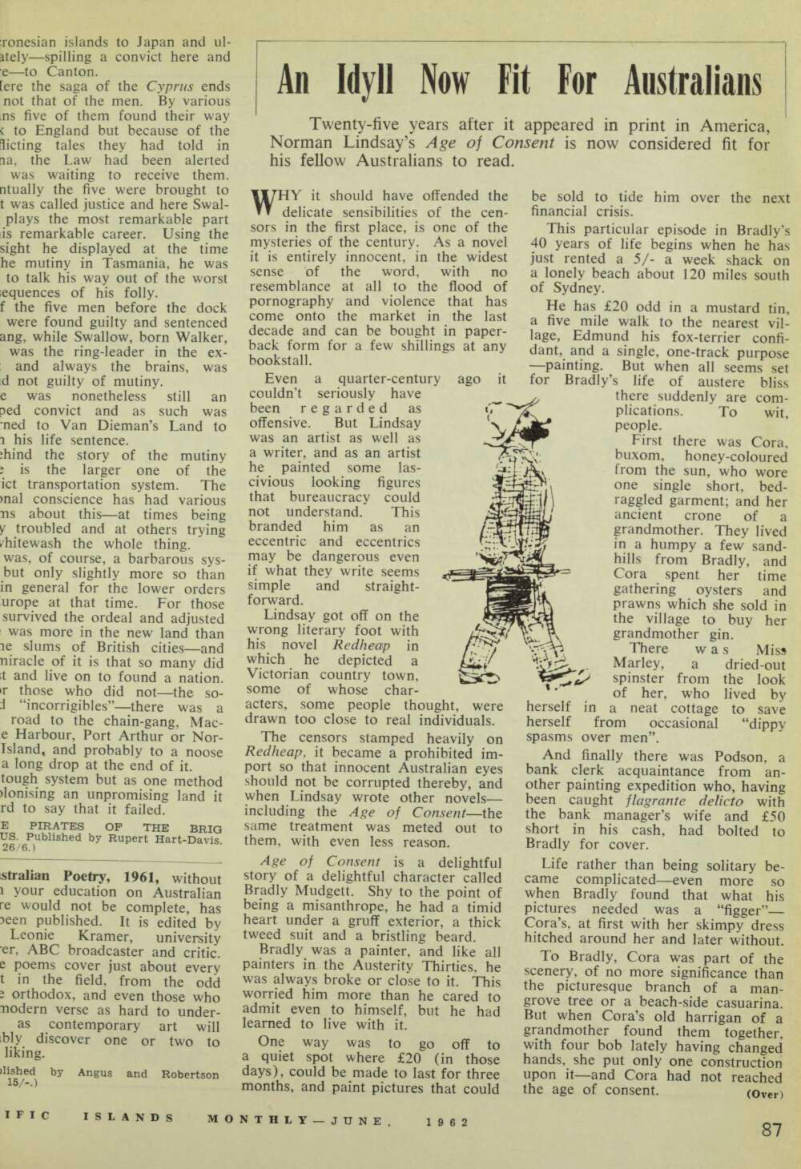
Twenty-five years after it appeared in print in America, Norman Lindsay’s Age of Consent is now considered fit for his fellow Australians to read.
WHY it should have offended the delicate sensibilities of the cen sors in the first place, is one of the mysteries of the century. As a novel it is entirely innocent, in the widest sense of the word, with no resemblance at all to the flood of pornography and violence that has come onto the market in the last decade and can be bought in paper back form for a few shillings at any bookstall.
Even a quarter-century ago it
couldn t seriously have been regarded as offensive. But Lindsay was an artist as well as a writer, and as an artist he painted some las civious looking figures that bureaucracy could not understand. This branded him as an eccentric and eccentrics may be dangerous even if what they write seems simple and straight forward.
Lindsay got off on the wrong literary foot with his novel Redheap in which he depicted a Victorian country town, some of whose char-
acters, some people thought, were drawn too close to real individuals.
The censors stamped heavily on Redheap, it became a prohibited im port so that innocent Australian eyes should not be corrupted thereby, and when Lindsay wrote other novels— including the Age of Consent —the same treatment was meted out to them, with even less reason.
Age of Consent is a delightful story of a delightful character called Bradly Mudgett. Shy to the point of being a misanthrope, he had a timid heart under a gruff exterior, a thick tweed suit and a bristling beard.
Bradly was a painter, and like all painters in the Austerity Thirties, he was always broke or close to it. This worried him more than he cared to admit even to himself, but he had learned to live with it.
One way was to go off to a quiet spot where £2O (in those days), could be made to last for three months, and paint pictures that could
be sold to tide him over the next financial crisis.
This particular episode in Bradly’s 40 years of life begins when he has just rented a 5/- a week shack on a lonely beach about 120 miles south of Sydney.
He has £2O odd in a mustard tin, a five mile walk to the nearest vil lage, Edmund his fox-terrier confi dant, and a single, one-track purpose —painting. But when all seems set for Bradly’s life of austere bliss
there suddenly are com plications. To wit, people.
First there was Cora, buxom, honey-coloured from the sun, who wore one single short, bed raggled garment; and her ancient crone of a grandmother. They lived in a humpy a few sand hills from Bradly, and Cora spent her time gathering oysters and prawns which she sold in the village to buy her grandmother gin.
There was Miss Marley, a dried-out spinster from the look of her, who lived by
herself in a neat cottage to save herself from occasional “dippy spasms over men”.
And finally there was Podson, a bank clerk acquaintance from an other painting expedition who, having been caught flagrante delicto with the bank manager’s wife and £5O short in his cash, had bolted to Bradly for cover.
Life rather than being solitary be came complicated—even more so when Bradly found that what his pictures needed was a “figger”— Cora’s, at first with her skimpy dress hitched around her and later without.
To Bradly, Cora was part of the scenery, of no more significance than the picturesque branch of a man grove tree or a beach-side casuarina.
But when Cora’s old harrigan of a grandmother found them together, with four bob lately having changed hands, she put only one construction upon it—and Cora had not reached the age of consent. (Over)
dthough her grandmother would e swapped Cora for a bottle of she yelled for the police and :kmailed Bradly out of his last nd note. She would have had e had not Fate decided to give bedevilled artist an unaccustomed ik.
Writer Lindsay has a pixie wit, a iamental understanding, not only he craft of which he writes, but of the Australian character and e. he fact that it was written over ago does not date it except the things he writes about have reshness and simplicity lacking i the same scene today. lin ked Australian artists now are n to looking like beatniks, paint positions that not even their own ired souls understand; while Aus an artists who have arrived never t anything that costs less than guineas, acre are few Bradly Mudgetts -and for the matter of that, no ly deserted beaches within 120 s of Sydney. The novel is illus d with 28 original Lindsay draw- OP CONSENT. Published by Ure i Pty. Ltd. 22/6.)
This Has Been
Australasian
)ld-Home Month
tactically every writer in Aus isia who ever rolled a piece ;opy paper into a typewriter ns to have appeared between covers of a hard-bound book month—as a quick look at review section shows. The )wing four, from three dif
nt publishers, help to prove
point.
the humble opinion of this re viewer, Dympha Cusack has r achieved the same high standard novels subsequent to her war- Come In Spinner, which she e with Florence James. And her t model. Picnic Races emphasises The best, or worst, that can be of it is that it is Gwen Mere s Blue Hills, with swearing,
übba, a NSW sheep-country
let, is celebrating the centenary ts white settlement and the two ons in the township have differ ideas on how this should be
The new blood, flash-rich, want to have Picnic Races; the conservative want to build a new Community Centre.
Around this cataclysmic split in local opinion, the author is able to hang all sorts of pure merino gim micks—like social climbing squatters, dispossessed aborigines, gold-mining, gum trees, . . . the lot. Like many other Australian writers, Dympha is ultra class-conscious and subscribes to the belief that being an under privileged battler has some special virtue. (PICNIC RACES. Published by Heine mann. 20/-.) LESS reeking of metaphorical gum trees although still in the great open spaces of a Queensland railway siding, is Don’t Speak to Strangers, by a newcomer, G. R. McCallum.
This is a story of a small boy and how he recovered from an emotional shock through the friendship of a mongrel dog and a childless couple.
Samuel Bentley Thornton is known through the book as Dummie because of his affliction. Shocked by the death of his father and a favourite dog, abandoned by his mother, who ran off to America with a boy friend, shut up one night in a grey hound kennel, he loses his memory and his speech. He is absorbed into the irregular life and family of Glory Ryan and her railway ganger hus band but is never quite part of it.
It is only towards the end of the story that Dummie finds his tongue and his name and loses his fears.
Miss McCallum is country bred, a trained nurse, occasionally a school matron and has written short stories and articles for Australian newspapers
and magazines. All have been good training for this, her first novel, (don’t speak to strangers. Pub lished by Macmillan. 17/-.) M EW ZEALANDER Mary Scot, has . wnt * en half a dozen other novels against the background of her native CO j nt J7.’ mc^u^m 8 Families Are Fun Dinner Doesnt Matter. Some of J he T characters in the latter—Susan ?L nc * a j Fy D . re ‘ a PP ear in her latest, Te “ and Biscuits. i • , ose like simple and kindly tales of authentic New Zea
country life, with comedy thrown iis will suit admirably. It con- Larry’s uncle, who decides to y a woman much younger than ;lf—a woman who turns out to caricature of every designing an that ever was.
A AND BISCUITS. Published by and Robertson. 17/6.) STRALIAN writer Hal Porter is an acquired taste and A elor’s Children is up to standard, “children” are in fact 30 of his stories of what he calls his t Period,” all of which have published in Australian maga , etc. ey are presented in the order in i they were written—the first >36 when he had just emerged the Victorian bush and gone vc in the city; the last in 1959 he was established as Regional irian for Goulburn Valley libra- Victoria. will be an interesting exercise he amateur critic to ponder on irst and last offering and com the style and technique of each, e may assume that Mr. r has now entered his Second d.
Bachelor’S Children. Angus And
tson. 22/6.)
te IB—lt's
id Fun
'ou can believe everything that’s ritten in The Doctor’s Tempta (by Hans Kades), it seems it ssible, in Europe, to have plenty n with your TB. des, who is translated from the lan, is particularly interested in rs, and their temptations (e.g., irst novel, The Great Tempta , and as medical matters are !ar with lay readers, he no t is on the right tack. » new novel adds sex, scenery other pastimes to the basic The entire action takes place sanatoria first near Lake ;iore, Switzerland, then in the : Forest, Germany and ugh the latter was a serious lishment, the former was run le lines of a tourist camp, with e boys and girls visiting around financing their rest-cure with h Insurance. e hero, Hugh Kokke, is a doctor who, even e he has finished his final s, finds himself with pulmonary Instead of going into practice 3es to the sanitorium on Lake ;iore, and when he is part-way
through his cure joins the staff of the slap-happy institution.
His temptation is in the matter of his professional integrity and not so much of the flesh—it is the director of the establishment who goes to bed with Hugo’s girl and makes her pregnant. (She was also a patient) This book should be read only by those who have a morbid or cynical interest in tuberculosis. It is not particularly stimulating otherwise and no advertisement for Swiss sanatoria (THE DOCTOR’S temptation. Published by Angus and Robertson Ltd.
Price, 18/8.)
Space-Man With
v
Reservations
rjIHE Colonel Glenns and Major I r . c . 1 , f. Gagarins of outer space might orbit hke dedicated men but it comes harder , to ' he , Bntlsh breed - , That seems to be the message of Long Ni « ht Amon S s ?f". Pat Booth, whoj won a prize with it.in the T,mes centenmal competition as c ea . r ’ . , T .
Squadron Leader Darllon Johnson was a most reluctant orbiter although be . h . ad volunteered for a dangerous mission two years previous to the beginning of the novel. (Over)
e novel concerns mostly the five prior to blast-off somewhere in al Australia but dips back retro vely long before that, j coming experience heightens on’s awareness to everything— i emotions, his career, his mar and to life itself—and he juizes about them all in a □-toughness that seems to in nothing much more than that poor, mixed-up kid. lehow, in spite of all the tech jargon and its 1960 brand of ur psychology, it’s hard to be that Sqdn. Ldr. Johnson would have got as far as being the Briton into space, even if i is now a third rate nation. • is it easy to believe that a, his wife, and the kids, would been permitted to live at the ling site so they might add their mal spasms to his. s easier to believe that there •re to being a “first” space ban being pushed along by a circumstances that you don’t how to get out of. illy, on the last page, Johnson ted into space but whether he lakes a re-entry into our atmos -which seems to be the real 0 this space business—is left ; sequel, or to the reader’s ation.
G Night Among The Stars
;d by Collins. 20/-.)
With Middle
Vapours
iR VANSII 1 ART’S Sources of nrest could be more properly ;d as art than a novel, as it > mainly of a prose-piece about with a misspent youth tremb the horrible brink of middle 3ugh it might be imagined liddle-aged vapours are con ) the female sex, Graham, the r, had them too, and having ssed through an emotional ex e via the divorce courts, he spend a holiday with an old friend to recuperate. horrible mental tortures 1 is to recuperate from is ery dear; nor is it clear what ails his host’s rebel teenage it together they make confu te confounded. purpose of this story seems ° show that even in an ap r quiet English village there d emotional undercurrents and ed souls. The mystery is yone would want to write it nd put it into a book at this CES OF UNREST. Published by fead. 18/9.) y
The Month's Mystery
IT’S against a background of her own line of country—country journalism—that Osmington Mills, pen-name of a she-reporter, writes her seventh detective novel, Headlines Make Murder.
It is therefore something more of a newspaper story than a standard type thriller, although the unmasking of the murderer, when it comes, will surprise even hardened crime-fiction addicts.
Otherwise the strange types that inhabit provincial journalism, the wild
rivalries between the stringers of various Fleet Street newspapers, the trials and tribulations of cadet report ers and the odd characters they all pursue in the line of duty, make up an entertaining few hours of reading.
(Headlines Make Murder. Pub
lished by Geoffrey Bles. 17/-.)
Her Ship is
Now Smaller
OCEAN yachtsmen, armchair and otherwise, who enjoyed Ann Davison’s My Ship is So Small will probably be disappointed in her latest
■y effort, Gemini. Gemini was yacht at all but an outboard boat and something of a gim let of tides have risen and in the Atlantic since Ann, in sailed her 23-ft. Felicity Ann it from England to the West and finally to New York, re was a marriage that failed 'as struck off the rolls; a seri llness, another marriage and the idea of a Grand Stateside in 17-ft. Gemini, equipped with 5 hp outboard motors, route was Miami back to via sheltered coastal lagoons nals, up the Hudson River and :anals into the Great Lakes to ;o; down the Rivers Illinois Mississippi to New Orleans; the Gulf of Mexico to Florida ► home to Miami.
'as a journey, so far as you ther, undertaken simply in or write about it and her con vith her publishers stipulated be a one-woman effort. Hus- Bert therefore cannot accom er although both, at times, do of mid-way commuting, far as the journey itself is led it could have been done adequately and with no less ire in a car, but doubtless the t stipulated also that it be t from the fact that no addict ies about long yacht voyages fobbed off with this sort of it is an interesting enough of wandering amongst Ame and Canadians in their own 'ds. In its descriptions of American canals and rivers it ip quite a new aspect of that it. [NI. Published by Peter Davies B.)
, Models and
esses AYME, whose publish have obligingly translated mscience of Love from the for your edification, does not here to draw the line between nd fantasy—as the publishers 'es admit on the jacket flap, should warn you of what is but if still undismayed, on. ipening sentences set the pace rest of it: “I am Martin,” narrator. “I am twenty-eight, ig home unexpectedly one n I found my brother and see5 ee asleep together in my -or a moment I controlled
of the house he met a neighbour, threw him over the banister and broke his neck.
Thp in™ AiA tho rmht f L- „ „ a the jury did the right thing and he got Off With two years, after which te returned to live with his brother a fi i. , , and his fiancee who presumably had gone on sleeping together in his bed while he had been unavoidably absent. A half-Russian friend introduces him to a new job and a world of mink coats, models and mistresses.
A real French lot, you might think.
But not exactly. The French are a practical people and usually draw the line at fantasy.
(The Conscience Of Rmnr R. K
nrhed by Bod.ey Head. Toy-T*
What’s New in Paper Backs
THE DHARMA BUMS, by Jack Kerouac.
The same tyP e of far> e as this writer’s other novel. “On the Road”, only more so - This also concerns the Beat Genera- American version, with the two main characters searching for truth and kicks on the Pacific coast. (Great Pan i singing in the shrouds, is by NZ ’ S Nga , io Marsh, a recent number, the ship’s voyage between °Cape Town. (Both Fontana.) T ? UZZLE FOR west, by
SS“ SS ’gS5“% u 5St
“Handsome” West has on his plate in l his Scotland Ya rd mystery. There is also
2® (Sufsk "'X™
DOCTOR IN EXILE, by Maysie Greig.
Love and fate and doctor-nurse relation ship on a romantic island in the West Indies. Need we say more? (Fontana.) MAN IN MOTION, by Charles Williams.
Thriller, American style; story of a man on the run after killing a policeman.
With —as it says on the back —“a bit of sex thrown in”. (Great Pan.) RIMROCK, by Luke Short. A Western up-to-date—No cows. Everyone’s looking for uranium although the hero goes round in a ten-gallon hat and low-slung six-shooter. It’s still tough, mighty tough, in America’s West. (Fontana.)
The Pan Book Of Etiquette And
GOOD MANNERS is a Pan Original. This book is specially designed for the needs of today and would probably cause the Emily Posts of a past generation to do a double take.
It is, moreover, British manners, not American —and in spite of a lot of fiction on the subject, Americans are probably more sold on convention and conforming to what’s done by the Joneses than the British.
The only real hurdle to jump, in the UK sense, is the old one of the U and the Non-U, which expresses itself mostly in an accent and a convention of words. (This, say the editors of this book, is probably because this is all the upper classes in England now have left.) So if you are Non-U and aspire to be U, you should read chapter 7, “Talking”, with great care; while if you are cosmo politan by inclination you can comfortably dismiss the whole thing in the knowledge that it is only the English who think these things important.
The book gives other valuable informa tion on such things as when not to wear brown boots, how to get rid of an un wanted boy-friend, how to be a good guest, what clothes are suitable for what, how to address Royalty. (You don’t say “Love” or “Ducks” even if you do live in a council house.) (Great Pan.) FORTUNE’S FOOL, by Rafael Sabatini.
With other books by this writer, including “Captain Blood” and “Scaramouche”, this was a best seller in the 1920’s when Sabatini was at his peak. His swash buckling heroes made romantic historical thrillers. This particular item has a back ground of London in the year of the Great Plague. (Pan Giant.)
Ritual In The Dark, By Colin
Wilson. This is an up-to-date Jack-the- Ripper type of story of a sex-killer loose in modern London. A monumental novel that combines research into the less elevating vices, with sex and Scotland Yard who-dunnit thrown in. The result has been described as “mature”. (Pan Major.)
Traitor Betrayed, By E. H. Cook
ridge, is a Pan Original—a story of the infamous George Blake who is at present serving 42 years imprisonment as a traitor. Blake was the son of a Jewish father and a Dutch mother and was born Behar. He was brought up as a Christian and when little more than a schoolboy became a leader of the Dutch Resistance, fooled the Gestapo in the disguise of a monk and escaped to England via France and Spain. He became a trusted member of Naval Intelligence and remained so for the rest of the war. After it he joined the British Foreign Service and was posted as Vice-Consul to the Republic of Korea, at Seoul. He was there able to take a grandstand seat when the Korea war be gan and was already sympathetic to the Communist cause. During the fighting he was taken prisoner, and a smart piece of brain-washing completed the work to which he was already inclined. When he was released he was posted by a grateful
Government to Berlin, as Ml6’s most trusted expert on Soviet methods. It took many years for the British to find that he had been working for the Russians too (Grea Pan.)
Scandal At High Chimneys, By
John Dickson Carr. Murder, sordid secrets, depravity—all behind the discreetly drawn curtains of a Berkshire manor house at a time when Victoria ruled England. (Great Pan.) THE LION, by Joseph Kessel. A colour ful story of a game reserve in Kenya with a Chief Game Warden, his neurotic wife and their young daughter as the central characters. This was originally written in French about a British colony and has now been filmed by an American motion picture company. (Great Pan.)
The Identity Of Jack Th
RIPPER, by Donald McCormick. Th Ripper roamed Victorian London’s Eai End and no one ever saw him except tt women whom he murdered. The man an the crimes have remained mysteries f< three-quarters of a century, but now tl author tries to set this right. (Grei Pan.)
The Abc Murders And Cat Amon
THE PIGEONS, both by Agatha Christ!
The first is a pre-war Agatha when He cule Poirot was in full flower and Capta Hastings was being his Watson. T] second is also a Poirot, sans Hastinjj and of much more recent vintage. (Foi tana.)
Quadrantus Rex, By
Coulehan. This novel of Ancient Rome ] its most golden imperial days was J viewed in PIM when the book was fii published in 1959. (Great Pan.)
Always Say Die, By Elizaw
Ferrars. A mystery of what happenecu Poor Aunt Violet who married late in li but suddenly, and then vanished fn human ken. (Fontana.)
Love Calls The Doctor, By Elil
beth Seifert. As everyone knows, doct( are so romantic —at least according toi novels. Marian, the beautiful sist thought so; so did Belinda, the hard wo: ing one. Somehow writer Seifert ms ages to square the triangle. (Fontand MAIDEN’S PRAYER, by Joan Flemi concerns the fate of a Miss Maiden J a mysterious Persian called, of all thin Mr. Aladdin. So far as Miss Maiden J concerned, Mr. Aladdin didn’t need magic lamp; or even mirrors. (Fontarl
The Hateful Voyage, By Mad
Neville. Murders are happening just ab everywhere these days and this one hi pened on a voyage between Australia* England—via Indonesia and Ceylon.l a work-plan that allows the author! only to be mysterious but to get in a of travel writing as well. (Fontana.)!
The Climate Of Courage, By J
deary—this is the now best-selling A tralian author’s first novel. It’s based his own experiences in the 2nd AIP! the Middle East and New Guinea. (P tana.) LOVE AND MONEY, by Erskine Cs well. The pursuit of love, Southern Pi style. (Great Pan).
Ordinary Families, By E. Al
Robertson. This novel by a well-kn( British writer is reprinted in the Fonfl Library series, which is reserved I “better writing”. It is about the p« and beauties of adolescence when tim an enemy—because it goes too sloj (Fontana Library, 5/6.) OVER MY DEAD BODY, by June 0 A different kind of "doctor” story,! true. Even those who do not like be about hospitals, sickness and the med profession may find it as absorbing a thriller. June Opie, a young New J lander on the usual working holidas the United Kingdom, became ill with P within a few days of landing in Lon and becomes totally paralysed. This is story of the slow road back, told I great humour. (Great Pan.) (All 4/-A. except “Ritual in the Ds and “Fortune’s Fool”, which are 7/6 5/6 respectively. Our copies from I Collins (Overseas) Ltd.)