Pitcairn's 'Worst Experience
pp. 79-80 · Read in the full issue
Men Against the Sea
Pitcairn's 'Worst Experience In Thirty-Five Years'
The wind had howled all night. Few had slept really well, dost were wondering what the sea would be like by 4 a.m. dien the bell was expected to ring in preparation for the oming of the Rangitata.
HEN it did ring, and the men folk and several women made ■ way to the landing with torches light the way, they soon dis ced that the harbour was reason good, but the open sea rather terous. was felt that three boats would iceded to care for the cargo and people’s orders from London, it was not long before they were ;r control and faced out to sea ing for the opportune moment. captains, with their faces ned and wet with perspiration salt water, stood up in the stern heir respective boats while their r crews watched and waited for order: “Pull! Everyman!” le battle was on—the men nst the sea.
Tien all the boats were safely of the harbour, the motor boat quickly attached to the other s. We were on our way, and in it thirty-five minutes reached our ezvous. le sky became overcast and wind i with squalls, so the boats had e kept on the move. The captain Id nose the motor boat into the ;s. lis was a terrifying experience, at the time the strong wind iped up tremendous waves which :ared to be about to engulf us. n we turned to cross them our ts seemed to come up into our ats, shutting off any words that it have been uttered. The boat turned in silence, len came the hair-raising ex mce of surfing on the crest of the
wave. The two boats behind would also be caught and come hurtling to wards the motor boat. The silence was then broken when several of the men began shouting instructions to the captain. He tried to calm our fears by saying all would be well.
After nearly two hours of nerve
racking riding in very heavy rain,
Pervis, the motor-boat captain, con
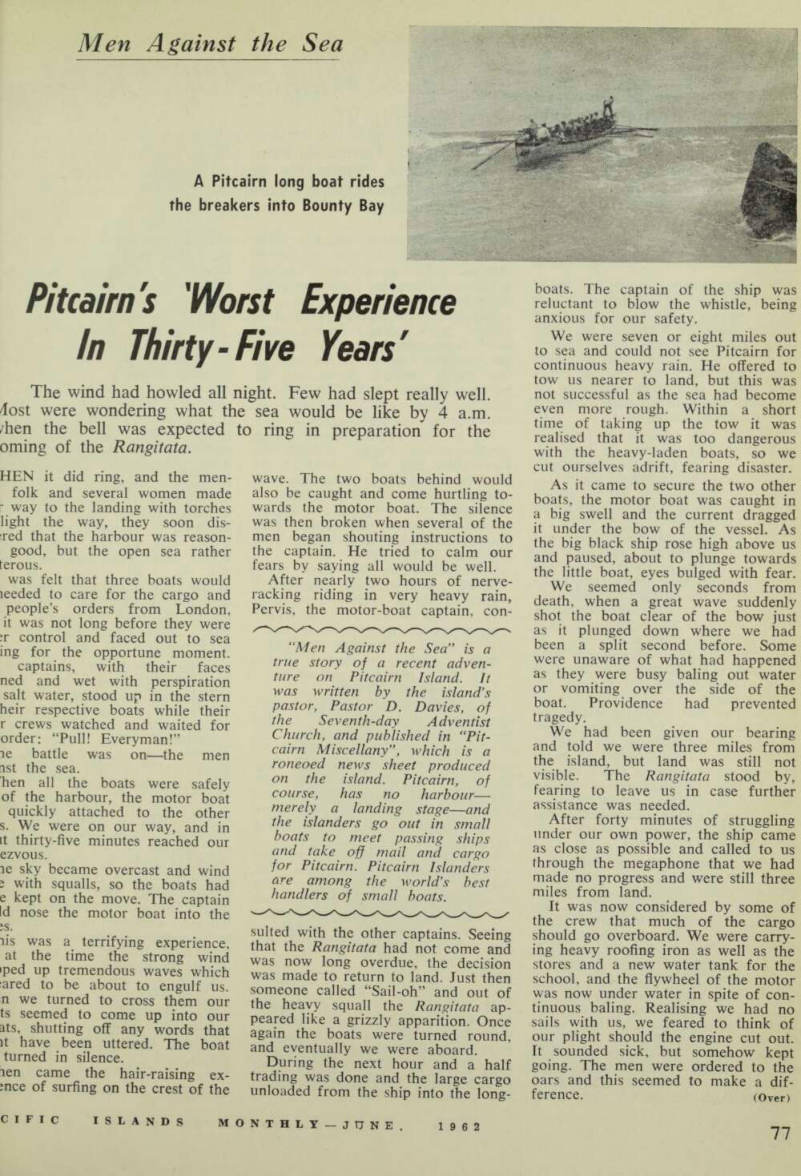
“Men Against the Sea” is a true story of a recent adven ture on Pitcairn Island. It was written by the island’s pastor, Pastor D. Davies, of the Seventh-day Adventist Church, and published in “Pit cairn Miscellany”, which is a roneoed news sheet produced on the island. Pitcairn, of course, has no harbour— merely a landing stage—and the islanders go out in small boats to meet passing ships and take off mail and cargo for Pitcairn. Pitcairn Islanders are among the world’s best handlers of small boats.
suited with the other captains. Seeing that the Rangitata had not come and was now long overdue, the decision was made to return to land. Just then someone called “Sail-oh” and out of the heavy squall the Rangitata ap peared like a grizzly apparition. Once again the boats were turned round, and eventually we were aboard.
During the next hour and a half trading was done and the large cargo unloaded from the ship into the long
boats. The captain of the ship was reluctant to blow the whistle, being anxious for our safety.
We were seven or eight miles out to sea and could not see Pitcairn for continuous heavy rain. He offered to tow us nearer to land, but this was not successful as the sea had become even more rough. Within a short time of taking up the tow it was realised that it was too dangerous with the heavy-laden boats, so we cut ourselves adrift, fearing disaster.
As it came to secure the two other boats, the motor boat was caught in a big swell and the current dragged it under the bow of the vessel. As the big black ship rose high above us and paused, about to plunge towards the little boat, eyes bulged with fear.
We seemed only seconds from death, when a great wave suddenly shot the boat clear of the bow just as it plunged down where we had been a split second before. Some were unaware of what had happened as they were busy baling out water or vomiting over the side of the boat. Providence had prevented tragedy.
We had been given our bearing and told we were three miles from the island, but land was still not visible. The Rangitata stood by, fearing to leave us in case further assistance was needed.
After forty minutes of struggling under our own power, the ship came as close as possible and called to us through the megaphone that we had made no progress and were still three miles from land.
It was now considered by some of the crew that much of the cargo should go overboard. We were carry ing heavy roofing iron as well as the stores and a new water tank for the school, and the flywheel of the motor was now under water in spite of con tinuous baling. Realising we had no sails with us, we feared to think of our plight should the engine cut out.
It sounded sick, but somehow kept going. The men were ordered to the oars and this seemed to make a dif ference. (Over)
A Pitcairn long boat rides the breakers into Bounty Bay
Changing course and going east, working by compass alone, we at tempted to reach land by coming up behind the island. We were now making slow but gradual progress and the Rangitata, delayed four hours while standing by us, steamed slowly away. We were alone.
On this occasion there were with us the two schoolteachers, Mr. M.
D. Howse about to depart and Mr.
S. A. Kinder recently arrived. What a farewell and what an initiation!
I can still picture their faces, Mr.
Howse thinking his farewell had in deed come and Mr. Kinder wishing his had.
Visibility cleared and we could now see the island a mile and a half away. As we came round the front of the island we were into the wind once again. Nearing the historic place where the Bounty was grounded and burned, the motor cut out. Panic now seized us through fear that we too were about to be dashed against the rocks without control.
Quickly the oars were snatched and ropes cut, leaving the two fol lowing boats to fend for themselves.
Almost super-human effort was made with only four oars to get the heavy motor-boat away from the rocks and out to sea again.
The condition of the harbour was now really dangerous, and only the experienced skill of hardened seamen could have possibly got the two boats safely in to the beach to quickly un load and go back to the rescue of the motor boat now drifting further and further from the land.
Every available woman and child was waiting at the new jetty to chain handle the unloading of the soaked, sodden goods.
This, too, was a task, as every car ton was wet and fell to pieces, and the tin goods had to be handled
individually. One-hundred-and-forty
pound bags of dripping wet flour and sugar some of the women hauled round with amazing agility. Only a part of one carton of spaghetti was dropped into the sea, and this the children dived for later.
Fully manning one boat and taking extra oars, a boat’s crew now faced the sea again to go to the aid of the motor boat. When these two jmned company a considerable por tion of the cargo was passed over from the vessel in distress, and both were then rowed back to harbour.
Normally the entire trip should have taken about three hours. But this day 11 tense hours had tried the nerve of those at sea and those wait ing anxiously on shore.
“The worst experience in thirty-five years” was the general opinion ex pressed by the men who have wrestled with the sea all their lives.