Remains Unconquered
pp. 77-78 · Read in the full issue
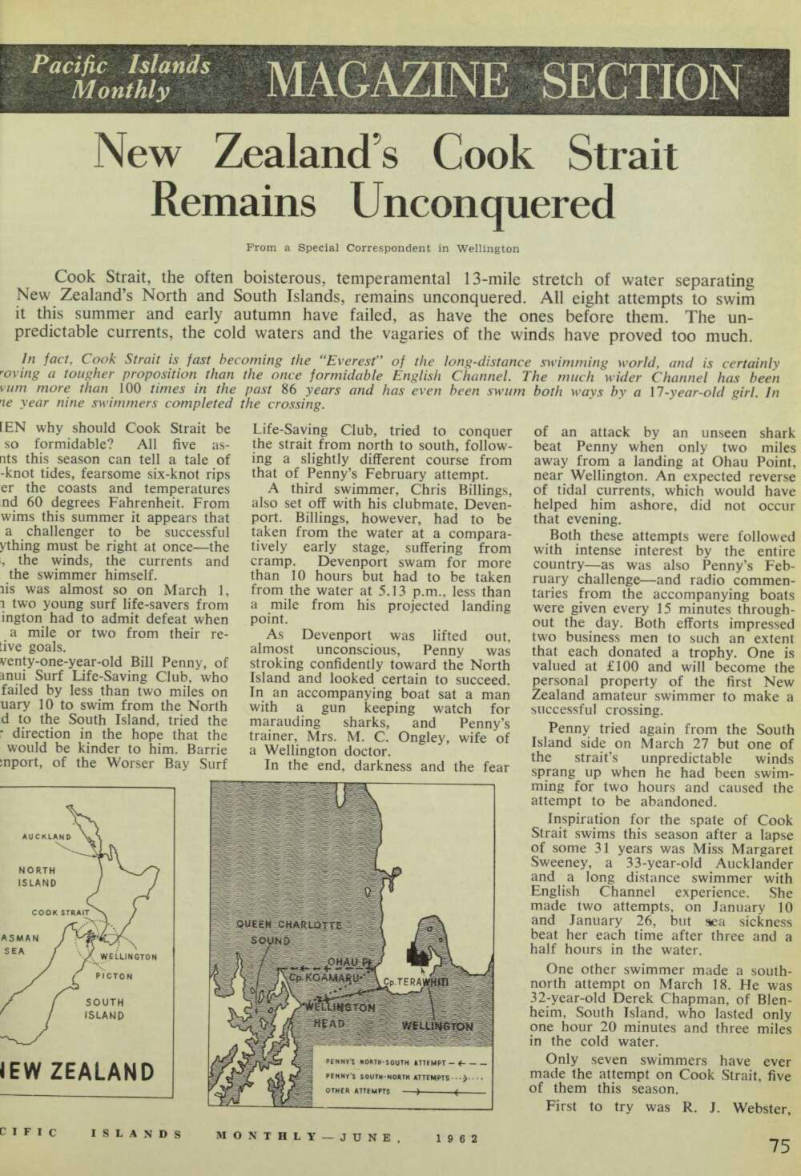
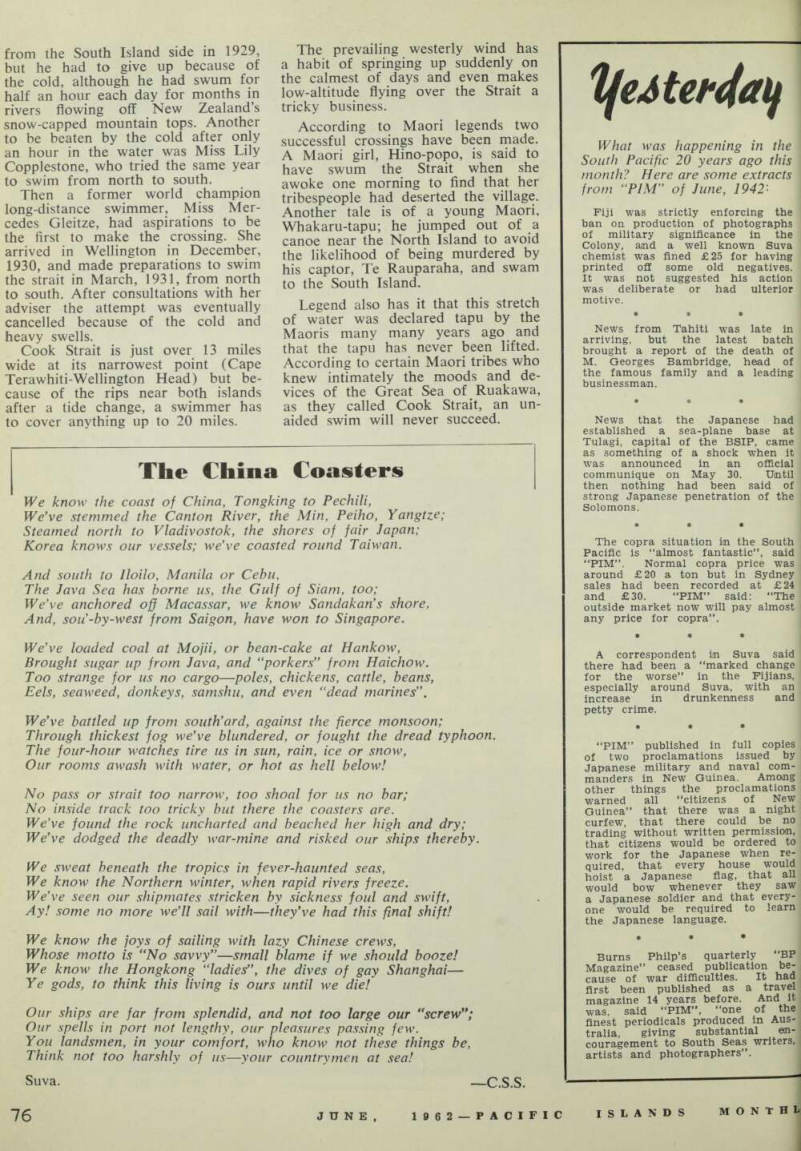
Pacific Islands Monthly
Macazine Section
New Zealand’s Cook Strait Remains Unconquered
From a Special Correspondent in Wellington
Cook Strait, the often boisterous, temperamental 13-mile stretch of water separating New Zealand’s North and South Islands, remains unconquered. All eight attempts to swim it this summer and early autumn have failed, as have the ones before them. The un predictable currents, the cold waters and the vagaries of the winds have proved too much.
In fact, Cook Strait is fast becoming the “Everest” of the long-distance swimming world, and is certainly moving a tougher proposition than the once formidable English Channel The much wider Channel has been vum more than 100 times in the past 86 years and has even been swum both ways by a \l-year-old girl. In ne year nine swimmers completed the crossing.
[EN why should Cook Strait be so formidable? All five as ats this season can tell a tale of -knot tides, fearsome six-knot rips er the coasts and temperatures nd 60 degrees Fahrenheit. From wims this summer it appears that a challenger to be successful ything must be right at once—the , the winds, the currents and the swimmer himself, lis was almost so on March 1, i two young surf life-savers from ington had to admit defeat when a mile or two from their re tive goals. venty-one-year-old Bill Penny, of anui Surf Life-Saving Club, who failed by less than two miles on uary 10 to swim from the North d to the South Island, tried the ’ direction in the hope that the would be kinder to him. Barrie mport, of the Worser Bay Surf
Life-Saving Club, tried to conquer the strait from north to south, follow ing a slightly different course from that of Penny’s February attempt.
A third swimmer, Chris Billings, also set off with his clubmate, Deven port. Billings, however, had to be taken from the water at a compara tively early stage, suffering from cramp. Devenport swam for more than 10 hours but had to be taken from the water at 5.13 p.m., less than a mile from his projected landing point.
As Devenport was lifted out, almost unconscious, Penny was stroking confidently toward the North Island and looked certain to succeed.
In an accompanying boat sat a man with a gun keeping watch for marauding sharks, and Penny’s trainer, Mrs. M. C. Ongley, wife of a Wellington doctor.
In the end, darkness and the fear
of an attack by an unseen shark beat Penny when only two miles away from a landing at Ohau Point, near Wellington. An expected reverse of tidal currents, which would have helped him ashore, did not occur that evening.
Both these attempts were followed with intense interest by the entire country—as was also Penny’s Feb ruary challenge—and radio commen taries from the accompanying boats were given every 15 minutes through out the day. Both efforts impressed two business men to such an extent that each donated a trophy. One is valued at £lOO and will become the personal property of the first New Zealand amateur swimmer to make a successful crossing.
Penny tried again from the South Island side on March 27 but one of the strait’s unpredictable winds sprang up when he had been swim ming for two hours and caused the attempt to be abandoned.
Inspiration for the spate of Cook Strait swims this season after a lapse of some 31 years was Miss Margaret Sweeney, a 33-year-old Aucklander and a long distance swimmer with English Channel experience. She made two attempts, on January 10 and January 26, but sea sickness beat her each time after three and a half hours in the water.
One other swimmer made a south north attempt on March 18. He was 32-year-old Derek Chapman, of Blen heim, South Island, who lasted only one hour 20 minutes and three miles in the cold water.
Only seven swimmers have ever made the attempt on Cook Strait, five of them this season.
First to try was R. J. Webster,
from the South Island side in 1929, but he had to give up because of the cold, although he had swum for half an hour each day for months in rivers flowing off New Zealand’s snow-capped mountain tops. Another to be beaten by the cold after only an hour in the water was Miss Lily Copplestone, who tried the same year to swim from north to south.
Then a former world champion long-distance swimmer, Miss Mercedes Gleitze, had aspirations to be the first to make the crossing. She arrived in Wellington in December, 1930, and made preparations to swim the strait in March, 1931, from north to south. After consultations with her adviser the attempt was eventually cancelled because of the cold and heavy swells.
Cook Strait is just over 13 miles wide at its narrowest point (Cape Terawhiti-Wellington Head) but because of the rips near both islands after a tide change, a swimmer has to cover anything up to 20 miles.
The prevailing westerly wind has a habit of springing up suddenly on the calmest of days and even makes low-altitude flying over the Strait a tricky business.
According to Maori legends two successful crossings have been made, A M ao d girl, Hino-popo, is said to have swum the Strait when she awoke one morning to find that her tribespeople had deserted the village, Another tale is of a young Maori, Whakaru-tapu; he jumped out of a canoe near the North Island to avoid the likelihood of being murdered by his captor) Te Rauparaha, and swam t 0 t h e South Island, . .
Legend also has it that this stretch of water was declared tapu by the many many years ago and that the tapu has never been lifted, According to certain Maori tribes who knew intimately the moods and de vices of the Great Sea of Ruakawa, as they called Cook Strait, an un aided swim will never succeed.