Territories TALK-TALK
pp. 63-66 · Read in the full issue
Upholding the appeal of some 49 Bukos against their con ations over the Hahalis incident will no doubt create a lot of tisf action in the minds of some folk who, inappropriately, Ink the native people of New Guinea are being needlessly ished around.
S does not question the finding >f a Chief Judge, but one is at y to assess the reaction which judgment will have upon the s mind, which knows little or ig of legal technicalities such as ifference between an “authorised *” and one who is “unauthorised” certain regulations, the Hahalis natives the judg merely indicates a victory over diite man’s law and a justifica for future similar action under r circumstances; or, to put it plainly, “We are strong; the : are weak. We are right; the are wrong.” r leaning over backwards in our listration of British Justice—as is wrote—can, at times, be ;ther impracticable amongst a aratively primitive people, unfortunate precedent has now created, which may have far ing and tragic effects at some : date.
P-Ng
ird tie months (or it may have been ago I had a whinge on these about the delayed delivery of ansard of P-NG Legco. Now a to the editor of The Sydney ing Herald from a Sydney cor
respondent complains that “the re ports of the third meeting of the first session of the fifth council, held dur ing September 19-28 last year, reached Sydney subscribers by air mail from Port Moresby on April 6. The same reports were available in Port Moresby itself only three days earlier. As at April 6, no reports were available in Australia or in the Territory of sub sequent meetings of the council. . . .
This delay of six months is so great as to amount to an especially objec tionable kind of censorship,”
I received my copy of this par ticular Hansard on April 5. But then I live in the country and the writer of the letter lives in Wahroonga! Be ing a printer at one time I tried in vain to work out a logical reason for such a long delay. But also having had the task of publishing a Hansard at one time—that of the TNG Legco back in the Thirties (there was no Government Printer at that time) —I do realise that most of the delay is in the proofing which, to the un initiated means allowing the members of the Council to correct their speeches so that what eventually appears in the finished product is not always what they actually said (particularly from a grammatical angle) but what they should have said. ' ( o V er)
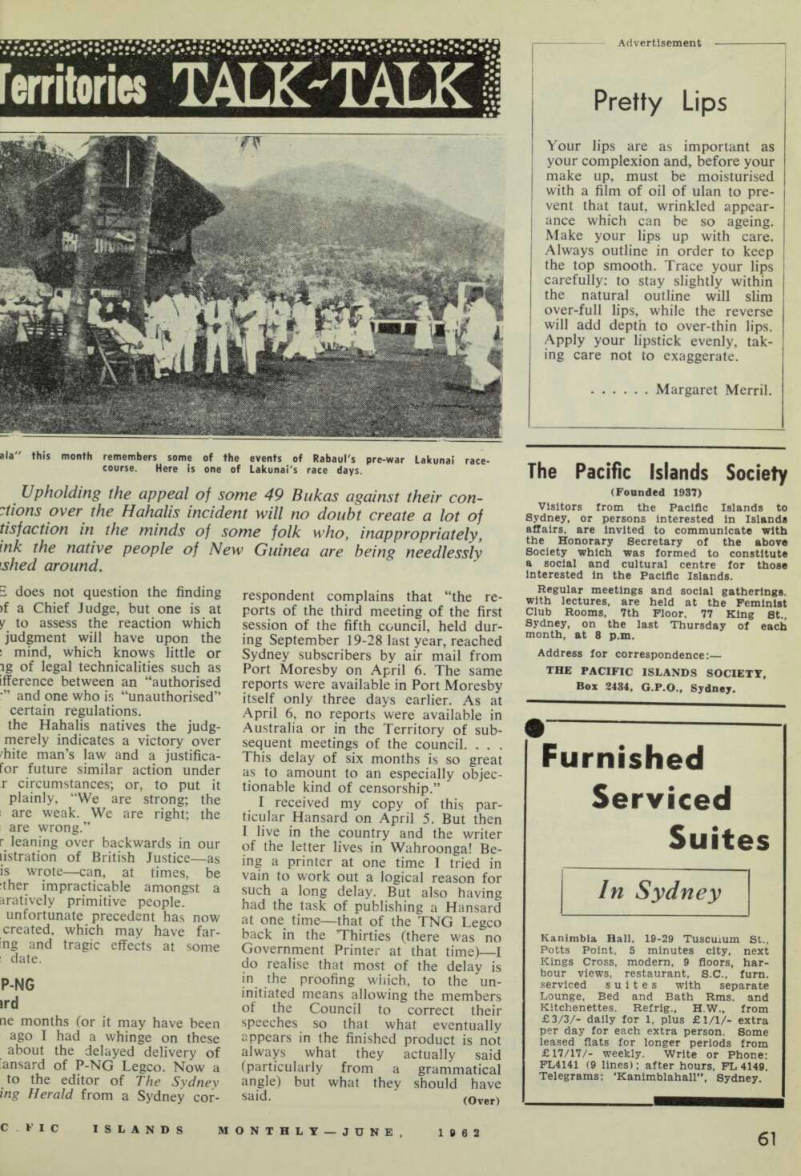
ala" this month remembers some of the events of Rabaul's pre-war Lakunai race course. Here is one of Lakunai's race days.
Even in the Thirties, when moi of the members were easily “get-ai able”, it required weeks before “fins proofs” were returned to the printe from the various geographical poim where members were located. So ho 1 much greater must the time lag b now when members are located h from Port Moresby, even allowin for aerial services.
One can realise it is not easy b any means for some of the nati\ members to give their final OK to proof, which appears in straigl English after translation from tl Pidgin. And then there is always tl possibility of a native member speech requiring the imprimatur ( the person or organisation of whic he or she is the mouthpiece.
What a time-saver it would be wei the speeches published, wit h o u amendment, and what reading j would make!
At the Rabaul Legco meetings or of my greatest difficulties was i securing sufficient stenographers wil speed capable of recording the pr< ceedings, despite the co-operation received from Administration, con mercial and professional employe: in the town. In fact (to repeat whi I wrote here in May, 1949, p. 4‘. one of the members—the Hon. Bi Grose—had such a speedy delivei that Mrs. Broadbent, who was i charge of the stenographers, used \ turn up a cardboard sign, GO SLOV when her staff was unable to ke€ pace with the Honourable Membe There was one thing, however, aboi Bill Grose; he made the least alter! tions in his Hansard proofs, althoug his speeches were extemporaneous.] Footnote : On glancing at my ol Hansards I notice that the last om referred to by the writer of the lette is the biggest issue yet published; als that other issues took from three 1 five months to reach me.
From Squally to California Following on the par. “A Wa Time Incident” ( Talk-Talk, Feb., i 34) came a letter the other day froi John G. Troster, of Atherton, Cal fornia, in which he said the pai “completes a story which began fc me back in 1940.”
He continues: “During the War spent 15 months on Emirau with US Marine Bomber Group. In 194-!
I think it was, I heard an Australia! radio broadcast (while I was o: Emirau) saying that some Australia Lt. Commander had received a meda for rescuing several hundred sui vivors of a German raider who wer put ashore on Emirau in ’4O or ’4l. .
“Several years ago I wrote several agencies of the Australian Govern
nt trying to find out about the sent state of Emirau. I wrote both the Embassy here and to Can ra. I received very nice publica is from Port Moresby on the Man ed Territories which included irau, but nothing about the island If. Possibly you know where 1 ;ht obtain up-to-date information, was really a very serene, idyllic nd—as we knew it at the time. . . One reason I like PIM is that m an amateur radio operator and e the opportunity to talk with ny through the Islands. It keeps up-to-date on what is going on their backyards!” low frustrating can it be when writes to a government depart it for specific information about Dcality and one receives in reply lossy brochure or pamphlet deal with Careers in the Territory’s >lic Service or the Progress of a pie, describing the advancement le by the indigenous folk under guidance of a paternal govern it. )ne hears there are steps being ;n to pep-up Public Relations in Territory. It’s about time, too, for / are at an all-time low at present, want factual information; not oily itudes about Administration evolence, nor highly-coloured malese stories—just dinkum facts, 'ome in Bruno Kroening, of irau, and appoint yourself a one i Public Relations Bureau for n G. Troster, of 45 Laurel ;nue, Atherton, California. Tell how this “idyllic island”, planted before War I by Nita and Carl de, is doing now.
Old Race Book ’rom time to time amongst my 1 I receive nostalgic links with the t, such as copies of the Eruption e of The Rabaul Times, roneo-ed :he Vunapope Mission during the 7 upheaval; or perhaps other es of that paper from old residents > explain the kindly thought by ng: “You seem to like living in Past, so this might interest . . . ,” And these old links with by-gone years certainly do hold interest and I thank them, one all. he latest link was a copy of a ; book for the New Guinea Cup ding on Saturday, September 28, 5, held under the auspices of the >aul Amateur Turf Club on the unai racecourse. “First race, 1.45 . Refreshments obtainable on the irse.” And E. G. Mac Adam, Act. i. Secretary.
'he Patron was the Administrator, Brigadier-General W. Ramsay Nicoll; the President: The Hon.
L. Clark, MLC; Vice-Presidents:
Dr. N. B. Watch and F. O, Green wood, Esq; Committee: Messrs. E. G.
Mac Adam, D. S. Davies, J. B. Cruise, G. Penton; Stewards: Messrs. J. C.
Archer, W. R. Smith, J. Ahearn, Hon.
J. C. Mullaly, J. M. David; Judge; Hon. H. O. Townsend, MLC, and Asst. Judge: C. J. Gascoigne, with many old-time names such as Syd Costelloe, Jack Edwards, Drs. E. T.
Brennan and H. C. Hosking, Messrs.
F. O. Moody, Andy Kelly and W. W.
Flynn.
Few of the officials mentioned are alive today and these include (to my knowledge) Gilbert Renton (still gal ivanting about the world from time to time); Clarrie Archer (now retired after being Administrator of NT for
some years); John Ahearn (retired in Melbourne, I believe); J. M. David (he was a bank manager, of whom I have lost all trace); Dave Davies (in WA, the last I heard); Syd.
Costelloe (still going strong some where in Sydney) and Andy Kelly (re tired Judge and now in Brisbane).
The records show that previous NG Cup winners, starting in 1930, were Enchant, running the distance of seven furlongs in 1.39 with H. A.
Gregory up. (He was later DO Rabaul and was lost at sea during the war); in 1931, Gaberdine won the nine fur longs in 2.04 with Ben Costello up.
In 1932 he was also the winner with the same mount and 2 lbs lighter and the time was 2.13 4/5. (Ben has gone
and his widow, Mildred, still carry on at Gire Gire plantation). In 193: the winner was Guiding Light, riddc by A. L. Robinson (who escaped tl Tol massacre by a whisker only to 1 murdered by natives in Decembe 1948, in that same area) in the bett< time of 2.2 1/5, And in 1934 Exi won in 2.2 2/5 with Jack Eaton u (I haven’t a clue where Jack is novs Going through the various tropl winners from 1931 to 1935 reca] some old-time amateur jockeys su( as Jack Sherry, Jack Allan (died b recently), Peter Blanden and R( Smith. Other riders in that peril were Theo Thomas (still goii strong). Major Ayris, Dick O (passed on) and E. S. Burke.
And so much for the 1935 Ne Guinea Cup Meeting held on the o Lakunai Race Course, where afte noon tea was served at 1/6 a p< and “Hot Frankfurts and Roll available for 6d each, and “music numbers rendered during the afte noon.”
I wonder if they have as much fi at the Vulcan Racecourse nowada as we had in 1935 with Dick Moo and Tom Barnett calling the odds?
Some Questions A United Nations Informal Centre, with Mr. Sami Dajani as i terim Director, has opened in Pc Moresby to “deal in facts only,” \ quote the interim Director, “not engage in propaganda”. The idea that the centre be ultimately head by a native of either Papua or Nc Guinea.
And why, might one ask, is ti Centre situated in Papua and not the UN Trust Territory of N( Guinea? And why possibly headed 1 a Papuan who couldn’t care If about UNO?
Or is Papua to become a Tn Territory under UN? As Eliza Do little would say: “Not bloody likelj If the location is to be near hea quarters, then why hasn’t Mr. Daja gone to Canberra, the true nen centre of both Territories?
BSIP Readers,
Attention!
An inquiry comes from Rob< Bruce, 85 Kingsway, South M bourne, about some old-time Solomi Islanders: Claude Buffet and Anderson, Stanmore, “Stinker” and Fuller, i of Kolombangara; “One Puncl O’Brien, of Gizo; old Tost, of Re dova and D’Arcy Brown.
Any clues from anybody from t Sorrowfuls? If so drop a line j Robert Bruce for auld lang syneJ
"Tolala