[?]om Leahy And His
pp. 37-38 · Read in the full issue
New Guinea Success Story [?]om Leahy And His Erap Peanuts
tome high officials may not ee, but history will say that no »le family contributed more to establishment of a sound Aus ian economic structure in New
inea than the Leahy family.
ICK and Danny, with Jim Tay lor, were the discoverers of the Elands around 1930. Mick later blished his famous farm in the neng-Zenag area; Danny has blished a somewhat similar farm the slopes of Mount Hagen; Jim successfully pioneered the coffee stry on a limited area near Go .; and Paddy is now a happy Je-planter near Wau. be New Guinea Administration j those brothers a great debt for enterprise, and for conveying tical know-how to the Highlands 'es (whom the planners expect 5 day will be native farmers), it the Leahy saga does not stop J. Already established in the dory, and thrusting on with old new kinds of agriculture and lal husbandry, are the sons and ews of the original four; and Guinea has not yet seen a better of young man. i a recent journey I saw two lem in action—Tim, who now is father’s general manager at g; and Tom, who by sheer in-
dustr y and intestinal fortitude (guts, if you P refer the simple Australian word ) has established himself at Era P’ in the Upper Markham Valley, 33 one of tbe bi g Best contributors to the ex P ort of peanuts, which now ea . rn . s the Territory a cold quarter million a year.
The story of Tom Leahy is an inspiration to all young Australian- New Guineans who can see a real future in this huge, blundering Ter ritory.
Nine years ago, Tom was simply a very young man with no money, but a great love of New Guinea land.
Somehow—l cannot imagine how, but I suspect that he got active help from certain high officials who liked young Tom, and disliked the Top Brass policy of discouraging Austra lian enterprise in New Guinea—he got possession of a couple of thousand acres on the flats between the Erap and the Mark ham; and he went into the job of farm-making literally with bare hands and bare feet.
He could afford only the simplest implements, and he admits that he could not afford shoes.
He went for cocoa—and learned his first bitter lesson. There is some thing in that stony soil that killed two-thirds of his cocoa trees. Other disappointments fell in on him. But he had married a young school teacher, and this quiet, charming youn" lady joined him in a native materials house, and kept his heart up. It was a hard, bitter fight— but young Tom came good.
He planted a large area in coco nuts, and it looks as if that slow growing plantation presently will give him a fine return.
And then, a few years ago, the farmers in that area discovered that the land will produce the finest pea nuts. The peanut is ready for harvesting 98 days after planting, and it will grow any time. Three crops a year!
No wonder Tom Leahy and those other hard-working settlers there abouts stirred up an almighty howl from the Queensland peanut growers, and that the badgered Australian Government was urged to keep out “the products of cheap black labour.”
Actually, the cost of producing a ton of Erap peanuts is higher than the cost in Queensland. The Erap plants grow prolifically, but so do the Erap weeds; and the texture of the Erap soil is such that machines can not be used to separate nuts from plants. But the Upper Markham farmers carried on, and beat all the ills that nature and some kinds of officialdom can throw against them.
Now, Tom Leahy has a fine new house, with all mod. cons., embowered in lovely trees which Mrs. Tom selected, and surrounded by wide green lawns. Three bright children (including one surprising pair of twins) frolic across the gardens, and ride on the tractors and trucks with Dad, and with the fine old boss-boy —he was Mick Leahy’s personal boy
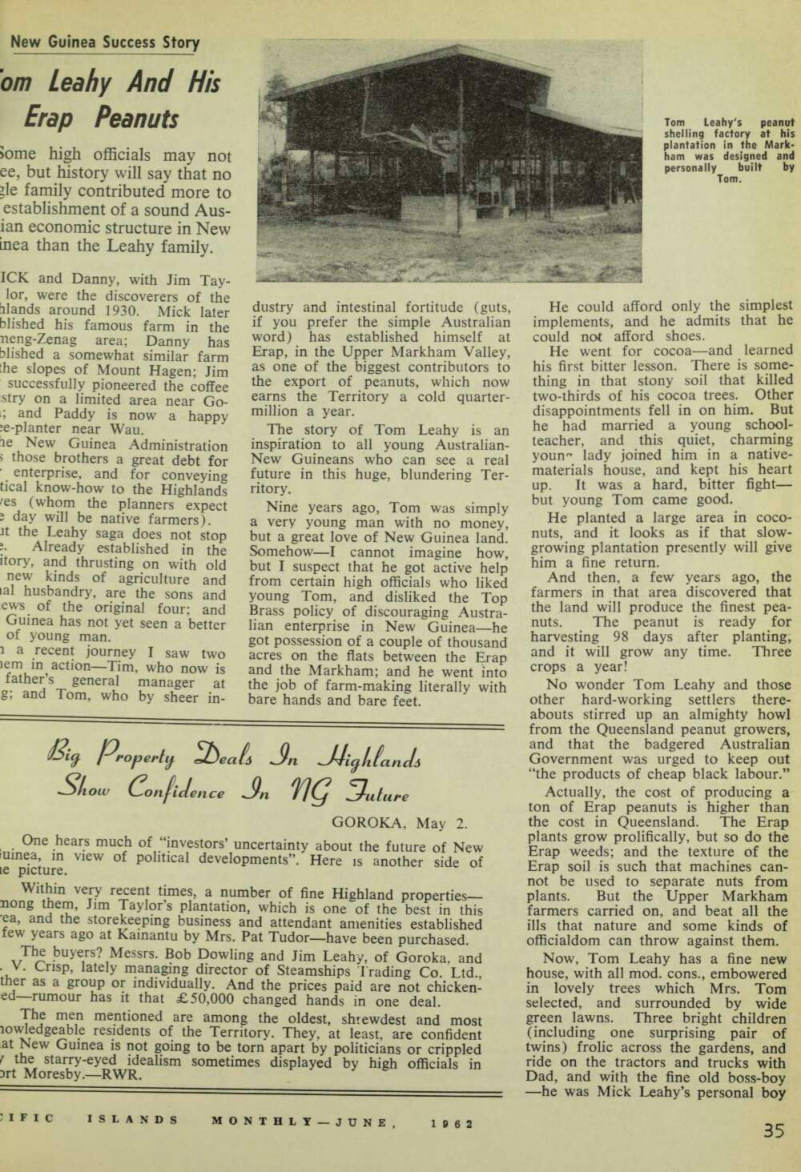
Tom Leahy's peanut shelling factory at his plantation in the Mark ham was designed and personally built by Tom.
when they discovered the Highlands over 30 years ago.
Tom Leahy now has most of the necessary equipment (including half a dozen pairs of good shoes in the bottom of his wardrobe) and com fort and happiness.
But he is anxious and worried lately. “Are they really going to take these properties off us, and give them to the natives?” he asks, repeat ing a question that nearly all private enterprise in this Territory is asking today.
They know how they have worked and earned these agricultural toe holds. They know that most natives, at the present stage, are quite incap
able of running this kind of farm, let alone an Administration. So they cannot believe the headlines, which suggest that New Guinea may become another Kenya.
It would be an act of mercy if Australia’s Prime Minister would make a clear statement, indicating just what Australia does plan to do with these pioneer people, who have established themselves in New Guinea.
R. W. Robson.
The trans-Tasman section of the Commonwealth cable is scheduled to be opened on July 9. The opening ceremony will take place simultane ously in Sydney and Auckland.