towards ?eminuaban
pp. 21-145 · Read in the full issue
Indonesia Makes (Unofficial)
War In New Guinea
A situation that can be called by the old-fashioned term of active litary aggression on the part of Indonesia has now developed in West >w Guinea, although it is being called by other fancier names in some arters.
TER May 24, the Dutch introduced some censorship on ntn X r tnT S JV he Ut end ° f May 1 600 Indo ’
W^ re k f ? OW ? torv d hi IUP ° f
lacdeur Guff f°ti h
towards ?eminuaban
itrh ! b •'
*s have 8 been a™ng them the air. itch Army and Navy patrols advancing on pockets of Indans from Teminuaban and 800 m and children have been evacufrom Teminuaban and four settlements around the Vogeland Fak Fak areas. They have taken to Hollandia, Biak and ikwari. is is about the extent of the facts that can be obtained, itime, although stating that this t yet “the” invasion, but simply i by “volunteers”, Indonesia is ing military victories in the ation” of such places as Temim, where it is alleged the town >med the invaders (or liberators)
with open arms and took on a “gay and festive mood”.
The Dutch den y these reports and refer onl y to mopping-up operations and the capture and killing of some paratroopers. It has been stated that the Indonesian s appear not to want to figh '’ but . try .‘? into the iun « le apparently with the idea of stirring up ‘ r ° Uble am ° ngSt ““ nativeS ' '' /,oral V,ctor y What the Indonesians are claim in 8 * n the military sense can be largely discounted as imaginative nonsense, but their paratroop cam paign as a probing operation both its moral and practical applica tions, can’t be so easily dismissed, If the Dutch are able to root out the paratroopers who have already landed and to adequately deal with others who are tempted to follow, Dr - Soekarno may think better of a py large scale attempt. But the difficulties of dealing with this sort °E war of infiltration in a country as primitive, unroaded and isolated
(Continued on p. i«)
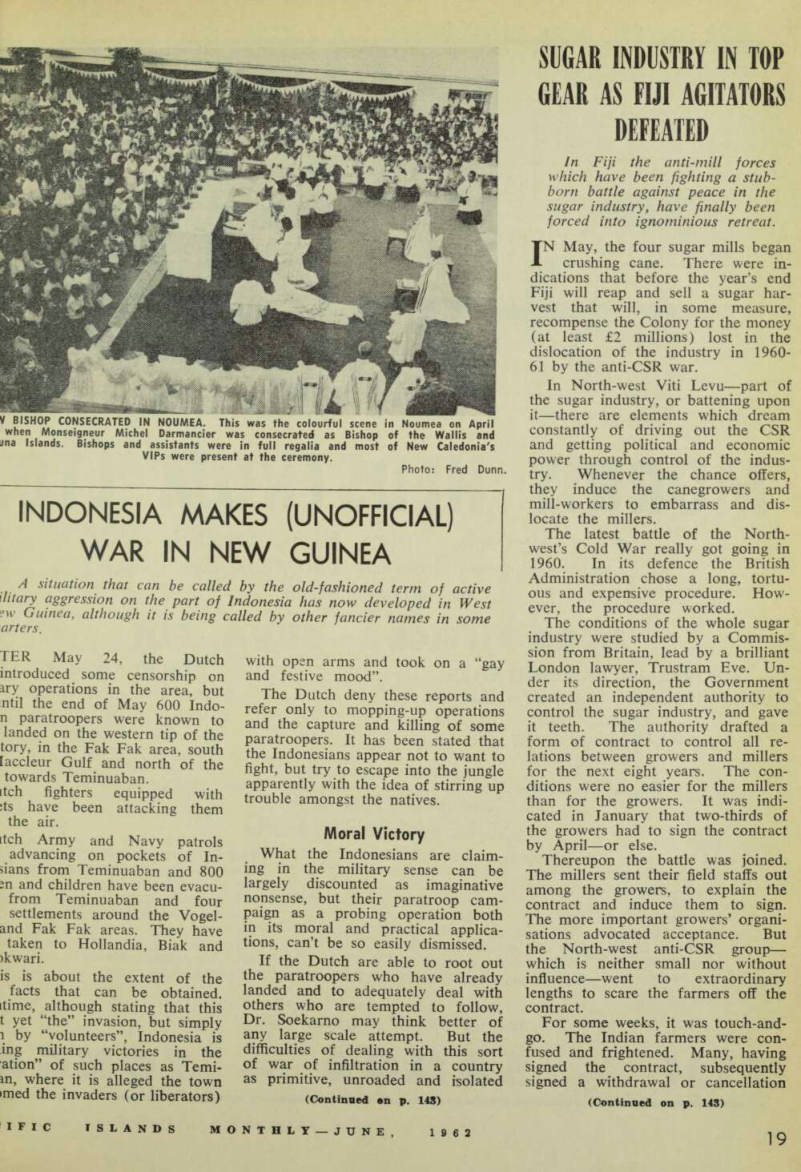
[?] BISHOP CONSECRATED IN NOUMEA. This was the colourful scene in Noumea on April when Monseigneur Michel Darmancier was consecrated as Bishop of the Wallis and una Islands. Bishops and assistants were in full regalia and most of New Caledonia's VIPs were present at the ceremony.
Photo: Fred Dunn.
t New Guinea, are tremendous ive no relation to ordinary f manoeuvring even with well and well equipped troops, he moral front, Dr. Soekarno ■eady got his victory in that ;r country—with the exception ibbit-like squeak from Austra s bothered to raise its voice est over what the Indonesians w actively engaged in doing Dutch Territory, state of affairs, from nations d small, who have gone on as being devoted to the causes :e, is hard to understand by ts of the South West Pacific ive watched this Dutch-Indo trouble develop over 15 years ve made no bones about their dies being with the Dutch, er there is a case where United i intervention might have
served some useful purpose, this seemed to be it. But the United Nations apparently throws its weight about only when right is on the side of someone in the Afro-Asian bloc.
Where the dispute is between a Euro pean power—and an ex-colonial one at that—and an Asian, the Euro pean power is left to stew in its own juice, even while it is morally right.
At the end of April and again in mid-May, the Dutch requested the United Nations Secretary-General to send UN observers to West New Guinea. Weeks dragged on with no reply, while the Security Council thought about it, but on May 24, U Thant finally replied to Dutch requests by turning them down.
Nothing could be done, he said, until Indonesia asked for it also.
The sovereignty of West New Guinea is still in the hands of Holland—not even the United Na tions has ever been able to decide otherwise nor has Indonesia ever been tempted to try it out in the International Court.
Yet, when a sovereign power asks for UN assistance in its own terri tory, it cannot have it because an aggressor, who claims the territory for no other reason than that it is Dutch, has not requested it.
For a dozen years Australia sup ported the Dutch cause in West New Guinea, but in the last year this policy has been subtly changed.
There are several reasons for this —one being that the Dutch them selves, although they do not want to hand over to Indonesia, do not want to stay in the Territory. The other is that, as Prime Minister Menzies pointed out last January, “our power ful friends”—meaning America— have no intention of going to war with Indonesia over NNG.
In bolstering this change of atti tude the Prime Minister has always clung to the assurances of Indonesia that it would not use force to gain New Guinea. 111-Timed Australian Visit Now, of course, the Indonesians are using force. At a Press confer ence before he left for the UK on May 24 (for Common Market dis cussions) Mr. Menzies described it as “a most unhappy business”. He said, also, that it was a break of assurances given Australia. He said he would have discussions on South East Asia while he was abroad.
At the same time he announced that the Australian Minister for De fence, Mr. A, G. Townley, would make an official visit to Indonesia in early June, as a return visit to
that made by Indonesia’s General Nasution to Australia last year.
Even Mr. Menzies’ most ardent supporters have been incensed at this visit at a time when our Dutch neighbours and allies are engaged in active warfare with Indonesia.
Mr. Menzies had raised his voice in protest earlier in May when In donesia’s Dr. Subandrio was in Mos cow on a buying spree for Soviet arms, and apparently as propaganda to back up this mission, Dr. Soekarno had gone on record in praise of Communism.
At an Indonesian Communist Party Rally on May 2, Dr. Soekarno said, in part, that he had “cured most Indonesians of their phobia against Communism although some were still obsessed.”
He said Communism had a great role to play in the anti-colonialist struggle.
He said the Indonesian struggle was a part of the greater revolu tion spanning three-quarters of the world.
The goals would be achieved only if there was a revolutionary national unity without internal discord.
Dr. Soekarno’s statement came a couple of days before the arrival in Australia of the US Secretary of State, Mr. Dean Rusk, but this espousing of the Communist cause appears not to have altered the United States’ belief that it would be a good thing to have Indonesia established in New Guinea.
Most residents of Australasia and the SW Pacific feel that, if what is going on in NNG at the moment is a sample of living closer with Asian neighbours (as they are continually being urged to do), they don’t think much of it.