Pacific Report
pp. 119-140 · Read in the full issue
The month’s round-up of news and pictures of people and ents, from P/M correspondents in the South Pacihc.
' Drug Claimed as
i for Fiiaria
search units based on the Medi :hool of the University of Otago, are claiming a great victory opical medicine. They report they have found a drug which :ure filariasis—the disease which ch a scourge throughout Poly , and to some extent in Fiji, ariasis often develops as ele dasis—sufferers being incapaci by grossly swollen limbs, long has been known as a uito-borne disease, and it also known that there was a sort of reaction between the mosquitoes human beings, under which tiny is become lodged in the lym c glands, leading to incapacity grave sickness. It could be re i, but not cured, e New Zealand researchers have busy in the Cook Islands, where
there is a great deal of filariasis, and the drug which has had a spec tacular effect against the disease is one that was evolved by an American doctor in his battle against sleeping sickness in Africa.
French medical teams, m Tahiti, have done a great deal of work against filariasis, and many will regret that they did not get the satisfaction of making this discovery.
However, their contribution has been substantial. The late Mr. D. W.
Amos also did a great deal of anti filariasis work in Fiji.
It is worth noting that, 30 years ago, there were four dangerous or debilitating diseases in the South Pacific Islands —malaria, in the South-west Pacific; scrub typhus, in New Guinea; hookworm, generally; and filariasis, in Polynesia.
Within that period of 30 years, hookworm has been almost entirely wiped out —the accomplishment of the American, the late Dr. S. M.
Lambert; new drugs have conquered scrub typhus; through the introduc tion of new drugs the incidence and virulence of malaria have lost much of their terror, although people liv ing in Melanesia may still catch malaria; and now filariasis apparent ly has been conquered.
Fiji Makes a Wide
Range of Goods for Herself
The Government of Fiji, not long after a visit by an Australian trade mission, and under promise of a similar trade mission from New Zea land in August, has issued a list of “products manufactured in Fiji”.
The pamphlet advocates, in large type: “Help yourself by helping Fiji —Give employment to your fellow countrymen.”
The list is impressive—it is shown that about 30 products, manufactured in Fiji, are now available for sale there.
Foodstuffs include biscuits, honey, butter and cheese, dressed poultry,
preserved meats, aerated waters and cordials.
Goods which are manufactured on a small scale include small craft, but tons, shoes, Venetian blinds, paints, mirrors, joinery, wrought iron and steel work, farm implements, con crete articles, printers’ blocks, per fumery, fertilisers.
Large factories have been estab lished in recent years for the pro duction of coconut oil and meal, soap, beer, cigarettes, cement and matches.
The small factories have been established and are run by indivi duals; but the big Australian cor porations mostly have supplied the capital for the larger factories—the brewery, cigarette factories, cement works, copra mill.
The argument is that if Fiji cannot find a market for primary products —from the proceeds of which she will purchase and import foodstuffs for her growing population—she will herself manufacture for her own con sumption all possible goods which, hitherto, she has been importing.
Generally, Fiji prefers primary production and the sale of her foodstuffs overseas; but if the latter markets languish, then she will try to provide her own requirements.
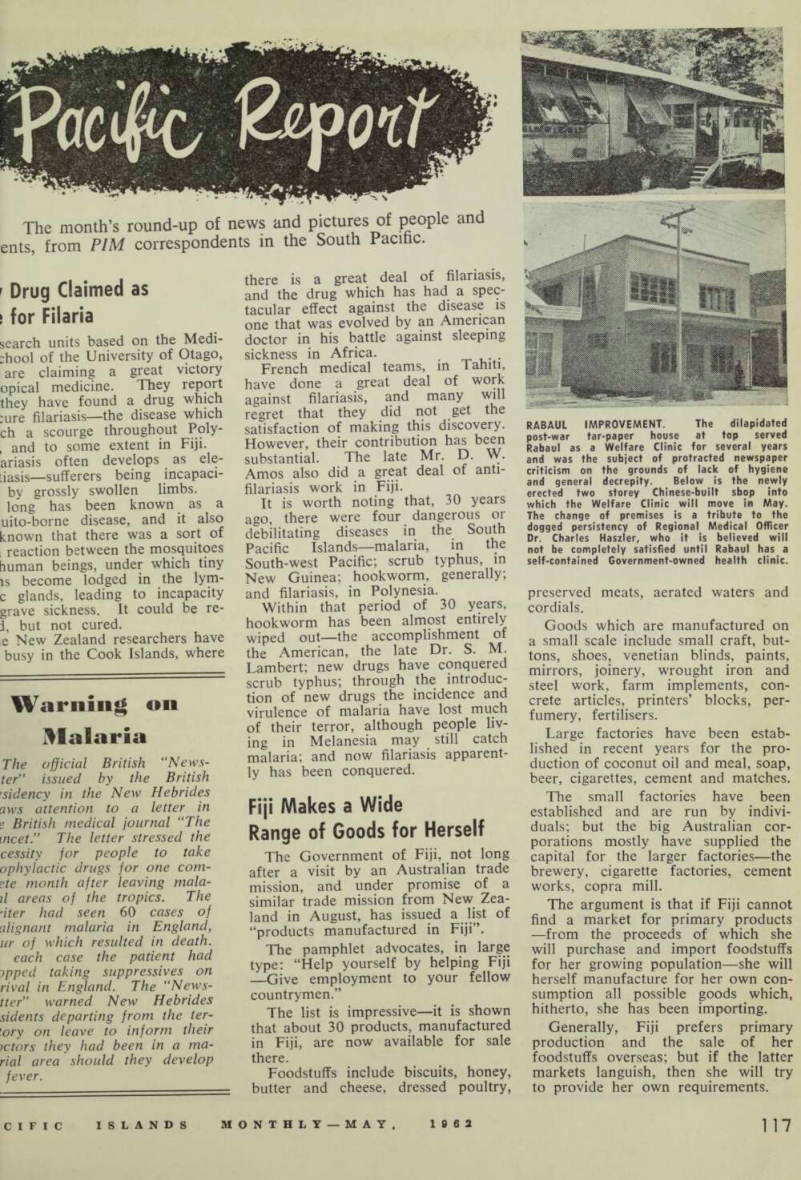
RABAUL IMPROVEMENT. The dilapidated post-war tar-paper house at top served Rabaul as a Welfare Clinic for several years and was the subject of protracted newspaper criticism on the grounds of lack of hygiene and general decrepity. Below is the newly erected two storey Chinese-built shop into which the Welfare Clinic will move in May.
The change of premises is a tribute to the dogged persistency of Regional Medical Officer Dr. Charles Haszler, who it is believed will not be completely satisfied until Rabaul has a self-contained Government-owned health clinic.
> Bros. Fiji
Settled on Terms
Akhil Mines-Banno Bros. )0 action in the Supreme of Fiji ended in March in snt on terms not disclosed, iblic hearing of the case lasted ays and cost several thousand in legal fees, parties got together then and two days hammering out de as said later that the terms [ement were for a sum a few id pounds higher than the I claim, in which Banno Bros, a court order to enforce Akhil to sell their mining rights, etc., no Oceania Ltd. for £375,000. y IM, April, p. 126.) i side had a Queen’s Counsel 1 its case.
H. Cresswell at
lony at Rabaul
i recent ceremony which re tire deeds of a Territorian- Mrs. H. Cresswell, now of presented a back-lag of four to the most efficient constables New Britain Police force. dw of Mr. A. H. Cresswell, Cresswell, aided by District issioner John Foldi, presented shields of the Cresswell Coro- Trophy to Sergeant Bapi efficiency winner), Senior Con- Sinsinga (1959), Constable Class Torikiam (1960), and nt Mabura (1961). linating in 1953 the Cresswell ation Trophy is now a memo- Englishman Arthur Cresswell war and pioneering history in erritory have become part of :rritory legend. [916, at the age of 16, Cress nlisted and was sent to France machine-gunner He was pre t the taking of Mont St. Quen d was duly recommended for ition. ir demobilisation Cresswell’s ;t turned to the Islands and H he became plantation over br the Ex-pro. Board, serving them in Kavieng, Manus and Britain. eral years later he made his o the goldfields at Edie Creek Kaindi. A successful miner, veil next purchased Lilinakaia ition in the Bainings, leaving the declaration of World War serve with the AIF in the e East. er Cresswell served with the ion Islands Defence Forces and
with ANGAU in New Guinea.
A few years later Lilinakaia, along with other lease holdings, was sold to the Catholic Mission.
In 1960 Arthur Cresswell, lover of the fruits of discipline—prompt ness, obedience and efficiency—died in the Mayo Clinic. His ashes were scattered over his old Edie Creek claim.
The Cresswell Coronation Trophy, now in its tenth year, perpetuates a soldiering man’s strong sense of duty —a fine incentive to New Britain’s native police force.
In New Caledonia the
"Ouis" Had It
With the rest of the French Union, New Caledonia and its dependencies were asked to vote on the recent
referendum on the future of Algeria. They might be said to have given only a half “Oui”, as only 20,000 out of the 37,000 registered voters bothered to cast a vote.
Of the 20,192 who voted 18,462 said “Oui” and 1,730 voted “Non”.
Although local papers screamed “New Caledonia votes 91 per cent.
Oui”, in headlines it is certain that in Paris the results have been re ceived very bleakly indeed.
From an analysis of the results it would seem that the native voters carried out their duties better than the Europeans. Noumea itself had the greatest number of abstentions and, of course, the greatest number of “Nons”. It would seem also that the majority of the “Nons” were Metropolitan Frenchmen rather than local New Caledonians. The local just doesn’t care what might take place in Algeria whereas the Metro politan does, and it is surprising the dislike many Metropolitan Frenchmen there have for de Gaulle.
In the Wallis and Futuna Group the result was as could be expected —herd-voting. Of 3,500 enrolled, 3,109 voted, and of these 3,102 voted “Oui” and seven voted “Non”. (Very probably these latter are still being chased around the islands).
The Wallis result was, of course, ridiculous. They must have been told how to vote by the Administra
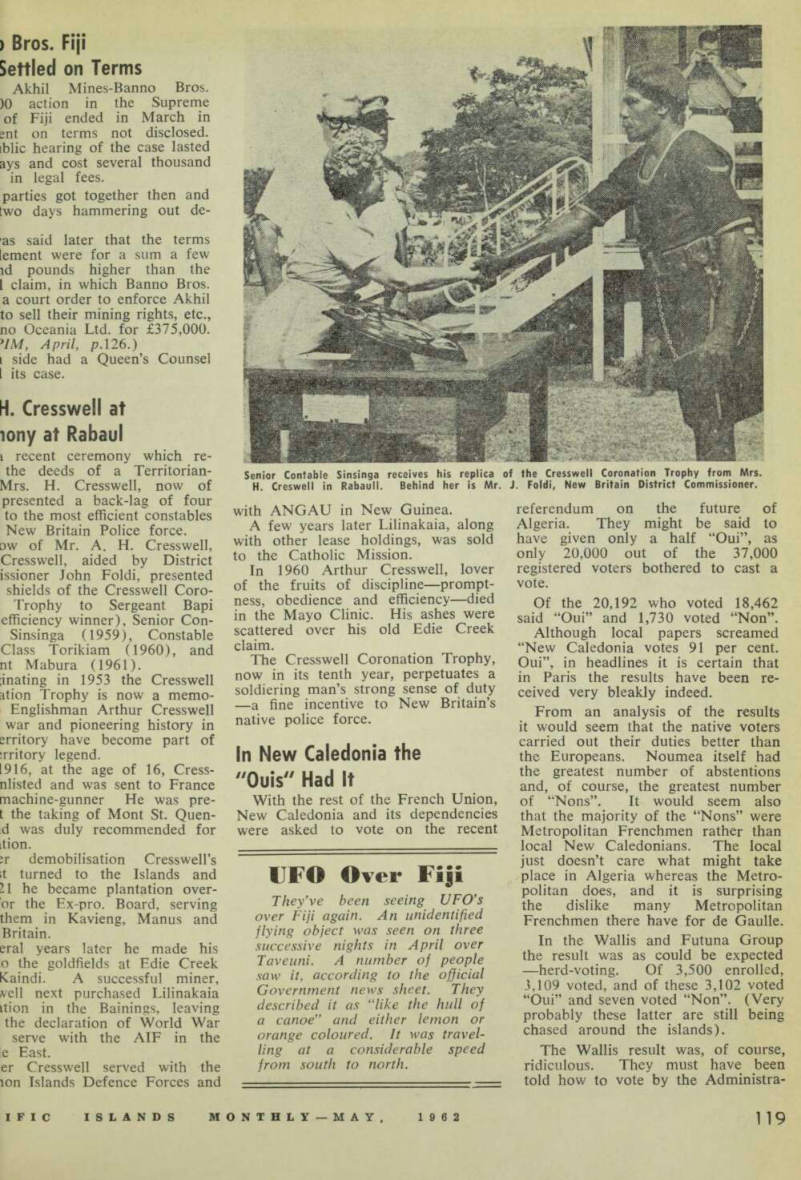
Senior Contable Sinsinga receives his replica of the Cresswell Coronation Trophy from Mrs.
H. Creswell in Rabaull. Behind her is Mr. J. Foldi, New Britain District Commissioner.
tion or by the Church, and j ahead—except for the seven I sheep.
Just how one could expect I people, few of whom speak Fn to weigh and deliberate the i of the Algerian crisis is be common sense. Probably in Fi itself very few understood the i of the referendum. They ] “Oui” because it was the only to end the Algerian war.
Hewlett Puts Them
Right About FMF
Mr. R. A. Hewlett, one-time retary of the Fiji Visitors Bi got himself a double column sj in The Sydney Morning Herai April in defence of the war r< of the Fiji Military Forces in j and Bougainville.
Bob Hewlett was referring t( previous Sunday’s episode “ANZAC”, which has been rui for weeks on the Herald’s TV st< ATN Channel 7, and he sai( part: “Mention was made of the : Battalion, Fiji Infantry Regimer being the only Fijian troops Bougainville. In effect, during period covered by the epi December, 1943, to July, 1944, were four units serving on Ton —the First Battalion, the Battalion, the Second Comm Unit and the Fiji Dock Compai “The omission of most coi to me was that no mention j made of the award of the Vic Cross, posthumous, to Cor Sukanivalu of the Third Battalic “This was the only VC awi to a member of the forces ol Crown Colonies and we of Fijian Infantry Regiment intensely proud of it. Cor] Sukanivalu gave his life in t: to save members of his patrol being wiped out by a Jap< machine-gun post.
“The commentary also infi that the Fijians were part of Third Division, Second NZEF. fact, the Fiji Infantry Regiment part of the Fiji Military Forces operated under control of Fourteenth Army Corps, US A We did have a number of Zealand officers and NCO’s atta to us and they did a very fine “During the entire campaigi the Solomons, the Fijians fough Guadalcanal, New Georg Kolombangara and Bougain and their record in regard to limited numbers is probably ut in any theatre of war.
“Honours won were one Vid
three DSO’s, two OBE’s, four 12 MC’s, four DCM’s, 19 two BEM’s and 54 MlD’s, of seven were posthumous. US included five Silver Stars and mze Stars.” iite of the name of the senes which should, by refer only to the men of istralian and New Zealand Corps who landed on li in 1915 —it concerns the of Australian and New servicemen in World War a basis of 90 per cent. Aus and 10 per cent. NZ. commentary that goes with i is, on the whole, superficial parts puerile, but the most inting thing about it is that oducers fell for the same listic line as producers of an war films. me coming to earth straight dars without any knowledge it history would assume, from this series, that the Aus alone fought the Pacific War, at the Kiwis took on Hitler Vlussolini single-handed in Africa and Southern Europe. a series about Australasians , of course; but a few more :es to the other people who ighting the same war would one nothing to harm it.
“ANZAC” series, although zs longer, is not in the same y as the short ABC series on istralians in the Middle East was seen over Sydney’s :1 2 last year. The commentary tat was done by Dudley thy, an assistant secretary of rritories Department in Can and it was a mature and ic piece of work.
tin Painting
ss £17,000 Gauguin’s famous painting top half of a panelled door £17,000 when it was sold tion at Sotheby’s, London, in painting, which Gauguin did liti to repay a native friend’s ss, was one of 34 impressionist gs which Sotheby’s auctioned ;hor Somerset Maugham. whole collection netted 50. gham bought the Gauguin g for 200 francs when he Tahiti in 1916 to gather il for his novel “The Moon ixpence”, which was broadly on Gauguin’s life. (See PIM, > P- 73). a foreword to Sotheby’s
catalogue, Maugham, who is nearly 90, said he was selling his paintings because of the irksome security precautions he had to take against thieves at his villa in the south of France His secretary said after the sale that most of the proceeds would go to a fund that Maugham had established for struggling authors.
Urban Fijians Becoming
1 'j
"Race of Pub Loungers
~, . , What to do with idle youth and hundreds of youngsters leaving school with little prospects of finding useful employment, is a question worrying thoughtful minds m Fiji.
The Government last year set up a committee to study youth problems.
The committee’s report was preseated a few months ago but presumably contained too many suggestions for a financially harassed Government to tackle. There has been no official announcement about any proposed action.
Mr. Alf Marlow, managing director of Fiji Builders Ltd., touched on the subject at a Suva Chamber of Commerce meeting in March, when he complained that he was not allowed, under the law, to employ anyone under 15. He had already done so, and was fined for employing a young boy to sort nails.
With a recent raising of school fees, many parents, unable to meet their commitments, have had to take their children away from school.
This early leaving has swelled the ranks of idlers round the streets of the main centres.
It would be better if these idle youths could be placed in some sort of light employment till they were ready for something solid later on.
However, Mr. John Stannage, manager of the Fiji Broadcasting Commission, probably thinking of the industrial revolution, expressed horror at the thought of “child labour”, although he modified his statement later by suggesting that re sponsible employers, such as Fiji Builders, could take young men in hand and look after them till they reached “working age”.
Right now, in Suva, they are tell ing this story to illustrate the feck lessness of local Fijians: Some months ago a committee in the Lami area, as an example of good neigh bourliness, ran a series of functions to raise money to buy amenities for the Fijians of the nearby Suvavou village. With the money they raised they bought a fishing net so that the villagers could use it to catch extra fish for sale.
Time went on and then one day a Fijian approached one of the com mittee and told him that the net was
worn out, and that the F wanted another.
He was taken aback when h( told that the net had been b( so they could catch fish for sa earn enough money to buy mon and so on till they had built regular income from fishing.
All that was said at the Cha of Commerce meeting and all tl said in the street is borne out b report of Fiji’s Chief Prot Officer (the Rev. N. H. Wright cently published.
Mr. Wright comments on th( that it is only necessary to down any Suva street, any day see groups of half a dozen F lounging against shop windows blocking entrances.
He feels that this unused power could be used on comni projects for the Fijians thems and takes a Fijian settlement in as an example. Here, when it he says, the roads and paths be sheets of mud. Many youths ! in the village have not workei long periods yet none of then had the initiative or energy t( stone to make proper paths.
The lack of leadership am these urbanised Fijians is blanu village life, tasks are alloted b Chief who sees that they are a out. Most Fijians without this ance seem to become drifters.
At the moment, said Mr. W young men are being educated are being kept out of mischi youth clubs where they learn to up their bodies by boxing and \ ling. The only result of he thinks, is that they then are fit than ever to go out to get mischief. Many of them end r having no other aim in life thj congregate in hotels.
Reverend Wesley Lutton (
Finish from New Guinea
A flying world tour is one o rewards Rev. Wesley Lutton is ing forward to when he goes from Rabaul, NG, in May aft< years’ mission service.
Another is to be reunited wit family which has already prei him south.
The world tour will include a 1 visit to Northern Ireland whic has not seen for 22 years, a toi the Bible lands and a visit to M dist missions in India, concluding a visit to Canada and USA thence back to Australia via the fic.
Arriving in New Britain as a sionary to Raluana in 1949 Mr. ton succeeded to the chairmansh the Methodist Overseas Missio
and is now concluding his ;rm of office. ells have been accorded him Slakanai area, Galum in the , at Raluana and at the Duke : Islands where enthusiastic ;owed a bulamakau from one i another for a farewell feast, usly touched by their gener r. Lutton has received a num ifts from natives —tapa cloth, jags, axes, weapons and a ized battle charm, besides the nventional gifts, sw job will be to superintend it End Methodist Mission in In Rabaul Reverend J. >f Raluana will become acting n of the Overseas Mission un iting of the Methodist Over jsion Board is held in Sydney st.
Prices Are
the Doldrums
price paid for copra shipped Papua-New Guinea Copra ng Board during April was i a c.i.f. price of £Stg.sB/7/6; ing the average price fixed Copra Association for iverage price showed a rise of over the previous month, i it still is not sufficient to lanters throw their hats in the copra is finding its way to from Indonesia; and Philip opra, on which world price is s expected to show some de scause of dry conditions. None neither fact has had any ible effect on the demand for edible oils have declined in
price in recent months —vegetable oils are down and so is whale oil.
The first of the 1962 whale oil sold at £Stg.so per ton —a drop of <£Stg.23 per ton on the price at the beginning of the 1961 season. Greatly increased supplies of fish oil from South America have had a depressing effect on the whale oil market although less is available this year.
Figures released by the P-NG Marketing Board for the first three months of 1962 show that more and more planters in the Territory, are producing hot air grade copra.
In the first three months of this year 12,318 tons of hot air grade copra was produced; 9,347 tons of FMS; grade; and only 4,177 tons of smoke grade. In the same period last year the figures were 10,709, 10,333, and 4,715 tons respectively.
The tentative main port prices be ing paid in P-NG are £.A54/10/ per ton for hot air; £AS4 for FMS; and £AS2 for smoke.
No Dragging in
The Dirt for PIR
Australian Minister for the Army, Mr. O. Cramer, had nothing but praise for the Pacific Islands Regi ment when he visited their barracks at Taurama, near Port Moresby, in April —an “amazingly successful Army project” is the way he put it.
But Major-General R. Wade (Northern Command), who was with him, must have recollected that with riots and a mutiny in the last few years, local Territorians have not always thought so. He said: “We dare not lower the standard just to allow natives to become officers—to lower the standard would drag it down into the dirt again”.
It was a follow-up to Mr.
Cramer’s statement that it was im portant to the PIR to have its own native officers. He said that two had applied to enter the Portsea (Victoria) Officer Cadet School last year but they were rejected because they did not have the educational standards.
Army Chiefs were now looking for two more P-NG native men who might have the necessary educational background to pass the Portsea course and become second lieutenants. The highest rank attained so far by native members of the PIR is sergeant.
Mr. Cramer, on the same occasion, announced another with drawal from the once great Manus base. This is the 200 strong PIR unit that has been established at Nutt Point, opposite Lombrum, for some years. The unit will be trans
ferred to Moem, near Wewak, where new barracks have recently been built. (The barracks at Nutt Point, like a lot of other things in the old Base, have been white-anted).
"Miscarriage of Justice";
Murder Conviction Quashed
The Fiji Court of Appeal in April left no doubt about what it thought of a conviction for murder and subsequent sentence of life im prisonment imposed by Mr. Justice McCaskie in the High Commissioner’s Court in the Gilbert and Ellice Islands.
The appeal was by Binatake Tekai, who was alleged to have murdered a man named Tebeibei on October 30, 1960.
The appellate court in May, 1961, heard an appeal by Binatake and directed that a new trial be held. The second trial resulted in the convic tion and life sentence, so Bikatake lodged a second appeal.
The grounds of appeal were a com plaint of serious irregularities in the conduct of the trial, amounting in all to a substantial miscarriage of justice; and also one of misdirection
Rev. Wesley Lutton.
by the trial judge on the law ing to provocation.
The counsel for the Crowi K. C. Gajadhar) showed at th set what he thought of the d by conceding that the con could not be supported.
He conceded: 9 There were serious irregul through which Binatake was d< of a fair trial and the possibl securing an acquittal; 9 There had been a subs miscarriage of justice; and • In all the circumstanc Crown felt it would not be prc ask for a new trial.
The Appeal Court said th concessions were very sweepii it was necessary to examii grounds on which they were b< The irregularities were seven 9 The absence of Binatake the court made a view of the of the alleged murder; • Consultation between th judge and the assessors before ment; @ Production of a plan no perly proved in evidence; • Lack of proper identifical the body examined by the n officers; • Cross-examination by the cution of its own witness at previously inconsistent unsworn ment when the witness had no declared hostile; • Failure to observe the or rules of procedure in criminal about the examination, cross' ination and re-examination o nesses; and • A finding by the trial judj in the final encounter between take and Tebeibei, Tebeibei adopted a “defensive attitude”, such a finding was totally unsup by the evidence.
The Appeal Court held th( judge had no power to allo\ part of the trial to take place absence of Binatake.
The judges said that in their o the consultation of the trial with the assessors, and a stat in his judgment that his decisio reached after a consultation them, amounted to a great deal than a procedural irregularity.
“The appellant was, in fact, by a tribunal consisting of a and two assessors,” they said, is a direct contravention of th< visions of the Order-in-Council clearly indicates that the decis to be the decision of the judge This, in our view, is a fatal fla [The Order-in-Council referr was the Pacific Order-in-O which deals with court trial.] , As far as the plan was cone
iound that the original was the court and another was i some extent from memory, some extent on the basis of immediately before the trial. This had very little .1 value, but could not be materially have altered the f the trial.
Appeal Court said there was nee to establish that the body 1 by medical officers was that ibei. idges said the trial judge was tied to make an order per an examination of a witness, ; cross-examination was con an a previous statement made olice. This so-called re-exam liffered in one or two material from that given in his ex m-in-chief. The judge had ome reliance on that witness, aur opinion, the procedure constituted a serious irregu id amounted to a miscarriage e,” they said. continued that there were in where the normal procedure tie examination of witnesses been followed by the trial >ut it was not necessary for » give detailed consideration procedural defects, said there was no evidence y a finding by the trial judge ;beibei had adopted a de attitude. matter is one of consider portance, as the appellant has ed throughout that he was aggressor,” they said. “Of it » would not be so grave as te the trial and conviction; nust be taken into account in tion with the other irregu
larities of which complaint has been made.”
In the result the court considered that the concessions by the crown were justified, and that a substantial miscarriage of justice took place, The appeal judges said they considered it would not be consistent with natural justice to order a third trial. They then directed that the conviction be quashed and that an acquittal be entered.
The appeal judges were Mr. Justice Marsack, formerly Chief Justice of Western Samoa, and Mr. Acting Justice Knox-Mawer of the Fiji Supreme Court.
Sydney Debut SOOH for
1 . : .
Rabaul Artist
A Ra b a ul, NG, artist whose can- V ases perpetuate the legend of the tropical paradise is at present in Syd n preparing for her first one-man s how.
The artist is Mrs Qus Kuster, who - s j iar( j at wor k on 60 paintings which w ju be shown in Anthony Hordern’s gallery in July.
Mrs. Kuster told The Sydney Morn ing Herald some of the history of her painting career—plus her own personal history which is at least as colourful as her artwork. (Over)
The mother of seven and th of a New Britain planter, Mrs." was born Annie Munster ol Polynesian, part-German pare; From her birthplace of ( Java (east of the Solomons); Annie was taken to Rabaul she became a protege of * Emma.
At Vunapope mission scho learned to paint the delicate scenes for which she is so well in Rabaul. Island canoes met in detail, glowing birds of pi sea, harbour and sunset scape prise most of her themes, thou Sydney exhibit will include paintings of historical interest Among these will be the oil ing (reproduced in PIM, Jan., of long-gone German Kokopo which Mrs. Kuster remembers her childhood days. There wi be a painting of the last native built on Anchorite Island. The was sent to the Berlin Museun this century by Henry Whale Mrs. Kuster’s father, Charles ster. Her painting is a copy of man painting of the canoe.
Also on show will be so Mrs. Kuster’s extensive shell tion made throughout the Islat Recalling some of her pas Kuster told the Sydney readei she used to dive for trochus am shell in the Western Islands, her first marriage to Ludwig F she lived on the Wau go! where three of her children born.
Now that her family is aim grown up Annie Kuster has back to her painting, recalling i cately beautiful colours some fast-disappearing aspects of ' life.
Said a Rabaul correspo “Islands artists join in wishh every success with her southen bition—and applaud her decis give 10 per cent, of the procee( charity.”
New Anglican Bishop
And His "Large Room"
For his sermon following 1 thronement on March 21, at Trinity Cathedral Church, Suv new Bishop in Polynesia, the Rev. John Charles Vockler, two texts—both singularly ap] ate.
They were from the Psalm they were “Thou . . . has si feet in a large room,” and “T is fallen unto me in a fair gi yea, I have a goodly heritage.
The new Bishop said: “Just now in this Cathedral C dedicated to the glory of the e
ndivided Trinity, I have been nd lawfully inducted, installed, ithroned as your Bishop, and I but be conscious of the im y of the task which confronts ether in the Diocese of Poly with its 11,500,000 square and its varied peoples and s and governments. ; are indeed ‘set in a large The challenges which face us hilarating and humbling. They loth deepen our awareness of ;d to depend upon God and His ficient mercy and, at the same :all us to such a dedication of icrgies and talents as will en s all, bishop, priests, and lay , to make a worthy response vocation God has committed We may be assured that God lot lay upon us responsibilities fer us opportunities without a nsation of grace, which, if we thful, will enable Him to work ill through us.” vent on to outline the problems the Christian world in general ose of a missionary Diocese in ilar and to pay tribute to his essor, Leonard Stanley Kemp , whose years of service to the e of Polynesia were more in r than the years of the new ’s life. enthronement of Bishop :r (who was previously Co r Bishop of Adelaide, SA) was ned by the Archbishop of New d, the Most Rev. L. A. Lesser, i Kempthorne was Bishop in isia for 39 years. He and Mrs. home now live in retirement a.
To Go
Jet
f Zealand’s own airline, Tas impire Airways Ltd., will be in larket soon for some pure-jet t. At present TEAL is using it Electras, one reason being "JZ has no airport capable of the big jets.
However, it expects to have the new jet airport at Mangere, near Auckland, ready for jet operations in 1964. Work on the £2,800,000 project will commence this month— about the same time that TEAL will recommend to the NZ Government what kind of jets the company would like.
At the time Qantas, Australia’s international airline, bought Boeing 707 jets, they were accused by some interests in New Zealand of un- British activities. Some people thought Qantas should have bought British Comets.
It will be interesting to see what New Zealand does about the same patriotic question. The British Air craft Corporation’s new VC-10, Boe ing 707-120 or 7208, or the Douglas DCB have all been mentioned as possibles. The most practical solu tion might be for them to follow Qantas’ lead and buy Boeings as then there could be flexibility be tween the two airlines.
At present TEAL operates Electras on its Tasman, Tahiti and Fiji ser vices. On the Tahiti service it is in direct competition with the French airline TAI, which operates DCBs.
It is felt that if TEAL really wants to compete, and to expand from Tahiti to the US Pacific coast as hoped, jets are a must.
TAI has meanwhile announced in creased services in the north Pacific, The Papeete-Honolulu service will be increased to twice weekly (instead of once weekly, as at present); and the direct Papeete-Los Angeles service will also go up from once to twice a week.
Long-Range Forecasting
Of Volcanic Eruptions
A new means of forecasting vol canic eruptions may be the outcome of studies made by Monsieur C.
Blot, of the Geophysics Division of the Institut Francais d’Oceanie, in Noumea, New Caledonia.
Instruments in Noumea have re corded the sound waves emanating from submarine earthquakes below the areas of the volcanoes of Am brym, Karua and Lopevi, in the New Hebrides, and subsequently they have erupted.
In the 1951 and 1953 eruptions on Ambrym, the relevant shock waves had been recorded five months previously. Four months after the shock waves had been recorded from Lopevi (a small island between Am brym and Epi) there was the cata clysmic eruption of 1960.
A great deal of work still needs to be done on past seismic records but it is thought that it could lead to a method of prediction of erup tions with a confidence hitherto im possible to achieve.
M. Blot was a member of a small party of geologists who met in Vila.
Others were Mr. I. C. Grover, Chief Geologist of the BSIP, Mr. R.
Priam, of the New Hebrides Mines Service, and Dr. R. Curtis, of the Geological Survey.
The party visited Lopevi, to see the areas affected by the 1960 erup tion and to observe gas emanations and temperatures. Hundreds of thousands of dead tree trunks stand
Bowlers In
Suva
A party of 31 Aus tralian bowlers paid a short visit to Suva on April 16 while en route to the United States for an international bowling tournament. In this photo, J. Morgan (NSW) is ready to put a bowl down at the Suva Bowling Club. In the background, from left, are H. Ragg (Suva), W. Passmore (Victoria), P. Madden (NSW) and K. Littlejohn (Suva).
Shark Catch
There was wide interest in this 9 ft shark caught off the King's Wharf, Suva, on April 9, by Mr. James Dunn, of Toorak, Suva.
on the slopes that were blasted ; eruption and vegetation has ;t begun to grow on the lava Temperature is still high— C—but there is less fumerole y than a year ago. geologists visited the Fourari nese mine and also Erromanga where exploratory drilling for nese is being undertaken. Be he party dispersed, some dis is were held on cyclone warn diich it is believed could also de by seismological means. ; believed that standing waves in the sea at the chaotic centre ; “eye” of the cyclone are sible for the waxing and wan ect of storm microseisms which e detected by seisometers up €0 miles distant, ditudes of microseisms at ;a and Vila have been corre with the actual paths of ic disturbances. It is now be that other instruments, wisely and calibrated over a period, lead to a system of cyclone ig hour-by-hour over the Coral id surrounding areas, would be of particular interest v Caledonia and New Hebrides are subjected to these tropical in the Southern summer s. The BSIP is generally out cyclone belt.
Caledonian "Inertia"
New Business
mea businessman Andrea , writing in Noumea’s Bulletin mimerce, castigates the New mian administration for what cribes as its inertia in attract w industries to New Caledonia, said the administration even ed to discourage them when ’ere attracted, and he cited the of two businessmen, one ise and one American, who 1 to establish a cold storage n Noumea and export frozen and later build a cannery, was also a suggestion that a :ulture centre be established. two concerns, he said, were faiyo Fishery Company, of , and Bumblebee Sea Foods, of a. The projects had been ied for nearly six years, but vere at present in exactly the position as they were six years Mr. Castex said the two busi ;n had later gone on to Aus and it was probable that New )nia had now lost them.
Castex added that two ise who went to New Cale last year wanting to start a culture industry had later gone
on to Queensland because of lack of administrative co-operation in New Caledonia. They were now working with an Australian group pearl farming near Thursday Island.
P NG Child Welfare
Is Australian Style
According to the official handout, Papua-New Guinea’s new Child Weifare Ordinance, which came into operation in mid-April, is based on the most up-to-date Australian model.
The Child Welfare Bill was passed by the P-NG Legislative Council in June, 1961.
The ordinance covers almost every thing connected with child welfare.
It provides for licensing of child minding centres; the care of mentally deficient children; Children’s Courts; the care of destitute, neglected, in corrigible and uncontrollable chil dren; and the adoption of children.
It is a far-reaching and necessary piece of legislation; and it is an in cidental indication of the different view one must take of P-NG today, A generation or so ago, all Euro peans who went to the Territory were assumed to be of the type who did not need services of this kind; while the native people were assumed—
perhaps wrongly—to be able to take care of these matters within their own cultural framework.
A Director of Child Welfare is to be appointed but Mr. R. Thomson, of the P-NG Department of Native Affairs, is acting in that capacity for the time being.
Hush-hush Seminar on
Fiji Land Problems
From whatever angle one looks at Fiji and its future one always comes back to the land, and how to develop it to cater for a rapidly increasing population in a multiracial community. In general terms the Fijians own the land, while the land hungry Indian community has
to be content with leases on short, and sometimes long-term bases, Fiji’s recently appointed Develop ment Commissioner (Mr. Eric Bevington) has made land develop ment one of his main tasks. To him has fallen the work of trying to find some way through a myriad of land laws to settle farmers on small, but economic holdings in various parts to help sort out th e p ro biem Mr.
Bevington late in March called a land development seminar, but there was no fanfare of trumpets. The first the public knew about it was when they read an opening speech by the Governor, It was all “hush hush”. It was for the benefit of heads of departments,
representatives of statutory b( such as the Native Land 1 Board and of the Fiji Develop Co, Ltd. (the Colonial Develop Corporation offshoot in Fiji), j Any outsider lucky enough t< his head inside the door would noticed the conspicuous absenc private individuals and Indians.
If any decisions were to be i they were to be made by official without the assistance of pi interests who have the pra know-how.
The Governor (Sir Kei Maddocks) opened the seminal a copy of his speech was rel to the public later.
Sir Kenneth made a few t points, but he mentioned little had not been the subject of i debate for years. He said tha rural population had become of listening to repeated exhorts to make better use of the lan< The usual reply was, “Give n capital” from the Fijians, and the Indians, “We lack the lei What was needed was an orgs tion which could devote the > of its time to providing leadership and constant, steady to settle new farmers on ui land, and to increase the produc of existing small holdings.
Sir Kenneth said there apparently been little effort a ordinating land matters in the but did not mention that this because of the assortment of control authorities. He did ref the “peculiarly intractable tenure situation prevailing in I For example, the Lands D< ment has control of some land Native Land Trust Board coi most, there is freehold land, there is Crown land. On top oi the Agriculture and Forestry D< ments have some say about usage.
How to sort out all these va methods of control to enable Bevington to bring about a sn transition to farming for hungry Indians, and to set indrv Fijians up in profitable land ven was the main task of the semina Towards the end of the confe a speech by the chairman ol Native Lands and Fisheries < mission (Mr. J. S. Thomson) on problems was released.
Then, after the wind up, Public Relations Office came to with a couple of releases which exactly nothing about any deci made. Instead there were phrases, as “Frank expression opinion”, “free exchange of i< and “utterances of honest critic
a sop, there were brief reports address by Mr. A. E. Muir, entative of an overseas fruit ing firm, on the need for top l products. The Commerce Industries Officer, Mr. Ray ison, also had part of his ;s released—it referred to the ution of local products for ts. there was nothing in the re that was not already known. 7 iji Times aptly summed them icn it called the final statement isterpiece of futile fatuity”. 1 the public knows nothing of may be in store for them as lit of the seminar.
: lu Epidemic
le Wane
influenza epidemic which raged ;hout Fiji from early this year 1 to wane early in April. The as not of a serious type, but it ifficient to lay a person low for r three days. ! schools were badly hit early new school year, with absentee s high as 75 per cent, in some The best advice the Medical tment could give was “stay at if you have it”. : biggest number of cases d in one week was 7,022, so ighest figure was probably well d that as many cases would not tified. At the end of March the y figure was down to 1,614.
ics Go With
ng in Noumea
ction time can always be excit i New Caledonia and no one
was much surprised when a New Caledonian native recently reported finding a bag containing 99 sticks °* , an( * a . lve . m °rtar shell while fishing in a river 30 miles from Noumea.
The bag was turned over to the police, who were already engaged on another mysterious explosives case— a dynamite explosion in the Assemblee Territoriale building in March.
The only clue is that nearby residents reported hearing the characteristic sound of a Citroen car being driven away soon after the blast. But as there are about 1,800
of these cars in New Caledonia, as a lead, it was not very helpful, It is |oca „ y accepted that the explosion was engineered to help the French Minister for Overseas Terri tories to make up his mind to dis solve the Assemblee—which he did on March 9.
The same tactics were used some years ago to hasten the decision to repatriate the Vietnamese—several Viet-owned cars were blown up dur *n 8 this time, There have been 13 dynamite “outrages” in Noumea since 1900 and only three of the culprits were ever brought to justice.
LEGS. But Pedro, of Lae, NG, was th four. Last year he developed a inter in one of them and the leg be amputated or else he had to be d. The amputation was a great Pedro is owned by Mrs. N. Palmer, He is described as "a kind of and he is a great eater of meat pies.—Photo: Pat Robertson.
Duty Free Gimmick
Urged for Fiji
The Government of Fiji has been under constant pressure for some months to allow luxury goods which catch the eye of the tourist into the Colony free of duty. The articles in clude transistor radios, watches, jewellery, cameras, projectors, etc., which are well beyond the reach of the average resident of Fiji. The idea is to build up a name for Fiji as a shopping Mecca for the tourist, and increase the amount of money in circulation.
An article which can be bought duty-free, even though it may cost hundreds of pounds, is almost irre sistible to wealthy American tourists, or so the theory goes.
Those in favour of such duty-free sales argue that the Colony revenue won’t lose a penny—in fact the public would gain through income tax what it might lose through duty-free sales.
At present most of these articles are bought by tourists under a system of drawback of duty, a system which is clumsy and laborious, and costs hundreds of man-hours filling in various forms in duplicate, trip licate and quadruplicate. So far the Government has not budged, Mr. Ken Witherington, a Suva manufacturer’s representative, at the April meeting of the Suva Chamber of Commerce, did not mince his words when he suggested that an approach should be made to the Board of Trade or the Colonial Office in London to have the duty removed from luxury goods. He said that Fiji was missing out on an attractive gimmick with places like Hongkong, Aden, Shannon, etc.
He said the tourist trade could be the next biggest thing to sugar as an earner of overseas exchange if de veloped properly. He asserted that the Chamber would get nowhere in an approach to the Fiji Government.
If an approach was made to London
no doubt pressure would be brought in the right quarter.
The Chamber agreed to have the matters raised by Mr. Witherington aired at a meeting of a tourist con ference committee, and also decided to raise the question of an exorbitant rent sought for the duty-free shop at Nadi Airport.
The duty-free shop there is likely to become a duty-free shop in name only under a new lease sought by the New Zealand Civil Aviation De partment, which controls the airport.
They want £4OO a month rent, plus a 15 per cent, rake-off of gross turnover.
It does not require a mathematician to work out with such an overhead, the lessee would be forced to charge prices which could not compete with outside traders who although they have to pay duty can get a drawback if they sell an article to an overseas tourist.
US Shipping Strike
Over—" Temporarily"
The US West Coast month-long shipping strike ended on April 18 when President Kennedy invoked the Taft-Hartley Act—which provides
for a compulsory 80-day “cool off period” in labour disputes. > seamen, firemen cooks and stew back, movement of ships eased i and other shortages in Hawaii— was welcome news for Governor Rex Lee, of American Samoa.
Governor Lee had a large urgently-needed consignment ofbi ing materials caught aboard the 1 son freighter Ventura in San F cisco when the strike began, cargo included roofing for the auditorium “fali” under construe at Pago Pago for use of S( Pacific Conference delegates July. ( PIM, April, p. 127). i Ventura cleared Los Angeles April 20.
Maritime employers and lal spokesmen indicated in San F cisco that the strike would be tinued once the 80-day court-ord truce period was over. The stri want pay increases.
Price War Over Fiji
And Tongan Bananas?
Fiji and Tonga could engage price war to secure entry of \ bananas to the lucrative Japa market, reported PlM’s Suva c< spondent. For some months now said, negotiation have been goinj behind the scenes, in Suva Nukualofa, and Tonga was firs come up with something cone Late in April a party of four anese visited Tonga to make arra ments for the first shipment Tongan bananas to Japan in bunc There must have been some pi fast work somewhere for withi few hours of their arrival news gone out to growers to prepare 1 bananas for the ship, which was at Nukualofa on May 2 or 3.
Round about the same time, Fiji Government announced that Development Commissioner, Mr.
Tonga High
School
The first stage of Tonga's new high school at Nukualofa will be completed in time for the official opening on June 4, which is the centenary of Emancipation. This photograph, taken in April, shows how quickly the work has advanced. (For details see April, p. 125). — Photo: Tulua Bros.
Emergency
Flight
A Taa B
freighter in April an emergency coil a steam generator Melbourne to the Moresby Hospital, aircraft made a trip from New Gi especially to pick the coil, which been assembled after engineers worked round the for three days, coil, needed for water and sterilisi was loaded into freighter with a i ance of only hal inch. TAA Brist operate only in Guinea.
gton) and the manager of the übsidiary of the Colonial De nent Corporation (Mr. G. I. ton-Williams) would go to to explore the possibility of ntering into the trade, irtly before their scheduled de e there arrived in Fiji a very rable report about samples sent Dan. There were also reports of »n demand for bananas from ’s 90,000,000 people, ire were hopes that Fiji might quota of 120,000 bunches a i, which could earn something £1,000,000 a year from Japan . Add to this about £.150,000 ar earned from the sale of las to New Zealand, and bananas I jump into third or fourth place, d sugar and copra, and perhaps aurist industry, as an earner of 'n exchange. e only fly in the ointment was Longa for some reason or other price which reportedly had been d between Tonga and Fiji. If a could produce enough to fill ble quotas from the two island ups, Messrs. Bevington and ston-Williams were starting from id scratch long before they left nanas were loaded into the lan ship, Cap Domingo, when visited Suva in March, but Mr.
G. (Tui) Johnson, managing tor of W. R. Carpenter and Co.
Ltd., agents for the German would say nothing about it. ic ship operates between NZ and
/ Guinea Islands Aero
) is Thriving
corporated lb months ago and g like a train, the impressive ding Bismarck Archipelago and >ainville Aero Club is now only ) short of its target of £4,000 re id for its first aircraft, ised in Rabaul the club is now ping around for a suitable train craft. “We want a good metal s or four seater craft,” treasurer : Honey said. “We are also in the ket for a flying instructor. As to the club the successful appli will be a full-time salaried er.” emarkably financial after such a t time the club is being enthusias ly supported by its 70 members energetic committee headed by ident John Chipper, MLC. d least four licensed pilots are on committee, among them Doug I who with three other members intly bought themselves the Tiger th pictured here.
Widespread interest is being shown
in the club and numbers of letters are being received from outlying dis tricts anxious to build light aircraft strips.
Keen member Clem Dowie, of Karlai Plantation, has already cleared the old wartime strip at Tol in Wide Bay. Subject to its being passed by a DCA inspector the old strip could again resound to the sound of plane take-offs and landings.
A Bainings member was not so fortunate in his choice of a possible strip. Declared unsuitable by a DCA inspector a second choice was made only to discover it was on native trust land. Bainings residents, depen dent on speed and workboat trans port to Rabaul, are now searching for another strip site.
New Hanover, New Ireland and Bougainville residents, including mis sions, are also keenly interested m putting down strips capable of taking the club’s aircraft.
In Rabaul the club has successfully tendered for several CWD dongas.
They now propose to erect them as operations buildings and club rooms on a site granted them by DCA at Lakunai airport.
Meanwhile the BA&BA Club goes
on with its fund-raising. As a foot note of interest, a boat donated to the club by Mrs. Una Adams was sold and now is the “smartest little workboat in Kavieng” according to ]vi ax Honey. Its new owners, Croy don and Meahan, paid £6OO for the boa t, giving the club a healthy start j n f un ds.
Q J QubbaV Takes Over
1
BSI Trading Corporation
After somethjng , ike 16 years in the retail trading business in the BSIP, the BSIP Government bows out and private enterprise fr m across the water bows in.
Tenders for the BSI Trading Corporation as a going concern closed at end of January and at end G f March the successful bidders were announced—D. J. Gubbay and Co. (New Hebrides) Pty., Ltd.
The Trading Corporation came into be i ng shortly after the Pacific W ar, when the United Kingdom, under a Socialist Government, was ma king things difficult for the re establishment of private enterprise in British colonies like the BSIP. Burns p bdp & Co. Ltd. and W. R.
Carpenter Co. Ltd., which had been esta blished in the Solomons before tbe war but w jped out during it, did pot f ee i encouraged to return. (In add i t i on? there was no war damage compe nsation in the Solomons as there was in p . NG To fill the gap , tbe BSIP government created a retail and wholesa i e instrumentality called h Trade Scheme. In recent years name was ch d to the Trad- Corporation with a board of management—but its functions have »- ■» According to the BSIP Financial Secretary, Mr. A. M. Wilkie, the Government has believed for some time that it should not be engaging
Doug Bird (right) arrives at Lakunai from Wewak with the Tiger Moth purchased by himself and three other Aero Club pilots.
in trade—hence the decision to pose of the Corporation.
Although many uncomplimer things have been said over the y about both the Trade Scheme the newer Corporation, it appear have grown on a few BSIP resid and there were some lamentat from both Europeans and Soloi Island members of the Legish Council at the Council’s last mee in December.
One native member said that natives regarded it as theirs hoped some day to run it th selves.
Although fears were expressed that meeting about “outsiders” o ing in to take over the Corporal it is probably a good thing that has now happened. The BSIP has little or no new blood in comma since the war.
The Gubbay organisation ue the direction of D. J. Gubbay, \ is still on the right side of 40, i with its headquarters in the nei bouring group of the New Hebri< has shown vigorous enterprise i far-sightedness in the last 10 yeai D. J. Gubbay (New Hebrides) I Ltd. is concerned mostly with tradi construction and contracting w< from headquarters at Santo. It is, well, connected with two Japan and one American firm in the ti fishery that is based at Palikulo I at the entrance to the Segc Channel, Santo.
Mr. Gubbay, accompanied by I Naoe, a director of Mitsui & ( (Australia) Ltd., arrived in Honi; on April 9 for discussions on Trading Corporation’s future. He s the company had no intention making staff changes. The compa hoped to expand orders and he i pected a ship would visit the BS soon to make a trading and shippi survey, and to check on the possit ities of catching live bait for sk jack, bonito and yellow fin tuna fi< ing in the Solomons. He said t matter of whether live bait could obtained was one of considerable ii portance in the establishment of commercial fishing industry.
Roy MacGregor "Goes
Finish" from New Guinea
Mr. Roy MacGregor, Madai resident and New Guinea Territory from way back, “went finish” fro: the Territory in April. Well, almo finish anyway. He says he’ll be bac occasionally—such as to attend tl Rugby match between Papua an New Guinea in July.
He has disposed of all his interes except his coconut plantations, an
would sell those too if it were ley are not saleable under conditions. his brother Bill, who was as well known before he died ;ars ago, he tried the Solomons the Territory where he has 36 years as planter, native r and trader. He’s a veteran wars and during the last his ; knowledge of the Madang )ik Districts made him an in ; member of ANGAU. Like erritorians, he lost everything ied but was one of the first n the job after the fighting ;r. In the immediate post-war Madang, when the only trans is by salvaged Jeep, when the vere not yet functioning, Roy :gor’s tar-paper house-cum tecame something of a ren and social centre, ays the Territory is not what and he’s glad to leave it. But could spend all those years n good times, bad times and thout leaving a good slice of irt behind. Roy MacGregor 1 like a sad man when he left, s are out of fashion these f course, but when this silly s over maybe the Roy and acGregors will get their real i history.
MacGregor left the Territory ir and they now will live in ;nt in Pennant Hills, an outer suburb.
sad Tolai
is for Phone
ing before his almost com- European-style home. To :e of Ramalmal, Rabaul, New has plenty to justify his look faction. -ahead Tolai, To Lawrence is nission schoolteacher who is accepting the European way lome at Malaguna on the out f Rabaul is the first European louse to be built in the town r a native and will soon be d with a telephone if To Law application, lodged in April, essful. To Lawrence is also ng director of the flourishing nal Trading Company, of a number of native leaders quitted themselves with credit the visiting UN Mission’s nee at Vunadidir in April, To ce has a shan? business head, sly through his efforts the old nal Advancement Society has I new lease of life. Now regis s the Ramalmal Trading Com a limited liability concern, it rade store, transport and t produce interests.
A six-ton Nissan truck forms part of the company’s equipment. Erec tion of a business office and enlarge ments to the trade store are in pro gress.
An opening ceremony is expected to take place later on with DC John Foldi officiating.
When asked about his smart new home (two bedrooms, dining, kitchen and conveniences), and his applica tion for a telephone connection, To Lawrence said he hoped soon to be able to call up and entertain his Euro pean friends to cups of tea—“ Eur opean style!”
Sydney Syndicate
Buys Norfolk's Hotel
The Hotel Paradise, Norfolk Island’s only hotel, has been sold.
Mr. Jim Hamilton was in Sydney in April signing the final papers with a Sydney syndicate who will take over the hotel as a going concern in the first week of June.
Mr. Hamilton said the sale price “was in the vicinity of £50.000”.
The sale includes the right of a lease of the former residence of the Super intendent of Convicts, known as No. 3 Quality Row. This will be restored within the next 12 months and be used as extra hotel accommodation.
It is alsongside the hotel. Mr. Hamil ton intends to remain in Norfolk and says he is contemplating taking an interest in commercial fishing. In 1956 he built the whaling and fish ing factory for Anderson’s Meat In dustry, and was its general manager until 1957.
When improvements are made to the Quality Row building, the hotel
will have accomodation for 72-SO guests.
New owners are Mr. and Mrs.
R. D. George and Mr. and Mrs. Eric Semple, all of Sydney. Mrs. George operates an employment agency in Sydney called George and Cope Em ployment Agency. Mr. Semple is a building contractor. Mrs. George said members of the syndicate had had no previous hotel experience. The members would live on Norfolk after arrangements were completed.
“Tourist traffic is increasing on Norfolk, and Qantas has now decided to continue weekly services,” she said.
“We hope to grow with the tourist traffic.”
Mr. Ritchie is Fiji
Financial Sec.—at Last
After several long periods as Act ing Financial Secretary of Fiji, Mr.
Harry Ritchie has been confirmed in the post. He was first an “actor” be tween the departure of Mr. Howard Davidson in 1958 and the arrival of Mr. Eric Bevington, and was largely responsible for drawing up the “hor ror” budget presented in December, 1958.
That budget increased income tax, port and customs service tax, and excise duty on beer and tobacco. It was generally agreed at the time, and it has been confirmed since, that the stern measures were neces sary.
Mr. Bevington held the post of Financial Secretary for a little more than a year, but late in 1960 he became Acting Colonial Secretary while the substantive holder of the
Any European would be proud to own this well-constructed home—the property of To Lawrence, of Ramalmal, a Tolai with progressive ideas. See story.
was on leave, and later while Colonial Secretary was Acting ernor. ius Mr. Ritchie had to present 1960 budget, which contained ing outstanding. Then in 1961 -everted to his substantive post Deputy Financial Secretary for it a week when the Colonial Sec ■y returned from leave and Mr. ngton stepped down one post. 3 Mr. Bevington became De pment Commissioner so it was i grade for Mr. Ritchie again, tie 1961 Budget, the first £10,000,budget in Fiji’s history, was in Ritchie’s hands. In it he hit the ker, beer drinker and driver, with increase in excise and customs es on tobacco, liquor and petrol, e again the measures were neces to help a Colony to provide sssary services for a rapidly ex
iing population.
Ir. Ritchie, with his Irish brogue, id never be described as an out ding speaker, but he does talk t of common-sense. Fiji’s finances ear to be in safe hands.
w Cable Laying Starts:
[ter P-NG Service
apua-New Guinea will have better s with the world as a result of Commonwealth coaxial cable n Australia to Malaya and Hong g.
'he £27 million cable will pass up east coast of Australia to P-NG, tish North Borneo and Singapore, ti a spur from North Borneo to ngkong. t will be joined to the new cable ich the cable ship Retriever began lay in April between Australia I New Zealand, and to the cable ich by the end of 1963 will be npleted between NZ, Canada and UK.
Work on the Sydney-Singapore ngkong cable is expected to start the end of this year and to be npleted by 1967. fhe cable will provide high quality
sphone, telegraph, photo-telegraph
i telex (teletype) channels.
rther Improvements
r Nausori Airport
A regional airport built on land be reclaimed at Suva Point, only mile and a half from the heart of va remains a dream. The matter is hotly discussed a year ago, and perts were imported from Australia make a report on the proposal.
The outcome was that they esti ated the cost at £500,000, whereas further develop Nausori, which is
14 miles from Suva, would cost
Anonoo
'Because' of the lack of money a decision has been postponed for five years. . .
In the meantime Fiji has received a grant of £63,000 from Britain through Colonial Development and Welfare funds towards a £70,000 scheme for improvements at Nausori.
Fiji will have to provide the remainine £7 000.
The improvements include bitumen sealing the existing gravel base of the runway at £30,000; a new control tower and navigation aids at £30,000; and drainage at £lO,OOO. In 1961, improvements at Nausori cost £25,000, including lengthening the runway from 3,600 feet to 4,000 feet laying a temporary gravel strip 100 feet wide and providing a safety ramp According to the Fiji Controller of Transport and Civil Aviation, Mr.
George Smith, a new control tower is necessary because the present tower is too close to the runway, and could represent a danger. Electrie lighting will be provided to make Nausori operational at night, and other aids will assist navigation in bad weather.
So for another five years at least air travellers from Suva face the long 14-mile haul, taking about 35 minutes
before boarding their aircraft. By air from Nausori to Nadi is about 35 minutes, so passengers spend about as much time on the road as they do in the air.
Australian Army
Builds NG Bridges
An engineer unit of the Australian Citizen Military Forces had a “camp ’ in New Guinea this year. During it, the men not only saw some of the country their fathers went to war in, but did something useful besides: They built a 100-ft wooden bridge across the Brandi River, about 12 miles from Wewak.
Thus encouraged, the Army authorities have promised that 90 CMF men from the 21st Construc tion Squadron, Victoria, will go to the Territory next year and join regular soldiers for two weeks prac tical training. (Regular soldiers of the Royal Australian Engineers have been in NG for the past nine months carrying out engineering tasks for the P-NG Administration).
Australian Army personnel in the Wewak area are stationed at Moem Point, near Wewak, where the Minister for the Army, Mr. J. O.
Cramer, officially opened a new barracks in mid-April.
The Minister visited this area dur
ing a four-day visit to the Territory.
He inspected other installations at Port Moresby, Rabaul and Goroka.
The new barracks are part of a building programme for P-NG’s own Pacific Islands Regiment.
NG Skilled Tradesmen
On the Increase
Papua-New Guinea’s force of fully trained indigenous tradesmen rose to 103 in April when five native appren tices received their certificates in a presentation ceremony at the Depart ment of Public Works, Rabaul.
The five New Britain boys, Beniona Towalaun, Arnold Tomralua Mode, Bartholomew Topae, Lari Dpa and Levo Simoa, graduated in :arpentry, mechanical and plumbing rades.
In an earlier ceremony in Port Moresby 32 natives, including one prl, 8010 Tutara, received their ;raduation certificates.
Addressing the Port Moresby iraduates Sir Donald Cleland pointed »ut that of 400 who had begun ap irenticeships, 103 had now graduated.
In Rabaul MLC John Chipper, in resenting certificates to the success ul apprentices, stressed responsibility f the small band of indigenous ■adesmen to their country’s econo lic future.
Present during the graduation ceremony were District Commis sioner John Foldi, Port Moresby Apprenticeship Board officers Messrs.
Newton and Linton, East New Britain DO Harry West and about 50 others.