Pacific Shipping And sing Yachts
pp. 101-113 · Read in the full issue
sing Yachts
On April 1, New Caledonia lost another of its local vessels the 66-ton M.V. Lakeleo. She was out of Mare Island and iding for Noumea with a crew of nine, three passengers and :argo of copra, when she went ashore on the island of Kie, the entrance to Havanah Passage, which gives access to mmea.
[ tide was nearly at full. First essel to answer the SOS was ickel Company’s Quebec, which mce been in a similar situation f at the inner end of Havanah ge on Porcupine Island. The ?c and a local tug attempted in to shift the vessel off the reef, nally all hands were taken off the vessel, plus cargo, aban- L She has a gaping hole in nil. : vessel is owned by Messrs, ious and Mariette, and was the command of Capt. Grassi.
Floating Schoolroom:
%iate Rebel, 124 ft schooner ng a crew of American students schoolroom world cruise, has visiting Madang, New Guinea, was built as a luxury racing in California in 1927. Ten ington college students bought in 1959 by each contributing ; £A4,000. They sailed frmn »a, Florida, in early 1960, on rid cruise, but ran into financial le. The problem was solved the parents of one of the 10 it Collegiate Rebel and chartered back to the students and an iation—Collegiate Rebel Asso n Incorporated. The associa aim is the cultivation of lite social and cultural attributes 5 members. e schooner’s captain is Robert swig. Only three of the original Washington students are still rd, and the vessel takes other ngers to help finances.
Madang Collegiate Rebel had janese film unit, which promptly off into the New Guinea High i on a filming expedition, ily woman aboard is Helen les, wife of one of the original biology graduate Gary Bairnes.
Bairnes has been collecting ore on this voyage, ley arrived in Madang via Tokio. leo, the Philippines and Nether
lands New Guinea. She will soon sail for Hongkong for a complete refit before making an oceanographic survey of the Pacific, according to an AAP-Reuter report from Madang. • FRENCH VISIT: The French corvette La Capricieuse, with 87 offi cers and men, was in Sydney in April, being refitted at Cockatoo Dock. Her crew meanwhile took some training at the RAN Torpedo/ Anti-Submarine School in Sydney.
La Capricieuse is based in Noumea.
• New One For Bsip: The
BSIP Government has paid a deposit in Australia on a new fisheries ves sel, the 45ft. San Juanita, built in 1959 and used as a trawler for commercial fishing. A Solomons crew will bring her back to Honiara after modifications have been made to her. She’ll be used as a local training vessel and to investigate po tential for a fishing industry in the
Bsip.
• In Trouble Again: Geic
auxiliary ketch Kiakia, which in Feb ruary was in trouble, struck trouble again in late March when she went aground near the entrance to Buta ritari lagoon with a smashed propel-
ler. Ninikoria went to the rescue, pulled her off and towed her back to Tarawa. In the February inci dent, Kiakia was adrift off Butaritari with a broken gearbox. MV Tun gam went to the rescue that time, and after a lot of trouble got her back to Betio after a 30-hour tow.
Kiakia is a Co-operative Society ves sel.
• Blast Those Reefs: The
Royal Navy reef-blasting team by this should have just about finished their first job in the GElC—which was to be at Nui’s treacherous reef.
They expected to start blasting a passage at the end of March or early April and to take about four weeks on the job.
• Almost Completed: Shaw
Savill’s new one-class 22,000-ton Northern Star, now building at Newcastle-on-Tyne, appears to be coming along fine. She recently got her funnel and finishing touches are now going on. Northern Star is the only passenger liner now building at a British shipyard and she is sche
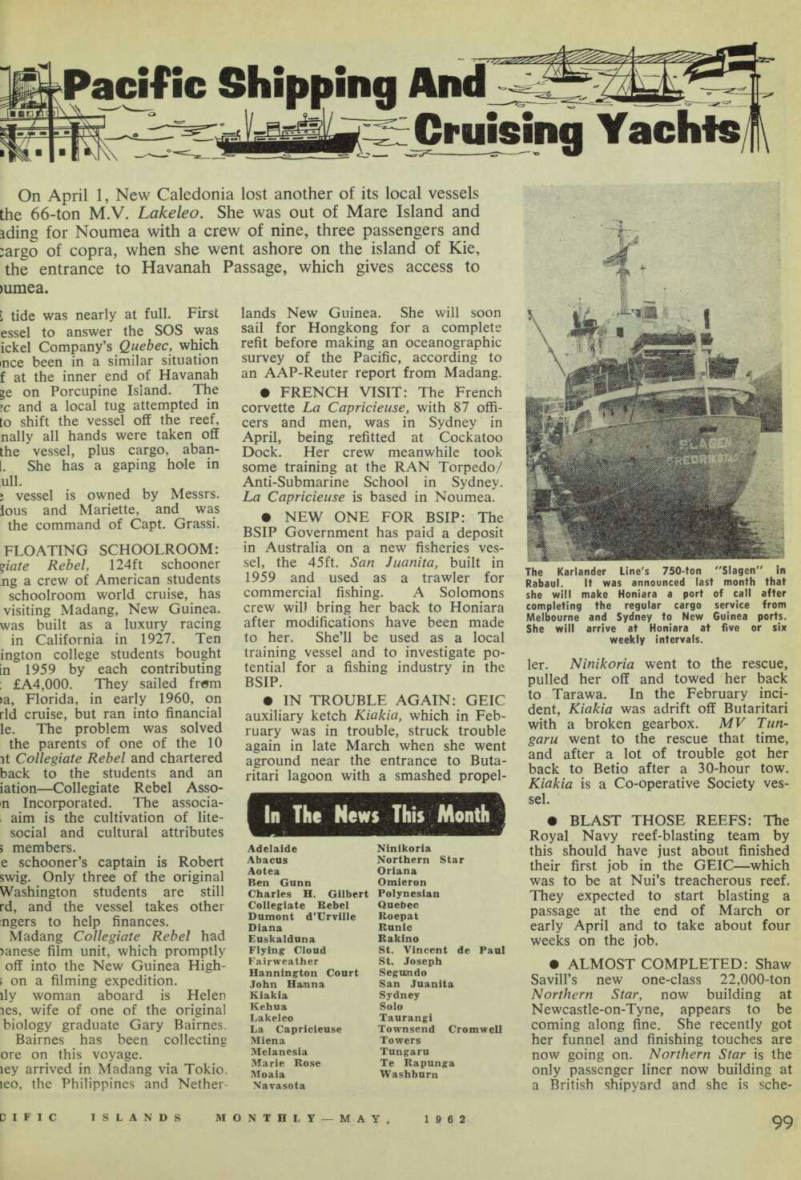
The Karlander Line's 750-ton "Slagen" in Rabaul. It was announced last month that she will make Honiara a port of call after completing the regular cargo service from Melbourne and Sydney to New Guinea ports.
She will arrive at Honiara at five or six weekly intervals.
to sail from Southampton on 10, and arrive at Australian in August.
Conversion Job: Hmas
y has now been converted an aircraft carrier to a fast transport and will take to the sea in exercises in her new or the first time in May. She’ll t for about 10 days.
BSIP WHARVES: Money has granted for the extension of Vuki wharf, BSIP, and grants been promised to BSIP Local rnment Councils to meet cost nstruction of wharves at select aces throughout the Protector ccording to an official announce from Honiara. The new /es will be sited in areas with lerable copra potential, so that ig can be centralised there for ing to the main copra export ;s. Total cost of the deep-water planned for Honiara (at pre there is merely a stub wharf) :imated to be about £165,000.
Government is attempting to :e it now, and has warned the iber of Commerce that its con ion would almost certainly an increase in port dues. The iber gave the go-ahead never is. It wants that full-scale
Captain Legras Bows
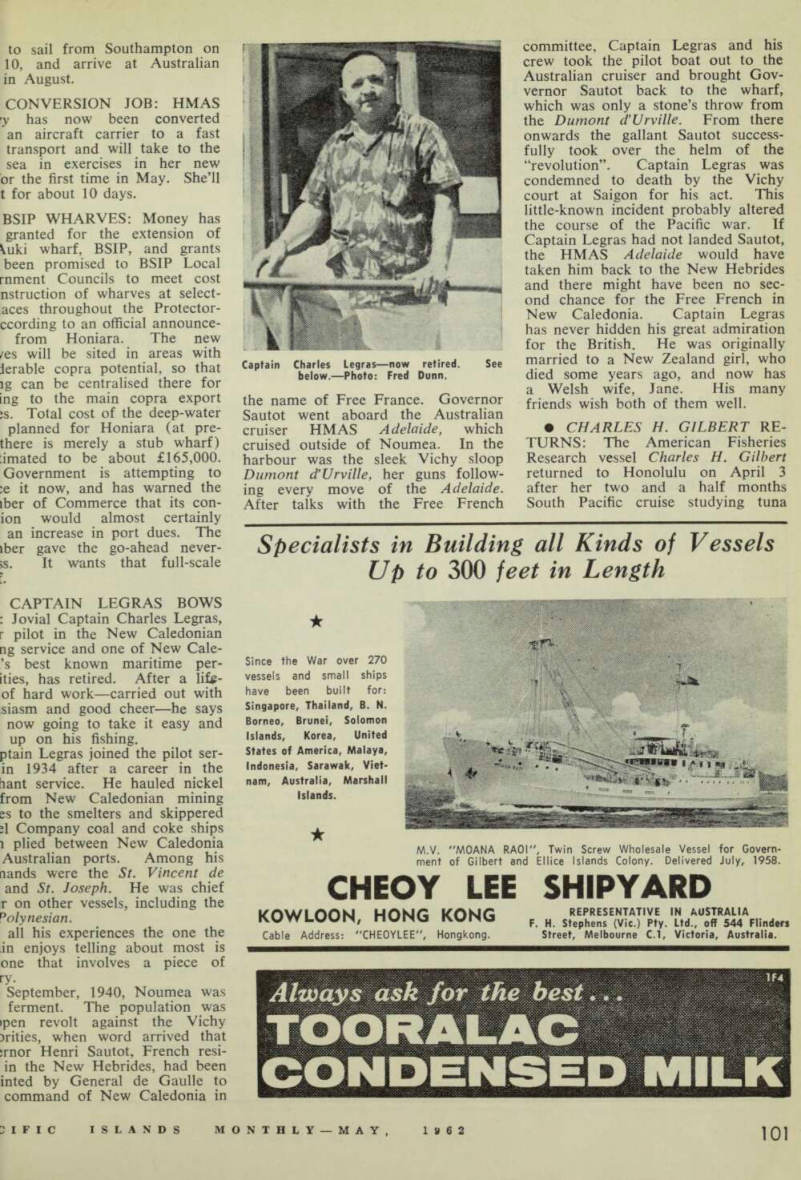
: Jovial Captain Charles Legras, r pilot in the New Caledonian ng service and one of New Gale ’s best known maritime per ities, has retired. After a life of hard work—carried out with siasm and good cheer—he says now going to take it easy and up on his fishing, ptain Legras joined the pilot ser in 1934 after a career in the tiant service. He hauled nickel from New Caledonian mining es to the smelters and skippered il Company coal and coke ships i plied between New Caledonia Australian ports. Among his aands were the St. Vincent de and St. Joseph. He was chief r on other vessels, including the Polynesian. all his experiences the one the in enjoys telling about most is one that involves a piece of ry.
September, 1940, Noumea was ferment. The population was ipen revolt against the Vichy irities, when word arrived that ;rnor Henri Sautot, French resi in the New Hebrides, had been inted by General de Gaulle to command of New Caledonia in
the name of Free France. Governor Sautot went aboard the Australian cruiser HMAS Adelaide, which cruised outside of Noumea. In the harbour was the sleek Vichy sloop Dumont d’Urville, her guns follow ing every move of the Adelaide.
After talks with the Free French
committee, Captain Legras and his crew took the pilot boat out to the Australian cruiser and brought Gov vernor Sautot back to the wharf, which was only a stone’s throw from the Dumont d’Urville. From there onwards the gallant Sautot success fully took over the helm of the “revolution”. Captain Legras was condemned to death by the Vichy court at Saigon for his act. This little-known incident probably altered the course of the Pacific war. If Captain Legras had not landed Sautot, the HMAS Adelaide would have taken him back to the New Hebrides and there might have been no sec ond chance for the Free French in New Caledonia. Captain Legras has never hidden his great admiration for the British. He was originally married to a New Zealand girl, who died some years ago, and now has a Welsh wife, Jane. His many friends wish both of them well.
• Charles H. Gilbert Re
TURNS: The American Fisheries Research vessel Charles H. Gilbert returned to Honolulu on April 3 after her two and a half months South Pacific cruise studying tuna
Captain Charles Legras—now retired. See below.—Photo: Fred Dunn.
New Caledonia, Fiji, the Islands, Tonga and Samoa. The of Commercial Fisheries re that the Charles H. Gilbert’s “aroused wide interest and mch Press and radio comment South Pacific. Recent develop in such places as Samoa and ;w Hebrides have made the rs aware of the economic po of the fishery resources around awhile, the Bureau announced il that a new oceanographic Series research vessel to be uring the year for the Bureau be named the Townsend >ell, after a Bureau oceano r who made important contri ; to scientific knowledge in ;ntral Pacific, and who died air crash in 1958, aged 35, on his way to join another ion to the Equatorial Pacific.
Commodore Retires:
odore of the Orient Line fleet, odore A. E. Coles, at present imand of Oriana, will retire Oriana arrives in Southampton n May. He obtained his early lining with the Mac Andrews id won his Master’s Certificate 6.
Believe It Or Not: The
ifficial News Sheet reported in the story of a guided vessel, a canoe which belonged to a : in the village of Posarae, ul. The teacher had left the in his village after he was ed on Gatokae, at the south- „ i end of the New Georgia 150 miles away across the sea. While he was away the was borrowed without permis y a man who anchored it one and found in the morning that gone. It was not seen again he teacher, Philip Piko, was y letter that it had been lost, ee months later Piko was div i the sea near the Gatokae when a canoe came drifting is him. He swam to it and it was his own canoe with a paddle and other things which >een left in it when it broke Added the News Sheet: “Piko fery upset, because the canoe pparently sought him out of its volition and he thought it might been guided by an evil spirit >e a forecast of a disaster for If or his family. But he has lad the canoe for seven months so far nothing untoward has ned.”
TUNA SUCCESS: It’s taken est of the Pacific a long time
to get started after the Japanese led the way, but apparently there is going to be money in tuna fishing for others as well. With the first eight weeks of the South Australian tuna season producing a catch nearly double that of the same period last year, the Australian Minister for Primary Industry, Mr. C. F. Ader mann, described on April 3 the Aus tralian tuna industry’s progress as “astonishing”. He said that South Australia was now the largest pro ducer of Australian tuna, having overtaken NSW. The Australian tuna industry began in the early
1940’5. Tuna is fished off the Southern coast of NSW from Aug ust to January and off South Aus tralia from January to May. There is a demand for all the tuna Austra lia can catch, said Mr. Adermann, and already it was one of Australia’s most rewarding fisheries. A market for Australian frozen raw tuna has developed in the US.
New Guinea people will hope that that territory will be allowed to take part in this “astonishing” progress, and many people are awaiting with interest the report of Mr. John van der Meulen, lecturer in agricultural
ng at the University of New 1, Armidale, NSW, who began reeks’ tour of P-NG in early to investigate increased fishing ities, including hopes for tuna, s reported to abound in the ET the Milne Bay area of
Merican Visit: The 20Th
celebration of the Battle of al Sea brought four American nd 1,000 US Navy men to ia this year. Each year the ans visit Australian ports for ined celebration of the occa len Australian and American from May 4-8, 1942, stopped icmy advance through the Pacific. Guest of honour at ;ar’s celebration is General O’Donnell, Jr., Commander t of US Pacific Air Forces. iur ships, all from the US Fleet, are the guided missile ;r USS Towers, the submarine egundo, the fleet oiler USS ia and the attack cargo ship dshburn. The ships are visit en ports. The submarine has redited with capturing a Jap submarine only a few days World War II ended. The an attack cargo ship, in case n’t know, is to provide equip veapons and food to amphibi iops during an assault.
Iechanical Problem:
o you land a crate weighing 5 from a ship anchored in the when the biggest crane avail n shore can lift only seven This was the problem con g the BSIP Ports Authority the MV Roepat arrived at a. The crate contained a [or the Honiara power station, a’s power consumption has Towing at the rate of 16 per year and by the end of 1962 a’s present four generators ve reached maximum capacity, ifth is therefore needed ur answer to the freight problem, ked out by Ray Murdock and Dowling of the Ports Auth :n conjunction with Don Saun- Lon Davies and Bert McGregor, D, was to use a steel landing which had been quietly rusting on the beach for many years. was repaired, strengthened, rutted, to receive PWD’s big eled trailer—minus its front wheels, which could not be to fit snugly into the bows. barge with the trailer inside wed to the ship, and the ship’s o” gear lowered the big box lace on the trailer. The barge
was then towed under the seven-ton crane on the wharf, and the front end of the trailer was lifted (with some effort) high enough for the bogie wheels to be replaced, together with a wooden ramp which now projected over the bows.
Next, the barge was moored bowson to a small stone jetty and a PWD “Traxcavator” made fast a heavy towing wire to the trailer. As the trailer was pulled forward in the bows, the altered trim craftily lowered the ramp down on to the jetty, and the trailer with its 15-ton burden rolled ashore.
There was one anxious moment when the rear wheels looked like
bogging down in a soft patch at the shorewards end of the jetty, but an extra heave pulled the rig clear and the big box was safely on its way to the power station. Exercise complete. No errors. Full marks, • FATE OF RUNIC : Shaw Savill line officials said in Sydney in April they expected to announce soon the fate of the 13,000 ton, £2i-million, freighter Runic, which has been aground on Middleton Reef, 120 miles from Lord Howe since Feb ruary last year. Efforts to salvage her failed. At one stage a boarding party camped in her, hoping to cash in, but they were unsuccessful, and
Yachts At
Auckland
Photographed in Auck land recently were these groups. Top picture shows the "Taurangi", 42 ft ketch, built by three young men at Invercargill. On the outside is "Ben Gunn".
See p. 113 for details of both. In the centre is Captain Hank Horn, with his daughter Nathalie (Niki) in the cockpit of "Ben Gunn". Auckland waterfront audiences were intrigued at Niki's agility in shinning aloft to give Dad a hand. Bottom is "Fair weather", US schooner which was expected to sail north to Hong kong in April. In port at the same time was "Yankee Doodle", which later sailed with "Ben Gunn" for Whangarei.
December Shaw Savill called for her disposal. Shaw Savill ms her, but an option taken her purchase, presumably as was expected to come due in when a decision would be 3ne way or another.
Lore Miena History:
I. Carfax-Foster, of Nadi, Fiji, etails in the January shipping i of some of the wartime ex es of the trading schooner (still featured on the BSIP’s tip) he started something. Mr. -Foster was the skipper of the during one of her wartime The present owner of Mr. J. W. R. Richmond, of lortlands, wrote to us last (April, p. 109) and reported iena was up for sale and still lot of fight left in her. Now e a note from Alan Reynolds, Russell Street, Oatley, NSW, fas skipper of the Melanesia she and the Miena got into together in NG, Mr. Rey recollects that the Melanesia lena were anchored at Douglas ir, when three Jap planes the camp ashore. When they icy flew low over the two ind “the fire from Miena and f sia definitely hit one plane,
which started to falter and fall. But later it picked up speed and depart ed.” The Miena left for Morobe the same day and an Australian army ship joined Melanesia at anchor. The next morning 13 Jap planes strafed both ships; the Army trawler caught fire and sank and the Melanesia had to be beached. She was salvaged later. Mr. Reynolds had taken over Melanesia from Mick Gunning, who had brought her from Sydney. Af ter the war he took over the Marie Rose (later changed to Kokoda) from Bob Cruickshank, and later he worked Tol Plantation, New Britain.
From Sydney he is very happy to hear about the old timers through
Pim.
• No Fun In China: There
was an unusual spot of waterside trouble in Sydney in April when half the crew of a British ship walked off and refused to sail for China with a load of wheat. They said they were fed up with trading to Communist-controlled ports, that the authorities in these places used pin pricking tactics against them, and there were no facilities ashore for relaxation. —(Over)
NE. Two well known craft in Fiji re the "Vuniwai" (Medicine Man), and
gi-Mai-Ra" (Southern Breeze). The
(top picture) is a ketch operated Medical Department and which trans ersonnel and medicine to virtually pulated island in the group. The i-Ra" is the official Government vessel Commissioner Eastern and plies regu the waters of Macuata and [?]e provinces carrying Government She was built by the Public Works ent in Suva.— Photos: Rob Wright.
officers, six seamen and four boys from the Hannington were involved in the walk-out. as one maritime incident that jd-controlled Australian Sea- Union ignored—a spokesman i effect, that they didn’t be —taking the view, apparently, very good unionist seaman love to go to Communist adults amongst the walk-out vere charged before a Sydney and sentenced to a month’s though the Radio Officer was aken in custody back to his id made to sail with her, (Un tion 223 (4) of the Merchant ig Act, shipowners can apply indispensable member of a ) be returned to his ship even s serving a prison term.) ;her old friend who has been something of Communist ports y —but without any tantrums im Shortall, ex-PIM shipping ondent, now on a ship trading Tokyo. las been to Whampoa, on the River 10 miles below Canton, 3 Campha, North Vietnam, s a lot to say about both which will be interesting lly to Viets in New Caledonia e New Hebrides, writes: “A few miles below 3oa we were boarded by a of police and Customs; the as searched pretty thoroughly e Chinese aboard were separ
ately cross-examined—all of which took about two hours. We then moved to our berth.
“I went ashore twice while we were unloading our phosphate, but there is little to see. There is a gloomy seamen’s club and store— full of art treasures probably owned by the wealthy class once, but now for sale to foreign seamen.
“I also walked a mile up the road the chief engineer, but everyone shies clear of foreigners, and there is no possibility of speaking to any one even if he can speak English.
The only people who spoke to us were the attendants in the club, and then they would discuss only the price of goods.
“The river traffic is exceedingly interesting . . . but there is no town at all at Whampoa. There is no private enterprise since the Com munists took over and what were once stores are now used for hous ing people. Everything is rationed and issued from government ware houses. There is nothing to see in the way of shops, no places of enter tainment and, apart from lorries, no cars at all except for a few for Government officials.”
Of the visit to Campha, Jim Shortall says: “We picked up the usual pilot and police off Haipong and proceeded along the coast through a maze of over 1,000 rocky islands—one of the great sights of the Seven Seas I should say and a potential tourist
ntinuing growth of Rabaul as a port of commerce was typified in April when no an five ships were being worked simultaneously at the wharf. Ships in the picture om left, "Cedarbank", "Sungei Bila", "Malacca" and (bridge visible at right) A touch of drama was provided when the latter two vessels had a neck-and-neck Simpson Harbour for the privilege of berthing alongside. "Malacca" won but then stole a march by berthing before her at 6 a.m.—only to be moved in nce with the "first come, first served" principle applying to non-trunk vessels.
delight—but our cameras wer locked away, so no photograp “We loaded coal from the cut mine near Campha and il women who came aboard to it in the holds—a tough, dust that must be hell in summer.' Vietnamese seem nice people a least haven’t yet forgotten he smile, as seems to be the ca Whampoa.
“Campha is a poor place again there is nothing to see a The shops have been shut dowi converted into dwellings, only a area is accessible to foreign s< and notices everywhere in s languages warn you off.
There is a so-called sea club, which is really a \ ganda centre full of Comr posters and literature. You cai a cup of tea or a bottle of but no one will speak to you. simply put up with us because need to export their coal and have no ships of their own to with.”
• “Caution” On
Some practices in marine pa being followed overseas shoul “viewed with caution”, accordi Mr. Michael Moore, senior cl of the Red Hand Compositions a subsidiary of Taubmans Indi Ltd., Australian paint mai turers. Mr. Moore, who re returned to Australia after vis England and the USA, said a in many shipbuilding and firms was to use two coats (p and finish coat) instead of a n four coats. He felt this was mature. “It is extremely doul he said, “that formulation of n paints has anywhere progress( the stage where a manufacture safely claim that two coats wil adequate protection without the for more frequent recoating”.
9 All For
Home to Rabaul with a big gri some brand-new qualifications i pocket is diesel engineer Pang Wai—“Pang” to all those wh( to sea in (sometimes) limping Pang, who gained his Aust naturalisation at Christmas, ha years wanted to go to Sydne the purpose of attending an ir fied course in high-power engini Pang’s chance came early this after his naturalisation as an tralian when he hied himself t huge marine engine workshop Ferrier & Dickinson.
As a result of his studies is now qualified to work on er up to 480 bhp, including the high speed up to 200 bhp m
Mission services and NG Ad ation are installing in their experience he has gained south ortant both to Pang and his for he numbers among his cus more than 50 vessels stretch m Manus in the north to BSIP south. in Rabaul, Pang is one of brothers all of whom were to labour for the Japanese the World War II occupation, aps his best-known brother is her “Pang” (Edward Pang Shing) whose unruly forelock or years been the most ent feature behind the bar of ’s New Guinea Club, ng the Pang family on strength idently no sinecure for Nip id it’s debatable whether the g paste Pang I put in their engines’ sumps or the other ionable substances Pang II their rice (he was impressed )ok) did the greater harm to orale. war’s conclusion Pang gave away for a time and took a fitter and turner with Admin.
Department, Then he teamed le Director of Shipping for ars, after which he launched his own. d what he liked about Aus- Pang said without demur: riendliness of the people. I stay home watching TV—I it to meet and talk to people, w many of the big factories ejects, including the Warra dam. Everywhere I went made me welcome.” e leaving Sydney Pang took * give the right steer to two Rabaul-Chinese who have
joined F & D’s upon leaving school as diesel engineer apprentices.
They are Stephen Chow (brother of Rabaul shipwright Henry Chow) and Ludwig Leong, son of F. L.
Kwock Cheong.
Both are fine lads, and according to Pang, are doing splendidly.
“I only wish a few more of our boys would settle down to learning a trade in Australia while they have the chance,” Pang said. • UNDER ARREST: The British Resident of Tanna in the New Heb rides, detained a Chinese fishing boat in April when it was found to be trochus fishing off Aneityum. The Resident, Mr. H. Wilkins, was on a
voyage of inspection when he sighted the vessel, which was from Formosa.
The crew offered no resistance and a guard was placed aboard the ves sel. For good measure Mr. Wilkins took part of the motor. The Con dominium decided that the vessel had to be taken to Vila to be searched and six French naval ratings under an officer were flown in from Nou mea to take the vessel to Vila. It was expected that the cargo would be seized and the vessel escorted out of New Hebrides waters and forbid den to return. Before the war the law was read differently. On a couple of occasions both the cargoes and ships were seized and sold at auction. —(Over)
in typical pose—working on one of is well-loved Gardner engines.