How Right Was John T. Lang?
pp. 87-89 · Read in the full issue
For those concerned with human progress, the develop ment of Western civilisation, and the uncompromising struggle between individualism and totalitarianism, there is no more fascinating subject than that of international finance.
MONEY originally was designed as a medium of exchange. It was based on the value of gold, because in the course of ages gold has become established as mankind’s precious metal.
Within the last hundred years or so, two things of international sig nificance occurred to dislocate the world’s money system. The first was the gradual appearance of a class of people whose business it is to control
the world’s money system for their private profit. The second was that two World Wars forced the world’s currencies off the gold basis, and permitted “inflation” on a scale never dreamed of in the 19th century. In flation, in turn, enormously expanded and strengthened the finance empire controlled by the money barons.
As our international money system was the backbone of our Western civilisation, and as the inflationary processes apparently cannot be halted, there are those who argue that the Western system must collapse, and will be replaced by totalitarianism in some shape or other—probably, Muscovite Communism. Those who live for another 20 or 30 years prob ably will know the answer.
Students of such subjects will be
deeply interested in a new book, The Great Bust, by J. T. Lang, former premier of New South Wales. This is the second of three books in which one of Australia’s most doughty political fighters describes what he says are the causes of the 1891 and 1930 Depressions, and how and why he took up arms against the money barons.
In his first book, / Remember, published two or three years ago, Mr. Lang began the story of how he entered Australian politics and be came a Labour leader. In the present volume the causes of world depres sion and of the acute financial em barrassments of New South Wales are outlined; and it is shown that these evils came to a head just as Mr. Lang became the State’s Premier, over 30 years ago.
"Repudiation"
The 1930 Depression deprived the State of so much of its ordinary revenues that it could not meet its current obligations, so long as those obligations included the transfer over seas of some millions of pounds to pay annual interest on overseas loans.
Mr. Lang claims that his choice was either pay the overseas money barons, or repudiate the loans, retain the money and feed the countless un employed.
In defiance of the Commonwealth and all the other State Governments, he chose “repudiation” and, by measures then without precedent, was dismissed from office by the Gover nor. In a general election, Mr. Lang’s policy was overwhelmingly rejected, and the bondholders were paid.
The uproar split the Australian Labour Party—the issue was “Is Lang Right?”—and destroyed the State Savings Bank.
This volume stops at the point where Mr. Lang is at grips with the Commonwealth Government and the banks. Next volume presumably will describe the downfall of his State Government, and of how he carried the war into the Commonwealth Parliament.
In The Great Bust, Mr. Lang opens only a little window on a very wide and tortured world. But he tells a
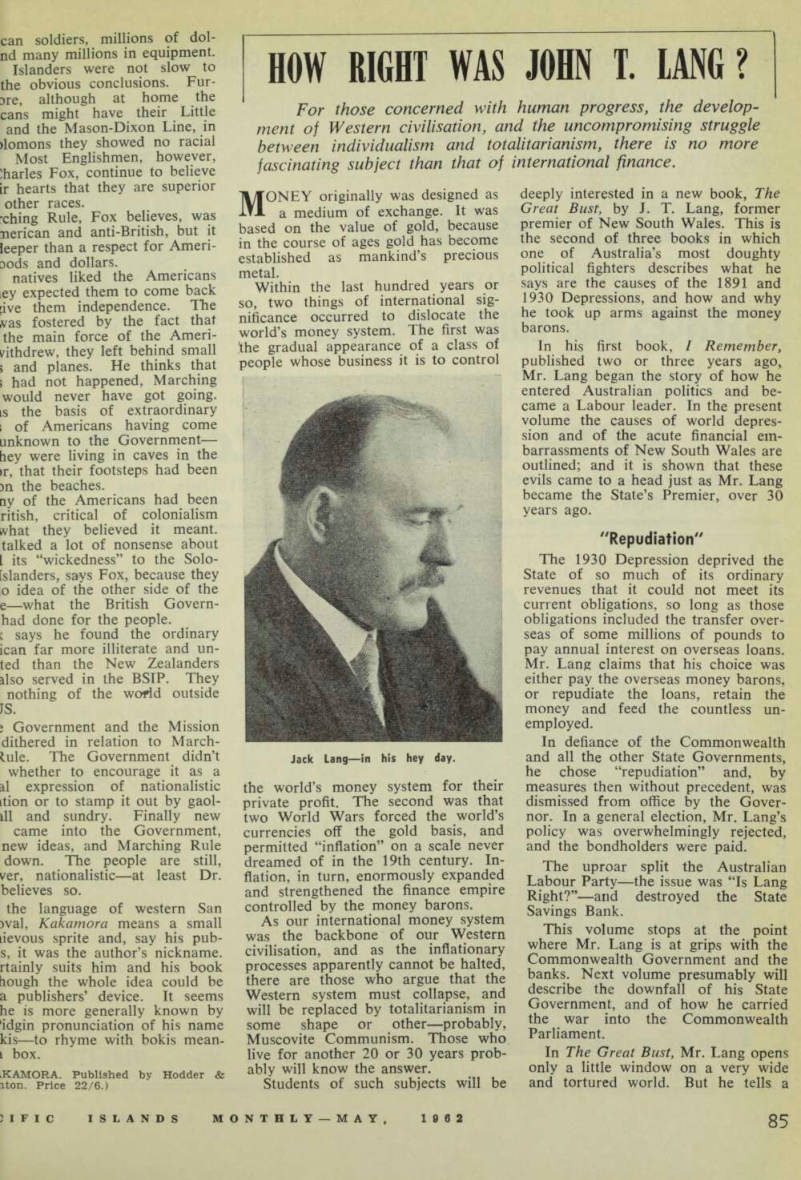
Jack Lang—in his hey day.
hat is strangely significant; and ;s it with a forthright honesty, :ountless bright memories of •rgotten politicians, and with a of literary skill that make the ok (over 400 pages) a pleasure 1 Australian newspapers, and the ibour commentators, tied many
tin kettles to the tail of the rebellious Mr. Lang in the ’Thirties. Now Mr.
Lang, with great heartiness, reverses the process. Here is real entertain ment, plus a lot of politico-economic instruction, for the average reader.
R.W.R.
(THE GREAT BUST, by J. T. Lang.
Published by Angus and Robertson, Sydney. 38/6.)