An Octogenarian Sprite Makes
pp. 85-87 · Read in the full issue
The Month's New Reading
With Judy Tudor
An Octogenarian Sprite Makes The Solomons Look Easy
Obviously in the view of many people, the life of Charles ox has been extremely eccentric. But out of his years of :rvice in Melanesia, he has evolved the right recipe for success il missionary service: He has identified himself 100 per cent, ith the native people.
IS year of 1962 is an important one in the life of the Rev. Canon •les Elliott Fox, MBE, MA, D he completes his 60th year ie service of the Melanesian Mis and there must have been very missionaries either in or out of jwn Anglican church to have put such a cricket score, arch, the same month that Dr. celebrated his Diamond Jubilee, also the publication of his book
QYYiovciy within whose sprightly
;s lie the formula for his suc e has written other works— e, learned tomes on Solomon ids languages and culture—but one is something different, a onal account of his long years ing the Melanesians of the SW ific. In it he displays a pixie wit, lown-to-earth knowledge of the pie of the Islands, and a robust >yment of life as* he chose to it.
Charles Fox joined the Melanesian sion from New Zealand —accordto a photograph of the time, as mall dark man with a moustache a cloth cap. The Melanesian ision school was then at Norfolk nd and he went there as a dier in 1902. In the following r he was ordained and spent some e in the Banks Group.
Je went to the Solomons, to San stoval, in 1908 and later began a 00l there and remained for 15 irs. 3 eople and languages always m ;sted him—he compiled a diction ’ and a grammar of the western i Cristoval language and for some ie lived with the villagers, having names” with a young ef called Takibaina.
With the name change went some the obligations and the debts and ; problems of being a Melanesian. ;ars later, when he revisited the lage where he had lived, the chief
was dead. He was taken to see the grave, where they had set up a cross, with the words: Charles Fox, Died June 15, 1919.
Fox describes the life he lived with the villagers, how at night they would lie down on the beds of slats made from betel-nut palm with their lap-laps spread over them. “About four in the morning, when the first cocks crow,” he says, “ a cold wind would come along the river valley and some or all of us would wake. Be tween each bed was a small fire but the fire had long gone out. Some one would blow on the embers until the house became bright with the blaze, and all of us would cluster
round it and have a smoke. At such times they would chat freely about all sorts of things. Usually I would simply listen, sometimes catch ing a word I did not know, making a mental note of it, and asking the meaning later in the day.”
At one period of 11 years he was a member of the Melanesian Brother
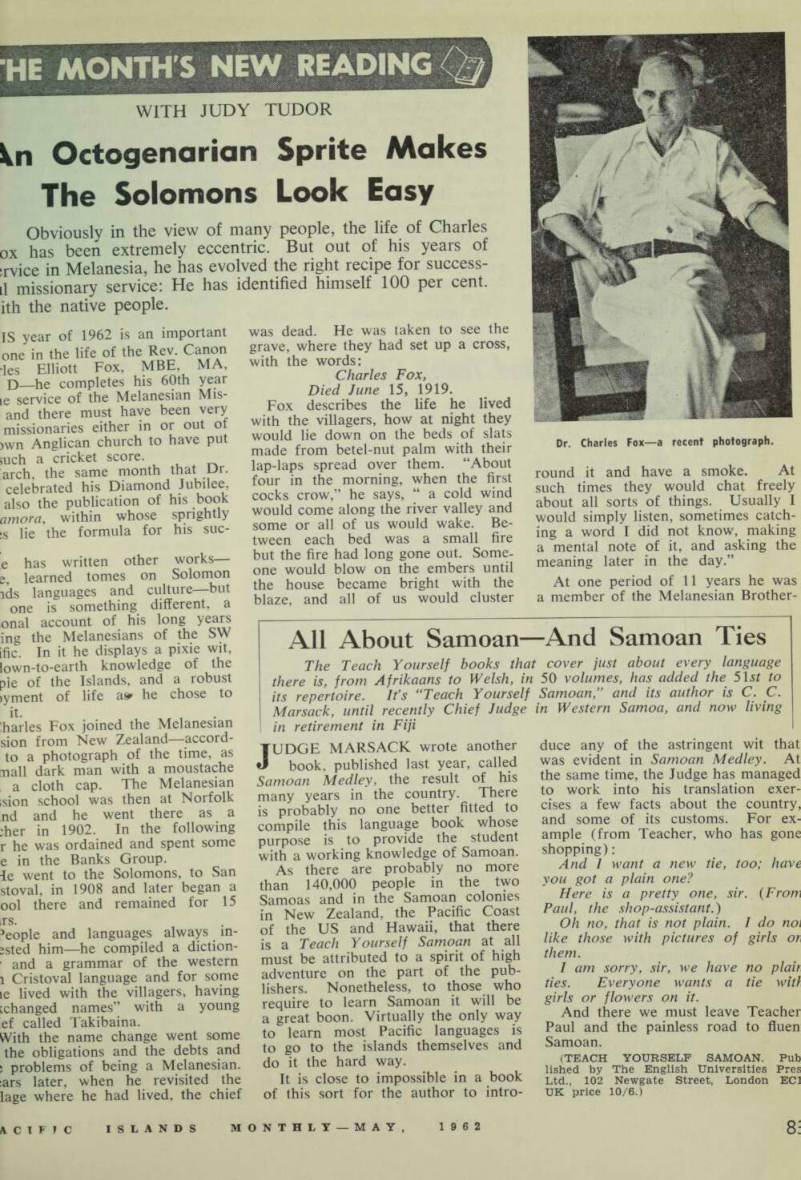
Dr. Charles Fox —a recent photograph.
hood, the only white man amongst 100 Melanesians, wearing their dress of loin-cloth and sash and working under the leadership of a Guadalcanal native.
Fox has many entertaining stories of Bishops and lesser clergy. At one time he set a Bishop and his chaplain (just out from England) to walk across San Cristoval, a journey that took the nimble Fox four hours.
The Bishop and his Chaplain took 10, at first in their new brown shoes, but later without—which was worse.
When they came to the last descent, of rough mountain scoria, the Bishop’s feet were not up to it. He sat down and slid.
“This removed the part of his pants
he was sitting on,” records Fox, “and it was very embarrassing because at the bottom was the village, two rows of houses at right angles to the sea, and the people standing at the doors to welcome him, and he was not in a fit state to be seen. Hold ing on to what was left, he trotted steadily between the people, straight into the sea, and sat down in the water. The village teacher approached him nervously.
“ ‘Father, the people are all wait ing to shake hands.’
“The Bishop replied, ‘Tell the people to go inside and shut their doors and the Bishop will come out of the sea,’ ”
On another occasion, in his earlier
days on San Cristoval, he an archdeacon—also fresh out fi England—to accompany him or peace mission to a hostile mounl chief. It was raining in torrents Fox and the archdeacon took I everything but their boots and g their clothes to two lads to ca At one point they came to a stn and there was no way to cross except by a convenient branch o tree. Fox went across upright the archdeacon crawled. “It ’ quite a new sight to me,” he si “A tall archdeacon with nothing about 10 feet above my head, cn ing along a slippery bough \ somewhat the motion of a la white caterpillar, and with a I of horror on his face. The lei clergy should not see these thing!
But worse was in store. As t approached the village, Fox sugges that as the chief was expecting high dignitary of the Church t should put on their clothes forthw to make a good impression. T] it was found that the boy who ] been carrying the archdeacon’s clot had beat it back to camp. There i nothing to be done except wrap archdeacon in a large bath towel.
“He wrapped it round him gloc ily and we went on. . . . The cl was sitting on a kind of dais, v some minor chiefs around him, i as we came in he looked very h; at the archdeacon. Of course, was expecting something unusual, even so he seemed surprised, spoke to me in the native tongi ‘ls that an archdeacon?’
“‘Yes,’ I said, keeping carefi to the native tongue. ‘They alwi dress in a special way.’ Which course is true enough.”
Marching Rule
Towards the end of his book I Fox gives one of the clearest ( planations that have been made the effect of the war on the Solom Islands natives and the nationalis movement that later developed Masinga Rulu or Marching Rule.
At the beginning of the war th( were, all told, a few hundred Eui peans in the Solomons. The worn were evacuated, the men who we left took to the hills in the face the Japanese invasion. They had profound influence on the peof immediately around them, and lat when coastwatching and other scoi ing services were required by ti Americans they played a big p£ in the war. But when the Ja invaded they were powerless.
Later came the American count invasion and with it thousands i
can soldiers, millions of dol nd many millions in equipment.
Islanders were not slow to the obvious conclusions. Fur 3re, although at home the cans might have their Little and the Mason-Dixon Line, in fiomons they showed no racial Most Englishmen, however, Charles Fox, continue to believe ir hearts that they are superior other races. •ching Rule, Fox believes, was nerican and anti-British, but it leeper than a respect for Ameri aods and dollars. natives liked the Americans icy expected them to come back ;ive them independence. The vas fostered by the fact that the main force of the Ameri yithdrew, they left behind small 5 and planes. He thinks that 5 had not happened, Marching would never have got going, is the basis of extraordinary i of Americans having come unknown to the Government — hey were living in caves in the ir, that their footsteps had been )n the beaches. uy of the Americans had been ritish, critical of colonialism ivhat they believed it meant, talked a lot of nonsense about I its “wickedness” to the Solo- Islanders, says Fox, because they 0 idea of the other side of the e—what the British Govern had done for the people, [ says he found the ordinary ican far more illiterate and un ted than the New Zealanders also served in the BSIP. They nothing of the world outside IS. 5 Government and the Mission dithered in relation to March lule. The Government didn’t whether to encourage it as a al expression of nationalistic ition or to stamp it out by gaol ill and sundry. Finally new came into the Government, new ideas, and Marching Rule down. The people are still, ver, nationalistic—at least Dr. believes so. the language of western San aval, Kakamora means a small lievous sprite and, say his pub s, it was the author’s nickname, rtainly suits him and his book tiough the whole idea could be a publishers’ device. It seems he is more generally known by 'idgin pronunciation of his name kis—to rhyme with bokis mean -1 box.
IKAMORA. Published by Hodder & iton. Price 22/6.)