On Hat Island?
p. 79 · Read in the full issue
aid What Of The Treasure On Hat Island?
From Capt. S. B. Brown, in Suva.
Recent reports of the sale of Vatu Vara, or Hat Island, in ;o an American syndicate by agents Tennant & Co., of Suva, renewed conjecture as to the existence of treasure on the i. The previous owner was Jim Kerrigan of Suva.
RIFS of the treasure have een varied but persistent >hout the years. “Authentic” ; I have heard claim the owner : treasure as any one of a not number of navigators that have sed the Pacific, including Ma and “Bully” Hayes, vever, a pattern does emerge among the many stories and Is, which tells of the arrival of men who did have treasure with The story is also told by old s from the neighbouring island cata, and has been investigated •. A, G. McCown, of Levuka, : men arrived when a three -1 barquentine was wrecked on
the island during a hurricane. (Other reports say the men arrived in a longboat after the barquentine was wrecked at sea.) The remainder of the crew were rescued and taken to Suva. The men brought chests ashore which were buried on the island.
One man, Thompson, was said to have killed the other two and was then rescued from the island and eventually returned to the U.S.A.
He stayed away for some years, dur ing which a series of hurricanes caused much damage to the island through landslides and erosion. When Thompson returned to Fiji he went to live on Vatu Vara in company with a Line Island woman, the name that was often used in those days to denote persons of the Gilbertese race.
Thompson was said to have be come a religious fanatic and never subsequently left the island, although he did tell the woman the story of the treasure and of how he had killed his two companions. He would never allow any Fijians to land on the island because of the treasure.
He became very ill, but still would not allow the woman to get assistance or to leave the island.
When he died he was buried under the beaten earth floor of the house, as the woman was unable to carry the corpse outside. She became demented and was finally taken off the island by a passing copra trader.
After treatment in Suva she re covered and is alleged to have told her story.
Over the years there have been several attempts to locate this buried treasure without success. One at tempt was made by Mr. McCown.
I have heard several variations of this story, one being that “Bully”
Hayes buried treasure on the top of the island—which would have been some climb! Even now the story is being added to. One theory that I have heard recently is that Chris.
Legge, recently retired Commission er, Eastern Division, who made a long and involved study of early Fijian history, came across evidence of the existence of the treasure and when he retired to America formed a company to buy the island.
This story will no doubt amuse Mr. Legge if he still sees PIM in America.
There appears to be no evidence that a barquentine has ever been wrecked near the island.
The new owners of Vatu Vara have not yet visited the island and it is unlikely that buried treasure was the reason for its purchase.
The island lies about 135 miles east-north-east of Suva. It is steep to the fringing reef and a partial barrier reef enclosing a small lagoon drops almost perpendicularly into deep water and offers no anchorage to ships. In rough weather there is no lee as the swell works round the circular coastline. There is no passage into the small lagoon that it suitable even for boats.
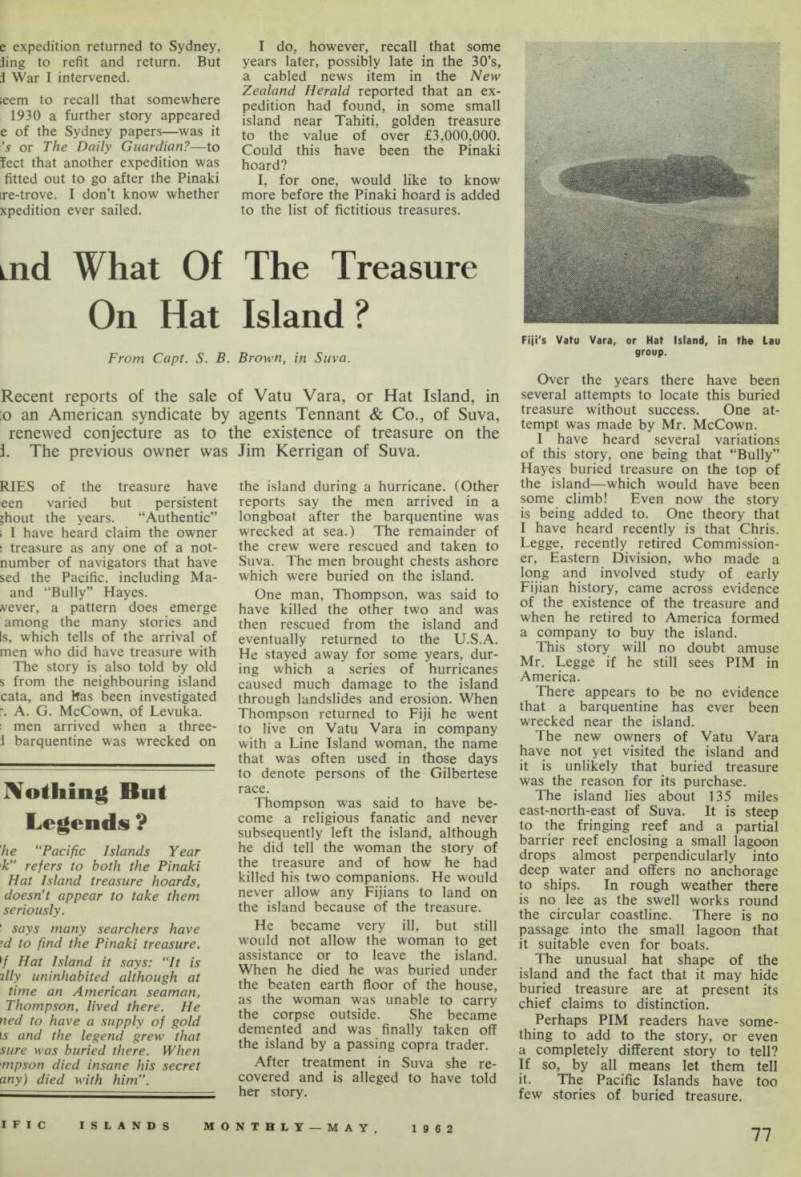
The unusual hat shape of the island and the fact that it may hide buried treasure are at present its chief claims to distinction.
Perhaps PIM readers have some thing to add to the story, or even a completely different story to tell?
If so, by all means let them tell it. The Pacific Islands have too few stories of buried treasure.
Fiji's Vatu Vara, or Hat Island, in the Lau group.