Magazine Section
pp. 75-77 · Read in the full issue
Pacific Islands Monthly
The Strange Case Of The Pool Of Death
By "Dr. Watson", in the "Melanesian Messenger".
In the year 1899 I chanced to meet a missionary from the savage Solomons, and told him of a visit Sherlock Holmes and I had paid to that strange group a few years before. He was interested and asked me to write down the story of our visit in simple English that the Islanders could read. I fear I have not been able to do this as he would have wished. Here, however, is the story.
iRLOCK HOLMES had been very seriously ill, worn out by following case, most of them [ers he had indeed dis ed the criminals, but at a terrible to his own health and strength, olmes,” I said, “you must take ig holiday, six months at least, wise you will break down.” nd where does Dr. Watson sug [ should go?” said my friend, lon’t know why, but suddenly the nons came to my mind, prob as furthest away and least sed.
Til you go with me?” said les. f course I will, my dear fellow, must have a doctor with you.” was settled, month later we went to Sydney n Orient steamship, and after a there of a few weeks took ship small Burns Philp steamer lling horribly of copra), and in ays came to Tulagi, the seat of rnment of the Solomons, indeed capital, consisting of one Euro house on a hill, in which the lent Commissioner lived, with native police to assist him.
The Resident Commissioner was Mr, Charles Woodford, a big black bearded man and an excellent naturalist, with whom Holmes found much common ground. As for other Europeans in the group there were a few traders, planters, and mission aries scattered among the islands. It was a wild group.
“You know,” said Mr. Woodford, “the islanders are still savages, and murder is quite common. I cannot allow you to go exploring on your own. But I am expecting any day a trader who recruits labour for plan tations.
He Lives on Ugi “He lives on a small island called Ugi, 120 miles from here, at a station called Alangaula. He is a rough fellow, but he has a very decent little partner, who keeps the station going while Roxley is recruiting labour, and I think you would be happy with him.
He is something of a scholar, who has come here to improve his health after a long illness. If you like I will speak to Roxley when his schooner comes in.”
We agreed to Mr. Woodford’s sug
gestion, and a few days later Roxley arrived.
He certainly was a rough fellow, quite my idea of a South Seas trader; and a more ugly lot of Malaita men as crew I could not imagine. How ever, Mr. Woodford assured us we should be perfectly safe with him, and as he was usually away recruiting labour, most of our time would be spent with Arthur Binton, his partner, whom we were sure to like. Holmes was already looking much more his old self and I felt quite happy about him.
In the end we made satisfactory arrangements with Roxley and set off for Ugi. The next few days, beat ing into a stiff south-east trade wind, I hardly remember, spending it flat on my back in my bunk. Holmes, how ever, seemed to enjoy it, making
Dr. C. E. Fox , at 82, is celebrating his sixtieth year i Melanesia. The famous missionary-scholar, author of "The [?]reshold of the Pacific" (1924), has just published his auto iography, which is reviewed on p.83. The following story, [?]hich he wrote under a pen-name, is a sample of his ersatility. It is extracted from "Melanesian Messenger", a elanesian Mission magazine which Dr. Fox edits.
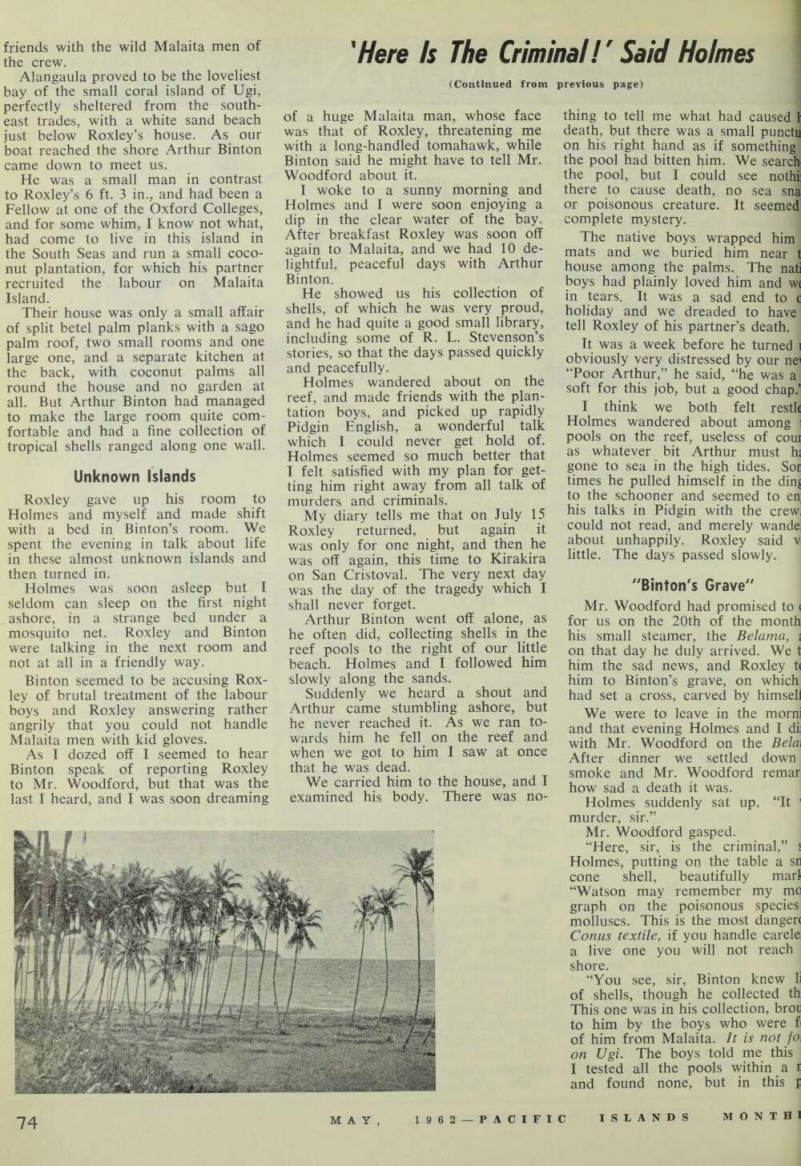
friends with the wild Malaita men of the crew, Alangaula proved to be the loveliest bay of the small coral island of Ugi, perfectly sheltered from the south east trades, with a white sand beach just below Roxley’s house. As our boat reached the shore Arthur Binton came down to meet us.
He was a small man in contrast to Roxley’s 6 ft. 3 in., and had been a Fellow at one of the Oxford Colleges, and for some whim, I know not what, had come to live in this island in the South Seas and run a small coco nut plantation, for which his partner recruited the labour on Malaita Island.
Their house was only a small affair of split betel palm planks with a sago palm roof, two small rooms and one large one, and a separate kitchen at the back, with coconut palms all round the house and no garden at all. But Arthur Binton had managed to make the large room quite com fortable and had a fine collection of tropical shells ranged along one wall.
Unknown Islands Roxley gave up his room to Holmes and myself and made shift with a bed in Binton’s room. We spent the evening in talk about life in these almost unknown islands and then turned in.
Holmes was soon asleep but I seldom can sleep on the first night ashore, in a strange bed under a mosquito net. Roxley and Binton were talking in the next room and not at all in a friendly way.
Binton seemed to be accusing Rox ley of brutal treatment of the labour boys and Roxley answering rather angrily that you could not handle Malaita men with kid gloves.
As I dozed off I seemed to hear Binton speak of reporting Roxley to Mr. Woodford, but that was the last I heard, and I was soon dreaming
of a huge Malaita man, whose face was that of Roxley, threatening me with a long-handled tomahawk, while Binton said he might have to tell Mr.
Woodford about it.
I woke to a sunny morning and Holmes and I were soon enjoying a dip in the clear water of the bay.
After breakfast Roxley was soon off again to Malaita, and we had 10 de lightful, peaceful days with Arthur Binton.
He showed us his collection of shells, of which he was very proud, and he had quite a good small library, including some of R. L. Stevenson’s stories, so that the days passed quickly and peacefully.
Holmes wandered about on the reef, and made friends with the plan tation boys, and picked up rapidly Pidgin English, a wonderful talk which I could never get hold of.
Holmes seemed so much better that I felt satisfied with my plan for get ting him right away from all talk of murders and criminals.
My diary tells me that on July 15 Roxley returned, but again it was only for one night, and then he was off again, this time to Kirakira on San Cristoval. The very next day was the day of the tragedy which I shall never forget.
Arthur Binton went off alone, as he often did, collecting shells in the reef pools to the right of our little beach. Holmes and I followed him slowly along the sands.
Suddenly we heard a shout and Arthur came stumbling ashore, but he never reached it. As we ran to wards him he fell on the reef and when we got to him I saw at once that he was dead.
We carried him to the house, and I examined his body. There was no
thing to tell me what had caused t death, but there was a small punctu on his right hand as if something the pool had bitten him. We search the pool, but I could see nothi there to cause death, no sea sna or poisonous creature. It seemed complete mystery.
The native boys wrapped him mats and we buried him near t house among the palms. The nati boys had plainly loved him and w( in tears. It was a sad end to c holiday and we dreaded to have tell Roxley of his partner’s death.
It was a week before he turned i obviously very distressed by our ne’i “Poor Arthur,” he said, “he was a soft for this job, but a good chap.’
I think we both felt restk Holmes wandered about among i pools on the reef, useless of com as whatever bit Arthur must hi gone to sea in the high tides. Sor times he pulled himself in the ding to the schooner and seemed to en his talks in Pidgin with the crew, could not read, and merely wand© about unhappily. Roxley said vi little. The days passed slowly, "Binton's Grave"
Mr. Woodford had promised to < for us on the 20th of the month his small steamer, the Belama, i on that day he duly arrived. We t him the sad news, and Roxley t< him to Binton’s grave, on which had set a cross, carved by himseli We were to leave in the morni and that evening Holmes and I dii with Mr. Woodford on the Belai After dinner we settled down smoke and Mr. Woodford remaf how sad a death it was.
Holmes suddenly sat up. “It 1 murder, sir.”
Mr. Woodford gasped.
“Here, sir, is the criminal,” s Holmes, putting on the table a sn cone shell, beautifully marl “Watson may remember my mo graph on the poisonous species molluscs. This is the most dangert Conus textile, if you handle carelei a live one you will not reach shore.
“You see, sir, Binton knew li of shells, though he collected th This one was in his collection, brou to him by the boys who were f of him from Malaita. It is not foi on Ugi. The boys told me this I tested all the pools within a t and found none, but in this p
us I found 10 living Conus e. [ow did they get there? The crew me that on his trip to Malaita ey gave tobacco for 10 live which he said he was going to to Binton. He never gave them, "e kept them in a bucket of water, and on the night he left lan Cristoval he went ashore, so rew tell me, with the bucket of ;, and then returned to the mer and weighed anchor. He Dubt put them in the pool, know linton collected there, inton had decided to report Rox cruel treatment of one of the irers, whom he flogged so severely the boy died a few days later, can easily get proof of all that re said.” :xt day we left in the Belama Tom Roxley and the witnesses les had given us. Roxley, when I with the charge had rushed ;ely at Holmes; but I was once mateur boxer of some repute, a quick left and right laid him and Mr. Woodford’s police did est.
Ugi passed out of sight Holmes to me: “Watson, your little holi las been a success! I feel a new After all there are great future bilities in the Solomons.” he story is fiction, it is not true, never were these men on Ugi. ips readers would like to write stories for the Messenger. —C. 3X.) mus textile. —The bite of this will kill a person in five minutes.